Google DeepMind Launches Gemini 3.8 Flash Cyber? This dual-model deployment represents a notable milestone in generative AI engineering as Google officially couples long-horizon autonomous reasoning with specialized, defensive cybersecurity capabilities. Formally announced on September 2, 2026, arriving three weeks after Gemini 3.7 Flash and marking the third Flash release in six weeks, the updated model family introduces two distinct variants: a standard workhorse model designed for software engineering and agentic execution, and Gemini 3.8 Flash Cyber, an expert model purpose-built for autonomous vulnerability discovery and automated code patching. By maintaining flat introductory unit pricing while expanding recursive reasoning capacity, Google highlights an accelerating shift toward task-specific, defensively aligned foundation models.
Gemini 3.8 Flash Architecture and Token Economics
At a Glance
- Google introduced Gemini 3.8 Flash alongside a dedicated Gemini 3.8 Flash Cyber variant on September 2, 2026, keeping introductory pricing unchanged at $0.75 per million input tokens and $3.75 per million output tokens through December 31, 2026.
- The baseline model features a 1,048,576-token context window, a 65,536-token output limit, and configurable thinking levels (low, medium, and high) to balance latency and computational depth.
- Gemini 3.8 Flash Cyber is restricted to verified defenders through Google’s Fairwind Program, delivering 86.2% on CyberGym and 47.2% pass@1 on the CWE-Bench automated patching benchmark.
The release of Gemini 3.8 Flash reflects an evolving competitive dynamic in frontier model engineering. Rather than focusing exclusively on massive parameter scaling, foundation model developers are increasingly optimizing execution efficiency within lightweight model classes. Gemini 3.8 Flash is designed to handle complex, multi-step agentic workflows and long-horizon software engineering while matching the speed and accessibility of high-throughput infrastructure.
On standard industry evaluations, Gemini 3.8 Flash demonstrates measurable gains over its predecessor. According to the Google DeepMind Gemini 3.8 Flash Announcement, the model scores 73.7% on DeepSWE v1.1 for long-horizon software engineering, compared to 65.3% for Gemini 3.7 Flash. It also records 61.4% on Vals Finance Agent v2 and 10.0% on Harvey’s Legal Agent Benchmark, surpassing several larger frontier models in domain-specific tasks.
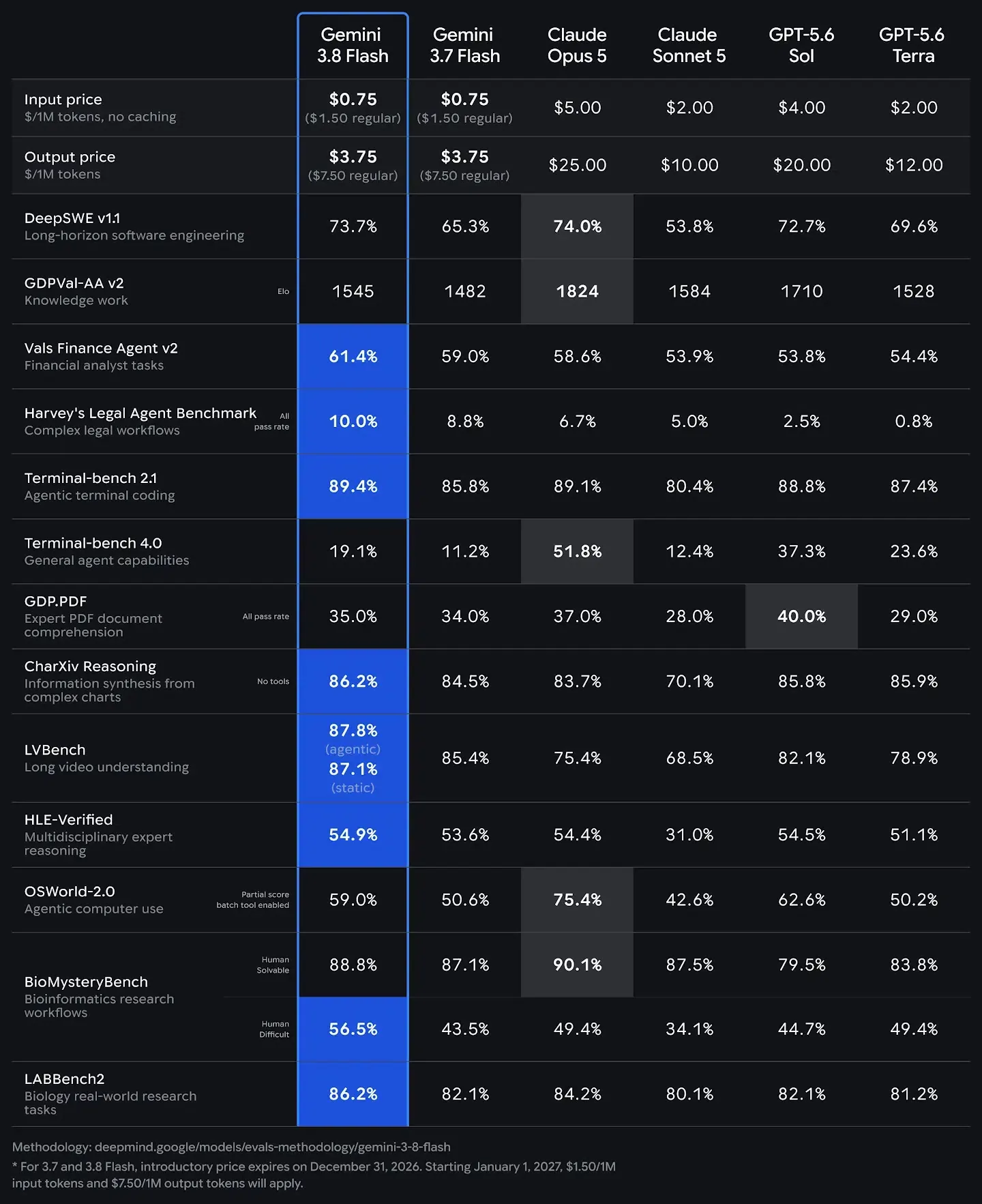
However, operational costs introduce an important caveat for engineering teams. While the per-token introductory price remains identical to Gemini 3.7 Flash, the Google AI Developer Documentation explicitly notes that 3.8 Flash “works harder” by default, running extra reasoning steps and calling tools iteratively on complex prompts. For high-volume enterprise deployments, higher effort settings may lead to increased total token consumption per task, prompting developers to evaluate when to use lower effort configurations or remain on Gemini 3.7 Flash for cost-sensitive operations.
Defensive Specialization and Autonomous Vulnerability Remediation
The introduction of Gemini 3.8 Flash Cyber addresses a growing structural challenge in modern software development: the acceleration of AI-assisted vulnerability discovery. As automated scanning tools become more proficient at finding software flaws across massive codebases, defensive engineering teams require dedicated models that can analyze dependencies, identify previously unknown vulnerabilities, and generate functional candidate patches at machine speed.
To address this challenge, Gemini 3.8 Flash Cyber is tuned specifically for defensive remediation. According to documentation in the Google DeepMind Model Card, the model achieved a success rate exceeding 70% on internal multi-language vulnerability benchmarks spanning twenty programming languages. In real-world validation, the Chrome Security team reported that the cyber variant generated 2.6 times more correct vulnerability patches than larger general-purpose commercial models.
Prompt Injection Resistance and Gated Access Governance
A critical technical attribute of the Gemini 3.8 release is its resistance to indirect prompt injection attacks. In agentic environments where models read untrusted external inputs, such as web scraping results, customer emails, or third-party API payloads, prompt injection poses a severe threat. According to Google’s published Gray Swan evaluation chart, Gemini 3.8 Flash achieved an attack success rate of 5.5% within fifteen attempts, while Gemini 3.8 Flash Cyber recorded 6.0%, marking a notable improvement over Gemini 3.7 Flash (9.2%).
The diagram below illustrates the operational flow of an agentic cyber defense pipeline compared to traditional static code scanning:
[Rule/Dataflow-Based Static Analysis]
  Source Code Commit ──> Static AST/Dataflow Scanner ──> Static Diagnostic Log ──> Manual Developer Triage

[Agentic Cyber Defense Pipeline]
  Source Code Commit ──> Gemini 3.8 Flash Cyber ──> Vulnerability Reasoning / Candidate Validation ──> Candidate Patch Generation
Because the cyber model incorporates more permissive mitigations to handle offensive security research, Google restricts access through the Google Fairwind Program, prioritizing government authorities, critical infrastructure operators, and verified software maintainers. This controlled distribution highlights the balance between enabling automated software defense and preventing malicious exploit generation.
Evaluating Code Security Paradigms in Modern CI/CD Workflows
As automated agents take on greater responsibility across development environments, engineering teams must evaluate how different security auditing methodologies perform under production conditions. Securing modern applications requires establishing integrity across code repositories, build pipelines, and runtime dependencies.
Technical Evaluation: Static Analysis vs. Agentic Defensive Remediation
Managing vulnerability remediation across software development lifecycles requires distinct technical strategies depending on whether the workload involves pre-commit syntax checks, runtime testing, or autonomous semantic patching:
| Security Architecture | Primary Inspection Method | Scope of Analysis | Operational Characteristics | Primary Application |
|---|---|---|---|---|
| Static Code Analysis (SAST) | AST, Dataflow, and Semantic Rules | Source Code Repository | Fast, deterministic rule matching | Pre-commit and pull-request gating |
| Dynamic Analysis (DAST) | Runtime Payload Injection | Running Application Interfaces | High overhead, tests live endpoints | Pre-release staging environments |
| Agentic Defense (Flash Cyber) | Contextual Reasoning & Synthesis | Multi-Language Codebases | Evaluates logic flaws and generates candidate patches for automated validation | Continuous automated vulnerability remediation |
Integrating automated vulnerability reasoning into software supply chains allows organizations to identify complex logical flaws that escape pattern-based scanners. Rather than simply generating static alerts, defensive models can construct localized test cases and synthesize candidate pull requests for review, reducing the mean time to remediation across complex enterprise software architectures.
Engineering Checklist: Hardening Development Pipelines with Specialized Models
To prepare development pipelines for the integration of reasoning-heavy foundation models and specialized security agents, engineering teams can adopt structured verification practices.
Developer Implementation Checklist
- Audit Inference Effort Configuration: Review API calls to configure appropriate thinking levels (low, medium, or high), ensuring that high-effort reasoning is reserved for complex tasks to control token expenditures.
- Integrate Automated Patch Testing: Establish sandboxed validation environments to automatically build, test, and execute regression suites on candidate code patches generated by defensive models.
- Deploy Indirect Injection Defenses: Sanitize all external data sources before passing context to autonomous agents, validating outputs against structured schemas.
Security & Infrastructure Governance Checklist
- Apply for Vetted Defender Access: Organizations operating critical infrastructure or maintaining public code repositories can apply for the Google Fairwind Program to access specialized cyber tooling.
- Monitor Token Utilization Trends: Implement real-time token tracking to measure whether new reasoning models alter the average cost per completed task across background workflows.
- Establish Build-Time Verification Gates: Enforce automated linting, unit testing, and cryptographic verification on all model-generated code modifications before merging into production repositories.
By aligning development workflows with these practices, teams can leverage advanced reasoning models while maintaining predictable infrastructure economics and robust security boundaries.
Frequently Asked Questions (FAQ)
What is the difference between Gemini 3.8 Flash and 3.8 Flash Cyber?
Why might Gemini 3.8 Flash increase token costs despite unchanged unit pricing?
How does Gemini 3.8 Flash Cyber handle automated code patching?
Practical Implications & Future Outlook
The dual release of Gemini 3.8 Flash and Gemini 3.8 Flash Cyber highlights the ongoing maturation of generative AI infrastructure. As foundational intelligence becomes commoditized, performance differentiation is shifting toward specialized reasoning capabilities, prompt injection robustness, and domain-specific defense.
For engineering organizations, navigating this landscape requires balancing model intelligence with economic discipline. By implementing defensive code verification, monitoring token efficiency, and enforcing rigorous sandboxed validation across continuous integration pipelines, developers can build resilient software architectures capable of thriving in an increasingly automated ecosystem.
References
-
Google DeepMind. Introducing Gemini 3.8 Flash and 3.8 Flash Cyber. https://blog.google/innovation-and-ai/models-and-research/gemini-models/3-8-flash-and-3-8-flash-cyber/
-
Google DeepMind. Gemini 3.8 Flash Model Card. https://deepmind.google/models/model-cards/gemini-3-8-flash/
-
Google DeepMind. The Fairwind Program for Trusted Cyber Defenders. https://deepmind.google/fairwind-program/
-
Google AI for Developers. Gemini 3.8 Flash Model Documentation. https://ai.google.dev/gemini-api/docs/models/gemini-3.8-flash
-
The Verge. Google says its new Gemini 3.8 Flash model works harder. https://www.theverge.com/ai-artificial-intelligence/988742/google-gemini-3-8-flash
-
VentureBeat. Google’s Gemini 3.8 Flash is built for agents while its Cyber twin hunts vulnerabilities. https://venturebeat.com/security/googles-gemini-3-8-flash-is-built-for-agents-while-its-cyber-twin-hunts-vulnerabilities
Share this article