What is mobile ad fraud and how does it happen? Mobile ad fraud is the deliberate manipulation of app install metrics using fake devices, emulators, or hijacked attribution signals to drain advertiser budgets and steal organic attribution credits.
Mobile ad fraud refers to the deliberate manipulation, fabrication, or hijacking of digital advertising signals and app install events designed to drain marketing budgets and misattribute conversion credit. In performance marketing, mitigating ad fraud requires deploying multi-layer attribution defenses that combine client-side environment checks, real-time anomaly thresholds, and Mean Time to Install (MTTI) distribution modeling to identify and act on suspicious traffic during or after attribution processing.
| Term | Definition | Related Entity | Search Intent Role |
|---|---|---|---|
| Ad Fraud | The deceptive generation of invalid clicks, impressions, or installs to drain ad spend. | Mobile Attribution | Informational / Commercial |
| Mean Time to Install (MTTI) | The elapsed time delta between an initial ad click and the first app launch event. | Performance Marketing | Technical / Informational |
| Conversion Tracking | The systematic measurement of valid install and post-install milestones. | Conversion Tracking | Informational |
Why Mobile Ad Fraud Threatens Performance Marketing and Budget Integrity
The Hidden Drain: How Fraudulent Traffic Distorts Cost Per Acquisition and ROAS
Performance marketing in mobile applications relies on clean, unpolluted conversion telemetry to evaluate channel profitability and calculate Return on Ad Spend (ROAS). When bad actors inject invalid installs into campaign data streams, the resulting financial metrics create an illusion of scale while draining marketing budgets. Advertisers pay Cost Per Install (CPI) or Cost Per Action (CPA) fees for traffic that fails to deliver authentic business value.
The financial damage extends beyond direct budget waste. When fabricated installs fail to generate post-install retention or in-app monetization, aggregate cohort performance degrades. Growth teams observe declining Day 7 and Day 30 retention rates alongside inflated customer acquisition costs, making it difficult to determine whether underperformance stems from creative fatigue, onboarding friction, or attribution manipulation.
Organic Cannibalization: How Bad Actors Steal Credit for Natural App Store Downloads
In attribution hijacking schemes, bad actors do not fabricate artificial installs on virtual devices; instead, they poach attribution credit for legitimate, organic users who were already intending to download the application through organic app store search or word-of-mouth referral.
By exploiting lookback window mechanics in last-touch attribution models, fraudulent traffic sources fire synthetic ad clicks immediately before or during an authentic download. When the user opens the app, the attribution engine matches the install to the fraudulent click rather than crediting organic discovery. Consequently, advertisers pay CPA fees for users they would have acquired without paid ad spend, while organic baseline metrics appear artificially depressed.
The Optimization Trap: How Corrupted Attribution Data Misaligns Programmatic Bidding Algorithms
Modern programmatic advertising networks (including automated DSPs and machine-learning bidding systems) optimize ad delivery using downstream conversion signals. When an ad network reports high install volumes from an anomalous sub-publisher, automated bidding algorithms interpret that channel as highly effective and automatically allocate a larger share of the advertiser’s budget toward it.
This creates a self-reinforcing optimization trap: algorithmic bidding engines channel more capital into fraudulent channels, starving legitimate publishers of budget. Implementing multi-signal fraud filtering at the attribution layer protects the telemetry stream, ensuring machine-learning models optimize toward human users who exhibit authentic post-install engagement.
Developers seeking lightweight client telemetry and attribution SDKs can explore packages via the mobile analytics SDK package.
How Does Ad Fraud Manipulate Attribution Models across the Install Pipeline
The Vulnerability of Last-Touch Attribution to Synthetic Temporal Signals
Standard mobile attribution operates primarily on a last-touch model: the ad network delivering the final recorded click within the configured attribution lookback window receives conversion credit upon initial application launch.
While computationally straightforward, last-touch attribution systems can be vulnerable when eligible clicks are accepted without sufficient authenticity and timing validation. Attribution engines evaluate the timestamp of the click relative to the install event. Fraudulent operations exploit this by flooding attribution servers with synthetic click timestamps, attempting to capture the final position before an install occurs.
Anatomy of the Attribution Hijack: Exploiting Lookback Windows and Time-to-Install Gaps
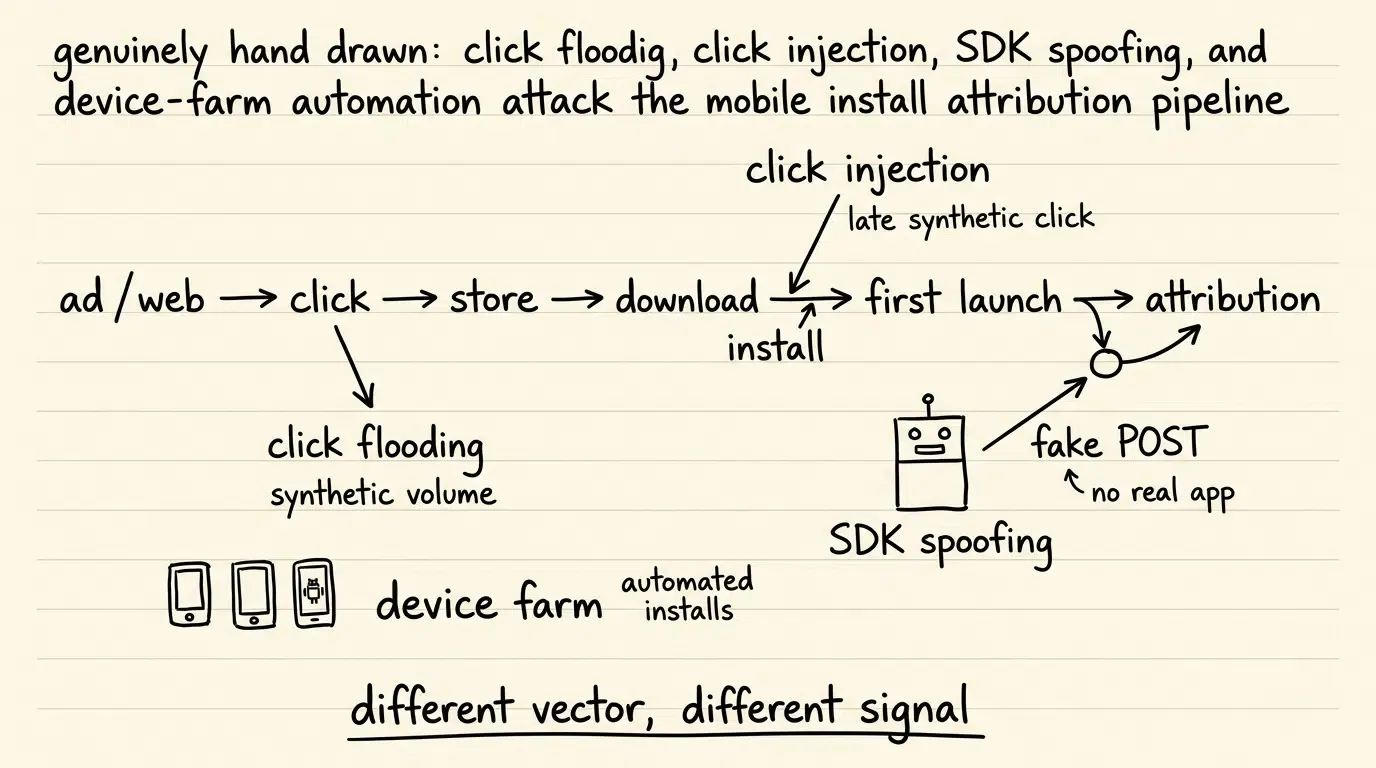
An attribution hijack exploits the chronological latency between initial media exposure, store navigation, package downloading, and first launch. Fraudulent operations intercept this pipeline through two distinct timing mechanisms:
- Pre-Download Click Flooding: Generating synthetic clicks across rotating device identifiers, gambling that some proportion of those devices will organically install the application within the configured attribution window.
- Intra-Download Injection: Detecting that an application download has commenced on an Android device and firing a synthetic ad click in the final seconds before package installation completes.
[Ad Exposure / Impression] ──► [App Store Navigation] ──► [Package Download] ──► [Native App Launch]
           │                                                    │                         │
           ▼                                                    ▼                         ▼
   [Click Flooding]                                   [Click Injection Signal]   [Attribution Engine]
 (Floods window with clicks)                         (Fires click during download)(Awards Last-Touch Credit)
Deconstructing the Attack Surface across Web Clicks, App Store Redirects, and Native Initialization
The mobile acquisition funnel spans three separate execution environments, each presenting distinct security and validation considerations:
- Web and H5 Landing Pages: Susceptible to hidden webviews, automated click scripts, and unauthorized redirect chains that generate artificial click events without user interaction.
- The App Store Barrier: Because app store downloading is an operating system process outside direct developer telemetry, the elapsed download duration creates a window where attribution signals must be cross-referenced against external timestamps.
- Native SDK Initialization: Susceptible to reverse-engineered network payloads (SDK spoofing) where server-side scripts bypass the mobile client entirely and simulate install payloads directly to attribution endpoints.
Securing the pipeline requires deploying defenses across all three environments: validating web-to-app routing parameters, monitoring download time deltas, and authenticating native client payloads.
Core Vectors of Mobile Advertising Fraud: Click Injection, Click Spamming, and SDK Spoofing
Attribution Hijacking: Click Injection and Click Spamming Mechanics
Attribution hijacking targets genuine users who are already converting, stealing credit from organic discovery or competing paid channels:
- Click Injection: Historically prevalent on Android, click injection exploits device-level application observation signals to detect when a new application package is being installed. Malicious background apps fire a synthetic click before installation finishes, registering a click timestamp immediately prior to the first launch. Because the user is genuine, post-install behavior appears normal, masking the theft of attribution credit.
- Click Spamming (Click Flooding): Operates across both iOS and Android by generating massive volumes of low-intent or invisible clicks (e.g., via 1x1 pixel hidden webviews, background browser scripts, or converting ad impressions directly into clicks). Because the spammer casts a wide net of timestamps across many devices, a fraction of those devices naturally install the app organically within the lookback window, claiming the conversion.
Conversion Fabrication: SDK Spoofing, Emulators, and Device Farms
Conversion fabrication generates synthetic installs without authentic user interest:
- SDK Spoofing (Replay Attacks): Bad actors reverse-engineer the attribution SDK’s network communication protocol and dispatch simulated HTTP POST requests directly to the attribution ingestion gateway. These spoofed payloads mimic valid installation events with randomized identifiers and simulated device metadata, generating zero real users and resulting in complete retention collapse unless the attacker also scripts fake post-install events.
- Device Farms and Emulators: Physical device banks or virtualized environments (such as cloud-hosted Android Virtual Devices) automate the process of downloading, opening, and navigating apps using automation scripts (e.g., ADB or Appium), repeatedly cycling device state and resetting identifiers between iterations.
Multi-Tier Identity and Geolocation Anomalies across Proxy Networks
Fraudulent operations often route traffic through commercial data centers, VPN endpoints, and residential proxy networks to disguise geographic origin and evade basic IP rate limiting. These anomalies manifest through geographic mismatches (e.g., IP geolocation originating from a hosting provider ASN while device locale settings indicate a different country) or unnatural clustering of high-volume install events originating from narrow IP subnets.
How to Use Mean Time to Install Distributions to Identify Click Hijacking
The Physics of Real Installs: Modeling Natural App Download and Launch Latencies
Evaluating click hijacking requires understanding the physical constraints governing legitimate human installs. A genuine conversion requires elapsed time: the user views the creative, clicks, redirects to the store, authenticates, downloads the application package over cellular or Wi-Fi networks, waits for operating system package verification and installation, and taps the application icon to launch.
Consequently, legitimate campaigns exhibit an empirical baseline distribution reflecting these latency components. The exact shape and duration vary by application package size, network conditions, geographic region, and whether the user opens the application immediately or hours later.
MTTI and CTIT Measurement: Distinguishing Install Begin from App Activation
In technical measurement, growth teams distinguish between two related timing metrics:
- Click-to-Install-Begin Time (CTIT): Measured on Android via the Google Play Install Referrer API, calculating the exact time delta between the ad click timestamp and the moment the Play Store initiated the package download:
- Click-to-Activation / Mean Time to Install (MTTI): Measured by the attribution engine as the time delta between the recorded ad click and the first native application launch:
A negative server-side click-to-install-begin delta (
Evaluating MTTI Distributions across Configured Analytical Intervals
To evaluate traffic health, attribution engines segment MTTI data across discrete analytical intervals. A common implementation model partitions latency into 22 product-defined time buckets spanning from sub-second ranges to 30 days:
| Interval 1 | Interval 2 | Interval 3 | Interval 4 | Interval 5 | Interval 6 |
|---|---|---|---|---|---|
| 0s–5s | 5s–10s | 10s–15s | 15s–30s | 30s–1m | 1m–5m |
| 5m–10m | 10m–30m | 30m–1h | 1h–2h | 2h–4h | 4h–8h |
| 8h–12h | 12h–24h | 0d–1d | 1d–2d | 2d–3d | 3d–4d |
| 4d–5d | 5d–6d | 6d–7d | 7d–30d | - | - |
Analyzing these distributions reveals statistical deviations from expected campaign baselines:
Install Volume (%)
  ▲
  │  [Candidate Click Injection Spike]
  │  (Unusual concentration in left tail)
  │      █
  │      █
  │      █       [Channel Empirical Baseline Peak]
  │      █       (Shaped by app size & network speeds)
  │      █           ▄▄▄▄▄▄
  │      █        ▄▄▀      ▀▄▄
  │      █      ▄▀            ▀▄▄   [Candidate Click Spamming Tail]
  │      █    ▄▀                 ▀▀▀▄▄▄▄▄▄▄▄▄▄▄▄▄▄▄▄▄▄▄▄▄▄▄▄▄▄▄▄▄ (Elevated late-window share)
  └──────┴───┴──────┬────────────┬─────────────┬─────────────┬───► MTTI Delta
        0s  15s    1m           5m            1h            24h+
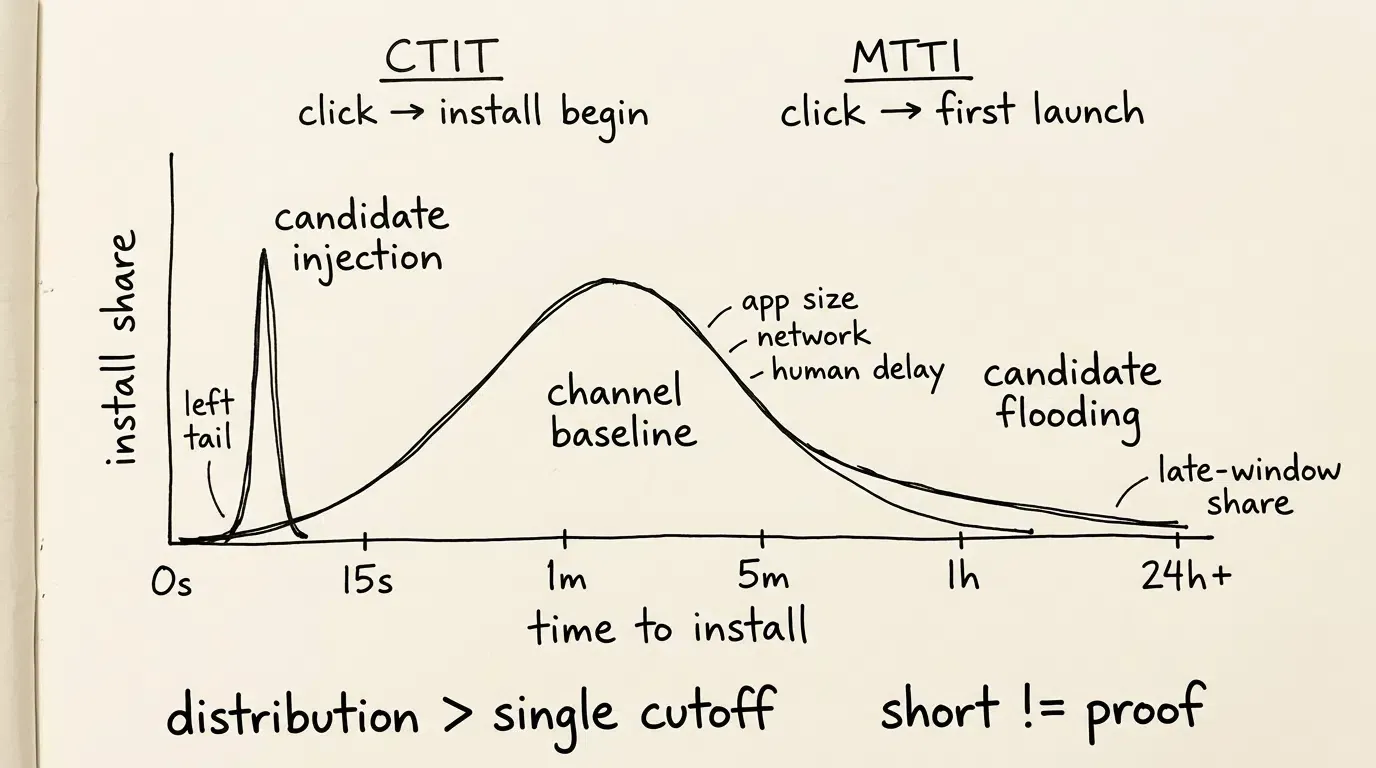
An unusually concentrated left-tail spike relative to the application’s historical baseline can indicate click injection and warrants investigation alongside install-referrer timestamps. Conversely, an unusually extended or weakly decaying late-window distribution with depressed conversion efficiency suggests candidate click flooding.
Comparative Evaluation of Primary Ad Fraud Mechanisms and Detection Signals
Contrasting Mobile Fraud Vectors, Delivery Methods, and Core Detection Heuristics
Evaluating fraud risk requires evaluating delivery vectors, anomaly signatures, and technical defenses across campaign channels.
The matrix below contrasts primary mobile ad fraud vectors and their detection heuristics:
| Fraud Mechanism | Fraud Classification | Primary Delivery Vector | Key Telemetry Risk Indicators | Primary Technical Defenses |
|---|---|---|---|---|
| Click Injection | Attribution Hijacking | Background apps observing installation-state signals | Abnormally short CTIT/MTTI, click timestamp logged after download start | Google Play Install Referrer API timestamp validation |
| Click Spamming | Attribution Hijacking | Hidden webviews, background scripts, impression-click conversion | Unusually low click-to-install conversion rates, elevated late-window MTTI share | Configured MTTI thresholds, click IP rate limiting, anomaly review |
| SDK Spoofing | Conversion Fabrication | Server-side bots simulating API endpoints | Inconsistent device entropy, missing operating system signals | S2S cryptographic signatures, platform integrity attestations |
| Device Farms | Conversion Fabrication | Physical banks of automated devices | High install density per subnet, repeated app/device-risk patterns | Device reset anomaly detection, subnet frequency capping |
| IP / Geolocation Anomalies | Traffic Quality Distortion | Data center routing, commercial VPN tunnels | Mismatch between IP country and device locale, data center ASN | Commercial hosting ASN filtering, IP anomaly monitoring |
How to Configure Rule Based Anomaly Thresholds to Block Invalid Traffic
Multi-Tier Defense: Real-Time Policy Enforcement vs. Post-Attribution Auditing
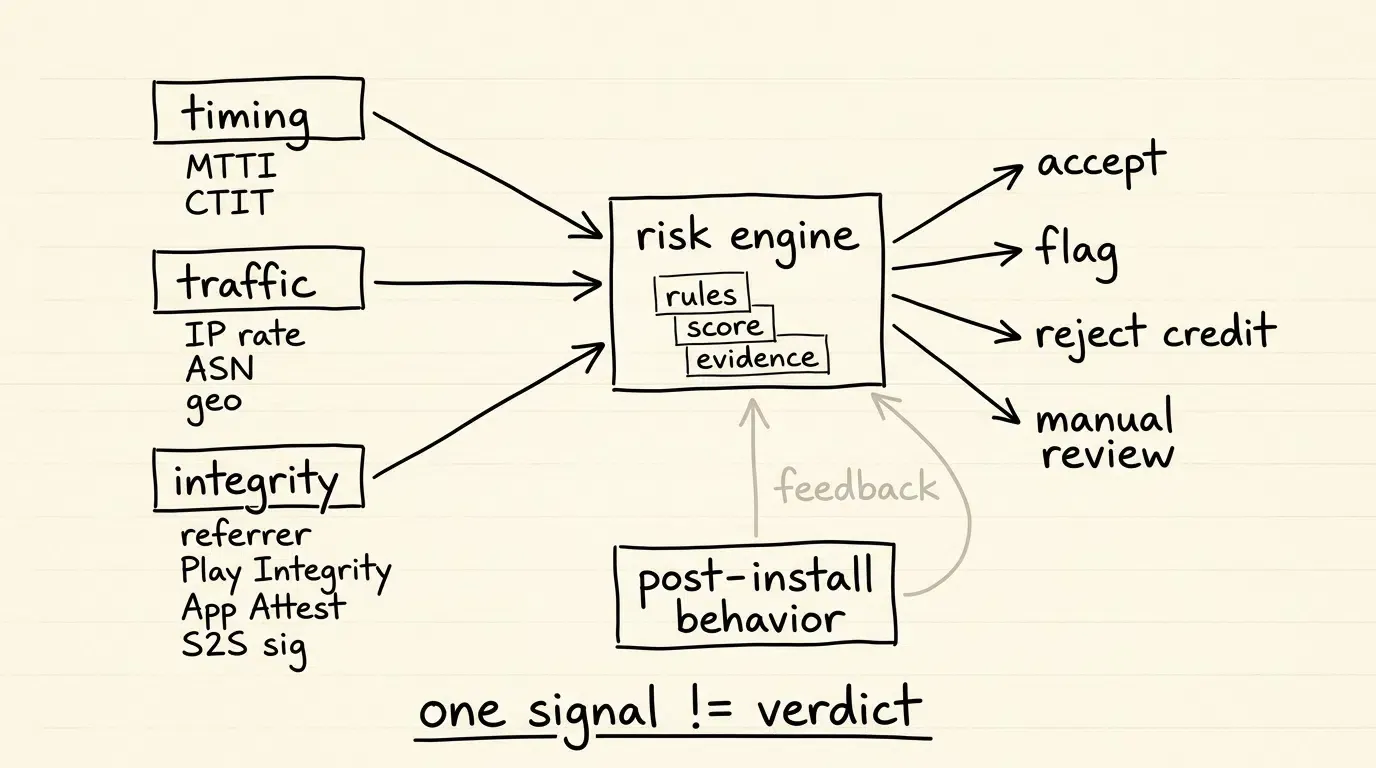
An effective anti-fraud architecture operates across two complementary operational layers:
- Real-Time Policy Enforcement: Evaluating incoming clicks and installs against configured rules, flagging suspicious interactions or routing them into review queues before firing attribution postbacks to ad networks.
- Post-Attribution Exception Auditing: Aggregating flagged IP clusters, device anomalies, and MTTI distribution shifts in reporting dashboards to support partner quality reviews and contractual clawbacks.
Configuring OpoInstall Cheating Monitoring Rules
OpoInstall provides a Cheating Monitoring engine that allows growth and risk teams to define threshold rules tailored to their application’s acquisition profile.
Engineers can consult the cheating monitoring documentation for technical specifications on configuring global rules and inspecting anomaly reports.
Core configuration rules include:
- Global Monitoring Status: Toggles real-time anomaly inspection across supported acquisition channels. Saved rule adjustments take effect within five minutes.
- Click IP Anomaly Threshold: Caps the maximum allowable clicks originating from a single IP address within a 24-hour window. Excess clicks are flagged as abnormal IP clicks and recorded in Exception Statistics.
- Installation IP Anomaly Threshold: Restricts the expected number of installation records associated with a single IP address per day. Excessive install volume marks excess records as anomalous for fraud investigation.
- Installation Device Anomaly Threshold: Monitors the frequency of installation records associated with a single internal device identifier within a 24-hour window, flagging repetitive installation patterns.
- Click Hijacking Window Period: Defines a customer-configured minimum MTTI threshold calibrated against the application and channel baseline. Installs where the elapsed time falls below this window are categorized as candidate click hijacking attempts. Rule-based labeling serves as a threshold-based operational categorization rather than standalone forensic proof of malicious intent.
Cryptographic Verification: S2S Signatures and Platform Integrity Attestations
Mitigating conversion fabrication requires separating server-to-server validation from client-side platform integrity checks:
- S2S Request Authenticity: Server-to-server postbacks between ad networks and attribution endpoints can be authenticated using mechanisms such as HMAC-SHA256 cryptographic signatures when supported by both endpoints, combined with shared secrets stored on secure servers and dynamic nonces to mitigate replay attempts.
- Client Device and App Integrity: Because client-side embedded secrets can be extracted via reverse engineering, verifying that an installation originates from an authentic app on a genuine physical device relies on platform-level attestation services. Android applications can integrate the Google Play Integrity API to receive verified integrity verdicts regarding app recognition, licensing/account details, and device trust signals (such as
MEETS_DEVICE_INTEGRITY). On iOS, applications can use App Attest for cryptographic, hardware-backed app-instance assertions, with DeviceCheck providing complementary server-side per-device state tracking.
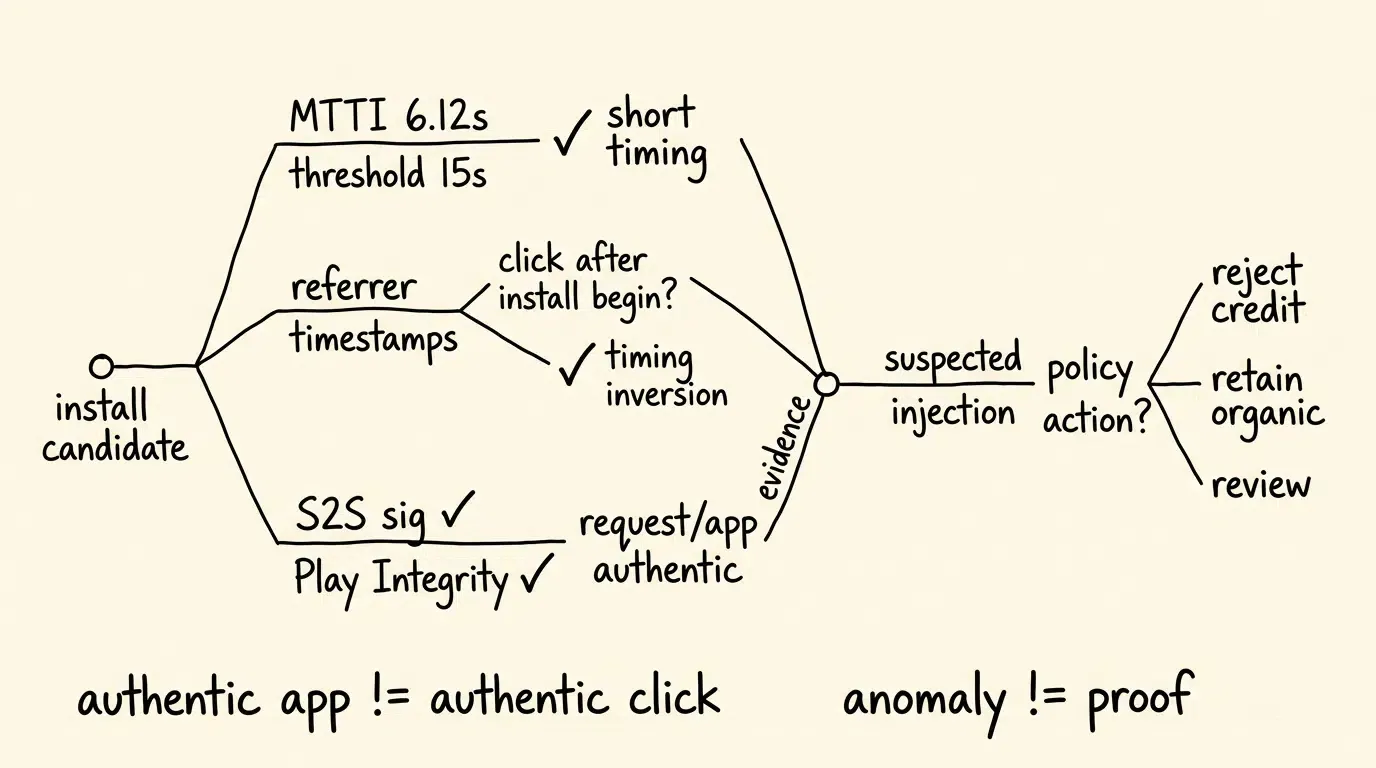
The JSON payload below demonstrates an illustrative production-oriented anomaly evaluation record assembled at the attribution gateway:
```json
{
  "schema_version": "1.2.0",
  "event_id": "evt_fraud_8f7e6d5c-4b3a-2109-8765-4a3b2c1d0e9f",
  "event_name": "anti_cheat_anomaly_detected",
  "evaluation_timestamp_utc": "2026-08-30T18:12:00.120Z",
  "server_received_timestamp_utc": "2026-08-30T18:12:00.850Z",
  "attribution_context": {
    "channel_code": "affiliate_network_delta",
    "campaign_id": "cmp_q3_scale_tier1",
    "click_timestamp_utc": "2026-08-30T18:11:54.000Z",
    "mtti_duration_seconds": 6.12,
    "is_attributed_candidate": true
  },
  "anomaly_evaluation": {
    "rule_triggered": "click_hijacking_window",
    "configured_mtti_window_threshold_seconds": 15.0,
    "observed_mtti_seconds": 6.12,
    "fraud_vector_classification": "suspected_click_injection",
    "signals_evaluated": [
      "short_mtti_delta",
      "install_referrer_server_timestamp_inversion"
    ],
    "risk_score": 0.88,
    "risk_score_scale": "0.0_to_1.0_normalized",
    "decision_basis": "configured_policy_rules",
    "policy_action": "attribution_rejected_retained_as_organic",
    "review_status": "automated_rule_applied"
  },
  "ip_telemetry": {
    "client_ip_anonymized": "198.51.100.0/24",
    "ip_daily_click_count": 482,
    "ip_daily_install_count": 14,
    "is_datacenter_asn": false
  },
  "device_telemetry": {
    "platform": "Android",
    "os_version": "16.0",
    "app_version": "3.2.0",
    "sdk_version": "<installed_sdk_version>",
    "device_risk_key_pseudonymous": "dev_risk_anon_99887766",
    "is_emulator_detected": false
  },
  "security_verification": {
    "s2s_postback_signature_valid": true,
    "platform_integrity_attestation": {
      "attestation_provider": "google_play_integrity",
      "app_recognition_verdict": "PLAY_RECOGNIZED",
      "device_recognition_verdicts": [
        "MEETS_DEVICE_INTEGRITY"
      ]
    }
  }
}
When Are Advanced Anti Fraud Frameworks Necessary for Performance Marketers
Suitable Conditions for Dedicated Anti-Fraud Deployments
Investing in dedicated real-time anti-fraud monitoring and anomaly detection provides high operational return under specific conditions:
- Multi-Channel Programmatic and Affiliate Campaigns: Marketing operations deploying significant ad spend across programmatic DSPs, ad networks, and multi-tier affiliate brokers where publisher transparency varies.
- High Baseline Organic Traffic: Brands with substantial organic app store discovery that are vulnerable to attribution poaching via click flooding.
- Divergent Downstream Metrics: Campaigns exhibiting high install volume paired with abnormally low registration completion, in-app purchase conversion, or Day 1 retention rates.
- Partner Quality Reconciliation: Teams managing external acquisition partnerships requiring objective anomaly reporting to support contractual traffic reviews.
Unsuitable Conditions for Complex Anti-Fraud Infrastructure
Deploying advanced fraud monitoring infrastructure may introduce unnecessary operational overhead in the following scenarios:
- Single-Source Organic Apps: Applications relying exclusively on unassisted organic app store search with zero active paid acquisition campaigns.
- Closed Self-Attributing Networks Only: Marketing campaigns operating strictly within closed walled-garden networks (e.g., Apple Search Ads only) with zero external programmatic or affiliate distribution.
- Early Pre-Marketing Prototypes: Early-stage proof-of-concept builds focused strictly on testing technical feasibility before acquisition marketing commences.
Common Misconceptions in Ad Fraud Prevention
- Misconception 1: Ad Networks Automatically Filter All Invalid Traffic: While major ad networks maintain baseline traffic filters, advertisers require independent attribution verification to validate campaign quality across disparate distribution sources.
- Misconception 2: Single Metrics Provide Definitive Proof of Fraud: Individual metrics (such as a short MTTI or low conversion rate) serve as risk indicators. Accurate fraud determination requires cross-referencing multiple independent signals, including install referrer timestamps, platform integrity verdicts, and post-install behavioral telemetry.
Frequently Asked Questions (FAQ)
What is the difference between click injection and click spamming?
How does MTTI analysis distinguish organic installs from hijacked installs?
What are the key thresholds for configuring mobile fraud detection rules?
Summary and Decision Framework
Protecting mobile performance marketing budgets requires moving beyond passive post-campaign audits to multi-layered fraud defense. Ad fraud corrupts attribution telemetry, drains marketing capital, and misaligns automated bidding algorithms by awarding credit to invalid or poached installs.
Building a resilient fraud mitigation architecture depends on analyzing Mean Time to Install (MTTI) distribution curves, configuring rule-based IP and device anomaly thresholds, and combining server-to-server signature validation with platform integrity attestations. By pairing independent attribution measurement with real-time fraud monitoring, platforms like OpoInstall provide the infrastructure required to inspect suspicious traffic, reduce attribution contamination, and support campaign optimization.
To evaluate how unified attribution and fraud monitoring infrastructure can protect your mobile campaigns, explore the mobile attribution implementation reference or configure your application on the OpoInstall developer console.
Related Materials
-
Concepts: Mobile Ad Fraud, Mean Time to Install (MTTI), Click-to-Install Time (CTIT), Click Injection, Click Spamming, SDK Spoofing
-
Technologies: Cheating Monitoring Engine, Google Play Install Referrer API, Google Play Integrity API, Apple App Attest, S2S Postback Signatures
-
APIs & Data Interfaces: Google Play Install Referrer API, Android Play Integrity API, Apple DeviceCheck / App Attest, OpoInstall Cheating Monitoring Configuration Interfaces
-
Official Documentation & References:
Share this article