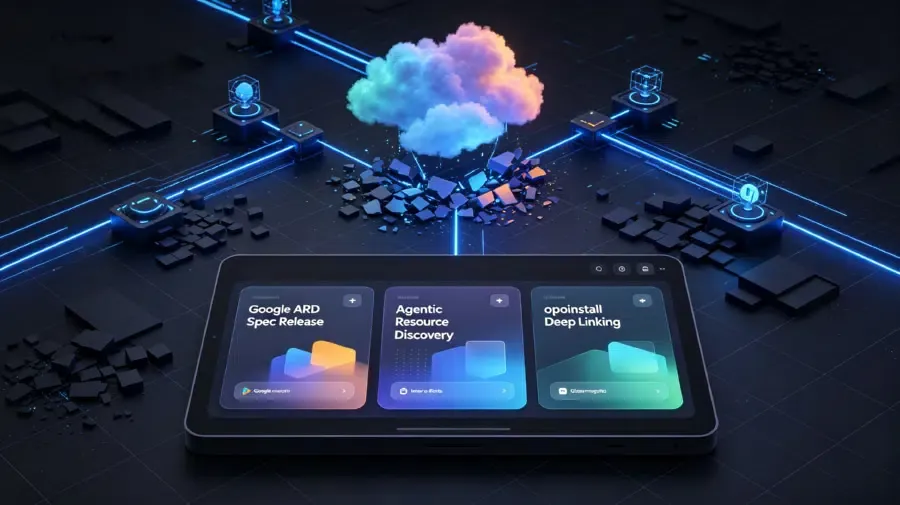
oogle Releases ARD Spec? This strategic pivot has been conclusively validated as major technology players align under a unified protocol to resolve the cross-platform tool-routing dilemma. On June 17, 2026, Google Cloud officially debuted the open-source specification. The market momentum surrounding this Google Releases ARD Spec deployment demonstrates that the developer community is moving toward a federated, domain-validated network. This system represents a major shift from centralized store indexation to decentralized, domain-validated discovery, preventing critical parameters loss as autonomous agents route workflows across network boundaries.
Fragmenting the Federated Web: The Google ARD Spec Release
Announcing the Open Specification for Resource Discovery
Google Cloud software engineers Junjie Bu and Srinivas Krishnan introduced the Agentic Resource Discovery (ARD) specification under the Apache 2.0 license. Crucially, the protocol builds directly on the foundational AI Catalog data model developed by the AI Catalog Working Group under the Linux Foundation.
Specifically, this open framework addresses a major operational bottleneck in agentic computing. AI agents currently remain fragmented and siloed within specific custom registries.
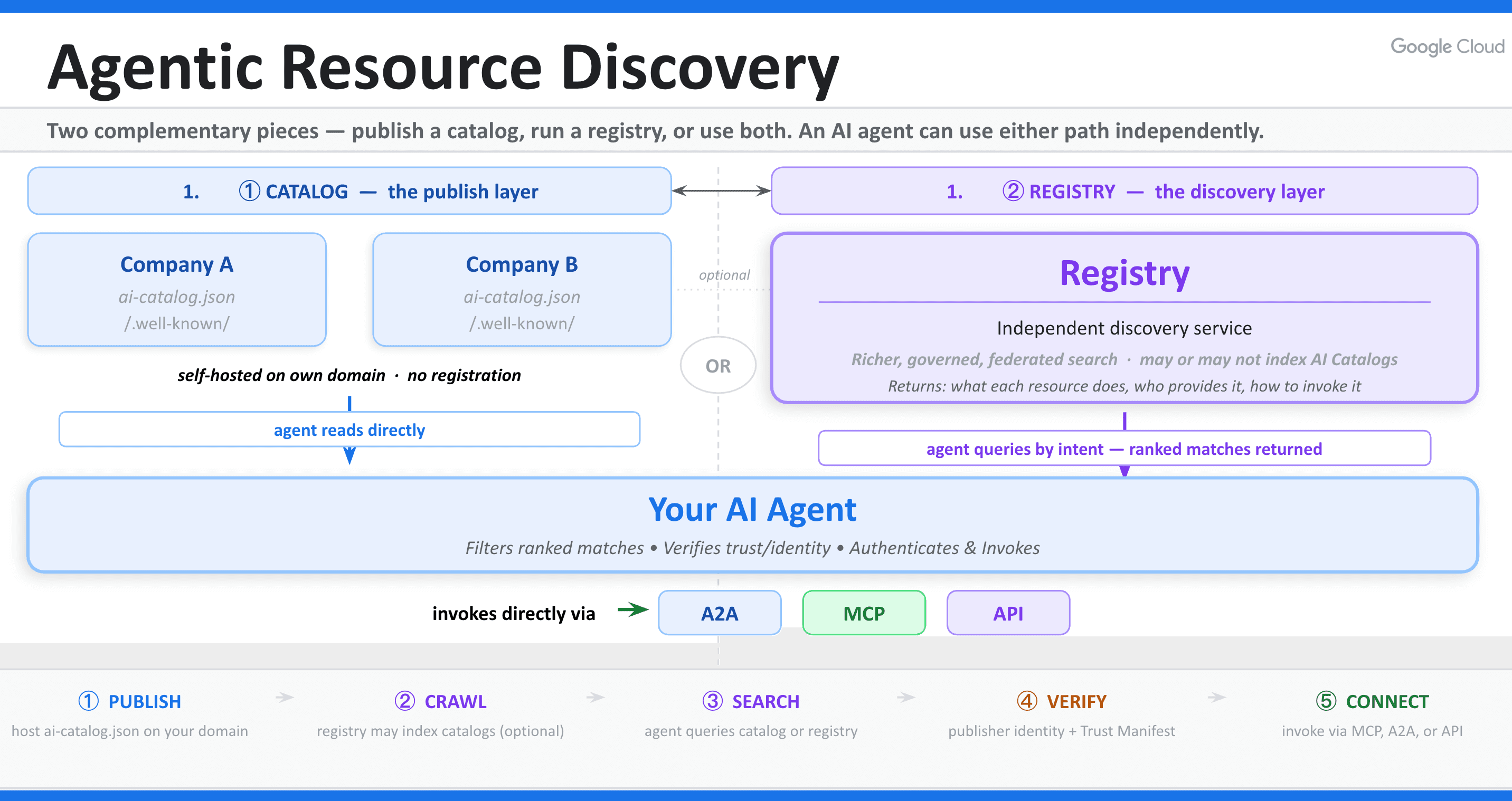
Consequently, an agent working in one environment has no standard way to locate or verify capabilities hosted elsewhere. ARD provides that missing layer. It standardizes how organizations publish available tools, skills, and agents directly under their own domain name, making them searchable across federated registries.
Deconstructing the ai-catalog.json Schema and Payload
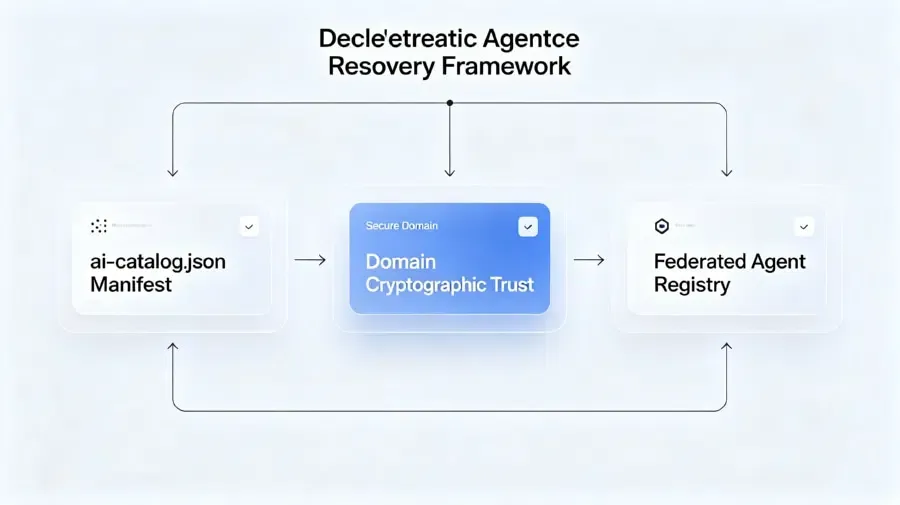
At the heart of the standard lies the ai-catalog.json manifest. Specifically, this manifest contains highly structured metadata describing the provider’s available capabilities.
To publish a catalog, an organization hosts this JSON file at a well-known path on its own domain. Because the file lives directly under the organization’s domain name, domain ownership serves as the cryptographic foundation for identity.
The catalog payload can describe multiple tool classes, including Model Context Protocol (MCP) servers, OpenAPI tools, or even nested sub-catalogs. This flexible payload structure allows agents to parse available resources programmatically, eliminating the need to pre-load heavy, unused libraries.
Federated Registries: Crawling and Indexing the Agentic Web
While catalogs store the metadata, registries act as search engines for the agentic web. Specifically, registries crawl published catalogs and index their contents.
When an agent needs a specific capability, it submits a plain-language discovery request to the registry. The registry then returns matching tools along with the cryptographic trust metadata.
Crucially, the registry only handles the discovery phase. It steps out of the way once the handshake is complete, allowing the agent to connect directly to the tool’s endpoint. This decentralized federation model prevents any single provider from establishing a discovery monopoly over the agentic web.
Google Cloud Integration: Agent Registry in Gemini Platform
Google Cloud is backing this open specification with native product integration. Specifically, the company introduced Agent Registry in the Gemini Enterprise Agent Platform.
This enterprise-grade system provides fully hosted support for searching, discovering, and hosting agentic resources. Crucially, Agent Registry manages secure resources using Agent Identity to verify the trust manifest before execution.
This verification layer enforces strict agentic egress policies and assigns globally unique namespaced URNs. Consequently, it helps enterprise clients meet strict compliance standards like HIPAA, ensuring that autonomous handshakes remain fully authenticated and safe from interception.
GitHub Copilot Integration: Launching the Agent Finder
Microsoft has also joined the federated network by launching the Agent Finder for GitHub Copilot. Historically, developers had to manually configure and inject MCP servers, which often filled the LLM context window.
The new Agent Finder resolves this limitation. By implementing the open specification, Copilot can now search an index of available AI resources.
Consequently, it loads tools dynamically based on the plain-language requirements of the task. Because the system utilizes the open standard, developers can point the Agent Finder at GitHub’s curated public catalog or their own private, secure internal registries.
Bypassing the App Funnel in Autonomous Transactions
Bypassing the Manual Visual Interface
As development teams utilize rapid code generation to deploy thousands of minor applications, the mobile web faces an unprecedented product flood. However, this massive increase in software volume coincides with a complete evaporation of the traditional user interface.
When an autonomous agent uses the open standard to complete a task, the human visual journey disappears. The agent directly queries indexed catalogs and executes the required tool in the background.
Consequently, we observe a massive shift from active web traffic to intent-driven traffic. Humans no longer browse landing pages or click promotional store redirects. Instead, background software processes make routing decisions, rendering traditional advertising channels ineffective.
The Challenge of Parameters Loss in Agentic Discovery
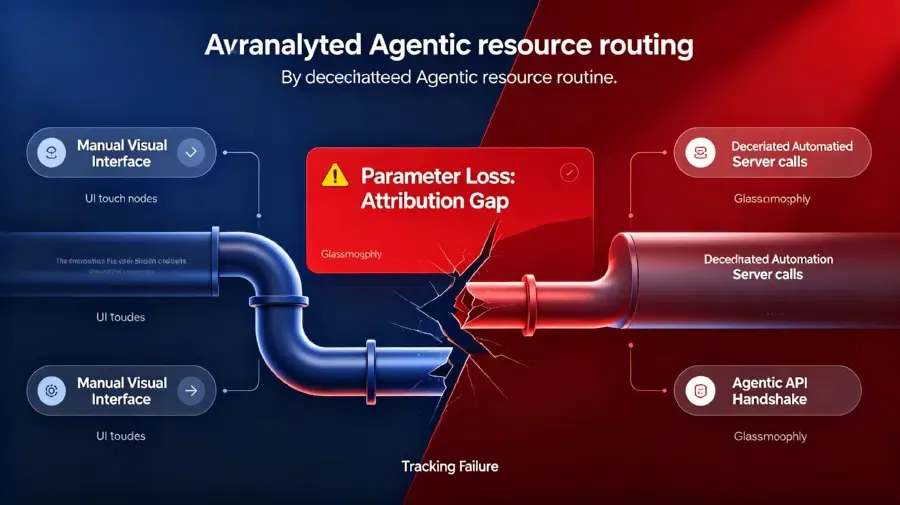
Traditional app routing depends on cookies and URL redirections to map the user journey. When an agent automates the tool discovery, these redirection mechanics are eliminated.
The agent establishes a direct API handshake. As a result, critical referral parameters and marketing attribution tags are stripped during transit.
Mobile measurement platforms receive empty metadata packages. Consequently, developers lose the ability to track the origin of the sale, creating a massive data gap.
Reference Architectures & Engineering References
Rebuilding the Parameter Handshake
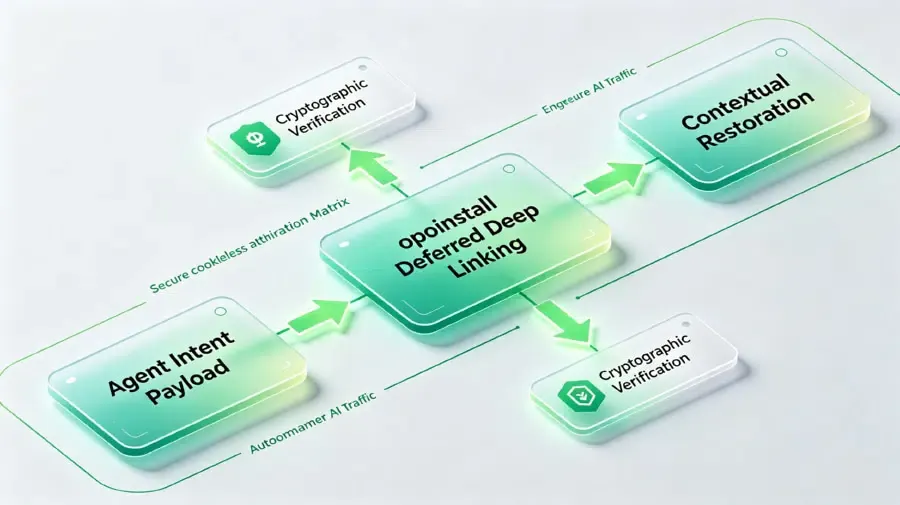
To bridge this semantic routing gap, software architects must deploy secure parameter-preservation frameworks. When an external agent invokes an application, it must transmit a verified payload containing the user’s original intent, referral parameters, and security tokens.
Crucially, developers can establish a resilient solution using the Deferred Deep Linking framework. This system ensures that dynamic payload parameters survive background installation loops. Even if the device lacks the native application, the contextual restoration infrastructure preserves the intent payload, passing it securely to the app upon first launch.
{
  "applinks": {
    "apps": [],
    "details": [
      {
        "appID": "9H938Y49U3.com.opoinstall.global",
        "paths": [ "/intent/*", "/restore/*" ]
      }
    ]
  }
}
Cryptographic Verification for Machine-to-Machine Transactions
Additionally, securing these automated transactions requires strict cryptographic handshakes. Because background agents operate without visual human supervision, malicious scripts can attempt to spoof transaction requests.
To prevent this, every deep link routing request must carry a verifiable cryptographic signature. The application must validate this signature against public developer registries before executing any action.
Enforcing a secure Deferred Deep Linking framework allows development teams to execute these validations automatically. This process protects the application sandbox from fraudulent installations and secures the transaction pipeline against ad fraud.
Industry Forward-looking Note: Regarding cross-device parameter passing for autonomous intent traffic, opoinstall’s tech lab is currently conducting joint exploratory research with leading enterprise App partners.
Technical Security Mandates for Enterprise Architectures
For Developers and System Architects
Integrating a native Google Releases ARD Spec implementation into the application architecture requires a major shift in development practices. Engineers must transition from designing traditional visual navigation paths to constructing detailed App Intents. These intents allow system-level agents to read app structures and query data programmatically.
Furthermore, developers must implement strict signature verification to validate all incoming deep link payloads. This validation prevents rogue agents from executing local sandbox escapes or triggering fraudulent purchases. Architects must also configure unified multi-platform ID systems to track the user journey across iOS, Android, and HarmonyOS NEXT.
For Product and Growth Managers
Meanwhile, product and marketing leads must redefine their growth metrics. In an agentic environment, traditional KPI metrics like page views, bounce rates, and session lengths lose their value.
Instead, growth leads must optimize for “Intent Capture Rates”. They must ensure their application provides highly structured, machine-readable metadata that agents can parse easily.
Additionally, teams must deploy advanced anti-fraud filters to identify and block automated script-based downloads. This protection ensures that acquisition budgets are spent on real user growth rather than inflated, machine-generated traffic.
Frequently Asked Questions (FAQ)
Why does the industry need the Google Releases ARD Spec initiative?
How does the catalog file establish trust under the open standard?
How does agent-driven routing impact mobile app attribution?
Ultimately, the traditional click-based economy is facing a rapid decline. As payment networks and device operating systems transition to autonomous agentic architectures, the value of software is shifting to the underlying routing layer.
Consequently, building robust, parameter-secure deep linking backbones is no longer a luxury. It is a baseline operational requirement. By preparing your application architecture for the agentic economy today, you ensure your software remains accessible, verified, and profitable in the post-screen era.
Share this article