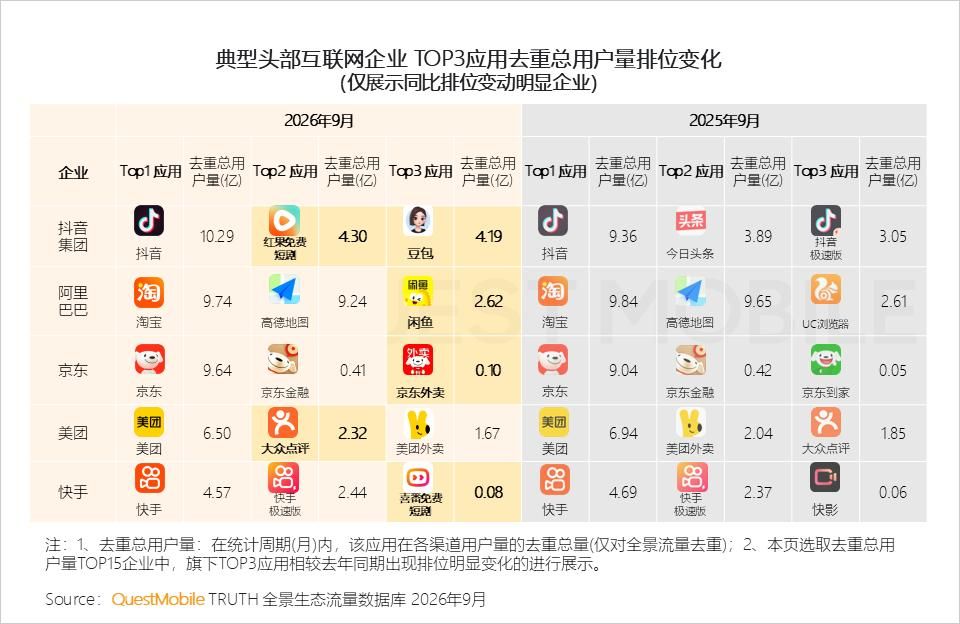
Hongguo Surpasses Doubao? QuestMobile’s September 2026 ranking puts Hongguo Free Short Drama at 430 million deduplicated users across measured channels, ahead of Doubao’s 419 million and behind Douyin’s 1.029 billion. These figures describe user reach under the report’s methodology, rather than standalone native-app MAU. For growth teams, the comparison raises questions about engagement and acquisition quality; it does not establish lower acquisition costs, higher retention, or users switching from AI assistants to short dramas. The data reflects a shifting mobile environment across China’s internet market, where overall active user growth slowed to 0.9% year-on-year to 1.281 billion monthly active users, while monthly per-capita usage duration expanded to 189.8 hours. Technical organizations evaluating multi-channel acquisition funnels must distinguish between deduplicated reach within the reporting window and sustainable user lifetime value.
The Operational Shift Behind the Headline: Deduplicated Reach and Saturated User Growth
At a Glance
- QuestMobile’s September 2026 audit recorded Hongguo Free Short Drama at 430 million deduplicated users across measured channels, compared to 419 million for Doubao.
- Total mobile internet monthly active users reached 1.281 billion, representing a modest 0.9% year-on-year increase as growth in the active-user population slows.
- Short-form drama and short video categories contributed 111.5% of the net growth in total internet time spent, offsetting duration losses in traditional online video and general information services.
The structural metrics published in the QuestMobile 2026 Autumn Report on 36Kr illustrate how competition within the Chinese mobile internet has evolved. Rather than competing for an expanding base of first-time smartphone adopters, digital platforms are contesting existing user attention. Across the measured ecosystem, monthly per-capita engagement rose 6.5% year-on-year to 189.8 hours in September 2026, indicating that user engagement continues to deepen even as growth in the active-user population slows.
Within this environment, serialized video content emerged as a primary driver of engagement expansion. According to industry analysis published in 36Kr’s report on Hongguo and Doubao, dedicated short drama applications expanded from roughly 10 million users to over 400 million in under three years. Reporting from China Daily on short drama growth highlights that in year-on-year changes for September 2026, short drama usage added a net 13.329 billion hours, while short videos contributed a net 5.717 billion hours. Together, these categories accounted for 111.5% of the net increase in total internet duration over that period, while traditional online video contracted by 1.38 billion hours.
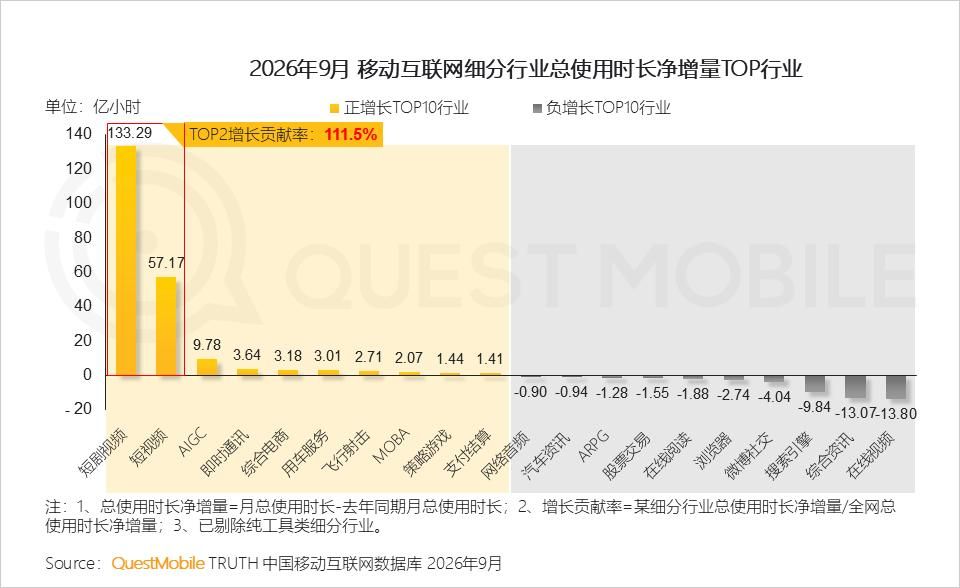
Hongguo’s lead in the September ranking reflects distinct commercial mechanics. Hongguo adopted a model combining free streaming, automated content recommendations, and ad-supported monetization. This structure lowered access barriers compared to early pay-per-episode short drama business models. However, analysts note that deduplicated user reach spans multiple access touchpoints—including standalone apps and integrated mini-programs—and does not demonstrate that individual users abandoned productivity assistants in favor of serialized fiction.
Engagement Dynamics: Content Consumption Versus Conversational AI Utility
Analyzing usage patterns between entertainment media and artificial intelligence assistants reveals fundamentally different behavioral characteristics. According to reporting from Caijing on Sina Finance, Hongguo recorded an average daily usage duration of approximately 151 minutes per person across July and August 2026. This metric reflects an ad-supported entertainment loop where viewers consume multiple sequential episodes in an accumulated daily period.
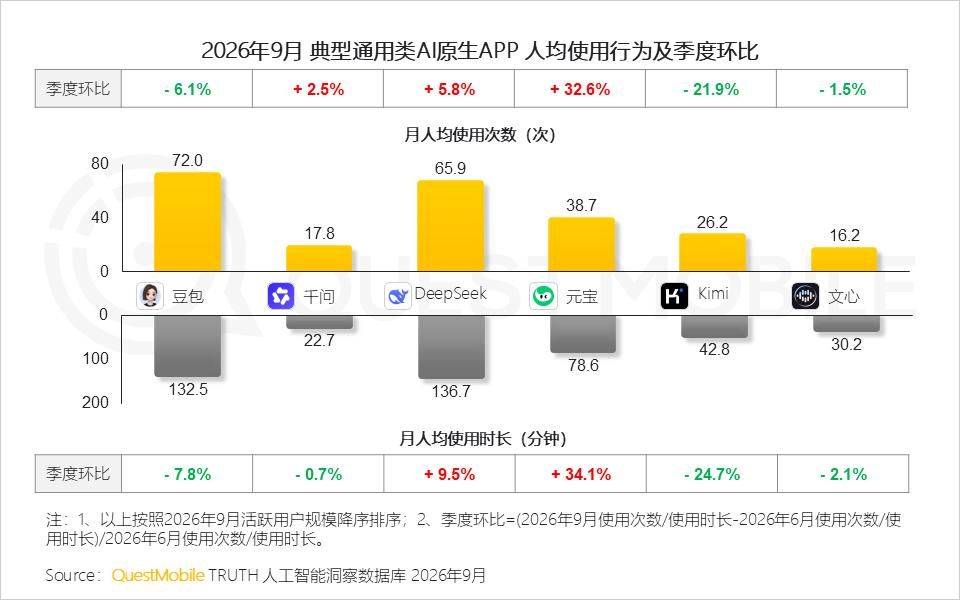
Conversely, conversational assistants fulfill on-demand, utilitarian requirements. Data from QuestMobile shows that in September 2026, Doubao recorded an average monthly duration of 132.5 minutes distributed across 72.0 usage occurrences, while DeepSeek registered 136.7 minutes across 65.9 occurrences. Users frequently open an assistant with an explicit task in mind—such as code debugging, document summarization, or drafting text—and may exit the interface once the system returns an answer.
The diagram below outlines the conceptual differences between ad-supported entertainment delivery and query-oriented utility workflows:
[Ad-Supported Serialized Content Funnel]
  Content Teaser / Shared Link ──> Web Landing Page ──> App Install & Launch ──> Video Playback & Interstitial Ads (Accumulated Dwell Time)

[Query-Driven Task Completion Funnel]
  Specific User Intent ──> Conversational Assistant Launch ──> Task Execution / Answer Delivered ──> Session Concludes (Discrete Interaction)
Note: The flow above represents an editorial conceptual model. Both product types serve fundamentally distinct consumer use cases; higher cumulative usage time does not inherently indicate superior unit economics or user switching.
Importantly, differences in total usage time do not determine the financial health or acquisition efficiency of an application. User acquisition costs (CAC) and customer lifetime value (LTV) depend on underlying commercial models. Free-to-watch drama platforms monetize through high ad impression density, while conversational AI tools incur ongoing GPU inference expenses for each prompt, requiring clear utility to justify retention. Furthermore, while industry analysis reported by 36Kr cites that production costs for certain generative AI short dramas have decreased by 80% to 90%, content platforms still face rapid title turnover and ongoing promotional spend to maintain visibility.
Build vs. Buy: Evaluating Attribution and Parameterized Onboarding Frameworks
As mobile applications acquire audiences across diverse digital channels—such as social feeds, web video snippets, creator referrals, and programmatic advertising—engineering teams face the challenge of measuring campaign performance accurately. Understanding acquisition performance requires measuring eligible touchpoints and linking them to app events where supported and permitted.
When designing acquisition tracking pipelines, technical teams must evaluate the operational boundaries of in-house logging, ad network self-reporting, and independent measurement frameworks:
| Evaluation Dimension | Custom In-House Database | Platform Self-Reporting (SANs) | Third-Party Measurement and Linking Tools |
|---|---|---|---|
| Primary Purpose | Internal telemetry logging and customized business intelligence | Performance measurement within an isolated ad network | Cross-channel acquisition measurement and deferred parameter recovery |
| Attribution & Channel Measurement | Custom internal server-side event correlation | Confined to proprietary network impressions and clicks | Evaluates supported channels and integrations across web and ad networks |
| Deferred Parameter Delivery | Requires building a permitted mechanism to associate web touchpoint with app launch | Deep-link support and parameter delivery vary by network and integration | Captures eligible parameters and returns them on first app launch after installation |
| Platform & Privacy Constraints | Apple prohibits deriving device data to uniquely identify a device or user through fingerprinting | Operates within network-defined attribution windows and privacy thresholds | Mechanism and availability depend on provider, platform policy, and SDK version |
| Fallback Handling | Unmatched installs are recorded as unattributed or unknown, according to the measurement model | The network reports conversions attributed under its own rules; other sources require separate measurement | The app should use a defined fallback when parameters are unavailable or untrusted |
| Maintenance Scope | Continuous internal engineering for schema, API, and platform updates | Minimal native setup, but produces fragmented data silos across networks | Managed client-server SDK integration with vendor-maintained updates |
| Best For | Large enterprise organizations with specialized internal infrastructure | Teams running isolated single-network marketing campaigns | Growth organizations measuring content-driven referral funnels and web-to-app onboarding |
Note: Capabilities vary by provider; this table describes evaluation categories rather than guaranteed product features.
This technical analysis does not confirm what specific commercial attribution or deep-linking tools are deployed internally by Hongguo or Doubao. However, for independent publishing and development teams running multi-channel campaigns, constructing an in-house attribution database requires ongoing engineering resources to manage schema changes, verify fraud protections, and maintain compliance with mobile platform policies.
For publishers already operating content-driven web-to-app campaigns, OpoInstall can be evaluated as an alternative for parameterized installation and channel tracking. According to the OpoInstall Documentation, the framework supports attaching custom parameters to web campaign links and retrieving eligible parameters on first app launch after installation. This capability allows the native application to navigate to specific content destinations, such as an individual drama episode or creator profile, while providing channel-level measurement. Implementation must be assessed against current platform privacy policies and the specific data handling practices of the relevant SDK version. These tools do not guarantee conversion recovery across every channel, and the native application remains responsible for validating parameters, verifying user permissions, and executing appropriate fallback navigation.
Integration Checklists: Aligning Acquisition Funnels with Modern Engagement Realities
Adapting growth architectures to a mature mobile market requires technical teams to align measurement pipelines with concrete business objectives rather than vanity reach metrics.
Engineering and Architecture Checklist
- Configure Deferred Parameter Delivery: Ensure that client SDK initialization routines retrieve eligible parameters on first app launch after installation to restore content routing context.
- Define Destination Fallback Logic: Implement explicit fallback rules within the application router so that if parameters are unavailable, corrupted, or untrusted, users are routed to default landing screens.
- Audit Platform Tracking Practices: Verify that analytics implementations do not derive device data to uniquely identify a device or user through fingerprinting. Separately assess whether the implementation requires ATT permission.
- Validate Measurement Consistency: Reconcile network reports with app activation data where permitted, accounting for attribution windows, event definitions, aggregation and reporting delays. Assess duplicate credit only where the available data supports it.
Product and Growth Strategy Checklist
- Align Acquisition Goals with Business Outcomes: Structure campaign evaluation around activation rates, 30-day retention, and verified commercial conversion rather than attempting to maximize session length across all product types.
- Pass Eligible Destination Parameters: Pass eligible destination parameters and validate routing with a defined fallback, matching promotional video snippets directly to corresponding in-app content.
- Evaluate Channel Mix and Acquisition Costs: Measure channel-specific performance to ensure that acquisition spend aligns with verified user lifetime value rather than top-of-funnel install volume.
- Separate Reach from Retention Metrics: Avoid treating deduplicated multi-channel reach as an indicator of product stickiness; evaluate cohort retention curves separately across organic and paid channels.
Frequently Asked Questions (FAQ)
Does Hongguo's user scale lead indicate lower customer acquisition costs than AI apps?
Can time spent be compared directly between short drama apps and AI assistants?
How do growth teams attribute app installations driven by shared video content?
What role does deferred deep linking play in content-driven onboarding?
Key Takeaways for Engineering Teams
The ranking change where Hongguo moved ahead of Doubao in total reach reflects an evolving digital environment where overall audience growth has moderated and platforms compete primarily for existing user attention. However, engineering and growth teams must avoid equating gross reach or engagement duration with universal product success.
To build sustainable digital properties, organizations must structure their measurement architecture around specific commercial goals. By deploying disciplined multi-channel attribution, implementing resilient deep linking that respects fallback boundaries, and analyzing retention cohorts against true acquisition costs, technical teams can optimize product funnels effectively within an increasingly competitive mobile landscape.
References
-
QuestMobile: 2026 China Mobile Internet Autumn Report (Report Publication on 36Kr) — Official report publication analyzing deduplicated user reach across measured channels, industry duration contributions, and mobile application rankings.
-
36Kr: Report on Hongguo Surpassing Doubao in User Scale — Technology business analysis detailing engagement metrics, advertising dynamics, and product portfolio shifts within ByteDance.
-
China Daily: Short-form dramas growing fast — Industry reporting tracking user growth trajectories, time-spent expansion, and market dynamics in the short-form drama sector.
-
Caijing / Sina Finance: Hongguo Monthly Usage Dwell Time Exceeds 830 Billion Minutes — Business reporting examining daily per-capita engagement metrics and ad-supported monetization structures.
-
OpoInstall Documentation — Technical overview of parameter pass-through mechanisms, deferred deep linking workflows, and mobile campaign attribution integration.
Share this article