Honor launches MagicOS 11? On September 15, 2026, Honor officially unveiled MagicOS 11 at its Global Developer Conference in Shenzhen, marking what Honor describes as the industry’s first commercial deployment of a system-level Agent Harness architecture on consumer smartphones. Slated to debut on the upcoming flagship Honor Magic9, the operating system represents a notable shift in mobile systems engineering: moving from traditional graphical application containers toward an “Agentic OS” (AOS). While earlier mobile AI assistants often emphasized conversational response and bounded task automation, MagicOS 11 expands the focus toward longer-horizon, system-level orchestration, positioning its core engine—branded as YOYO Harness—as a system-level runtime control plane. For software architects and mobile platform engineers, this release brings critical questions to the forefront: how does a system-level harness decompose unconstrained natural language into verified multi-step tasks, how does it manage tool invocation across structured protocols versus visual fallback layers, and how are agent actions governed across Android application and permission boundaries?
Architectural Paradigm: From App Containers to an Agentic OS
Over the past decade, mobile operating systems have evolved primarily around resource allocation—optimizing CPU/GPU scheduling, memory compression, wireless telemetry, and display rendering for sandboxed third-party applications. User interaction has remained fundamentally user-driven: an individual opens an application, navigates nested navigation hierarchies, executes specific functions, and manually bridges context between fragmented services.
At a Glance
- System-Level Harness Control Plane: YOYO Harness acts as the middleware runtime between frontier reasoning models and physical terminal capabilities, orchestrating device perception, long-horizon task planning, tool dispatch, and execution feedback.
- Dual-Track Tool Invocation Pipeline: MagicOS 11 prioritizes structured, typed execution paths via the Model Context Protocol (MCP), native Skills, and system APIs, while retaining computer vision (CV) and GUI automation as a dynamic fallback for un-adapted applications.
- Long-Horizon Execution Boundaries: While Honor reports the capability to execute sequential task chains exceeding 100 steps across 40 trigger conditions and 130+ execution actions, practical consumer utility centers on compact, high-frequency micro-workflows which, where appropriate, should incorporate explicit confirmation checkpoints for high-impact actions.
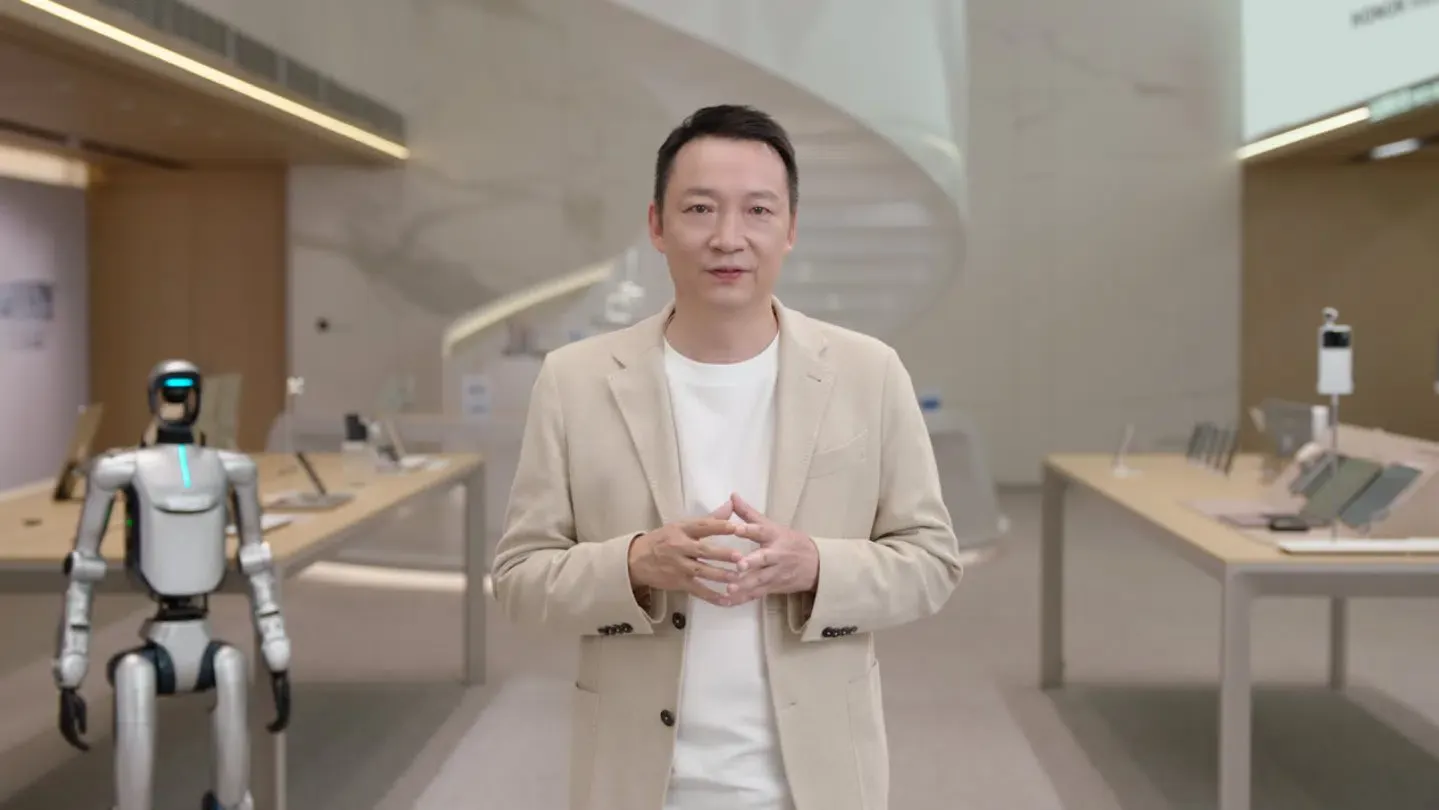
Honor’s architectural transition reflects a ten-year trajectory in on-device machine intelligence. Starting with the first-generation Magic Live engine in 2016, through platform-level intent recognition in MagicOS 8.0 and autonomous agent exploration in MagicOS 9.0, the platform has steadily shifted computing resources toward contextual comprehension. During the launch keynote, Honor leadership framed this milestone under its broader Alpha Strategy and AHI (“AI Human Interaction”) vision, building on the company’s previously announced commitment to invest more than $10 billion over five years in its AI device ecosystem transformation.
According to platform metrics disclosed during the keynote, YOYO currently serves over 160 million monthly active users across 1,000 proactive life scenarios. However, transitioning from proactive recommendations to autonomous task execution requires restructuring how an operating system interacts with external services. Rather than expecting users to find and operate individual tools, an Agentic OS must interpret intent, compose distributed tools, handle intermediate execution failures, and deliver verified outcomes.
Deconstructing YOYO Harness: Perception, Planning, and Dual-Track Execution
In contemporary AI systems, a foundation model alone cannot function as an autonomous agent. As system architects frequently note, while a large model provides cognitive reasoning, the harness provides the operational workbench—supplying persistent memory, environment perception, structured tooling, and safety constraints. Without an orchestration layer that supplies persistent state, tools, and execution feedback, a foundation model by itself cannot reliably verify external actions or recover from environmental changes.

YOYO Harness coordinates these responsibilities by operating as a system-level orchestration layer within MagicOS, bridging terminal-side lightweight models with cloud-based reasoning clusters.
Engineering Scope Note: The following diagram is an illustrative reference model synthesized from Honor’s public descriptions of perception, planning, tool invocation, execution, and plugin interfaces. Honor has not publicly documented the complete internal YOYO Harness component topology.
+-------------------------------------------------------------------------+
|      REFERENCE MODEL: YOYO HARNESS SYSTEM-LEVEL ORCHESTRATION           |
+-------------------------------------------------------------------------+
|                                                                         |
|  [ Multimodal Ingestion Layer: Voice, On-Screen Context, Sensor State ] |
|                                |                                        |
|                                v                                        |
|  [ Context Aggregator: Personal Preferences & Environmental Telemetry ] |
|                                |                                        |
|                                v                                        |
|  [ Cognitive Planner: Stepwise Task Planning & Goal Decomposition ]     |
|                                |                                        |
|                                v                                        |
|  [ YOYO Harness Control Plane: Task Dispatch & Policy Checks ]          |
|                                |                                        |
|         +----------------------+----------------------+                 |
|         |                                             |                 |
|         v (Primary: Structured Path)                  v (Fallback Path) |
|  [ Standardized Tool Routing ]              [ GUI Grounding Engine ]    |
|  - Model Context Protocol (MCP Plugins)     - On-Screen OCR / CV Model  |
|  - System APIs (Phone, Calendar, Alerts)   - System-Mediated UI Action |
|  - Registered App Skill Schemas             - Visual State Observation  |
|         |                                             |                 |
|         +----------------------+----------------------+                 |
|                                |                                        |
|                                v                                        |
|  [ Execution Feedback Loop: Step Observation & Failure Recovery ]       |
|                                                                         |
+-------------------------------------------------------------------------+
The Dual-Track Invocation Pipeline
To execute actions across heterogeneous application ecosystems, YOYO Harness deploys a two-tier execution hierarchy:
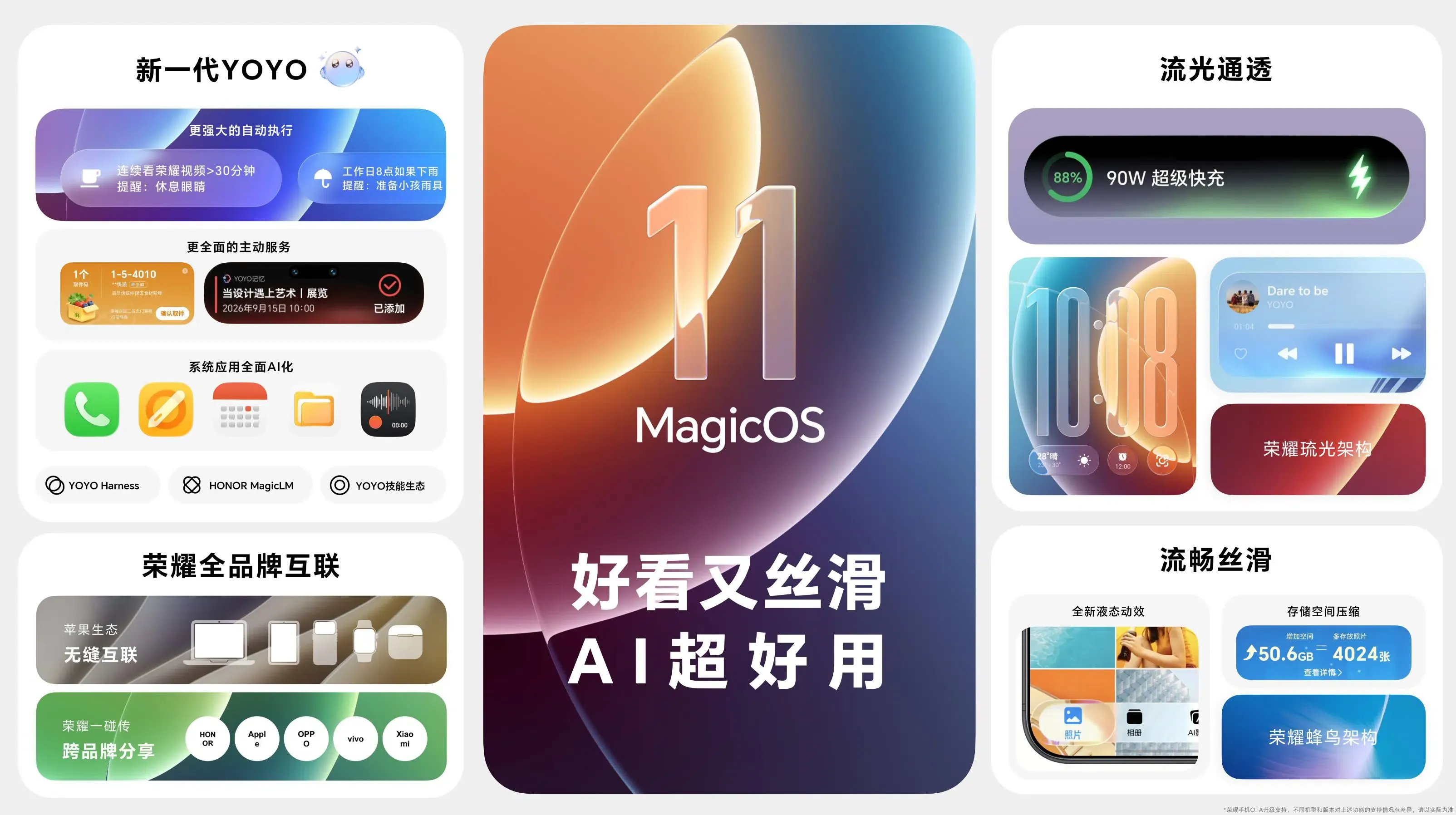
- The Structured Highway (MCP, Skills, and System APIs): When third-party services or system components expose formal contracts—such as the Model Context Protocol (MCP), verified skill endpoints, or native Android intents—YOYO interacts through structured tool and service interfaces. MagicOS 11 launches with 700 built-in system tools and over 500 standardized skills. In parallel, Honor reports that its broader ecosystem connects across more than 10,000 third-party AI services. Structured interfaces generally provide more explicit parameter contracts, lower interaction overhead, and clearer permission boundaries than visual automation.
- The Dynamic Fallback (Computer Vision & GUI Grounding): For applications without structured interfaces, YOYO can fall back to GUI-based interaction. Public materials indicate that the agent can interpret application interfaces and perform user-like operations, while Honor has not publicly documented the complete perception and input-injection stack behind this fallback path. Platform engineers treat GUI automation as a pragmatic fallback due to its susceptibility to UI layout changes, dynamic rendering latency, and application anti-automation measures.
Intent Resolution and Everyday Micro-Workflows
Honor reports that YOYO achieves a 91.8% comprehensive intent comprehension rate, with task execution accuracy reaching 93% on simple tasks and 87% on complex workflows, yielding an overall closed-loop completion rate of 90%. While marketing disclosures emphasize the technical milestone of executing task sequences exceeding 100 continuous steps, for many everyday consumer scenarios, the practical value is likely to come from shorter, repeatable workflows rather than 100-step chains.
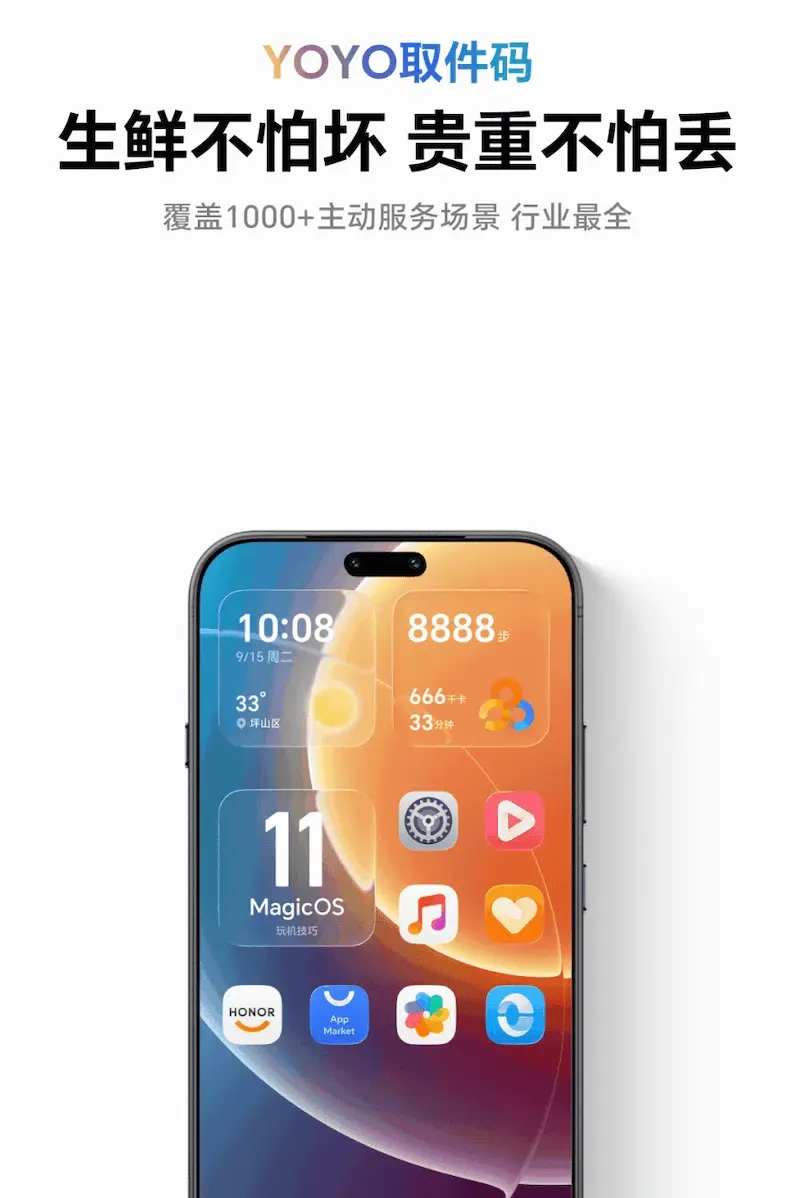
To operationalize these everyday tasks, MagicOS 11 introduces “YOYO Tasks,” allowing users to bind actions across 40 trigger conditions and 130+ execution primitives:
- Automated Service Queuing: The AI Call Assistant can dial customer service hotlines, navigate interactive voice response (IVR) keypad trees, hold the line through call queues, and alert the user via haptic notification only when a human representative answers.
- Multimodal Context Extraction: During cellular calls, on-device audio transcription extracts mentioned meeting dates, flight numbers, or phone contacts, staging them directly into local calendar and address book providers.
- Contextual Logistics Parsing: Rather than simply aggregating tracking numbers from SMS and e-commerce applications, the system categorizes delivery codes based on item attributes—flagging perishable groceries for immediate pickup or coordinating assistance for bulky freight shipments.
Defensive Security, Sandbox Isolation, and Error Compounding
Granting an autonomous software agent programmatic control over mobile workflows introduces significant operational risks. As outlined in standard vulnerability classifications for autonomous agents (such as OWASP’s LLM and Agentic AI security taxonomies, which highlight risks including Prompt Injection, Excessive Agency, and Tool Misuse), concerns become acute when an assistant can mutate system or application state.
A fundamental engineering reality of multi-step agent execution is the compounding nature of error probabilities. If an individual task step maintains an independent reliability rate of 95%, an illustrative reliability model demonstrates that the probability of successfully completing an unassisted 100-step task chain drops precipitously:
Consequently, the 100+ step figure is better interpreted as a ceiling on demonstrated long-horizon execution capability than as evidence that typical consumer workflows should run unattended for 100 steps. To prevent runaway state drift, autonomous mobile architectures require rigorous containment:
- Application-Level Governance: Honor documents an application-declared control mechanism that lets third-party developers determine whether YOYO’s GUI agent may interact with their app via manifest metadata. The complete privilege model of the system-level YOYO runtime has not been publicly documented, though it operates alongside Android’s baseline platform isolation.
- Android Sandbox Context: Standard Android security isolation—including runtime permission dialogues, package signature checks, and isolated process spaces—remains the baseline boundary for third-party software, requiring agent integrations to respect declared manifest boundaries.
- Engineering Confirmation Checkpoints: In enterprise agent design, high-impact state mutations—such as financial settlements, credential alterations, irreversible deletions, and physical hardware control (e.g., smart locks or connected vehicles)—require explicit Human-in-the-Loop (HITL) confirmation dialogues before committing changes.
| Dimension | Classical Mobile OS (App-Centric) | Early Mobile Voice Assistants | System-Level Agent Harness (MagicOS 11) |
|---|---|---|---|
| Execution Primitive | Static Application Binary | Hardcoded Voice Intent Handler | Multi-Step Task / Intent Graph |
| User Interaction | Manual screen touch and UI navigation | Rigid voice command-and-control | Natural language goal -> Orchestrated execution |
| Tool Integration | Explicit Intent filters and Deep Links | Proprietary cloud extensions | Hybrid: Standardized Plugins + Dynamic GUI |
| Context Scope | Restricted to active foreground app | Limited to audio input session | Systemwide: Screen, Audio, Location, Preferences |
| Failure Recovery | Process crash / App ANR dialog | Generic speech error apology | Execution-result checking, user interruption, and recovery logic |
Developer Integration and Cross-Brand Interoperability
For third-party software developers, integrating with an Agentic OS requires moving toward structured, machine-readable tool contracts. Honor’s developer ecosystem provides programmatic access through the Honor Agent Platform, which supports plugin integrations including Model Context Protocol (MCP) servers communicating over StreamableHTTP or Server-Sent Events (SSE), alongside standard API plugins and system automation interfaces.
When an application exposes its capabilities through standardized schemas, it provides the operating system planner with typed parameter descriptions, required input constraints, and execution requirements. This allows the system agent to dispatch requests cleanly via backend service binders or network endpoints without relying on fragile screen automation.
// Conceptual Reference Design — Non-Executable Honor SDK Example:
// The following Kotlin sample illustrates application-side schema validation,
// state idempotency, and Human-in-the-Loop (HITL) confirmation concepts for agentic tool execution.
// It does not implement Honor's proprietary YOYO SDK or an MCP server protocol,
// and it should not be used as a drop-in integration implementation.

package com.example.platform.agent.tools

import android.content.Context
import kotlinx.coroutines.Dispatchers
import kotlinx.coroutines.withContext
import org.json.JSONObject
import java.util.UUID

// MARK: - Tool Parameter and Execution Contracts
data class BookingParameters(
    val serviceId: String,
    val appointmentTimestamp: Long,
    val clientMutationToken: String,
    val requiresHighValueConfirmation: Boolean
)

sealed class ToolExecutionResult {
    data class Success(val transactionId: String, val message: String) : ToolExecutionResult()
    data class RequiresUserConfirmation(val confirmationPrompt: String, val pendingToken: String) : ToolExecutionResult()
    data class Failure(val errorCode: String, val errorMessage: String) : ToolExecutionResult()
}

// MARK: - Standardized Agent Tool Provider
class AppointmentBookingTool(private val context: Context) {

    companion object {
        const val TOOL_NAME = "schedule_appointment"
        const val TOOL_DESCRIPTION = "Schedules a service appointment with verified state idempotency."
        private const val MAX_VALID_ADVANCE_DAYS = 90L
    }

    // Exposes declarative JSON Schema illustrating structured tool definition
    fun getToolDefinition(): JSONObject {
        return JSONObject().apply {
            put("name", TOOL_NAME)
            put("description", TOOL_DESCRIPTION)
            put("parameters", JSONObject().apply {
                put("type", "object")
                put("properties", JSONObject().apply {
                    put("serviceId", JSONObject().apply {
                        put("type", "string")
                        put("description", "Unique identifier of the target service.")
                    })
                    put("appointmentTimestamp", JSONObject().apply {
                        put("type", "integer")
                        put("description", "Epoch timestamp in milliseconds for the reservation.")
                    })
                    put("clientMutationToken", JSONObject().apply {
                        put("type", "string")
                        put("description", "Durable UUID to ensure idempotent execution during assistant retries.")
                    })
                })
                put("required", org.json.JSONArray().apply {
                    put("serviceId")
                    put("appointmentTimestamp")
                    put("clientMutationToken")
                })
            })
        }
    }

    // Executes the tool within an isolated coroutine context
    suspend fun execute(rawArgumentsJson: String): ToolExecutionResult = withContext(Dispatchers.IO) {
        val params = try {
            parseAndValidateParameters(rawArgumentsJson)
        } catch (e: IllegalArgumentException) {
            return@withContext ToolExecutionResult.Failure(
                errorCode = "ERR_INVALID_SCHEMA",
                errorMessage = e.message ?: "Parameter validation failed."
            )
        }

        // Defensive Idempotency Check: Prevent duplicate side effects across planner retries
        if (IdempotencyManager.isTokenProcessed(params.clientMutationToken)) {
            val existingId = IdempotencyManager.getTransactionId(params.clientMutationToken)
            return@withContext ToolExecutionResult.Success(
                transactionId = existingId ?: "UNKNOWN",
                message = "Action was already completed under prior execution cycle."
            )
        }

        // Safety Gate: Enforce Human-in-the-Loop confirmation for high-impact constraints
        if (params.requiresHighValueConfirmation) {
            return@withContext ToolExecutionResult.RequiresUserConfirmation(
                confirmationPrompt = "Confirm booking for service ${params.serviceId} at timestamp ${params.appointmentTimestamp}?",
                pendingToken = params.clientMutationToken
            )
        }

        // Domain Execution: Perform the actual business mutation
        return@withContext try {
            val transactionId = UUID.randomUUID().toString()

            // Commit mutation to local database or remote service
            BackendBookingService.commitBooking(
                serviceId = params.serviceId,
                timestamp = params.appointmentTimestamp,
                txId = transactionId
            )

            // Record mutation token to guarantee subsequent idempotency
            IdempotencyManager.recordToken(params.clientMutationToken, transactionId)

            ToolExecutionResult.Success(
                transactionId = transactionId,
                message = "Appointment successfully scheduled."
            )
        } catch (e: Exception) {
            ToolExecutionResult.Failure(
                errorCode = "ERR_BACKEND_REJECTION",
                errorMessage = e.localizedMessage ?: "Failed to execute booking with remote service."
            )
        }
    }

    private fun parseAndValidateParameters(jsonString: String): BookingParameters {
        val json = JSONObject(jsonString)

        val serviceId = json.optString("serviceId")
        require(serviceId.isNotBlank()) { "Parameter 'serviceId' must not be blank." }

        val timestamp = json.optLong("appointmentTimestamp", -1L)
        val currentEpoch = System.currentTimeMillis()
        val maxFutureEpoch = currentEpoch + (MAX_VALID_ADVANCE_DAYS * 24 * 60 * 60 * 1000)

        require(timestamp > currentEpoch) { "Appointment timestamp must be in the future." }
        require(timestamp < maxFutureEpoch) { "Appointment cannot be booked beyond $MAX_VALID_ADVANCE_DAYS days in advance." }

        val mutationToken = json.optString("clientMutationToken")
        require(mutationToken.isNotBlank()) { "Durable 'clientMutationToken' is required." }

        // Dynamic risk evaluation: Example business rule flagging premium services
        val isHighValue = serviceId.startsWith("PREMIUM_")

        return BookingParameters(
            serviceId = serviceId,
            appointmentTimestamp = timestamp,
            clientMutationToken = mutationToken,
            requiresHighValueConfirmation = isHighValue
        )
    }
}

// MARK: - Supporting Mock Infrastructure
object IdempotencyManager {
    private val processedTokens = mutableMapOf<String, String>()

    @Synchronized
    fun isTokenProcessed(token: String): Boolean = processedTokens.containsKey(token)

    @Synchronized
    fun getTransactionId(token: String): String? = processedTokens[token]

    @Synchronized
    fun recordToken(token: String, txId: String) {
        processedTokens[token] = txId
    }
}

object BackendBookingService {
    fun commitBooking(serviceId: String, timestamp: Long, txId: String) {
        // Simulates database write or authenticated remote API dispatch
    }
}
In addition to software agent integration, MagicOS 11 addresses multi-device interoperability. Honor collaborated with mainstream Android original equipment manufacturers (OEMs) to establish unified cross-brand “Tap-to-Share” technical standards, enabling nearby file sharing through touch-initiated interactions between supported devices.

Furthermore, the platform expands cross-ecosystem continuity via Honor Connect, enabling file transfer across supported iPhone, iPad, and Mac devices (including NFC-initiated touch transfer on supported iPhones), alongside notification sharing with supported Apple endpoints.
Frequently Asked Questions (FAQ)
What is the core difference between YOYO Harness and earlier generations of voice assistants?
Why does MagicOS 11 implement a dual-track execution model instead of relying entirely on GUI automation?
How do Agentic OS architectures protect against unauthorized or destructive actions?
Strategic Implications and Platform Outlook
Honor’s commercial deployment of MagicOS 11 reflects a broader evolutionary shift in mobile device software. As hardware differentiation across silicon nodes, display panels, and camera modules reaches incremental thresholds, operating system differentiation is shifting toward system-level autonomous orchestration.
While technical challenges surrounding multi-step compounding error rates, interface drift, and cross-platform privacy governance remain active engineering frontiers, system-level harnesses establish the foundation through which future terminal intelligence will operate. For mobile engineering teams, the mandate is clear: applications must evolve from passive graphical containers into structured, permission-aware tool providers designed to operate seamlessly within an autonomous multi-agent operating environment.
References
-
Honor. (2026). MagicOS Official Product Page. Honor Official Portal.
-
TMTPost. (2026). Honor CEO Li Jian: AI is Rewriting the Future of Mobile Operating Systems. TMTPost Official Website.
-
Honor Developers. (2026). YOYO Agent Platform: MCP Plugin and Remote Service Integration Guide. Honor Developer Portal.
-
Honor Developers. (2026). YOYO Device Control and Third-Party Application GUI Interaction Configuration Guide. Honor Developer Portal.
-
Model Context Protocol Project. (2026). Model Context Protocol (MCP) Architectural Specifications. Agentic AI Foundation.
-
OWASP GenAI Security Project. (2026). Top 10 for Large Language Model Applications 2026. OWASP Foundation.
-
OWASP GenAI Security Project. (2026). Top 10 for Agentic Applications 2026. OWASP Foundation.
Share this article