 Hynix Expert Claims GPU Idle? Why HBM Memory Is Key is a question of paramount importance. According to a presentation delivered by KAIST Professor Joungho Kim, who has collaborated extensively with SK Hynix on HBM research, GPU utilization during AI inference is increasingly constrained by memory bandwidth rather than raw compute capability. This growing “memory wall” has made High Bandwidth Memory (HBM) one of the most important technologies in AI infrastructure. As generative artificial intelligence platforms transition from the training era to the inference era, the primary performance bottleneck has shifted from raw processor compute capacity to memory bus throughput. Standard graphics processing units (GPUs) are designed to handle massive parallel computations. However, because each inference step requires reading billions of parameters from memory, executing the calculation, and writing the states back, processors spend the majority of their operational cycles idling, waiting for data to travel across standard buses.
Why HBM Memory Is Key: Aligning High-Throughput Pipelines with Hardware Limits
At a Glance
- Industry analysis suggests that even with millions of standard graphics processing units deployed, actual compute utilization is limited to ten to thirty percent due to memory bus transfer delays.
- The physical limitations of chip scaling are driving a paradigm shift toward memory-centric computing, utilizing vertically stacked high-bandwidth memory (HBM) architectures.
- Next-generation 3D composite packaging is expected to stack graphics processing units, high-speed on-package SRAM cache, and high-capacity 3D NAND flash storage to resolve data transfer bottlenecks.
The global computing infrastructure is facing a structural crisis. For several years, the race to build larger AI models has focused on scaling raw computing power. Enterprises and cloud providers have invested billions of dollars to acquire massive clusters of graphics processing units (GPUs). This focus was highly logical during the initial training era, when model training depended on continuous backpropagation calculations. Under those workloads, parallel computing units operated at maximum capacity to update model parameters, as detailed in the NVIDIA Hopper Architecture Whitepaper.
However, as applications transition to the inference era, the engineering requirements have changed. In inference scenarios, the primary challenge is not updating weights, but streaming massive, pre-trained parameters to the processor to answer immediate queries. Every generated token requires repeated access to billions of model parameters stored in high-bandwidth memory. Because standard bus architectures cannot move data fast enough to match standard processor execution speeds, computing cores are starved of data, resulting in extremely high idle rates. This performance bottleneck is discussed in technical industry reports, including research published by academic bodies such as the Korea Advanced Institute of Science and Technology (KAIST) and hardware developers like NVIDIA and SK Hynix.

This performance gap demonstrates the physical constraints showing why HBM Memory Is Key in the inference era. According to the HBM technology roadmap published by the KAIST TERA Lab, future HBM generations will continue increasing bandwidth through additional DRAM stacking, TSV integration, advanced packaging, and thermal optimization. Standard DRAM packages lack the necessary parallel lanes to support the processing speeds of modern accelerators. To overcome this “memory wall,” hardware architects have turned to high-bandwidth memory (HBM) systems. By stacking DRAM dies vertically and utilizing thousands of silicon vias (TSVs) to establish wide, parallel buses, the JEDEC HBM3 specification (JESD238) explains how TSV-based stacked memory dramatically expands available bandwidth compared with conventional DRAM packages. For developers, this hardware evolution illustrates a fundamental rule of high-throughput systems: the bottleneck is almost always the transport layer, not the computation node.
Under-the-Hood Mechanics of the HBM Memory Is Key Concept
At the architectural level, standard computer buses act like narrow highways, restricting the flow of high-volume datasets. When an application executes an inference call, the processor must read data from memory, complete the operation, and write the output back. In standard configurations, this process creates severe latency because data must travel across a wide physical distance on the motherboard.
To resolve these transport-layer bottlenecks, next-generation AI computers are evolving into three-dimensional composite architectures. Under this model, the computing core is placed directly on top of stacked memory, utilizing advanced packaging to minimize physical distance and latency.
The 3D Memory Hierarchy: Stacking SRAM, DRAM, and NAND
To handle different classes of data, hardware architects are proposing a stratified, layered 3D semiconductor skyscraper. This structure separates data storage into distinct physical zones based on access speed and capacity requirements:
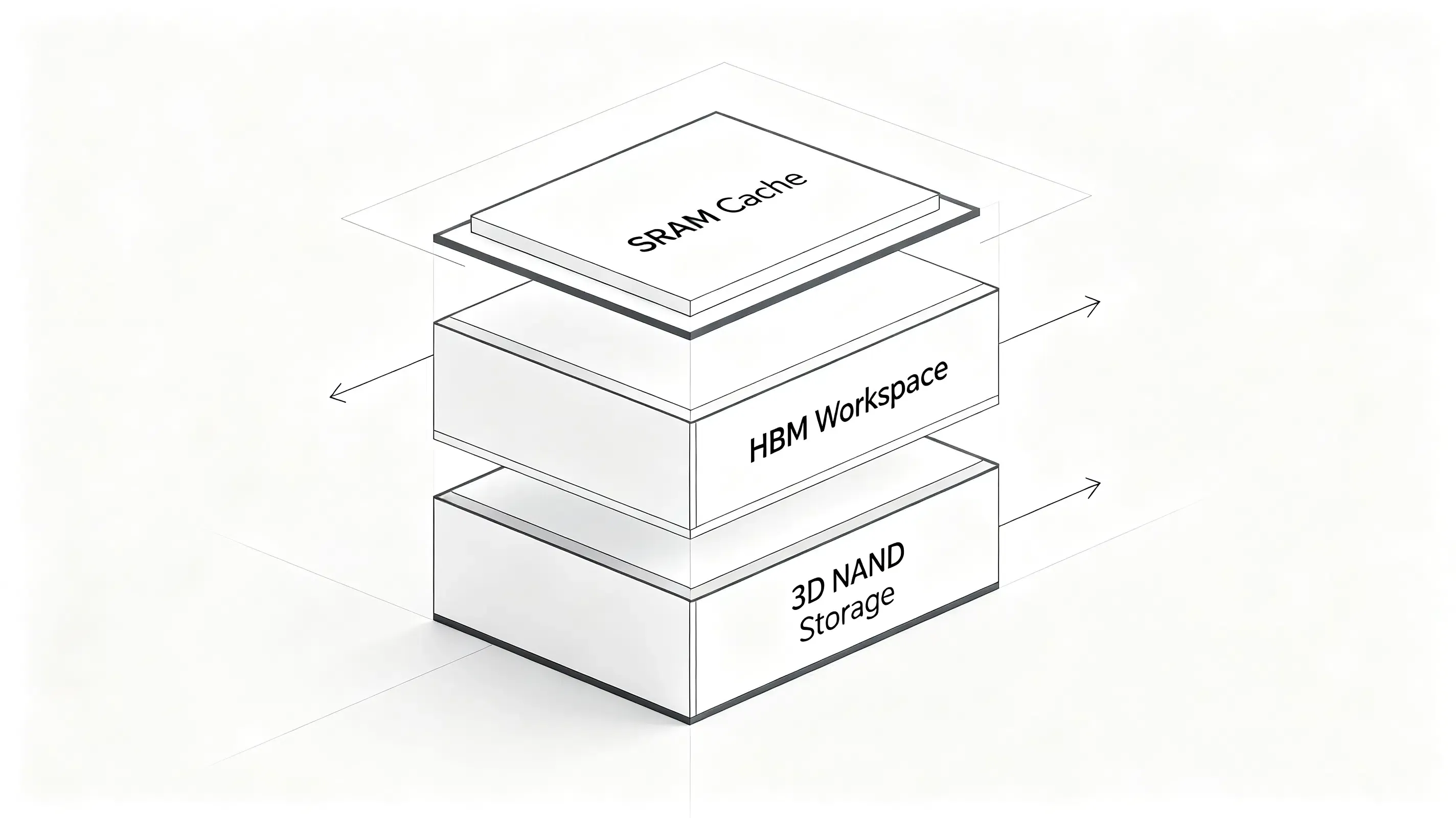
- High-Speed On-Package SRAM Cache: Acting as the ultimate high-speed cache, SRAM is integrated directly alongside the processor, significantly reducing memory access latency compared with conventional DRAM to handle active parameter registers.
- High-Bandwidth Memory (HBM): Serving as the main active workspace, HBM handles active parameter retrieval and high-frequency state updates, with JEDEC standards defining its wide interface.
- High-Capacity 3D NAND Flash Storage: High Bandwidth Flash (HBF) remains an emerging storage architecture proposed by KAIST researchers to complement HBM by providing significantly larger storage capacity for future AI systems, utilizing vertically stacked NAND flash to provide massive, long-term storage capacity to preserve videos, documents, and persistent conversational memories.
The diagram below illustrates this physical vertical integration:
                  [ GPU / Processor Core ] (Roof-level Cooling)
                             │
                             ▼
                  [ High-Speed On-Package SRAM Cache ] (Ultra-Fast Wafer Cache)
                             │
                             ▼
                  [ High-Bandwidth Memory ] (Active Workspace DRAM)
                             │
                             ▼
                  [ High-Capacity 3D NAND Flash Storage ] (Long-Term NAND Storage)
This integrated 3D architecture ensures that standard computing units are continuously supplied with data, reducing idle cycles. Traditional DDR memory provides only a fraction of the bandwidth available from HBM. According to the NVIDIA GTC technical presentations jointly delivered with SK Hynix, HBM provides substantially higher bandwidth than conventional DDR memory while occupying a significantly smaller physical footprint. Specifically, HBM2 delivers approximately 307 GB/s per stack, while HBM2E increases this to roughly 358 GB/s, with HBM3 targeting bandwidth beyond 500 GB/s.
Although memory bandwidth and application attribution belong to different engineering domains, both highlight the same architectural principle: moving state management away from constrained local resources toward scalable server-side infrastructure. When user interactions are decoupled from standard client-side state tracking to satisfy privacy guidelines, maintaining seamless session continuity across different web and mobile environments becomes highly complex. Just as processors require persistent, high-speed memory pipelines to match state contexts, downstream marketing pipelines require robust, server-side data preservation to correlate separate installation events without relying on vulnerable client-side cookies or device-level attributes.

Build vs. Buy: Managing Server-side Session Continuity and Data Throughput
As modern computing environments move away from local, client-side identifiers, maintaining session state across distributed digital touchpoints has become a primary engineering challenge. For developers, managing session states in the HBM Memory Is Key era requires architectures that are both compliant with data privacy laws and highly accurate. Organizations that need to preserve user journeys across web and mobile experiences increasingly rely on server-side session management rather than persistent client-side identifiers. Depending on business requirements, teams may build these capabilities internally or adopt existing attribution platforms.
Architectural Evaluation: Custom Build vs. Standardized SDK
Building a custom, in-house system to manage server-side state matching offers maximum flexibility but demands significant ongoing engineering resources. Developers must manually construct database schemas, write secure cryptographic hashing functions, and continually update the system to comply with shifting regional regulations. Conversely, deploying a pre-built, certified SDK reduces integration complexity and guarantees long-term compliance without additional overhead.
The table below compares standard methodologies for managing session state and conversion context:
| Solution | Persistence | Throughput | Best For |
|---|---|---|---|
| In-house Session Database | High (Continuous Sync) | Medium (DB Latency Limits) | Custom enterprise environments with highly specialized storage logic |
| Browser-based Session Tracking | Low (Session Cookies) | Low (No Server Logging) | Basic website tracking with minimal cross-domain conversion requirements |
| Server-side Caching (e.g. OpoInstall) | None (Temporary Server-side Session Tokens) | High (Standardized Sandbox) | High-concurrency mobile app and multi-platform campaign attribution |
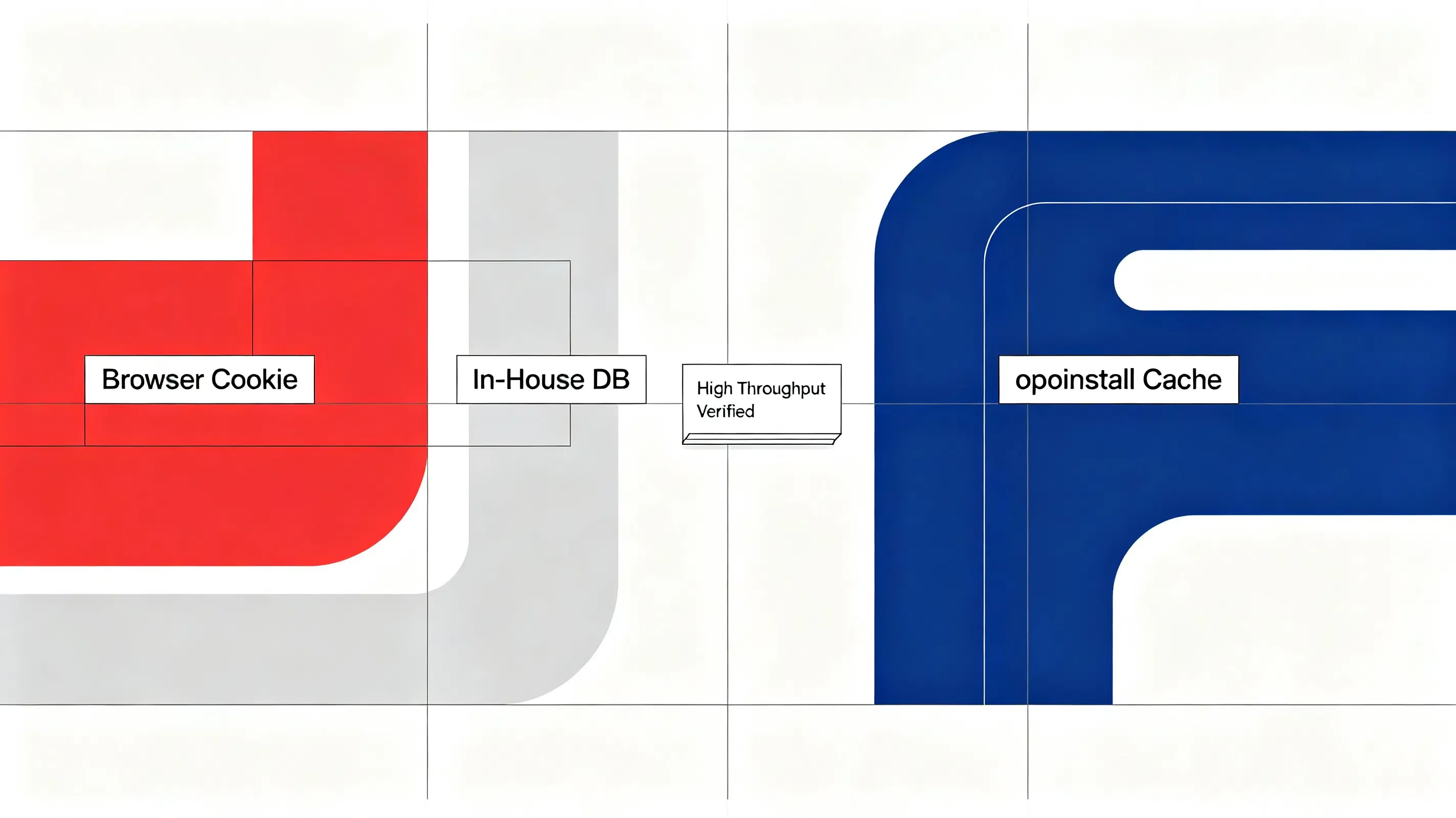
Recent GPU architecture research published on arXiv database studies also demonstrates that memory access efficiency frequently determines overall inference throughput more than raw arithmetic performance. While custom database configurations can handle basic context, specialized server-side state preservation can optimize development resources. Depending on implementation requirements, organizations may build their own server-side session management system or adopt commercial platforms such as OpoInstall. For instance, OpoInstall offers server-side state restoration and parameter pass-through frameworks, mapping session metadata to a server-side session database to maintain session continuity anonymously, without storing sensitive, long-term personal conversational history. By mapping session metadata to a centralized database rather than relying on browser-based redirects, such a system ensures that conversion contexts remain consistent even when initial tasks are executed anonymously. Engineering teams can evaluate these approaches to balance data protection and measurement consistency.
Integration Checklists: Preparing Your Architecture for Memory-Centric Computing
To secure data pipelines and ensure user security in a post-alias era, developers and architects can evaluate decentralized, open-source alias management and server-side state preservation. Relying on single-provider OS-level features introduces systemic vendor lock-in and leaves organizations vulnerable to silent backend updates. Instead, engineering teams can evaluate alternative routing technologies that grant complete data ownership.
A standard alternative involves registering a dedicated custom domain specifically for email compartmentalization. By routing this domain through an open-source, self-hosted aliasing engine like SimpleLogin and pointing it to an encrypted mailbox like Proton Mail, developers can ensure that their aliases look like standard custom domains, preventing anti-abuse systems from blocking them as a group.
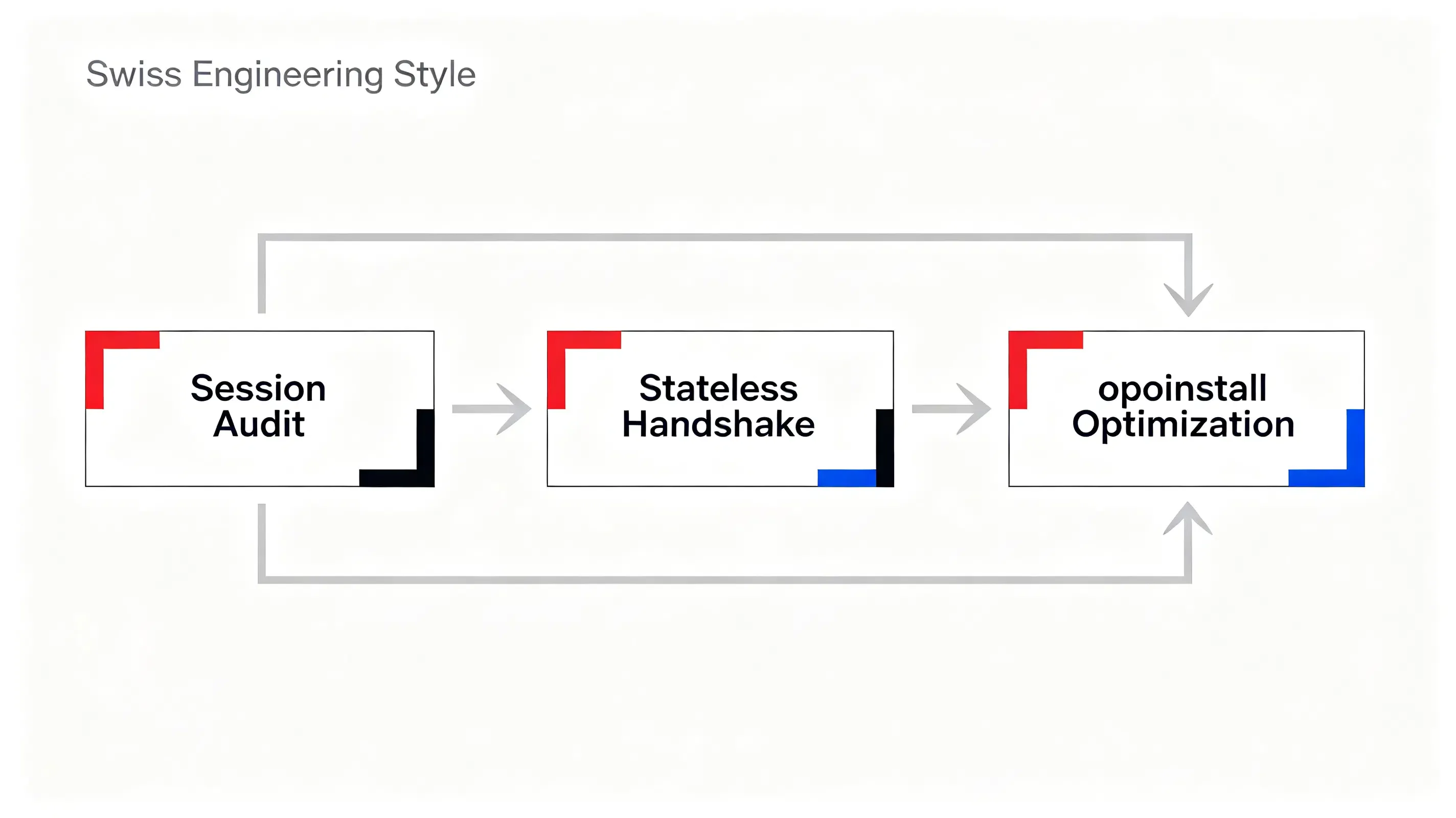
Developer Implementation Checklist
- Audit Session Data Retention: Review all databases to ensure that persistent, emotionally companionate chat histories are purged in accordance with data-deletion timelines.
- Implement Stateless Session Handshakes: Transition API routes to stateless processing models, utilizing cryptographically signed tokens to pass temporary context between nodes.
- Enforce Age-Verification Gateways: For consumer-facing products, deploy child safety safeguards to prevent minors from accessing restricted conversational features.
Product & Growth Strategy Checklist
- Reorganize User Experience Flows: Pivot from companion-based engagement models to task-oriented, high-utility tools that do not rely on emotional dependency.
- Optimize Conversion Funnels: Leverage non-intrusive parameter pass-through frameworks to maintain acquisition tracking without violating user privacy guidelines.
- Monitor Platform Compliance: Ensure that all integrated third-party SDKs comply with local data protection laws and the upcoming July 15 mandate.
By establishing these structured guidelines, development teams can transition their applications to safer, more compliant architectures while maintaining operational continuity.
Frequently Asked Questions (FAQ)
Why does the same GPU stay idle for up to ninety percent of its runtime?
What are the technical differences between HBM, HBF, and HBS?
How does server-side session restoration resolve state bottlenecks?
Why is HBM more important during AI inference than training?
Key Takeaways for Engineering Teams
As AI platforms adapt to new regulatory requirements, engineering teams will increasingly rely on stateless architectures, server-side session management, and privacy-first design. Evolving data architectures require a fundamental shift in how we build and measure digital experiences. As stateless proxies and headless scrapers become standard consumers of web content, traditional client-side attribution models will continue to degrade. Relying on standard cookies and referrers is no longer sufficient to secure the data pipelines that drive user acquisition.
To maintain growth, engineering and product teams must prioritize stateless data structures and server-side state preservation. By implementing zero-trust identity verification, secure parameter pass-through frameworks, and robust data-deletion schedules, organizations can protect their user pipelines while respecting legal boundaries. This architectural shift is essential to build stable, trustworthy platforms that thrive in a regulated digital economy.
Share this article