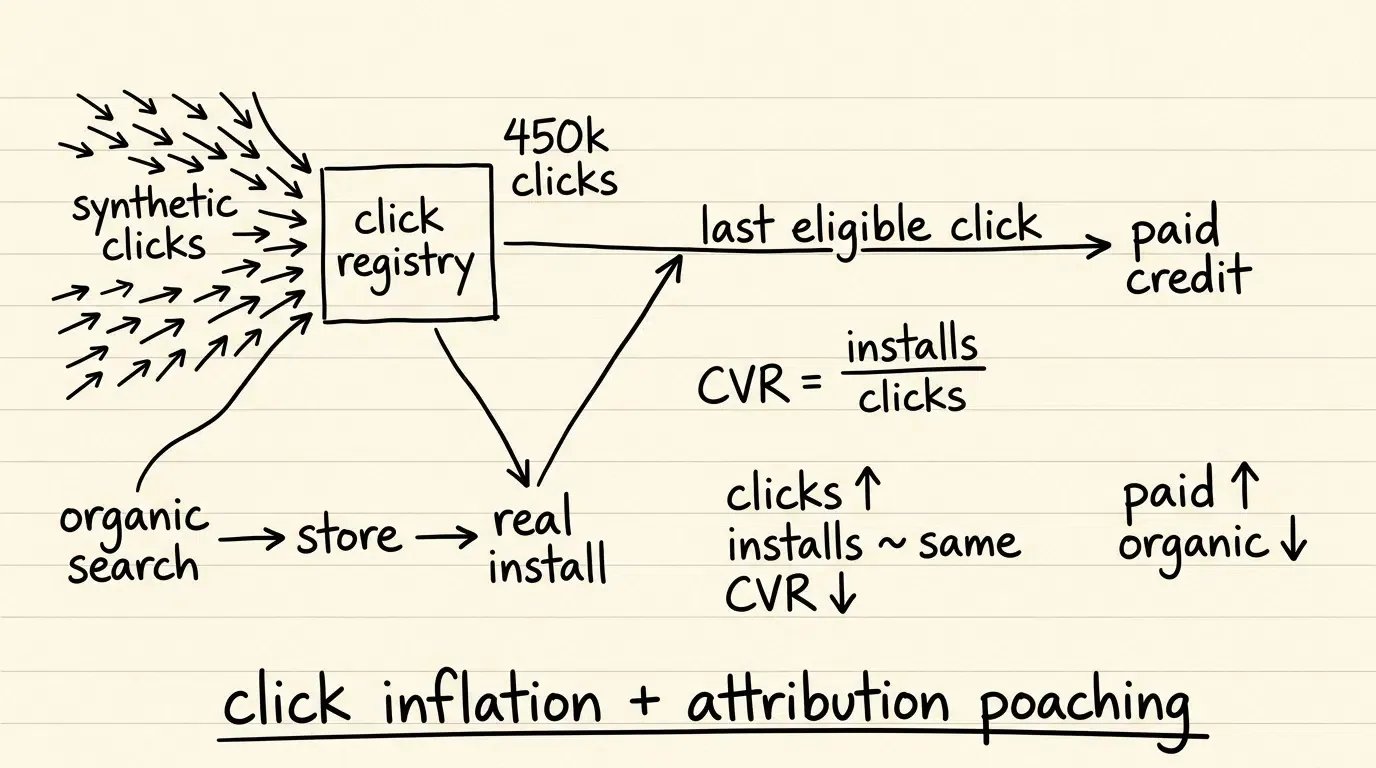
How does IP distribution analysis help identify proxy fraud? IP distribution analysis helps identify suspected proxy fraud by combining abnormal subnet concentration, network/ASN classification, and coarse geographic consistency signals against campaign-specific baselines.
IP distribution analysis is the systematic evaluation of geographic, network, and routing characteristics associated with incoming ad clicks and app install events. In performance mobile marketing, auditing IP distribution data enables data and security teams to detect proxy ad fraud, identify commercial data center server clusters, uncover geolocation mismatches, and surface suspicious network traffic for review or configured policy enforcement before downstream attribution settlement.
| Term | Definition | Related Entity | Search Intent Role |
|---|---|---|---|
| IP Distribution | The geographical and network-level spread of IP addresses across campaign traffic. | Mobile Marketing | Informational / Commercial |
| Proxy Fraud | The routing of synthetic ad traffic through intermediate servers to disguise origin. | Ad Fraud | Technical / Informational |
| Datacenter ASN | A network or routed prefix classified by an IP-intelligence source as cloud, hosting, or datacenter infrastructure, often associated with a hosting-provider ASN. | Tracking Parameters | Technical / Informational |
Why IP Distribution Analysis Is Critical for Mobile Marketing Security
The Geolocation Arbitrage: Why Fraudsters Disguise Traffic Origins
In digital performance marketing, advertising payouts are often stratified by geographic market. Media campaigns targeting high-payout territories command significantly higher Cost Per Install (CPI) and Cost Per Action (CPA) rates than emerging markets. This economic disparity creates an arbitrage incentive for fraudulent traffic operators.
Bad actors operate automated botnets, script farms, or incentivized pools in lower-cost regions, routing traffic through proxy servers and virtual private networks (VPNs) located in target countries. By disguising their true IP origins, fraudulent sources attempt to claim premium acquisition payouts while delivering non-local, synthetic, or non-incremental traffic. Auditing IP distribution data allows analytics teams to evaluate network routing metadata and identify suspicious geographical patterns.
The Problem of Subnet Concentration: Evaluating Network Clustering
Legitimate consumer mobile traffic exhibits broad geographic and network dispersion. In standard acquisition campaigns, installs originate from millions of distinct consumer IP addresses assigned dynamically by mobile network operators (MNOs) and residential internet service providers (ISPs).
Fraudulent operations, by contrast, are often constrained by their server hosting infrastructure. While residential proxies and distributed botnets can achieve broader diffusion, some centralized fraud operations exhibit heavy concentration through narrow IPv4 subnets (such as /24 CIDR blocks) or commercial hosting provider facilities. Analyzing IP distribution density uncovers these unnatural clustering patterns, flagging subnets where installation velocity drastically exceeds baseline consumer population density.
How Proxy Fraud Distorts Regional Attribution Ledgers and Media Bidding
When proxy traffic bypasses attribution defenses, regional marketing analytics become corrupted. Growth teams observe seemingly strong acquisition numbers in target markets, prompting automated programmatic DSPs and manual media buyers to allocate more budget toward those campaigns.
However, downstream financial reconciliation reveals the distortion: the attributed users fail to generate expected local in-app purchases, exhibit zero localized ad engagement, and display abnormal cohort attrition. Furthermore, localized marketing efforts (such as regional promotions or local language onboarding) are wasted on non-human traffic. Establishing robust IP distribution filtering at the attribution gateway ensures that regional acquisition spend is directed toward authentic local audiences.
Developers seeking lightweight client telemetry and attribution SDKs can explore packages via the mobile analytics SDK package.
How Does Proxy Ad Fraud Disguise Device Geolocation and IP Origins
Datacenter Proxies vs. Residential Proxy Networks: Understanding the Threat Vector Spectrum
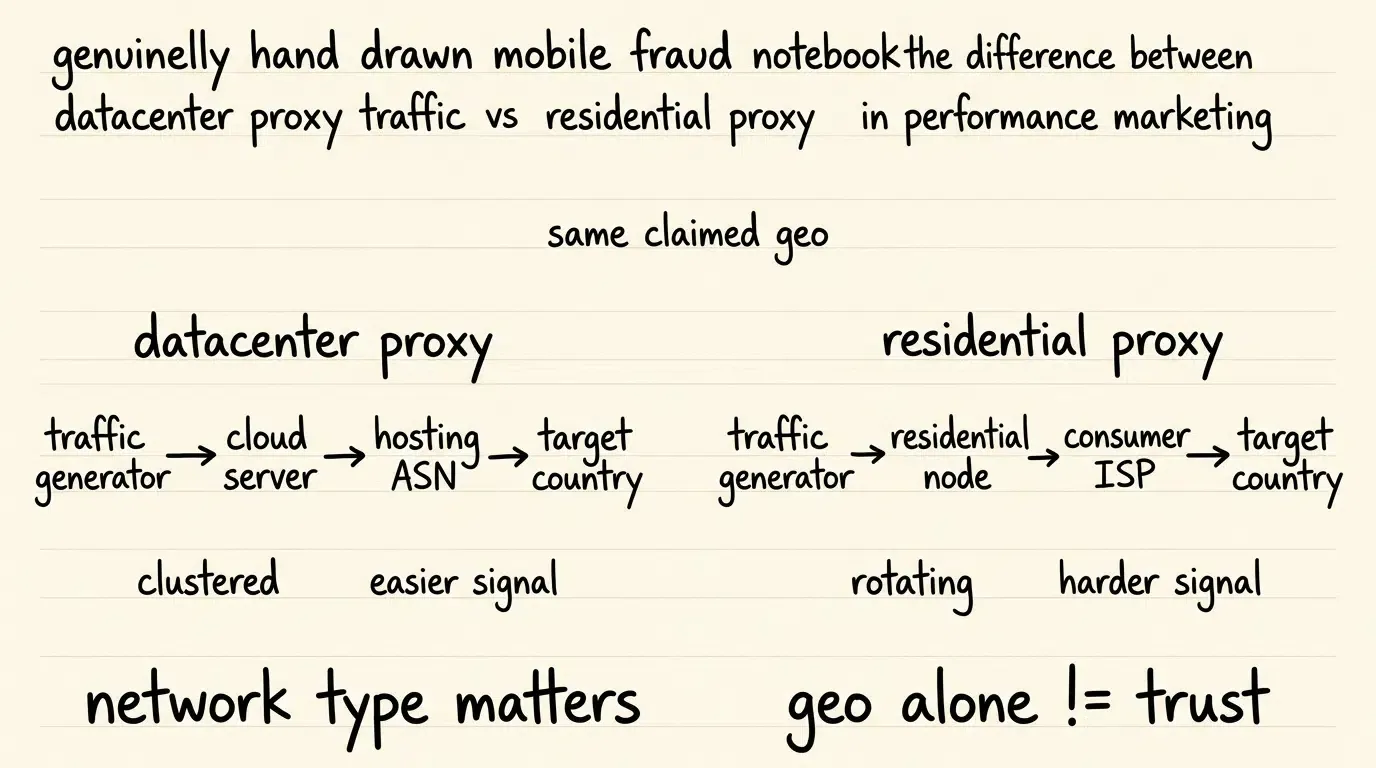
Proxy fraud operates across a spectrum of technical complexity, ranging from basic cloud servers to distributed residential networks:
- Datacenter Proxies: Synthetic traffic is generated on cloud servers (e.g., hosted on commercial VPS providers) and routed directly to attribution endpoints. These proxies possess distinct Autonomous System Numbers (ASNs) registered to hosting facilities rather than consumer ISPs, making them identifiable through network intelligence databases.
- Residential Proxy Networks: Bad actors route synthetic requests through consumer devices, home routers, or SDK-bundled proxy networks. Because the IP addresses belong to residential ISPs, they mimic legitimate household Wi-Fi traffic, requiring behavioral, subnet density, and timing cross-checks to detect.
[Synthetic Traffic Generator]
              │
              ├─► [Route A: Datacenter Proxy] ──► ASN: Hosting Provider ──► [Flagged via ASN Database]
              │
              └─► [Route B: Residential Proxy] ──► ASN: Consumer ISP    ──► [Requires Multi-Signal Telemetry]
                                                                                (Subnet Density + Locale Audit)
The Mechanics of VPN Tunnels and Anonymizing Relays in Click Operations
Commercial VPN services and anonymizing networks allow automated scripts to cycle through geographic egress nodes programmatically. A script executing in a device farm can establish a VPN tunnel to a specific regional exit node, dispatch an ad click, disconnect, reconnect to another node, and trigger a second installation event minutes later.
While commercial VPNs are widely used by consumers for privacy, their operational signature in performance marketing differs from authentic mobile behavior: they frequently present hosting provider ASNs, maintain high concurrent connection counts, and exhibit network latency profiles distinct from local physical cell towers.
Circumventing Basic Geofencing: Why Surface-Level GeoIP Is Insufficient
Basic geofencing rules evaluate only the two-letter ISO country code returned by a single GeoIP lookup. Fraudsters easily circumvent these superficial checks by leasing proxy endpoints within the exact target territories required by the campaign brief.
Relying solely on country-level GeoIP validation creates a false sense of security. Comprehensive fraud mitigation requires multi-dimensional network inspection: cross-referencing IP routing types, evaluating ASN ownership, tracking subnet concentration ratios, and checking coarse device-level configuration telemetry.
Technical Mechanics of Datacenter ASN and Subnet Clustering Identification
Differentiating Consumer Internet Service Providers from Cloud Infrastructure ASNs
Every network connected to the global Internet routing table is assigned an Autonomous System Number (ASN) managed by regional internet registries. ASNs are categorized by organization type:
- Consumer Internet Service Providers (ISPs) and MNOs: Organizations (e.g., consumer wireless carriers and broadband providers) that provide direct network access to consumer mobile phones and residential homes.
- Commercial Cloud and Hosting Infrastructure: Organizations (e.g., commercial cloud hosting providers and data centers) that provide server hosting and server-grade bandwidth.
Legitimate mobile application installations occur primarily across consumer ISPs, mobile network operators, and public Wi-Fi access points. Traffic from hosting or cloud-associated networks can be a useful risk signal, but ASN and network classification alone is insufficient to classify an install as fraudulent without supporting behavioral evidence.
Formulating Subnet Clustering Density Metrics
To quantify unnatural network concentration across acquisition channels, analytics engines compute the IP Subnet Density Ratio across configurable prefix aggregations (such as /24 IPv4 subnets):
When an acquisition channel displays a high concentration index—such as a single /24 subnet accounting for an anomalous proportion of daily installations while maintaining a high pseudonymous device rotation rate—the telemetry indicates an automated device bank operating on a local subnet pool:
Mapping the Proxy Inspection Pipeline
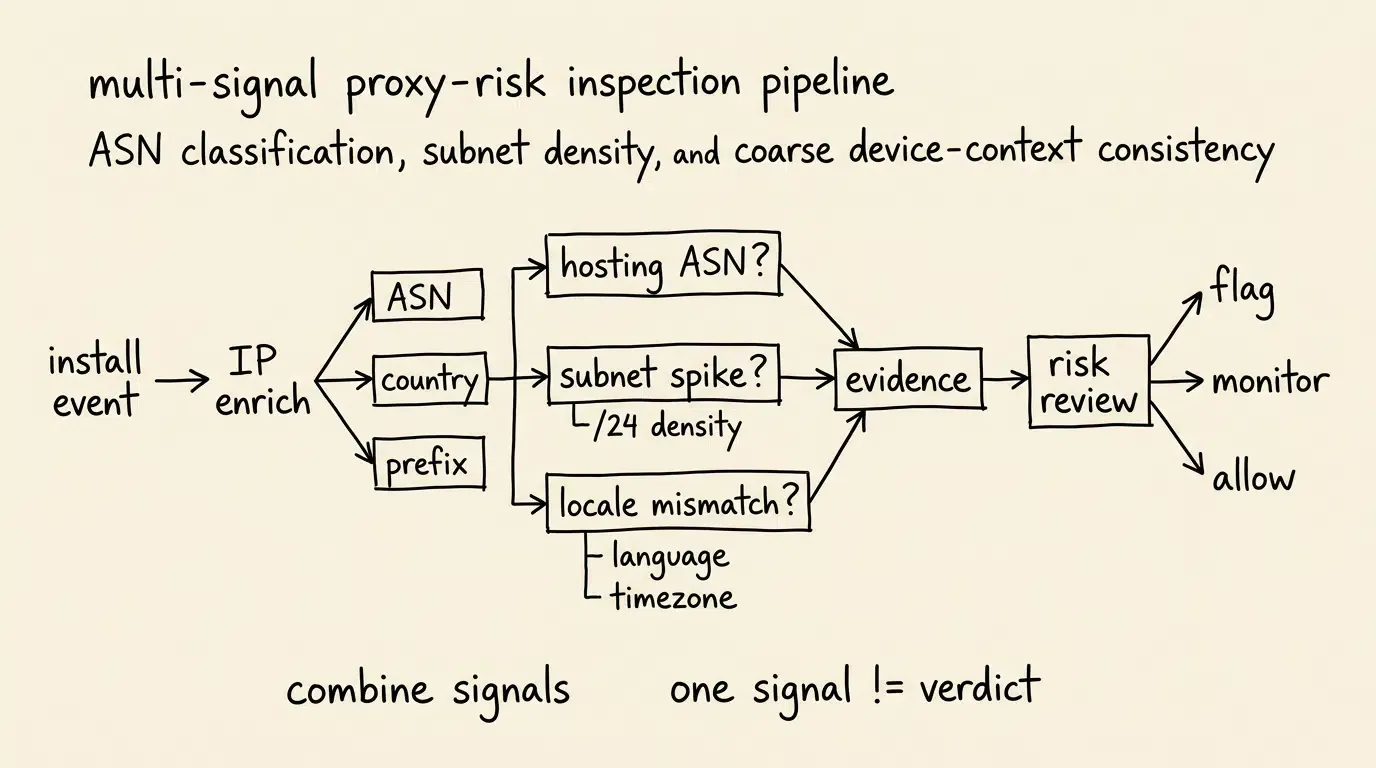
The diagram below illustrates the multi-tier inspection pipeline executed at the attribution gateway upon receiving an installation event:
[Incoming Install Event] ──► [IP Intelligence Extraction]
             │                           │
             ▼                           ▼
   Client IP: 203.0.113.45     ASN Lookup: AS_HOSTING_PROVIDER_PLACEHOLDER
             │                           │
             ▼                           ▼
[Check 1: Datacenter ASN] ──► Flags Candidate Cloud Server Anomaly
             │
             ▼
[Check 2: Subnet Density] ──► Evaluates Install Volume on 203.0.113.0/24
             │
             ▼
[Check 3: Locale Match]   ──► Compares IP Country vs. Device Locale (e.g., US vs. DE)
             │
             ▼
[Attribution Gateway Policy]──► Applies Configured Fraud Disposition (Flag / Review)
How to Audit Geolocation Discrepancies Between IP Telemetry and Device Locales
Coarse Consistency Checks: Comparing IP Geolocation, Device Language, and System Timezone
Precise GPS tracking requires explicit runtime location permissions. Because performance attribution operates primarily without intrusive location prompts, security architectures rely on coarse, privacy-compliant consistency checks between network telemetry and system configuration:
- IP Country vs. Device System Language: Population-level analysis evaluating whether an anomalous cluster of installs from a specific country IP uniformly displays mismatched system languages or default emulator locales.
- IP Timezone vs. Device System Clock: Statistical evaluation comparing regional IP timezones against device system clock offsets.
- Carrier Configuration Consistency: Cross-referencing platform-provided carrier country metadata (where legitimately exposed by platform APIs) against network IP country data. Note that on iOS, carrier metadata APIs (such as
CTCarrier) are deprecated and must not be relied upon as a portable signal.
While individual discrepancies can occur legitimately (e.g., international travelers or multilingual users), a statistical cluster of locale mismatches across a single publisher sub-ID supports a proxy-routing hypothesis.
Benign Network Exceptions: Accounting for Carrier NAT, Corporate VPNs, and Apple iCloud Private Relay
Anti-fraud architectures must distinguish malicious proxy farms from legitimate network technologies that naturally aggregate or mask consumer IP addresses:
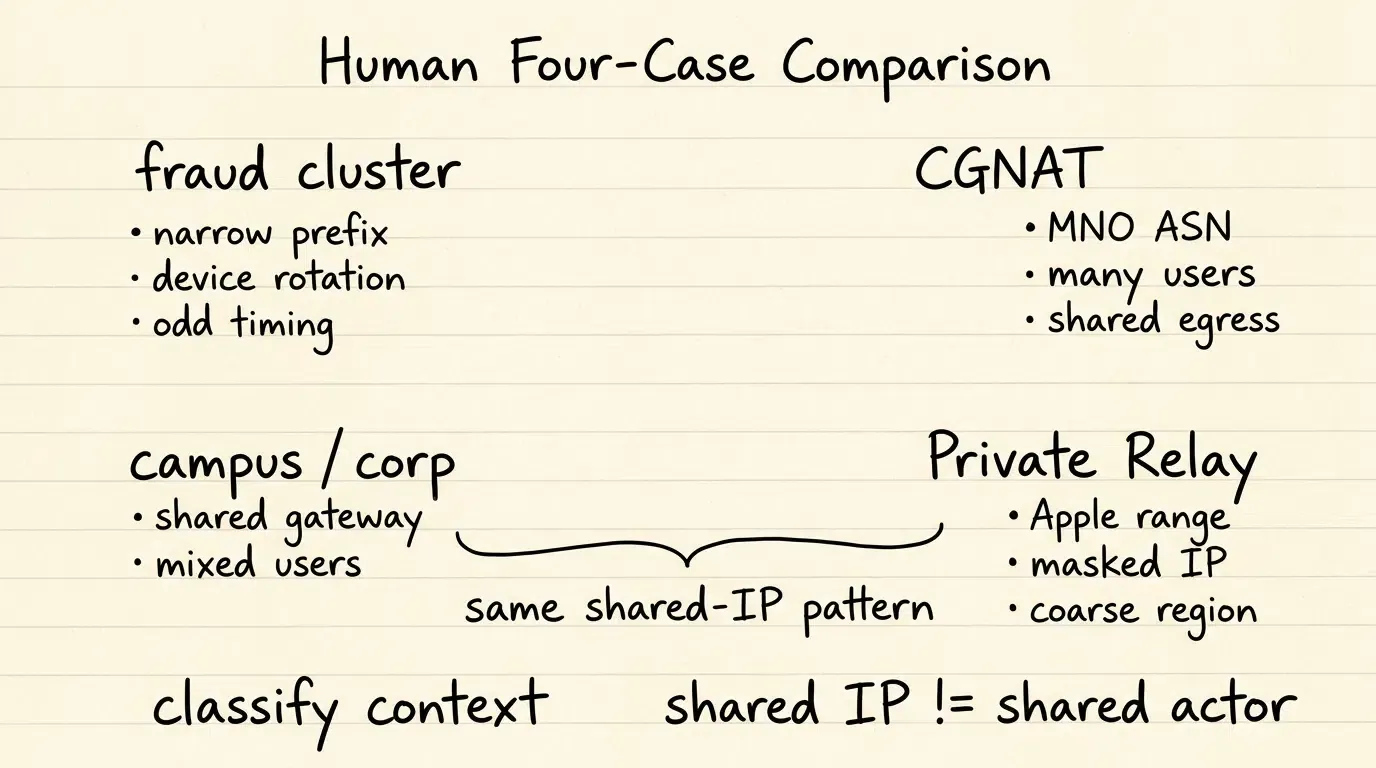
- Carrier-Grade Network Address Translation (CGNAT): Mobile network operators assign private IPv4 addresses to mobile handsets, multiplexing thousands of authentic consumer devices through a single public IP gateway. CGNAT pools are distinguished by consumer MNO ASNs and natural session distributions.
- Corporate and Campus Wi-Fi Networks: University campuses, enterprise offices, and airport Wi-Fi networks route hundreds of authentic employees or students through shared public IP gateways.
- Apple iCloud Private Relay: iOS users with iCloud+ route Safari web browsing traffic, DNS queries, and unencrypted app traffic through dual-hop secure relays. Apple publishes official egress IP address ranges mapped to specific geographic regions. When a request is identified as originating from iCloud Private Relay, attribution systems should downgrade IP uniqueness and concentration anomaly weights while retaining Apple’s coarse regional mapping as valid location context.
Structuring Multi-Signal Evidence: Avoiding False Positives from Legitimate Privacy Tools
A single network anomaly (such as an IP address belonging to a commercial VPN or cloud provider) should not serve as an automatic, binary conviction of fraud. Legitimate users frequently utilize VPNs for personal privacy or access public Wi-Fi networks while traveling.
Accurate fraud prevention requires multi-signal risk assessment: combining ASN categorization with timing curves, in-app event velocity, and device integrity attestations before enforcing attribution rejection.
Comparative Evaluation of Legitimate Network Traffic vs Proxy Fraud Signatures
Contrasting Network Telemetry across Clean Traffic, Commercial VPNs, Datacenter Farms, and Carrier Networks
Identifying proxy fraud requires evaluating network properties across multiple infrastructure categories.
The matrix below contrasts primary network telemetry signatures:
| Network Dimension | Legitimate Mobile Consumer | Datacenter Proxy Farm | Residential Proxy Pool | Carrier NAT (CGNAT) |
|---|---|---|---|---|
| ASN Classification | Consumer Mobile ISP / MNO | Commercial Cloud / Hosting ASN | Residential Consumer ISP | Major Wireless Carrier ASN |
| IP-to-Device Density | Consistent with Single User Baseline | Unusually Concentrated per IP | High Rotation / Low Persistence | High Legitimate Device Sharing |
| Locale / IP Alignment | Usually Matches Region and Timezone | Frequent Geolocation Mismatch | Often Aligned to Target Geo | Matches Carrier Regional Base |
| Timing Telemetry | Natural Baseline Distribution | Concentrated or Synthetic | Variable Distribution | Natural Baseline Distribution |
| Primary Risk Signal | Normal Baseline Behavior | Hosting ASN + Subnet Spike | Rapid Rotation + Behavioral Shift | Normal High-Volume Egress |
How to Configure Anti-Fraud IP Thresholds in OpoInstall Cheating Monitoring
Structuring Diagnostic Telemetry Payloads for IP Anomaly Audits
Reconciling network discrepancies and identifying proxy farms requires ingesting structured anomaly telemetry at the attribution gateway. When an incoming event triggers network risk rules, the system logs a diagnostic record capturing network routing properties, ASN classification, and anomaly evaluations.
The payload below demonstrates an illustrative production-oriented telemetry record capturing an IP anomaly inspection:
```json
{
  "schema_version": "1.2.0",
  "event_id": "evt_ip_anomaly_8f7e6d5c-4b3a-2109-8765-4a3b2c1d0e9f",
  "event_name": "ip_distribution_anomaly_detected",
  "evaluation_timestamp_utc": "2026-08-30T22:10:00.120Z",
  "server_received_timestamp_utc": "2026-08-30T22:10:00.850Z",
  "data_governance": {
    "retention_class": "fraud_investigation_ephemeral",
    "purpose": "attribution_security_audit"
  },
  "ip_intelligence_provenance": {
    "provider_name": "commercial_ip_intel_feed",
    "feed_version": "2026.08.r3",
    "lookup_timestamp_utc": "2026-08-30T22:10:00.140Z",
    "classification_confidence": "high"
  },
  "attribution_context": {
    "channel_code": "affiliate_network_gamma",
    "campaign_id": "cmp_q3_us_tier1_scale",
    "target_country_code": "US",
    "reported_ip_prefix": "203.0.113.0/24"
  },
  "ip_telemetry": {
    "ip_routing_type": "datacenter_hosting",
    "asn_identifier": "AS_HOSTING_PROVIDER_PLACEHOLDER",
    "asn_organization": "Commercial Cloud Hosting Provider",
    "asn_classification_source": "commercial_ip_intel_feed",
    "ip_country_code": "US",
    "subnet_daily_install_count": 1420,
    "subnet_ip_density_ratio": 0.48
  },
  "device_telemetry": {
    "platform": "Android",
    "os_version": "16.0",
    "app_version": "3.2.0",
    "sdk_version": "<installed_sdk_version>",
    "device_risk_key_pseudonymous": "dev_risk_anon_11223344",
    "device_system_language": "ru_RU",
    "device_system_timezone": "Europe/Moscow"
  },
  "anomaly_evaluation": {
    "fraud_vector_classification": "suspected_datacenter_proxy_arbitrage",
    "signals_evaluated": [
      "datacenter_asn_match",
      "high_density_subnet_clustering",
      "coarse_context_inconsistency"
    ],
    "risk_score": 0.92,
    "risk_score_scale": "0.0_to_1.0_normalized",
    "risk_score_semantics": "illustrative_policy_score_not_calibrated_probability",
    "risk_model_version": "v1.4.2_ruleset",
    "decision_basis": "configured_ip_threshold_policy",
    "policy_action": "attribution_flagged_for_partner_review",
    "review_status": "pending_manual_reconciliation"
  }
}
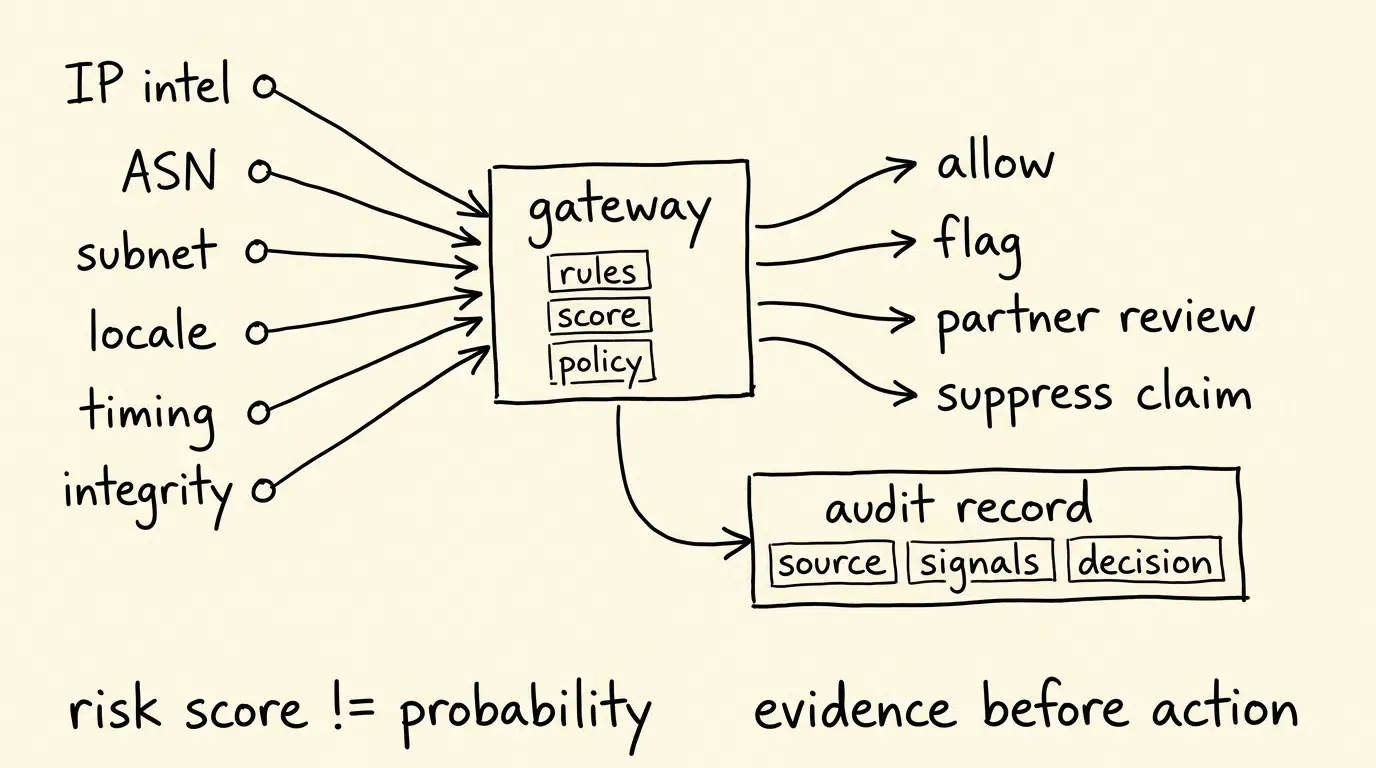
Configuring OpoInstall Cheating Monitoring Rules for Network Anomaly Defense
Representative monitoring controls documented in related product materials include the following threshold rules; exact rule names and behavior should be verified against the current OpoInstall console and documentation before implementation:
- Click IP Anomaly Threshold: Caps the maximum allowable clicks originating from a single IP address within a 24-hour window. Excess clicks from automated proxy scripts are marked as abnormal IP clicks and recorded in Exception Statistics.
- Installation IP Anomaly Threshold: Restricts the expected volume of installation records associated with a single IP address per day. Excessive install volume marks excess records as anomalous for fraud investigation, identifying proxy servers and localized device banks.
- Installation Device Anomaly Threshold: Monitors the frequency of installation records associated with single internal device anomaly identifiers, capturing potential repetitive-device anomalies.
- Additional Timing Rules: Dedicated click-hijacking timing rules and MTTI thresholds operate alongside IP rules to protect the install pipeline (see Article #62 for timing mechanics).
Auditing Exception Statistics: Drilling into the Exception IP List to Isolate High-Risk Sub-Publishers
When anti-fraud thresholds are triggered, the monitoring console compiles auditable evidence in dedicated exception views:
- Exception IP List: Displays specific IP addresses that triggered click or installation thresholds, tracking total click volume, install volume, active days, and associated source channels (after deduplication). Clicking on “Source” reveals the specific publisher channels routing traffic through that IP.
- Exception Device List: Details internal device anomaly identifiers, hardware models, operating systems (iOS/Android), and source channels for devices executing repetitive installs.
- Channel Data Reports: Compares gross clicks and installs against abnormal IP clicks and abnormal IP installs per acquisition channel, providing clear data for partner reconciliation.
When Are Advanced IP Distribution Audits Necessary for Marketing Analytics
Suitable Conditions for Dedicated IP Geolocation Audits
Deploying dedicated IP distribution analysis and anomaly detection provides high operational return under specific campaign conditions:
- Geographically Differentiated Campaigns: Marketing programs targeting Tier-1 markets where high payout bounties incentivize proxy arbitrage from lower-cost regions.
- Open Affiliate and Programmatic DSP Networks: Media buying across non-transparent ad networks where traffic is sub-syndicated across unverified third-party publishers.
- Unexplained Geographic Revenue Discrepancies: Applications observing that a specific country cohort generates high installation volume but materially weaker localized engagement or monetization than expected.
- Partner Quality Reviews: Teams requiring transparent network-level telemetry to support contractual reviews and review or suppress low-quality publisher sub-IDs according to policy.
Unsuitable Conditions for Complex IP Inspection
Implementing high-complexity IP filtering infrastructure may introduce unnecessary operational overhead in the following scenarios:
- Direct-Sold Carrier Placements: Marketing campaigns running exclusively on verified, direct-sold mobile network operator inventory.
- Single-Region Organic Discovery: Applications relying solely on unassisted organic app store search with zero paid user acquisition.
- Early Prototype Explorations: Early-stage pre-commercial applications operating in closed developer testing environments.
Common Misconceptions in IP Anomaly Detection
- Misconception 1: All Shared IP Addresses Represent Fraud: Legitimate mobile users frequently share public IP addresses due to Carrier-Grade NAT (CGNAT) on mobile networks, as well as corporate Wi-Fi and university campus networks.
- Misconception 2: Static IP Blacklists Permanently Stop Proxy Fraud: Relying exclusively on static IP blacklists is ineffective against modern botnets, which dynamically rotate across residential proxy nodes and cloud instances.
Frequently Asked Questions (FAQ)
How does IP distribution analysis identify proxy and VPN ad fraud?
What is the difference between a residential proxy and a datacenter IP in mobile fraud?
Why can legitimate users share the same IP address in mobile marketing reports?
Summary and Decision Framework
Auditing IP distribution data is a vital component of a comprehensive mobile fraud prevention architecture. By routing synthetic traffic through datacenter proxies, commercial VPNs, and rotating residential networks, bad actors attempt to exploit high-payout marketing budgets without generating authentic local engagement.
Building an effective network defense requires combining ASN classification, IP subnet concentration metrics, and locale consistency checks with rule-based anomaly thresholds. By pairing independent attribution measurement with real-time cheating monitoring, platforms like OpoInstall provide the infrastructure required to inspect suspicious network clusters, reduce network-attribution risk, and improve confidence in geographic traffic quality.
To evaluate how unified attribution and cheating monitoring infrastructure can improve campaign geolocation risk assessment, explore the mobile attribution implementation reference or configure your application on the OpoInstall developer console.
Related Materials
-
Concepts: IP Distribution Telemetry, Proxy Ad Fraud, Datacenter ASN Detection, Subnet Clustering Density, Geolocation Arbitrage
-
Technologies: Cheating Monitoring Engine, IP Intelligence Enrichment, S2S Webhooks, Attribution Data Interfaces
-
APIs & Data Interfaces: OpoInstall Cheating Monitoring Configuration Interfaces, Attribution Reporting APIs, Exception Statistics Export
-
Official Documentation & References:
Share this article