Is Doubao Testing a Shopping Sidebar? On November 24, 2026, ITHome, Blue Whale News, and Jiemian News reported that ByteDance’s Doubao App was gray-testing a dedicated Doubao Shopping entry in its sidebar, visible to selected accounts. Media screenshots show that the new entry opens a shopping experience provided by Douyin E-commerce. Separately, ByteDance’s official Doubao Shopping and Wallet FAQ documents its existing partner-commerce services, confirming that users who link a Douyin account can complete supported purchases within Doubao, while links to third-party shopping platforms require users to continue on those external platforms. The FAQ does not independently confirm the rollout or internal implementation of the new sidebar module. On the same day, Doubao also opened an invitation-only public beta for Xiaodou, its AI personal assistant.
Inside Doubao’s New Shopping Sidebar and Douyin E-Commerce Stack
At a Glance
- Following Douyin Mall links in late 2025 and in-app shopping updates in early 2026, Doubao’s November 24 gray test introduces a dedicated left-sidebar entry.
- Media testing indicates the sidebar storefront loads Douyin Mall product feeds, coupons, sales counts, buyer reviews, and livestreams, prompting users to link a Douyin account before viewing full pricing or placing orders.
- Separately on November 24, 2026, ByteDance launched an invite-only public beta for Xiaodou, an AI personal assistant whose capabilities are expected to be introduced gradually into the main Doubao App.
Doubao had already experimented with integrated shopping before this latest test. On October 28, 2025, National Business Daily reported from hands-on testing that Doubao was recommending products in shopping-related conversations and linking users to Douyin Mall product pages. A November 7, 2025 report by China Business Journal also quoted a ByteDance representative confirming that Doubao had connected to structured e-commerce information to improve the quality of relevant answers. By March 2026, media testing reported by Sina Tech had documented in-app product recommendations and checkout flows, allowing users to complete supported purchases without opening the Douyin app. On April 24, 2026, ITHome reported the launch of “Doubao Help You Choose” as a dedicated navigation entry supporting closed-loop Douyin E-commerce transactions, followed by its May upgrade and renaming to “Ask Doubao Before Buying.” The November 24 gray test represents a further change in how shopping is surfaced inside the app: a dedicated sidebar entry placed alongside New Chat, Scheduled Tasks, and Plugins/Skills, rather than Doubao’s first attempt at in-app commerce.
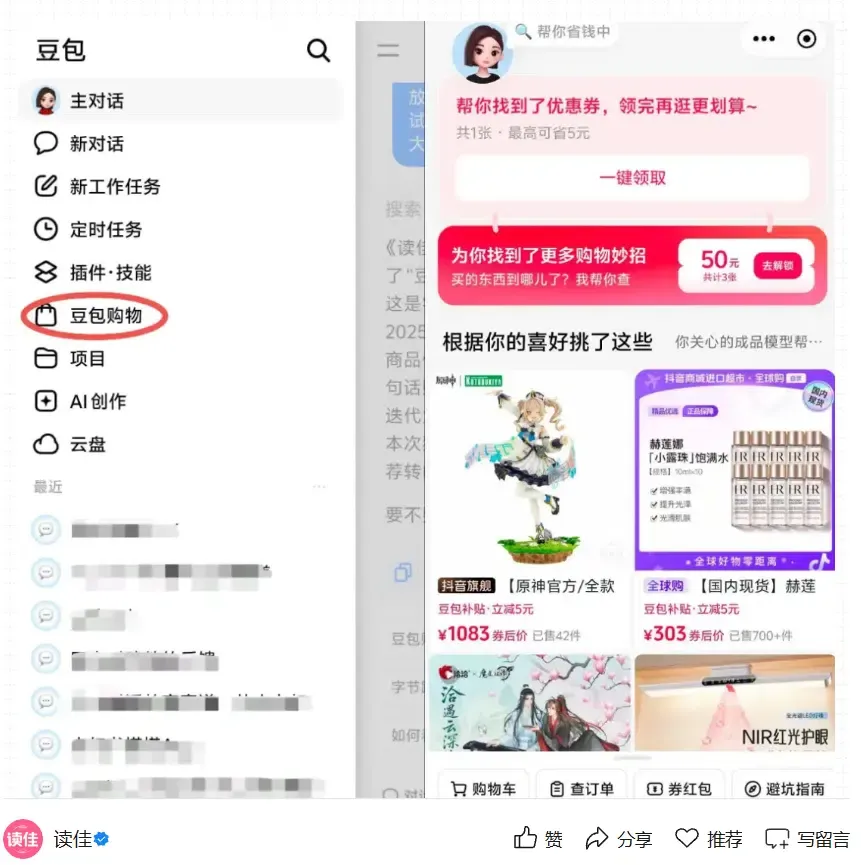
Media reporting highlights distinct aspects of the tested interface across independent observations. ITHome, citing Dujia, noted that the mini-program-like Douyin E-commerce page supports physical goods, local dining group-buying, and event ticketing across checkout, refunds, and after-sales verification, with an authorization notice naming Douyin E-commerce. Blue Whale News reported that users can describe requirements in chat for price comparisons and item matching before jumping into the storefront. Jiemian News separately observed that the feed prompts users to link a Douyin account before displaying full pricing, stock, or order options, surfaces coupons, sales volume, reviews, and livestreams, allows long-pressing product cards for follow-up pros-and-cons analysis or similar-item search, and allows long-pressing livestream cards to flag pricing or quality concerns. Earlier in June 2026, ITHome cited 36Kr reporting from unnamed sources claiming Doubao planned to expand paid scenarios in the third quarter and direct subsidized traffic toward Douyin Mall in the fourth quarter ahead of 2027 monetization goals, though ByteDance has not confirmed an official commercialization timetable.
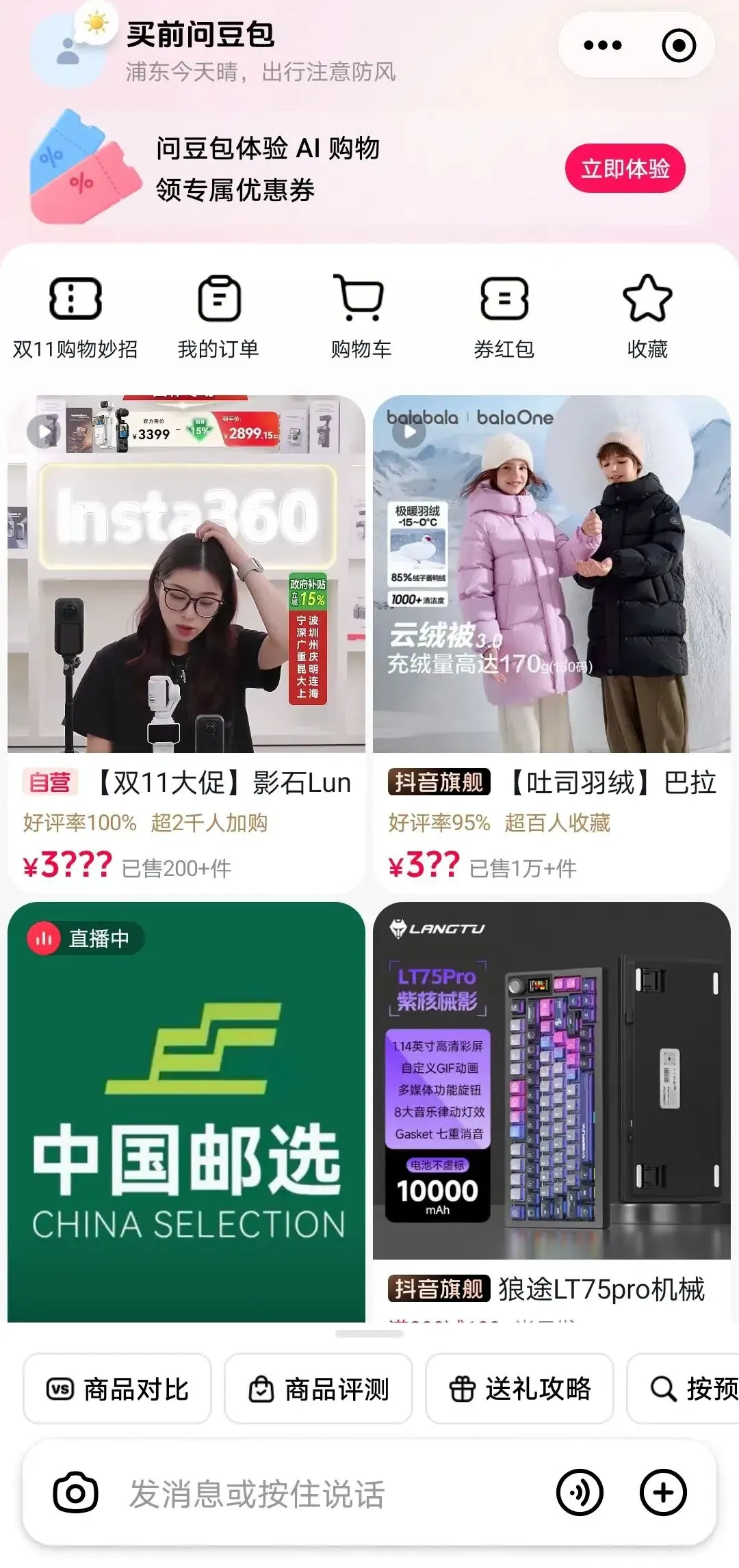
How Doubao Shopping Handles Account Linking and Checkout
ByteDance’s official Doubao Shopping and Wallet FAQ documents Doubao’s existing partner-commerce services and their operating boundaries. It does not independently confirm the detailed implementation or rollout scope of the newly reported sidebar module. Within those documented boundaries, the FAQ separates responsibilities across partner providers, account linking, ranking rules, and external links:
- Partner Commerce Providers: Douyin E-commerce supplies product browsing and purchasing services, Douyin Life Services supplies local group-buying transactions, and Douyin Pay along with third-party payment institutions handle payment services.
- Account Linking and In-Client Orders: Users must sign into a Doubao account and link a Douyin account to use partner-commerce features. Once linked, eligible users can browse, place orders, pay, and view orders or wallet settings synced with Douyin inside the Doubao client without switching to another app or platform.
- Search Ranking and Joint Campaigns: The FAQ states that linked Douyin account information, device information, and other authorized data may be used to optimize product search results and ranking. Users can disable personalized product and service recommendations in Doubao’s privacy settings, after which the platform will provide general search-based displays instead. Separately, the FAQ allows for optional joint marketing campaigns with partner platforms, which should be distinguished from paid bidding or sponsored ranking of individual product cards.
- Third-Party Shopping Links: When users ask Doubao for shopping links from external third-party platforms, the model responds based on search results and users must jump to those external platforms to finish purchasing, with the destination page governed by the third-party site.
- Main Conversation Scope: Doubao’s current shopping FAQ also states that commerce capabilities are primarily available in the main conversation experience and are not yet supported in other agent chats.
Official documentation notes that partner-commerce availability and behavior inside Doubao may differ from Douyin depending on pilot rollout scope, device, city, client version, operating system, and SDK version.
How Xiaodou’s Public Beta Connects to Doubao’s Agentic Strategy
On November 24, 2026, ByteDance separately opened an invitation-only public beta for Xiaodou, a standalone AI personal assistant app granting testers complimentary quota upon invite-code activation. According to the announcement and Xiaodou’s App Store listing, the app covers six task categories: general lookup, reminders, local lifestyle queries, shopping after-sales tracking, health reminders, and office drafting.

Daily Economic News reported on November 24, 2026 that Xiaodou can connect to authorized apps such as Douyin, Feishu, calendars, and health services to monitor tasks in the background, including price drops and expiring vouchers. Xiaodou’s public materials describe proactive task execution and authorized app connections, but do not establish a native shopping checkout workflow. Separately, Doubao’s existing shopping FAQ limits its documented commerce capabilities primarily to the main conversation experience; this limitation should not be treated as a definitive statement about Xiaodou’s standalone app capabilities.
Closed Commerce Ecosystems vs. Open Agentic Commerce Protocols
Across AI shopping deployments, platform ownership dictates whether discovery stays inside a captive mini-program or connects across open merchant interfaces. In China, Alibaba announced on May 11, 2026 that it connected its Qwen App with Taobao’s full product catalog, bringing conversational discovery, comparison, ordering, and delivery tracking across both the Qwen App and Taobao App ecosystems. On July 15, 2026, Tencent and JD.com connected JD’s AI agent to Tencent’s Yuanbao app via WeChat mini-program integration, routing Yuanbao users directly from product cards into JD’s shopping mini-program.
Internationally, OpenAI and Stripe introduced the open-source Agentic Commerce Protocol (ACP) in September 2025 to power Instant Checkout inside ChatGPT. By March 2026, Search Engine Land reported that OpenAI had shifted its Instant Checkout strategy toward connected Apps, while continuing to prioritize product discovery inside ChatGPT and develop ACP as an open commerce integration standard for connected applications and merchants through ACP developer documentation.
Google introduced the Universal Commerce Protocol (UCP) on January 11, 2026, co-developed with industry leaders including Shopify, Etsy, Wayfair, Target, and Walmart, with endorsement from more than 20 additional ecosystem participants, including Adyen, American Express, Mastercard, Stripe, and Visa. As outlined in Google’s UCP Developer Blog overview and UCP Developer Guide, UCP defines a common framework for agent-to-business commerce interactions, including product discovery, checkout, and optional identity-linking capabilities. Google’s implementation currently distinguishes native checkout on its AI surfaces from cart transfers to merchant websites, and not every capability defined in the evolving specification is available across all Google surfaces. Although UCP defines identity-linking capabilities, Google’s current Merchant Center UCP integration guide still lists this feature as coming soon. Native checkout and cart transfer are separate implementation paths, and their availability depends on the merchant’s approved integration.
Separately, Google launched its Universal Cart across U.S. Search and the Gemini app on October 15, 2026, and expanded UCP-powered direct checkout to eligible Canadian retailers in Search AI Mode and Gemini on November 4, 2026, with participating merchants remaining the seller of record. Notably, neither ACP nor UCP is a deep-linking SDK or app-install parameter-passing solution; merchant identity, payment processing, and order fulfillment remain governed by their respective commerce integration layers.
Three Architectural Models for AI Commerce
| Functional Layer | Closed Platform Commerce (Doubao / Douyin) | Partner Mini-Program Handoff (Yuanbao / JD) | Open Protocol Integration (UCP / ACP) |
|---|---|---|---|
| Discovery Surface | AI assistant and integrated shopping entry | AI conversation and structured product cards | AI chat, search, or agentic shopping interface |
| Commerce Integration | Partner-provided commerce services inside the host app | Partner mini-program launched from the host ecosystem | Standardized APIs and agent-to-merchant integrations |
| Identity & Authorization | Douyin account linking and partner-platform authorization | Partner account and mini-program session | Merchant account linking or delegated authorization, depending on the protocol and integration |
| Checkout Execution | Completed within the Doubao client through supported partner services | Completed in the JD shopping mini-program | Native or embedded checkout on supported AI surfaces, cart handoff to a merchant website, or connected app/merchant checkout handoff, depending on the protocol and implementation |
| Fulfillment & Settlement | Douyin E-commerce, Douyin Life Services, and supported payment providers | JD commerce and fulfillment infrastructure | Merchant-controlled commerce systems and participating payment providers |
| External App Dependency | Not required for supported partner-platform purchases | Depends on the partner mini-program environment | Varies by protocol implementation and platform checkout strategy |
| Merchant Relationship | Governed by the participating platform agreements | Governed by the partner ecosystem | Merchant retains its defined commercial and customer responsibilities |
Note: This table compares functional responsibilities and integration patterns, not verified internal platform architectures. ACP and UCP are distinct protocols, and their checkout implementations should not be treated as interchangeable.
Engineering Implications for Merchants and Mobile App Teams
The central question in AI commerce is not only where shoppers discover products, but which platform controls discovery, account authorization, transaction fulfillment, and any downstream mobile app installation. Within Doubao’s partner-commerce flow, Douyin E-commerce provides the underlying partner-commerce services, while Doubao exposes the supported shopping experience within its own client. The public FAQ documents account linking, order access, and payment-related responsibilities, but does not disclose the underlying session-management architecture. For merchants selling through Douyin Mall or Douyin Life Services, the merchant’s own standalone app is not part of the documented partner-commerce checkout path. This makes product information quality, partner-platform search relevance, and the accuracy of merchant-provided catalog data important operational considerations, although Doubao has not disclosed a complete product-ranking formula.
Separating Discovery from Web-to-App Installation
Doubao’s external third-party links route shoppers out to corresponding third-party shopping platforms, whose landing pages and checkout flows determine the user experience. A separate scenario arises when an independent merchant operates its own mobile web landing page and uses an AI discovery channel to attract shoppers. If that merchant subsequently directs users from its H5 page to install or open a standalone app, preserving merchant-configured campaign or referral parameters becomes a separate engineering requirement.
This is where a Web-to-App parameter-passing framework such as OpoInstall may be relevant. According to OpoInstall’s public integration documentation, this workflow uses a Web SDK on the merchant’s H5 page and native Android or iOS SDKs to retrieve merchant-configured custom parameters after installation and first launch. Its documented scope covers the app-installation and launch boundary rather than upstream AI discovery or commerce protocols. This workflow is not established by Doubao’s published FAQ and should not be interpreted as an existing Doubao integration, nor is OpoInstall an AI-agent traffic detector, mini-program SDK, payment processor, or replacement for ACP, UCP, or platform account linking.
Integration Checklist for Commerce and Growth Teams
- Verify Partner-Commerce Boundaries: Confirm which services are supplied by the host platform and which are provided by external commerce partners, including account authorization, payment processing, order management, refunds, and after-sales support.
- Verify Agent Capability Boundaries: Confirm whether shopping, account linking, and checkout are supported in the main assistant, connected agents, or standalone personal assistant products. Do not assume that capabilities available in the host application automatically extend to every connected agent.
- Separate In-Host Orders From External Platform Links: Track orders completed inside partner commerce experiences separately from traffic directed to third-party platforms or independent merchant sites.
- Maintain Accurate Partner Catalog Data: Keep product titles, specifications, prices, and inventory accurate, since the documented shopping flow extracts shopping intent and queries partner-platform search results.
- Validate Independent H5-to-App Paths Separately: Where an independent merchant directs AI-referred mobile web visitors to install or launch a standalone mobile app, test Universal Links, App Links, and deferred parameter passing across mobile browsers independently.
Frequently Asked Questions (FAQ)
Is Doubao Shopping officially available to all Doubao users?
Does Doubao Shopping redirect users to external e-commerce apps?
How is Xiaodou different from Doubao Shopping?
Key Takeaways for Engineering Teams
AI commerce entries do not automatically equate to unified AI checkout systems or open mobile app distribution pipelines. As Doubao tests a dedicated shopping sidebar alongside partner fulfillment from Douyin E-commerce—while peers integrate Taobao, JD mini-programs, ACP, or UCP—engineering and growth teams must map which entity governs discovery, identity, settlement, and any external app installation. Separating closed partner-platform flows from independent merchant Web-to-App journeys keeps technical architecture and measurement aligned with documented platform boundaries.
References
Doubao Shopping, History & Xiaodou Coverage
-
ITHome — Report on Doubao Gray-Testing Doubao Shopping With a Primary Feature Entry
-
ITHome — Doubao Launches Invite-Only Public Beta for AI Personal Assistant Xiaodou
-
ITHome — Report on Doubao Plans for Paid Content and Douyin E-Commerce Traffic Integration
-
ITHome — Doubao Launches “Help You Choose” Feature With Closed-Loop Douyin E-Commerce Transactions
-
Sina Tech — Doubao App Hands-On: Supports “One-Sentence Shopping” and Direct In-App Payment
-
Doubao Official Website — Xiaodou AI Personal Assistant Product Page
Industry Comparisons & Partner Integrations
-
Alibaba Group Official Announcement — Alibaba Opens All of Taobao to Qwen AI
-
ITHome — JD AI Agent Connects With Tencent Yuanbao Mini-Program Ecosystem
OpenAI Agentic Commerce Protocol (ACP)
-
OpenAI Official Announcement — Buy It in ChatGPT: Instant Checkout and the Agentic Commerce Protocol
-
Search Engine Land — OpenAI’s Big ChatGPT Instant Checkout Plan Just Changed
Google Universal Commerce Protocol (UCP) & Universal Cart
-
Google Official Blog — New Tech and Tools for Retailers to Succeed in an Agentic Shopping Era
-
Google Developers Blog — Under the Hood: Universal Commerce Protocol (UCP)
-
Google for Developers — Google Universal Commerce Protocol (UCP) Guide
-
Google for Developers — How to Start UCP Integration in Merchant Center
Technical Documentation
Share this article