Mozilla and Shopify Press EU on Apple iOS Browsers? On November 23, 2026, Mozilla, Shopify, Vivaldi, and 39 other initial signatories—coordinated by Open Web Advocacy—published an open letter urging the European Commission to open formal Digital Markets Act (DMA) enforcement proceedings against Apple over its rules for competing iOS browser engines. According to the coalition and a companion Mozilla policy post on November 20, 2026, no browser vendor has migrated its existing European Union user base off Apple’s WebKit engine more than two and a half years after the March 7, 2024 DMA compliance deadline; for now, EU iPhone users see no immediate software changes, and the Commission has not yet announced new formal proceedings specifically targeting browser-engine migration.
What the Coalition Is Demanding and Why It Matters Now
At a Glance
- Open Web Advocacy, Mozilla, Shopify, Vercel, Y Combinator, and publishing and digital-rights groups are collecting signatures through December 3, 2026, calling on European Commission President Ursula von der Leyen to enforce existing DMA rules rather than draft new legislation.
- According to Open Web Advocacy, the 42 initial signatories represent an estimated 45,000 to 55,000 EU-established businesses and organizations—a campaign estimate rather than an independently audited figure.
- Mozilla reports that daily Firefox usage on iOS has doubled following earlier EU browser-choice changes, yet all existing Firefox iOS users remain on Apple’s WebKit engine rather than Gecko.
For years, every browser on iOS and iPadOS—including Chrome, Firefox, Edge, and Vivaldi—was required to render web pages using Apple’s WebKit engine, the same rendering stack that powers Safari. Under the DMA, Apple introduced a framework beginning with iOS 17.4 in early 2024 allowing eligible developers to request an entitlement to run competing browser engines in the EU, alongside an EU browser-choice screen shown to Safari users.
In the open letter, the coalition argues that technical and distribution conditions attached to that entitlement have prevented existing-user migration from materializing. The group counts 991 days since Apple’s March 7, 2024 DMA deadline without a single major browser migrating its existing EU user base off WebKit. Signatories include Vivaldi, Kagi, Vercel, Y Combinator, the European DIGITAL SME Alliance, the European Publishers Council, News Media Europe, and European Digital Rights.
From a commercial perspective, Shopify, publishers, and web-platform supporters argue that limited engine adoption holds back web applications from competing directly with native App Store software. In its supporting notes, the campaign estimates that EU businesses could save €11 billion annually in development costs and €1.3 billion in App Store fees, though that projection is a campaign estimate conditional on half of native iOS app development shifting to the web.
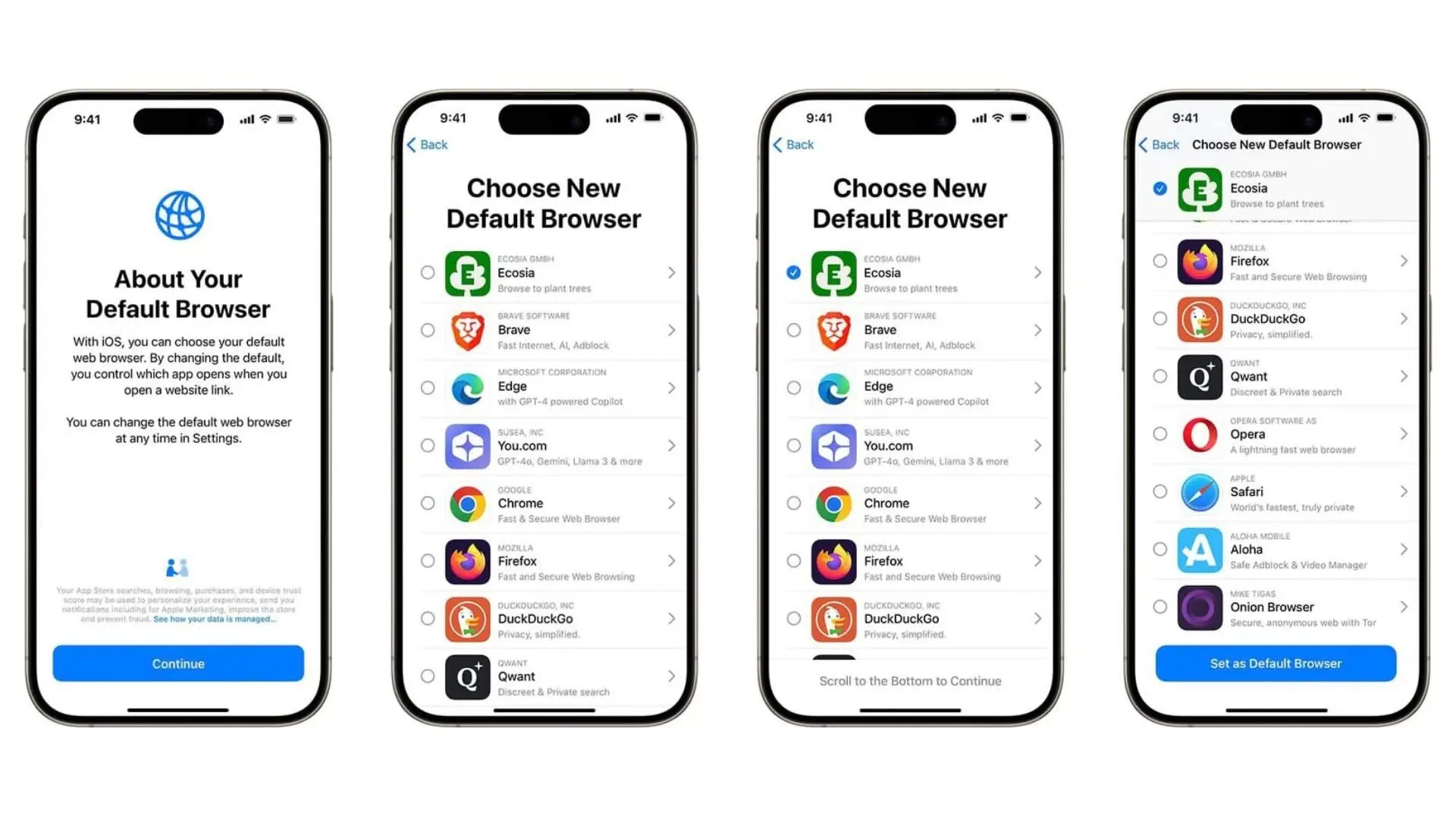
Noticeably, the European Commission previously closed its investigation into Apple’s user-choice screen obligations in April 2025 after Apple updated how users select default browsers and remove Safari. That closure did not resolve underlying alternative-engine migration disputes, and the coalition argues that a default-browser choice screen cannot deliver genuine competition if every browser option on the screen still relies on WebKit underneath.
Apple’s Published Rules vs. Mozilla’s Migration Objection
Evaluating this dispute accurately requires separating Apple’s written developer terms from the operational friction that browser vendors say those rules create in practice. As illustrated in Mozilla’s browser-engine overview, major rendering families such as Gecko, WebKit, and Blink evolved independently across desktop and mobile platforms, yet Apple’s published documentation does not contain an explicit clause ordering developers to build a brand-new App Store listing. Instead, browser vendors contend that the combination of EU-only distribution rules and data-isolation requirements produces that barrier for global apps.
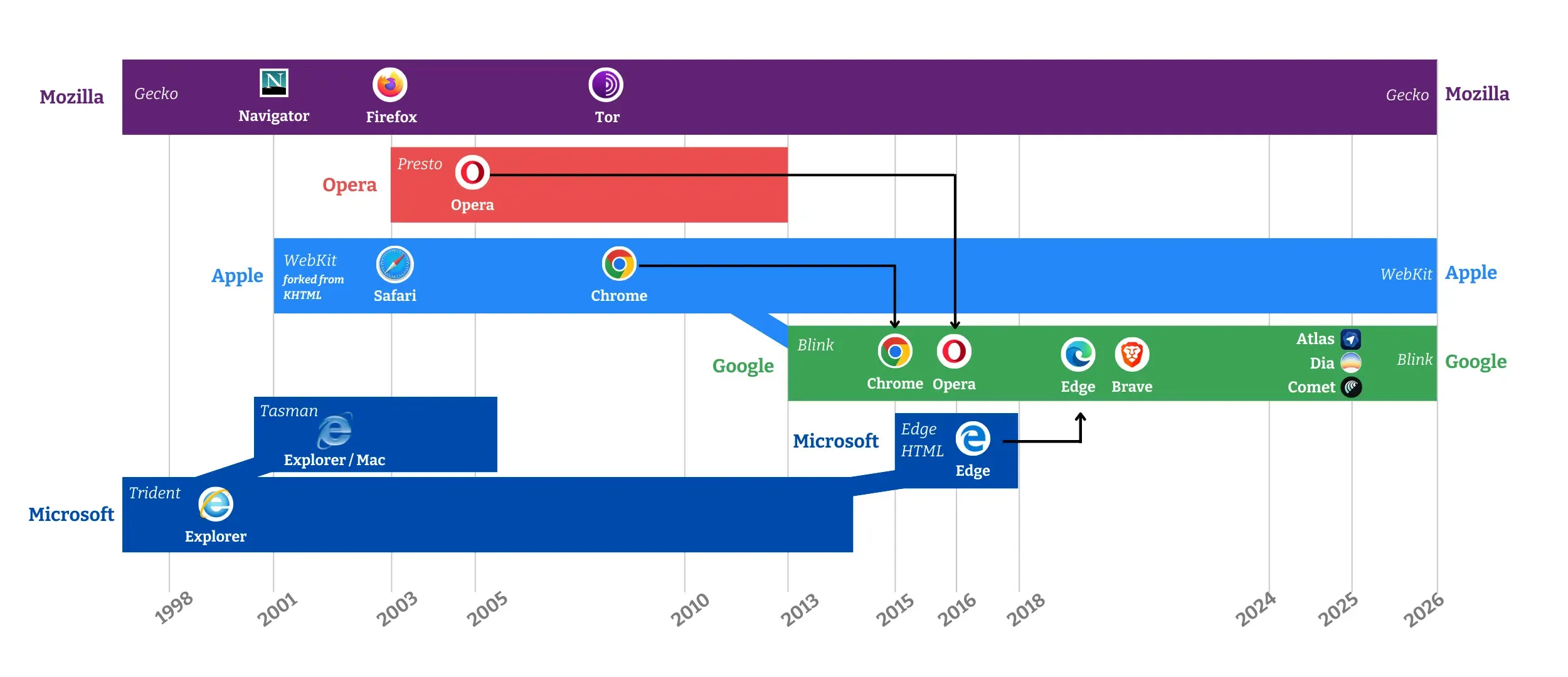
According to Apple’s official alternative browser engine documentation and its broader DMA compliance overview, alternative browser-engine entitlements are available to eligible browser developers distributing in the European Union on iOS 17.4 or later and iPadOS 18 or later, subject to Apple’s approval and ongoing requirements:
- EU-only distribution: Apps using the
WebBrowserEngineEntitlementmay be distributed only within the European Union on iOS 17.4 or later and iPadOS 18 or later. - Cross-app data restrictions: An alternative-engine app cannot sync or share data with another app—even from the same developer—without explicit user permission.
- Standards and patching thresholds: Apple requires competing engines to pass at least 90% compliance with Web Platform Tests (WPT) and at least 80% compliance with Test262, and requires those test thresholds to remain satisfied when JIT compilation is unavailable. Developers must also maintain strict process and memory isolation and remediate actively exploited security flaws on tight timelines (for example, within 30 days for the simplest vulnerability classes).
Apple frames these conditions as security and privacy safeguards, noting that browser engines process sensitive user data and execute untrusted web code. In its November 20 policy brief, however, Mozilla explains why those terms prevent an in-place upgrade for existing global browsers: because Firefox ships a single worldwide iOS app outside the EU, adding an EU-only alternative-engine entitlement would, in Mozilla’s assessment, force the vendor to publish a separate, EU-only Firefox application rather than updating its existing App Store binary in place.
According to Mozilla, existing EU Firefox users would have to discover and install that second, empty app and manually transfer bookmarks, passwords, and browsing history—friction Mozilla expects would cause most users to abandon the switch. The coalition’s supporting notes also highlight constraints on testing alternative engines outside the EU and restrictions around Home Screen web apps, where Apple continues to limit EU Home Screen web apps to WebKit rather than allowing third-party engines to install and manage them directly.
| Aspect | Apple Published Policy (developer.apple.com) |
Coalition & Mozilla Claim (open-web-advocacy.org / blog.mozilla.org) |
|---|---|---|
| Regional Distribution | Alternative-engine entitlements apply to eligible developers distributing only in the EU on iOS 17.4+ and iPadOS 18+ | Restricting builds to the EU prevents global App Store browsers from upgrading existing EU users in place |
| User Data & Migration | Apps using the entitlement cannot sync data with another app without user permission | According to Mozilla, shipping a separate EU-only app creates an empty installation requiring manual transfer of bookmarks, passwords, and history |
| Security & Standards | Requires 90% WPT compliance, 80% Test262 compliance (including without JIT), process isolation, and timely patching (e.g., 30 days for simplest exploited classes) | Conditions impose heavy compliance friction, limit testing outside the EU, and have seen zero existing-user migrations after 991 days |
| Home Screen Web Apps | Home Screen web apps in the EU remain anchored to WebKit | Third-party engines should be able to install and manage web apps without being forced onto WebKit |
Browser Engines, Embedded Views, and Web-to-App Routing Boundaries
When assessing how browser-engine rules affect mobile app distribution and developer workflows, engineering teams should separate four distinct technical layers rather than assuming that changing a standalone browser’s rendering engine alters every web-to-app interaction uniformly.
First, standalone browser engines (WebBrowserEngineEntitlement) govern how independent browser apps like Firefox or Chrome draw pages, run JavaScript, and expose modern web APIs. Second, embedded in-app browsing inside non-browser apps (such as social, commerce, or messaging clients) runs either on system WKWebView / SFSafariViewController components or under Apple’s separate Embedded Browser Engine Entitlement, meaning standalone browser changes do not automatically unify in-app webviews. Third, browser storage and Home Screen web apps govern cookie partitioning, local storage isolation, and whether a site can run cleanly as an installed web app without App Store distribution. Fourth, OS-level native link routing (Universal Links) is resolved by iOS using Associated Domains (apple-app-site-association) at the operating system layer, rather than being dictated solely by which HTML rendering engine drew the referring page.
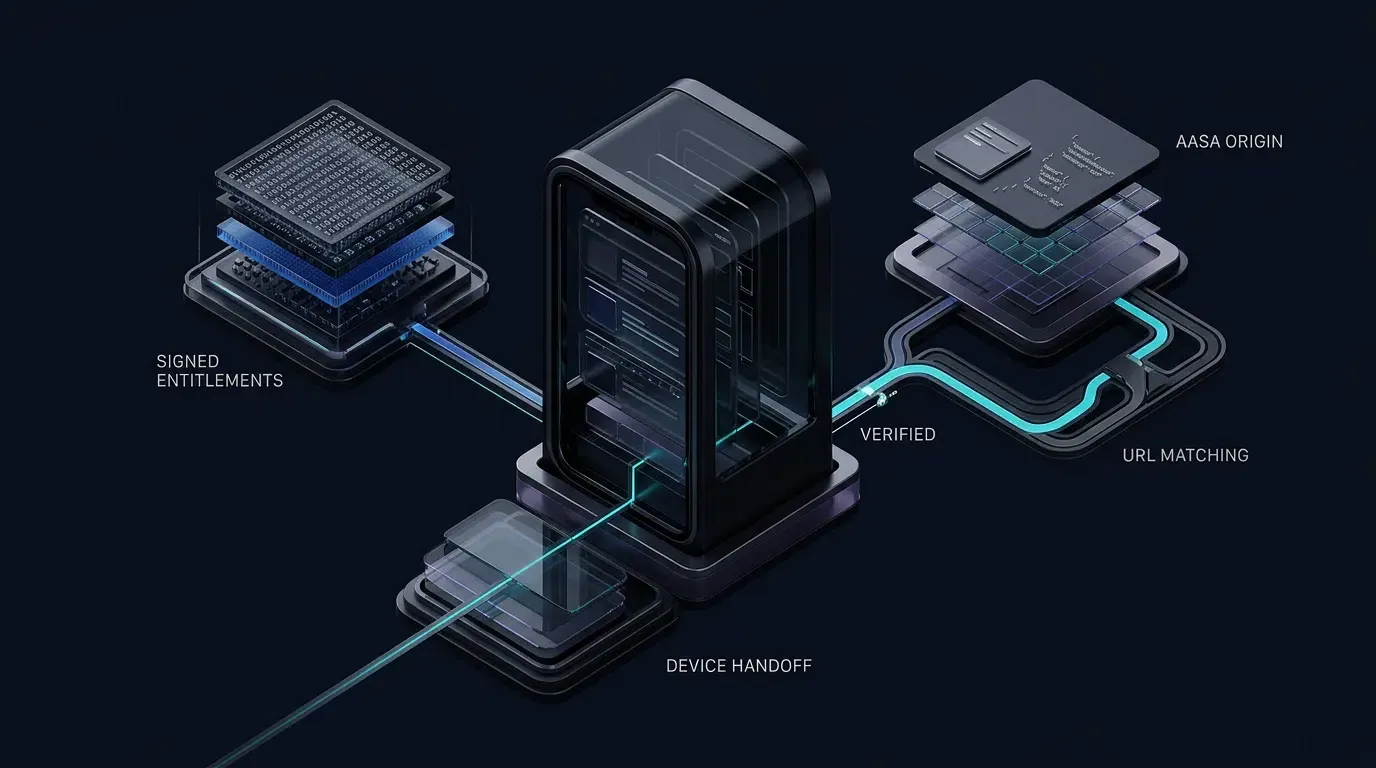
Within these adjacent Web-to-App journeys—where a merchant or publisher hosts a web landing page that directs mobile visitors to install an app—browser-engine policy layers and installation parameter pass-through layers serve strictly separate functions and must be verified independently. Developers utilizing an installation parameter pass-through framework such as OpoInstall operate strictly at the parameter handoff boundary: a merchant configures a parameterized link, an H5 page captures those parameters, and an in-app SDK retrieves them on eligible first launch so the application backend can reconcile business workflows. OpoInstall does not replace WebKit or third-party browser engines, bypass Apple’s WebBrowserEngineEntitlement or Embedded Browser Engine Entitlement controls, alter browser cookie partitioning or Home Screen web app behavior, or perform authentication and in-app purchase verification.
Conceptual Responsibility Model (Illustrative Responsibilities)
Note: The table below represents an illustrative engineering responsibility model rather than an official Apple or European Commission architectural topology.
| System Layer | Illustrative Responsibilities | Does Not Handle |
|---|---|---|
| iOS Browser Engine Layer | HTML/CSS/JS rendering, Web API availability, sandbox process isolation, WPT and Test262 compliance | OS-level Universal Links matching or third-party app install parameter retrieval |
| In-App Embedded View Layer | Rendering web links inside host apps via WKWebView, SFSafariViewController, or embedded engine entitlements |
Standalone browser app distribution or backend app entitlement checks |
| iOS OS Routing Layer | Evaluating Associated Domains (Universal Links) and app-launch intent handoff between web and native apps |
Rendering web-app UI or defining EU DMA competition policy |
| Installation Parameter SDK (e.g., OpoInstall) | Retrieving merchant-configured H5 parameters on eligible first app launch for application backend processing | Browser engine selection, entitlement compliance, cookie storage rules, or IAP validation |
What Happens Next for EU Regulators, Browser Vendors, and Developers
The coalition’s open letter closes for signatures on December 3, 2026, and is addressed directly to European Commission President Ursula von der Leyen alongside Executive Vice-Presidents Henna Virkkunen and Teresa Ribera. Because the signatories contend that existing DMA statutes already grant enforcement authority without requiring new legislation, the immediate focus shifts to whether Brussels opens formal non-compliance or specification proceedings targeting iOS browser-engine migration.
For EU iPhone users, nothing changes immediately: Firefox, Chrome, and other third-party browsers remain operational on Apple’s WebKit engine while the Commission evaluates the request. For web platform teams, e-commerce merchants, and mobile developers, tracking these proceedings separately from routine App Store distribution and Web-to-App routing tests ensures product roadmaps do not confuse prospective regulatory proposals with current production behavior on iOS.
Frequently Asked Questions (FAQ)
Can EU iPhone users already download Firefox with the Gecko engine?
Does Apple explicitly ban alternative browser engines or existing-app updates on iOS?
Has the European Commission already opened a formal investigation into this complaint?
Will switching iOS browser engines automatically change how Universal Links open native apps?
Practical Implications for Engineering and Web Teams
While the 42-organization coalition escalates pressure on Brussels ahead of the December 3 signature deadline, engineering teams should treat iOS browser-engine migration openness as an active policy dispute rather than a shipped platform reality, given that no major browser vendor has yet transitioned its existing EU users off WebKit. Because standalone browser engines, embedded in-app browsers, Home Screen web apps, and OS-level Universal Links operate on distinct technical boundaries, mobile and web teams should continue building against verified WebKit behavior on iOS today while monitoring formal European Commission actions for any future shifts in EU browser-engine entitlements.
References
-
Europe Rallies for a Free and Competitive Web on iOS (Open Web Advocacy)
-
Open Letter to the European Commission on iOS Browser Competition (Open Web Advocacy)
-
Supporting Notes on Apple’s iOS Browser Engine Rules (Open Web Advocacy)
-
Apple’s iOS Browser Engine Rules Leave EU Users Stuck on WebKit (Mozilla Blog)
-
Using alternative browser engines in the European Union (Apple Developer)
-
Digital Markets Act and Apps in the European Union (Apple Developer)
-
Commission closes investigation into Apple’s user choice obligations (European Commission DMA)
Share this article