What are the limitations of last touch attribution? The primary limitation of last-touch attribution is that it assigns no conversion credit to preceding (earlier) touchpoints that occurred before the final attributed interaction.
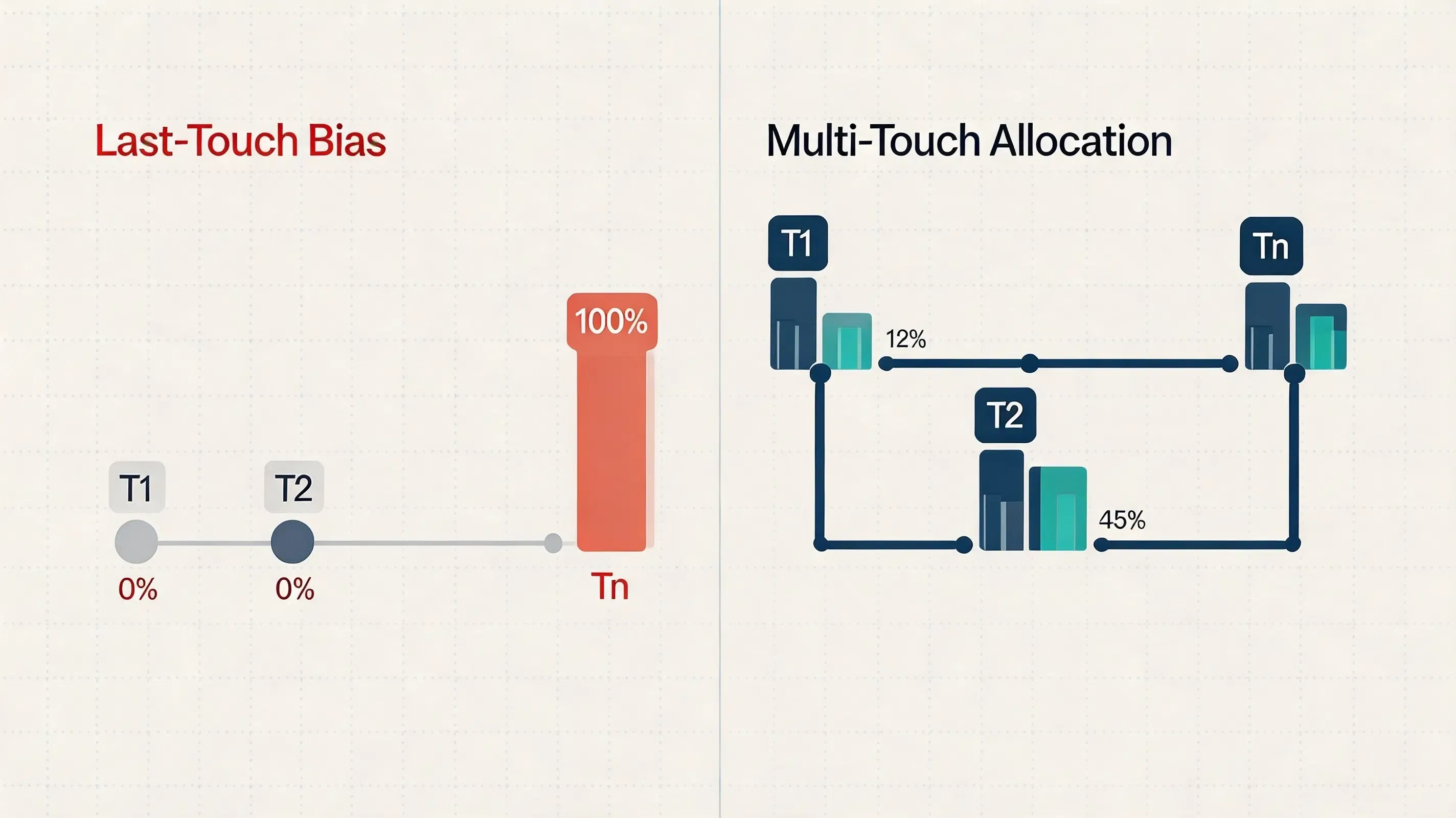
Last-touch attribution is a single-point measurement framework that allocates 100% of conversion credit to the final eligible touchpoint within the attribution window prior to a conversion event. While simple to implement, this single-point model does not assign conversion credit to earlier discovery and consideration touchpoints, distorting Customer Acquisition Cost (CAC) and over-crediting retargeting channels.
| Term | Definition | Related Concept | Search Intent Role |
|---|---|---|---|
| Last Touch Attribution | A methodology assigning total conversion credit to the final interaction. | Attribution Model | Informational / Commercial |
| Multi-Touch Attribution | A measurement approach that distributes conversion credit across interactions. | Fractional / Algorithmic Attribution | Commercial |
| Attribution Model | A mathematical framework defining how conversion value is allocated. | Fractional Credit Allocation | Informational |
| Conversion Tracking | The systematic logging of user actions from click to post-install events. | Server-to-Server Postback | Technical / Informational |
| Mobile Measurement Partner | A platform that collects and attributes mobile advertising interactions across channels. | Mobile Attribution | Technical / Commercial |
Short Answer
Last-touch attribution is limited because it credits only the final interaction while excluding earlier discovery and consideration touchpoints. This can inflate retargeting performance, underestimate upper-funnel contribution, and lead to inefficient mobile advertising budget allocation.
Why Last Touch Attribution Distorts Campaign Performance Evaluation
The Mechanics of Single-Touch Credit Allocation
Single-touch models, specifically last-touch attribution, evaluate marketing performance through a winner-take-all rule. When an application installation or post-install event is recorded, the attribution engine inspects available interaction logs within a specified lookback window. The channel or ad creative that logged the final temporal interaction (
Mathematically, if a conversion journey consists of
Where:
While this rule simplifies database logic and real-time event aggregation, it fails to capture the cumulative nature of consumer decision-making across multi-channel environments.
The Illusion of Bottom-Funnel Efficiency
Because this single-point model awards complete credit to the final touchpoint, channels operating at the bottom of the conversion funnel appear disproportionately efficient. Branded search campaigns, retargeting ads, and affiliate links naturally capture
When marketing teams evaluate performance solely through single-touch reporting, bottom-funnel channels display artificially low Customer Acquisition Cost (CAC) and inflated Return on Ad Spend (ROAS). This creates a false measurement feedback loop: performance managers reallocate media spend toward bottom-funnel channels, starving upper-funnel discovery campaigns of necessary funding.
Systemic Undervaluation of Top-of-Funnel Discovery Channels
Upper-funnel channels—such as programmatic display, social video, native content, and influencer promotions—primarily serve to generate initial brand discovery (
When upper-funnel budgets are reduced due to poor last-click performance, the total volume of new prospect discovery declines. Over subsequent campaign cycles, bottom-funnel retargeting efficiency degrades because fewer new users enter the conversion pipeline, demonstrating the structural vulnerability of single-point evaluation.
How Post-ATT Privacy Changes Intensified Single-Touch Challenges
Apple’s ATT framework and privacy-preserving measurement systems such as SKAdNetwork (SKAN) have reduced deterministic user-level attribution visibility across mobile ecosystems. Marketers relying on last-touch attribution face growing blind spots when evaluating multi-platform user journeys across restricted environments. An independent MMP can consolidate available attribution signals from integrated ad networks, privacy-preserving frameworks, and first-party event streams to improve measurement consistency across fragmented mobile environments.
Last Touch Attribution vs Last Click Attribution
While frequently used interchangeably, last-touch attribution and last-click attribution differ in touchpoint scope:
-
Last-Click Attribution: Assigns 100% of conversion credit exclusively to the final click event logged before installation, ignoring all prior clicks and impression views.
-
Last-Touch Attribution: Evaluates the final eligible interaction across multiple formats, which may include eligible clicks, view-through impressions, or other configured signals depending on the attribution provider, attribution window, and measurement policy.
Understanding this distinction is critical when evaluating programmatic display campaigns, where view-through impressions often play a key role in brand discovery prior to a direct search click.
Primary Analytical Limitations of Last Touch Attribution
Limited Visibility Into Middle-Funnel Nurturing Touchpoints
Mobile acquisition journeys rarely consist of an immediate single-click app install. Users frequently encounter an initial discovery ad, consume video content, read a review on a mobile web page, and later respond to a targeted search or retargeting ad.
This measurement approach renders the entire middle-funnel sequence (
Why Attribution Credit Does Not Equal Incremental User Value
A primary limitation in performance measurement is conflating attribution credit with incremental user value. Standard last-touch attribution answers which ad logged the final touchpoint before an install, whereas incrementality measurement answers which campaign changed the user’s decision to convert.
When an ad channel captures credit for a user who would have installed the app organically, the attribution model records a successful conversion without generating true incremental lift. Distinguishing between assigned attribution credit and incremental lift is essential for evaluating true ad spend efficiency.
Organic Install Cannibalization
A significant operational risk of last-touch attribution is organic install cannibalization, particularly within retargeting and branded search campaigns. Users who have already decided to download an application naturally search for the app by name or encounter retargeting ads during routine browsing.
If a user clicks a retargeting ad seconds before completing an installation they intended to make organically, this final-touch measurement model awards 100% of the credit to the retargeting campaign. Paid media spend is expended to claim an acquisition event that would have occurred without paid intervention, artificially inflating paid conversion counts while depleting organic baseline metrics. These conversions represent attributed installs rather than true incremental installs.
Distorted Unit Economics
By failing to measure incremental channel lift, last-touch attribution misleads CAC and Lifetime Value (LTV) calculations across media networks. Calculated CAC for bottom-funnel channels appears artificially suppressed:
Because touchpoint
Increased Exposure to Attribution Fraud
The winner-take-all structure of this single-point model can create incentives for attribution fraud techniques such as click spamming and click injection. Fraudulent publishers generate large volumes of low-quality background click events on mobile devices, claiming credit for conversions that may not have resulted from the fraudulent interaction.
If a fraudulent click successfully registers as
How Single-Touch Credit Distorts Top-of-Funnel Discovery Channels
The Growth Funnel Distortion Caused by Last-Touch Optimization
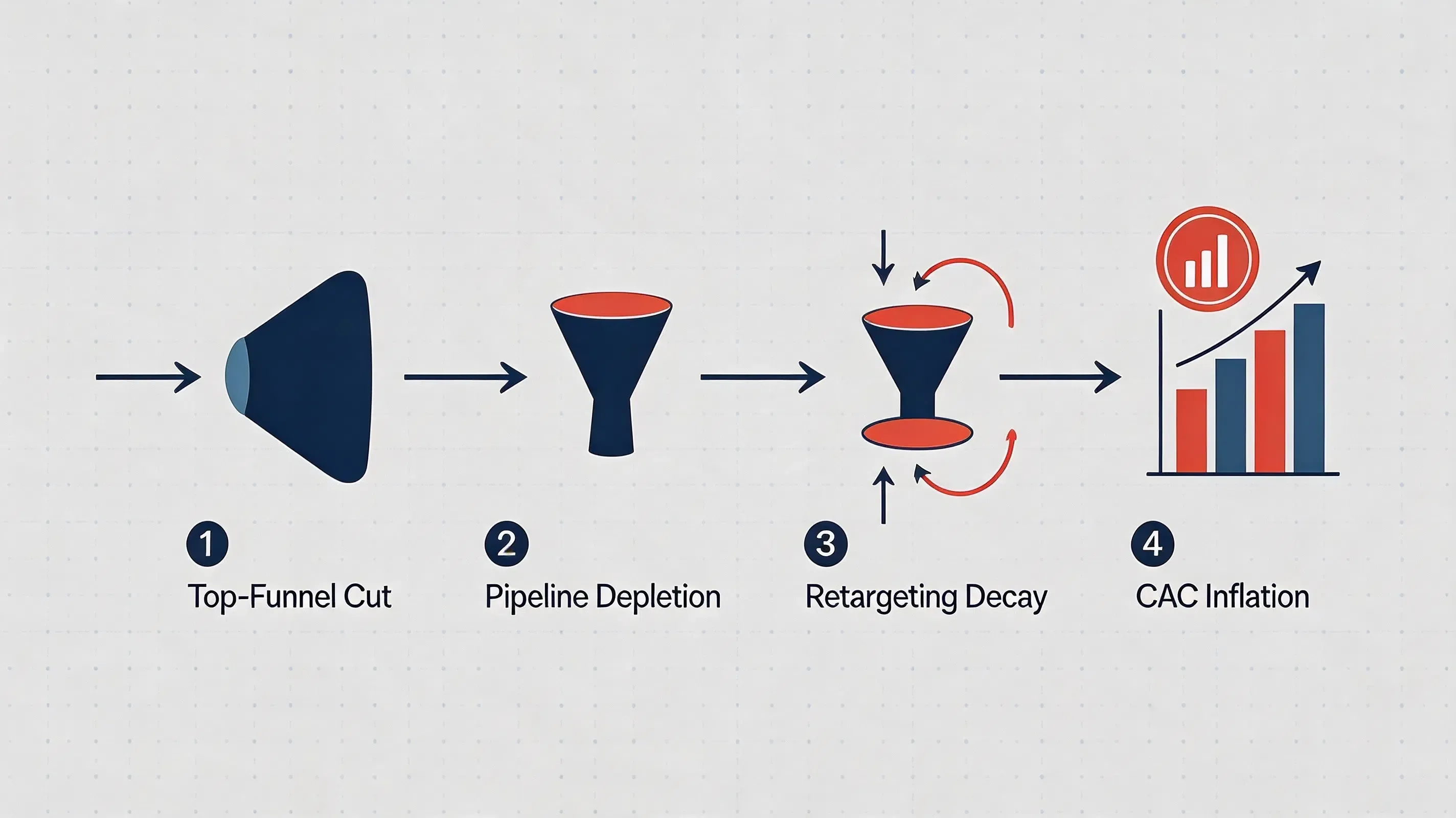
Relying exclusively on single-touch attribution triggers a predictable sequence of campaign optimization errors:
-
Initial Evaluation: Upper-funnel discovery campaigns display high CAC and low direct ROAS on single-touch reporting dashboards.
-
Budget Reallocation: Growth managers cut funding for programmatic display, social video, and influencer channels to reallocate spend to retargeting and search.
-
Pipeline Depletion: Top-of-funnel audience reach shrinks, reducing the overall pool of qualified prospects aware of the application.
-
Retargeting Decay: Bottom-funnel retargeting performance degrades as retargeting campaigns repeatedly bid on a diminishing audience pool.
-
Funnel Distortion: Overall application installation volume declines, and aggregate customer acquisition costs increase across all channels.
Misaligning Programmatic Bidding Algorithms
Modern demand-side platforms (DSPs) and ad networks rely on automated bidding algorithms (such as target CPA or target ROAS) to optimize impression purchasing. These algorithms ingest postback conversion signals to train internal predictive models.
When last-touch postbacks are fed into DSP bidding engines, the algorithms optimize toward user segments and inventory sources historically associated with attributed conversions, rather than finding new user segments.
Evaluating Incremental Contribution vs Last-Click Credit Assignment
To overcome the limitations of last-touch credit, growth teams evaluate incremental contribution—measuring whether an ad interaction generated a conversion that would not have occurred organically or through other channels.
Evaluating incrementality requires comparing conversion rates between a treatment group exposed to ad touchpoints and a holdout control group. Combining multi-touch analysis with incrementality testing provides a more complete view of both contribution and causal impact, allowing growth managers to evaluate true marginal lift rather than relying solely on temporal proximity.
          │                            │                           │                     │
          ▼                            ▼                           ▼                     ▼
   Initial Discovery             Brand Nurturing            Final Interaction    Attribution Reporting
   (0% Credit Assigned)          (0% Credit Assigned)       (100% Credit Assigned) (Potential Measurement Bias)
Comparative Analysis of Last Touch Attribution vs Multi-Touch Paths
Methodological Distinctions Between Single-Touch and Fractional Credit Models
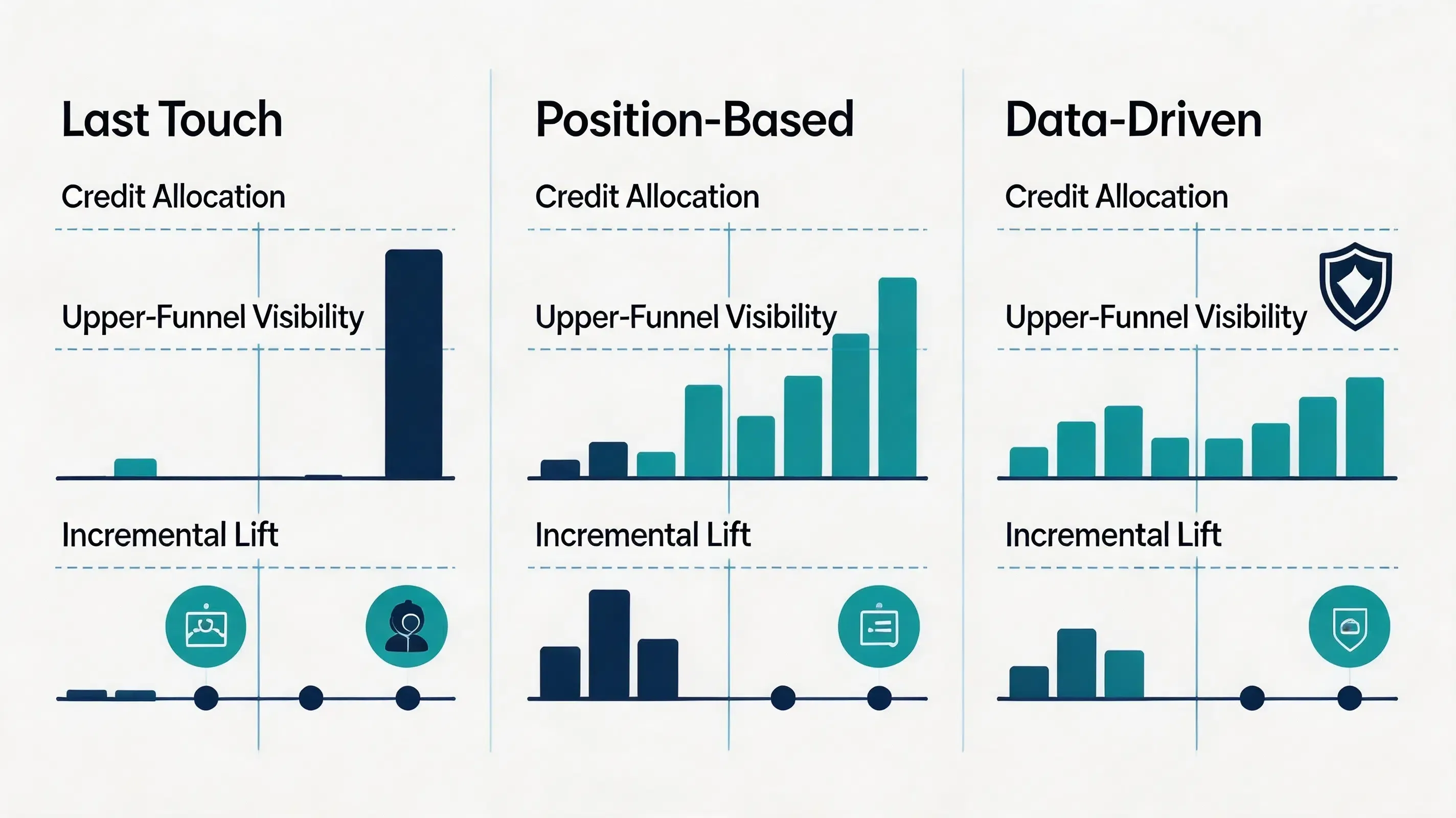
Transitioning from single-touch to fractional credit models alters how media efficiency is evaluated across the marketing funnel. Single-touch models prioritize operational simplicity, whereas multi-touch models provide visibility into multi-channel interactions.
The table below contrasts last-touch attribution with position-based and algorithmic multi-touch models:
| Measurement Dimension | Last Touch Attribution | Position-Based Multi-Touch | Data-Driven Algorithmic |
|---|---|---|---|
| Credit Allocation | 100% to |
Distributed (e.g., 40% |
Statistically modeled using conversion-path algorithms |
| Upper-Funnel Visibility | No direct conversion credit | Captures initial brand discovery ( |
Models channel contribution using statistical attribution algorithms |
| Retargeting Evaluation | Systematically over-credited | Evaluated alongside prior discovery | Credit scaled based on marginal lift |
| Implementation Complexity | Low | Moderate | High (Requires large conversion volume) |
| Ad Spend Protection | Vulnerable to click spamming | Distributes credit, mitigating single click theft | Filters out non-incremental claims |
Comparing Performance Evaluation Outcomes Across User Acquisition Funnels
When evaluated under a position-based model, channels previously dismissed as unprofitable under single-touch reporting rules (such as top-of-funnel social video) often demonstrate strong assistance value. Conversely, retargeting channels frequently see reported ROAS adjust downward to reflect their role as closing mechanisms rather than demand generators.
Teams implementing multi-touch measurement pipelines typically use attribution SDKs, raw event exports, and server-side data integrations. Engineers can consult the OpoInstall attribution SDK integration resources to implement client-side event logging and raw payload extraction.
How Self-Attributing Networks Interact With Attribution Windows
The Walled-Garden Self-Claim Problem
Self-Attributing Networks (SANs) typically perform attribution evaluation inside their own ecosystems and may provide advertisers with limited visibility into the underlying matching logic or competing network interactions. When an app install occurs, a SAN checks its internal user engagement database for matching clicks or impressions within its configured lookback window (e.g., 7-day click, 1-day view).
If a match is found, the SAN reports the conversion to the advertiser. Because each SAN evaluates conversions independently using network-specific attribution rules within its own ecosystem, reported conversions may differ across network dashboards because each platform applies its own attribution logic, reporting windows, and eligibility rules.
Overlapping Attribution Windows and Double-Counting
Attribution discrepancies may occur when advertisers compare isolated network dashboards without centralized deduplication logic.
A Mobile Measurement Partner (MMP) helps centralize attribution logic, normalize available touchpoints, and reduce duplicated conversion claims across participating channels. By applying configured attribution rules across timestamped signals, the MMP helps reconcile overlapping attribution claims.
Technical details regarding raw event log schemas and server-to-server (S2S) postback pipelines are accessible via the raw data export documentation.
The JSON schema below illustrates a simulated S2S attribution payload (example payload for conceptual illustration only) contrasting a last-touch winner-take-all assignment with fractional touchpoint data:
{
“event_type”: “app_install_attribution_audit”,
“app_id”: “com.example.app”,
“audit_metadata”: {
“conversion_id”: “conv_audit_5544332211”,
“install_timestamp_utc”: “2026-08-07T01:15:00Z”,
“evaluation_mode”: “last_touch_vs_multi_touch_comparison”
},
“single_touch_last_touch_result”: {
“winning_channel”: “retargeting_network_c”,
“winning_touchpoint_index”: 3,
“allocated_credit_percentage”: 100.0,
“analytical_bias_flag”: “retargeting_over_credited”
},
“position_based_attribution_result”: {
“touchpoint_sequence”:
},
“verification”: {
“payload_validation”: “example_only”
}
}
When Is Last Touch Attribution Appropriate for Mobile Applications
Suitable Conditions for Utilizing Last Touch Attribution
Despite its analytical limitations, last-touch attribution remains functional under specific operational conditions:
-
Single-Channel Acquisition Strategies: Marketing operations running campaigns exclusively on a single advertising network without overlapping channels.
-
Impulse-Driven Utility Applications: Simple utility applications with short consideration cycles where users convert immediately upon clicking a single ad.
-
Early-Stage Applications: Early-stage apps with low conversion volumes that lack sufficient data density to populate multi-touch algorithmic models.
Unsuitable Conditions for Utilizing Last Touch Attribution
Conversely, relying on single-point models introduces severe measurement risk in the following environments:
-
Multi-Channel Media Mixes: Campaigns operating across programmatic display, social video, paid search, retargeting, and influencer networks.
-
High-Consideration Products: Applications in fintech, B2B SaaS, e-commerce, or mid-core gaming where consideration funnels span multiple days or weeks.
-
High-Budget Performance Campaigns: Operations scaling significant media spend where misallocating a significant portion of media budgets to non-incremental channels results in substantial financial loss.
Common Misconceptions in Last-Touch Performance Tracking
-
High Last-Click ROAS Indicates Campaign Efficiency: A high last-click ROAS in retargeting or search often reflects existing user purchase intent rather than incremental demand created by the ad.
-
Ad Network Dashboards Adjust for Preceding Touchpoints: Walled-garden ad dashboards report conversions based strictly on internal engagement logs and do not adjust for prior or concurrent touchpoints logged on external ad networks.
Frequently Asked Questions (FAQ)
What is the primary limitation of last touch attribution in app marketing?
Is last touch attribution accurate?
What is the difference between last-click attribution and last-touch attribution?
How do attribution windows affect last-touch attribution?
Why does last touch attribution over-credit retargeting campaigns?
Does last touch attribution measure incremental conversions?
Does last touch attribution still have value for mobile campaigns?
Does last-touch attribution work with SKAdNetwork?
What attribution model should mobile apps use instead of last-touch attribution?
How can mobile marketers transition away from last touch attribution without breaking campaign tracking?
Key Takeaways
-
Single-Point Bias: Last-touch attribution allocates 100% of conversion value to the final interaction, without assigning credit to middle and upper-funnel discovery channels.
-
Organic Cannibalization: Single-touch models over-credit bottom-funnel retargeting ads that capture users who already possess high brand intent.
-
Multi-Touch Transition: Adopting fractional attribution models or incrementality testing enables growth teams to protect top-of-funnel budgets and optimize overall ROAS.
Recommended Measurement Framework
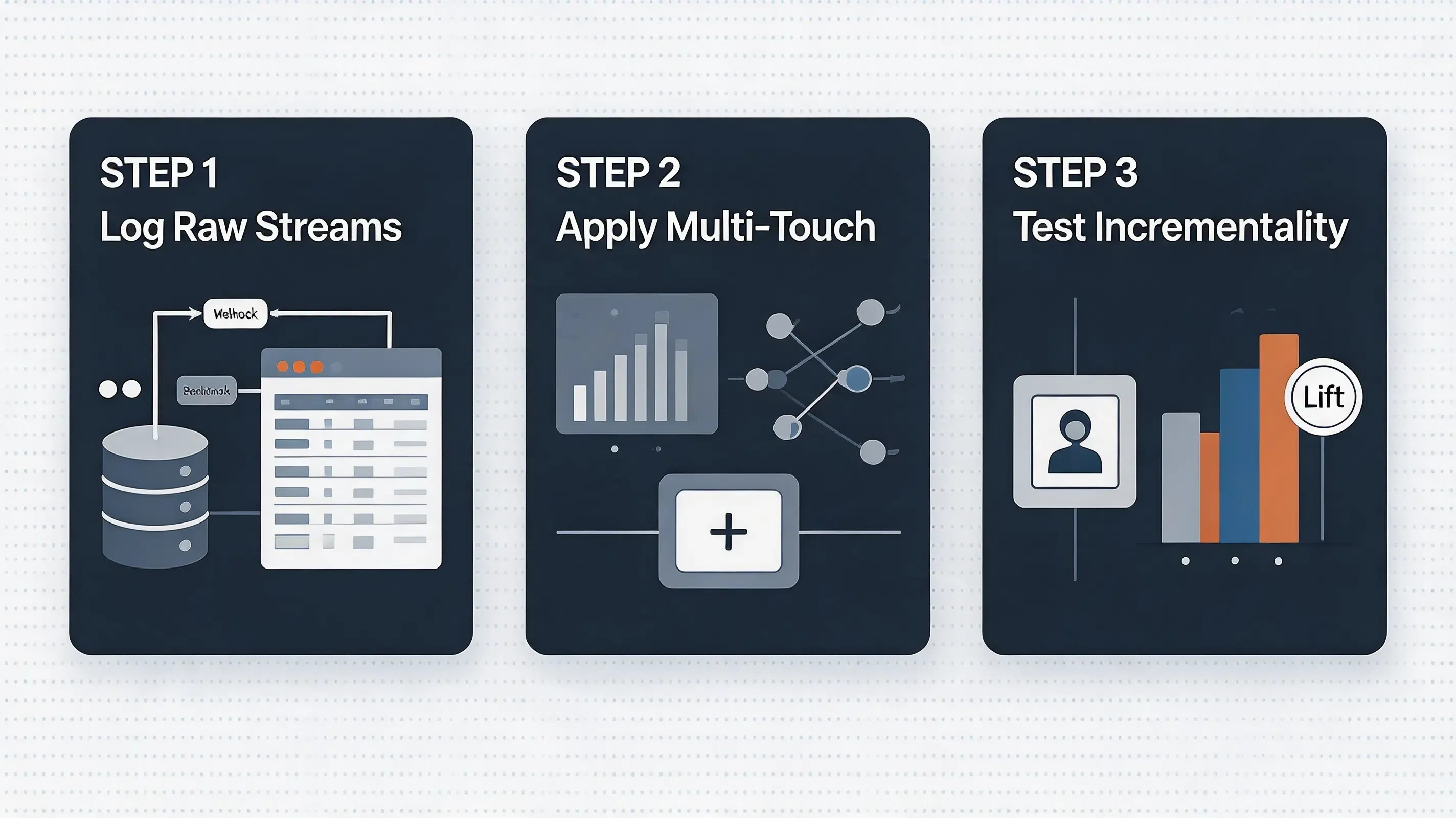
For most mobile applications managing complex growth budgets, a balanced measurement stack combines:
-
Operational Reporting: Single-touch models for daily operational tracking across isolated channels.
-
Contribution Modeling: Multi-touch analysis to evaluate middle-funnel assistance value across multi-channel journeys.
-
Budget Optimization: Incrementality testing and holdout experiments to guide major ad spend allocations based on true marginal lift.
-
Platform Compliance: Privacy-preserving attribution frameworks to ensure compliance with operating system privacy policies.
Summary and Decision Framework
To optimize mobile marketing spend effectively, performance teams must recognize the analytical limitations of last-touch attribution and transition toward multi-touch evaluation. Relying on single-point measurement distorts channel efficiency, starves upper-funnel growth, and leaves ad spend vulnerable to retargeting cannibalization.
Looking toward future privacy regulations, independent measurement frameworks will increasingly rely on privacy-compliant first-party data pipelines, S2S postbacks, and aggregated incrementality testing. By implementing client-side SDKs alongside backend raw data pipelines, measurement platforms can provide the infrastructure needed to de-duplicate network claims and improve cross-channel ROI evaluation accuracy.
To explore how unified mobile measurement can optimize your application’s growth strategy, consult the OpoInstall mobile attribution implementation reference or register an account on the OpoInstall developer console.
Related Materials
-
Related Articles:
-
What Is Multi-Touch Attribution in Mobile Marketing?
-
How Mobile Measurement Partners Work
-
SKAdNetwork vs MMP Attribution
-
Incrementality Testing for App User Acquisition
-
-
Concepts: Last Touch Attribution, Multi-Touch Attribution, Organic Cannibalization, Incremental Attribution, Lookback Windows
-
Technologies: Mobile Measurement Partner, Server-to-Server Postback, Web JS SDK, Raw Data Pipelines
-
Standards: W3C Fetch API Specifications, IETF RFC 7231 HTTP Semantics, OWASP Mobile Security Guidance
-
APIs: OpoInstall mobile attribution event logging capabilities, Apple SKAdNetwork Postback API, Google Play Install Referrer API
-
Official Documentation & References:
Share this article