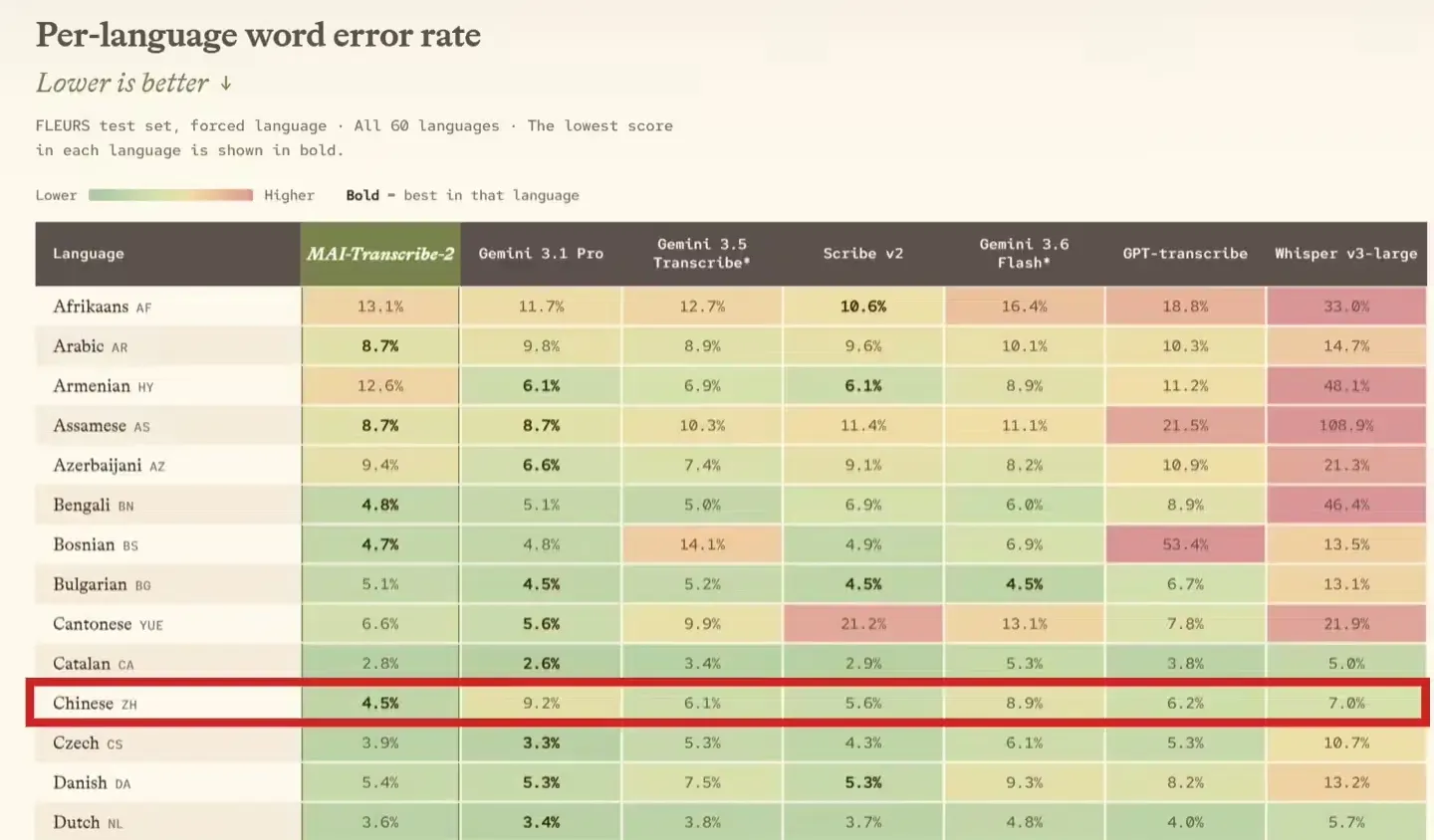
Microsoft Releases MAI-Transcribe-2 for 60 Languages? This speech recognition deployment marks a notable milestone in multimodal infrastructure as Microsoft officially releases MAI-Transcribe-2, defining the accuracy-latency Pareto frontier across sixty languages. Arriving five months after the initial release of MAI-Transcribe-1 and just three months following version 1.5, the updated foundation model combines an average Word Error Rate (WER) of 5.2% on the multilingual FLEURS benchmark with batch processing speeds up to ten times faster than competing frontier offerings. By pricing the service at an introductory ten cents per audio hour—a roughly 72% reduction from the $0.36-per-hour rate of versions 1 and 1.5—Microsoft accelerates the commoditization of automated speech recognition while providing capabilities like speaker diarization, word-level timestamps, and code-switching directly through Microsoft Foundry in public preview.
Speech Recognition Economics and MAI-Transcribe-2 Capabilities
At a Glance
- Microsoft released MAI-Transcribe-2 on September 3, 2026, setting an introductory price of $0.10 per audio hour through the end of the year.
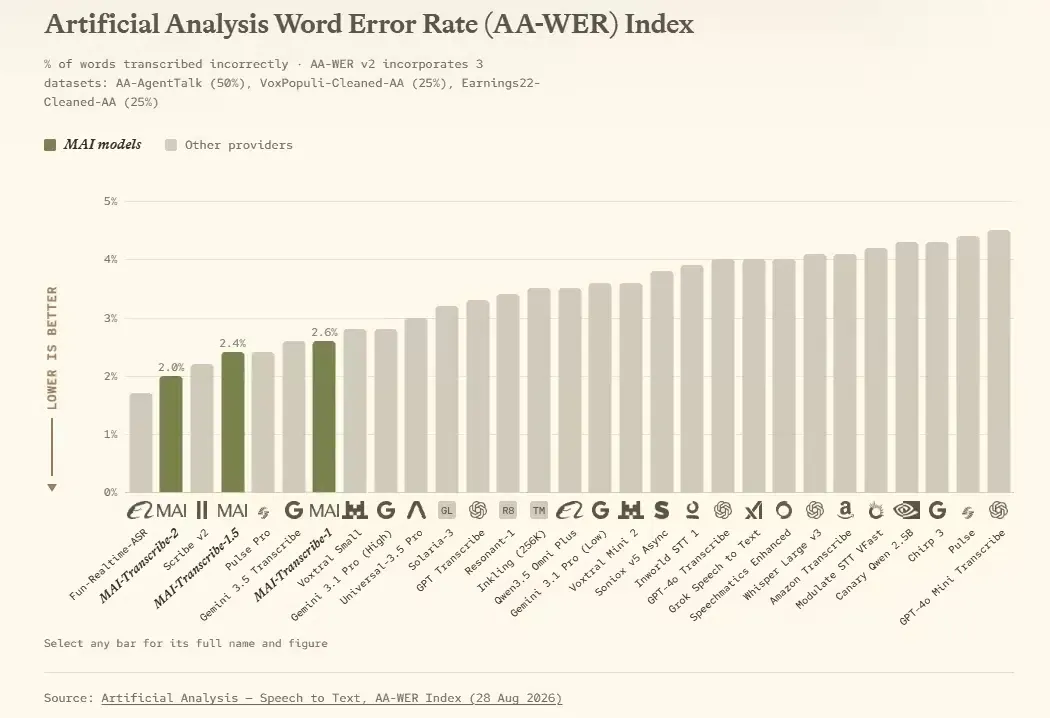
- The model evaluates at a 5.2% average Word Error Rate across 60 languages on the public FLEURS benchmark and ranks second on the Artificial Analysis WER leaderboard.
- Model capabilities include speaker diarization, word-level timestamps, domain keyword biasing, automatic language identification, and configurable transcription formatting.
The economics of enterprise speech-to-text processing have historically forced engineering teams into difficult architectural trade-offs. Organizations managing high-volume audio pipelines—such as customer contact centers, legal documentation platforms, and clinical transcription workflows—frequently balanced the high accuracy of expensive frontier APIs against the operational burden of hosting self-managed open-source models. Specialty vendors often compounded this friction by gating critical features like speaker diarization and audio timestamps behind premium pricing tiers.
The release cadence of Microsoft AI reflects a deliberate strategy to build in-house foundational model capabilities. By shipping three model generations within five months—scaling from 25 languages at $0.36 in April to 43 in June, and reaching 60 languages at $0.10 in September—Microsoft demonstrates a rapid release pipeline for speech model optimization. Analysis by VentureBeat indicates that higher batch throughput can reduce the required GPU-hours per fixed workload, while earlier MAI-Transcribe architectures were similarly designed to lower serving overhead.
For technical decision-makers, evaluating the impact when Microsoft Releases MAI-Transcribe-2 for 60 Languages involves analyzing both unit costs and operational throughput. In high-volume environments processing hundreds of thousands of audio hours annually, reducing baseline transcription fees to ten cents per hour transforms speech recognition from a major cost center into an accessible utility. Furthermore, bundling core capabilities into the base model can reduce the need for complex multi-vendor routing layers in enterprise applications.
Technical Architecture and Latency Frontiers: How MAI-Transcribe-2 Operates at Scale
Achieving high accuracy across varied real-world audio requires models to handle challenging acoustic environments, overlapping speech, and low-resource vocabularies. According to official performance disclosures on the Microsoft AI MAI-Transcribe-2 Product Page, MAI-Transcribe-2 is designed to perform robustly across noisy recording conditions, mixed-language conversations, and variable-quality inputs.
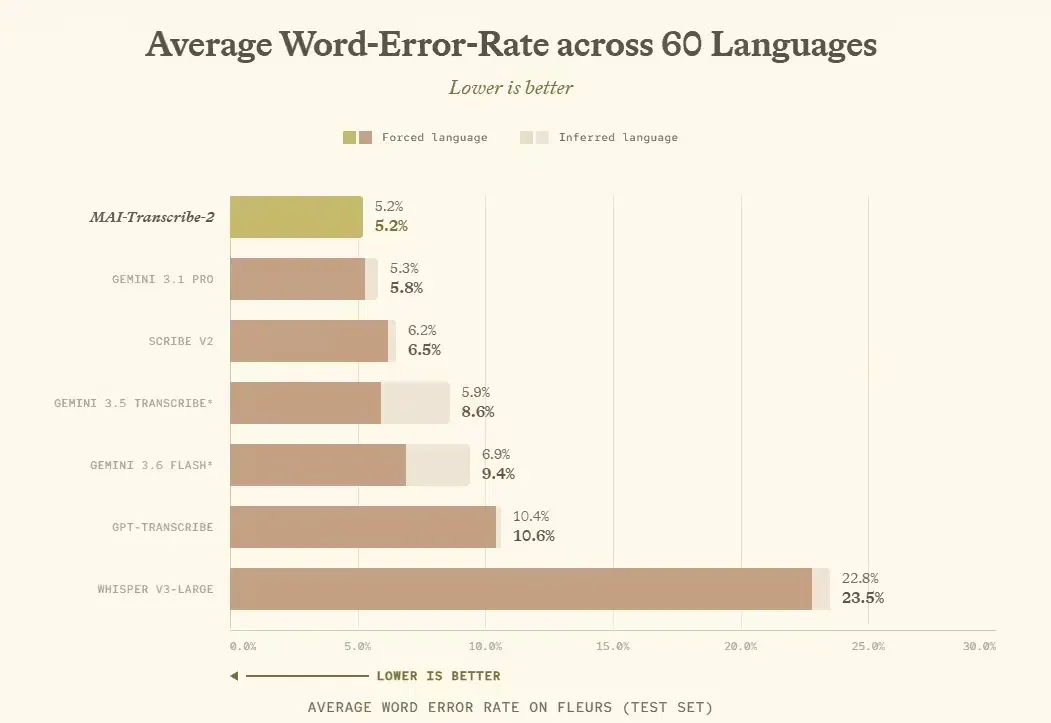
On the standardized FLEURS evaluation suite, the model achieves a 5.2% average Word Error Rate across 60 languages. According to Microsoft’s published benchmark chart as reproduced by technical reporting from ITHome, MAI-Transcribe-2 maintains this 5.2% average across both forced-language and automated language-detection runs. In comparative evaluations, Gemini 3.5 Transcribe is cited in Microsoft’s official release notes as a primary industry baseline, while secondary benchmark charts demonstrate competitive performance against Gemini 3.1 Pro (5.3% to 5.8%), OpenAI’s GPT-Transcribe (10.4% to 10.6%), and Whisper V3-Large (22.8% to 23.5%) across identical test sets.
Throughput Economics and the Pareto Latency Frontier
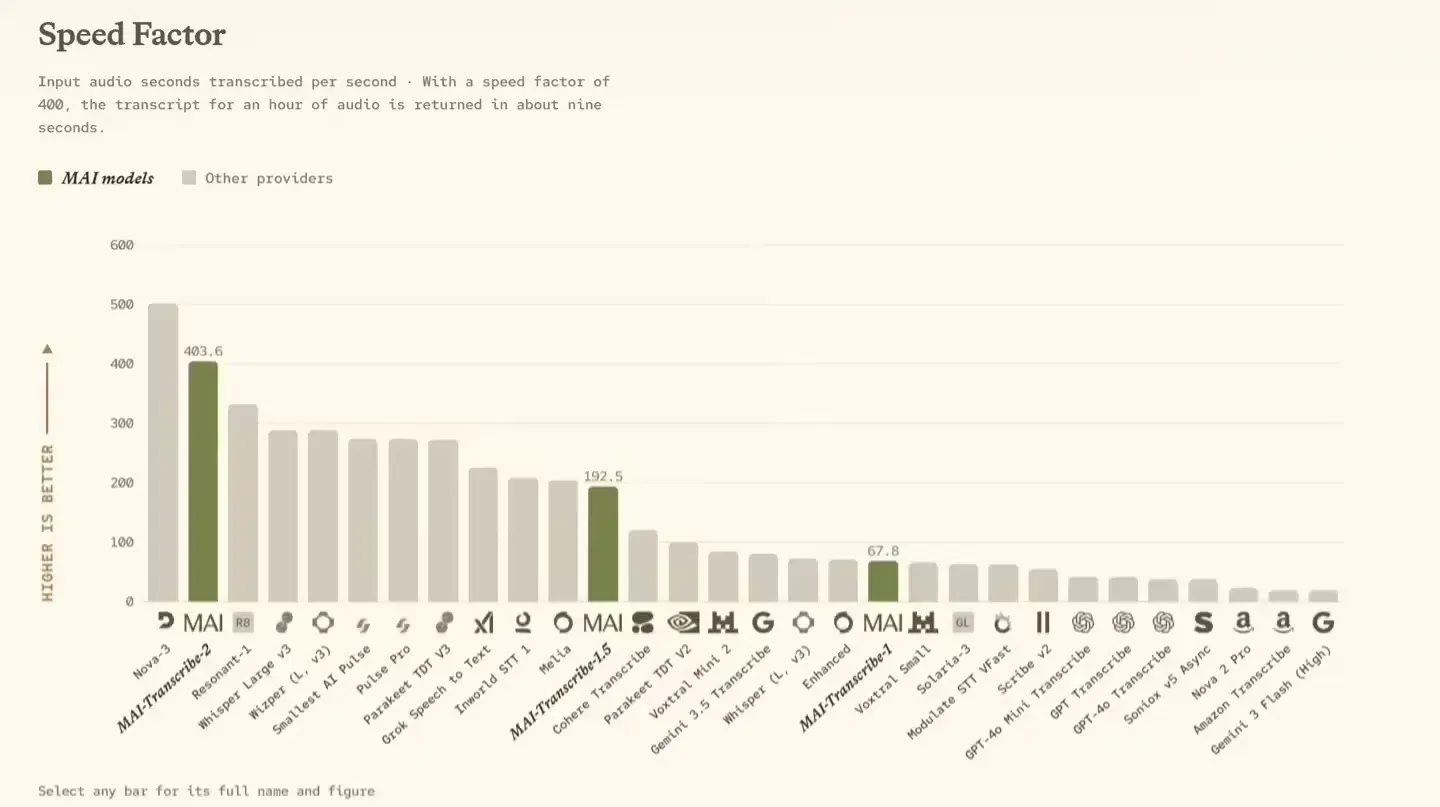
In batch audio processing, inference throughput is an important contributor to operational compute costs and service pricing. A model capable of processing recordings at several hundred times real-time can reduce the GPU time required to process a fixed amount of audio compared with slower alternatives. Evaluations conducted by Artificial Analysis place MAI-Transcribe-2 directly on the accuracy-latency Pareto frontier, reporting a speed factor of 403.6x real-time—allowing a one-hour recording to return in approximately ten seconds.
The diagram below outlines the supported processing capabilities available to developers:
[Incoming Audio Ingestion]
  Audio Payload (WAV / MP3 / FLAC / Documented Codecs)
                         │
                         ▼
[Supported Model Capabilities]
  ├── Automatic Language Identification (Auto-detect / Forced)
  ├── Multilingual Speech Recognition (60 Languages)
  ├── Speaker Diarization & Word-Level Timestamps
  └── Keyword Biasing Support
                         │
                         ▼
[Configured Output Generation]
  Formatted Output Stream (Verbatim Mode vs. Clean Mode)
To address diverse business requirements, the architecture incorporates flexible output configurations. Developers can select a verbatim mode that captures pauses, filler words, and false starts for legal compliance and clinical auditing. Alternatively, a clean mode automatically filters conversational filler to produce polished transcripts for meeting summaries, subtitles, and external publications.
Evaluating Speech-to-Text Paradigms in Enterprise Pipelines
Selecting a speech recognition architecture requires evaluating hosting complexity, privacy requirements, and long-term operating costs. Engineering organizations generally weigh three distinct operational models when building automated transcription workflows.
Technical Evaluation: Self-Hosted Models vs. Specialized High-Throughput APIs
Deploying self-hosted open-source models like Whisper provides complete control over data residency but introduces substantial infrastructure overhead. Engineering teams must manage GPU clusters, optimize batch sizes, and maintain separate pipelines for speaker diarization. In contrast, cloud APIs offer immediate scalability without ongoing infrastructure maintenance.
The table below contrasts standard methodologies for processing high-volume enterprise audio:
| Architecture | Infrastructure Footprint | Diarization & Timestamps | Multilingual Maintenance | Operational Trade-off |
|---|---|---|---|---|
| Self-Hosted Open-Source (e.g., Whisper) | High (Dedicated GPU Cluster) | Requires Secondary Pipelines | Self-Managed Model Tuning & Evaluation | Full data isolation with heavy maintenance overhead |
| Generalist Frontier Omnimodal APIs | Low (Serverless Cloud Endpoints) | Variable by Vendor | Broad Coverage | Potentially higher unit cost for transcription-only tasks |
| Specialized Speech Engine (MAI-Transcribe-2) | Low (Managed Azure / Foundry API) | Built-in Diarization & Timestamps | Unified Single-Model Deployment | Low unit cost with dependency on vendor roadmaps |
While self-hosting remains necessary for air-gapped environments, the unit economics of specialized APIs are shifting the balance toward managed services. A managed endpoint that bundles diarization, timestamps, and vocabulary biasing at ten cents per hour significantly reduces the total cost of ownership for most commercial workloads.
Engineering Checklist: Integrating High-Throughput Speech APIs
To ensure smooth integration of cloud transcription models into production workflows, development teams can structure their implementations against established platform guidelines.
Developer Implementation Checklist
- Validate Audio Constraints: Microsoft’s general Fast Transcription API accepts files under 500 MB and five hours; developers should verify the current MAI-Transcribe-2 preview endpoint’s model-specific limits before production deployment.
- Configure Keyword Biasing: MAI-Transcribe-2 supports keyword biasing for domain-specific vocabularies and acronyms; teams should verify the current Foundry preview schema for the deployment-specific keyword-biasing field.
- Select Output Formatting Styles: Direct compliance and auditing workflows through the documented verbatim setting, while utilizing the clean transcription style for consumer-facing summaries and public notes.
Security & Infrastructure Checklist
- Verify Regional Data Boundaries: Ensure that audio processing resources comply with organizational data residency and governance requirements within cloud consoles.
- Implement Batch Chunking Logic: For large enterprise archives exceeding individual file thresholds, deploy pre-processing pipelines that split recordings along natural pauses to preserve acoustic continuity.
- Review Preview Endpoint Documentation: Microsoft’s launch materials confirm diarization in MAI-Transcribe-2, while earlier integration documentation is being updated; verify the latest preview endpoint parameters before relying on a specific request schema.
By adopting these systematic implementation standards, engineering organizations can integrate high-throughput transcription services into their core data pipelines while maintaining architectural predictability.
Frequently Asked Questions (FAQ)
What is the significance of the 5.2% Word Error Rate on the FLEURS benchmark?
How does MAI-Transcribe-2 compare to OpenAI's GPT-Transcribe and Whisper?
What is the difference between verbatim and clean transcription styles?
Key Takeaways for Engineering Teams
The ongoing evolution of dedicated speech recognition models illustrates a broader shift toward modality-specific efficiency in artificial intelligence. While general-purpose multimodal models continue to expand their reasoning capabilities, specialized speech engines demonstrate that targeted optimizations yield superior latency, lower error rates, and compelling unit economics.
For technical organizations, integrating high-throughput transcription services enables scalable automation across audio-heavy business operations. By choosing specialized architectures that combine native diarization, customizable output formatting, and efficient batch inference, development teams can build responsive, cost-effective data workflows that scale alongside enterprise demand.
References
-
Microsoft AI. MAI-Transcribe-2 is the fastest, most accurate and cheapest speech recognition model in the world. https://microsoft.ai/news/mai-transcribe-2-is-the-fastest-most-accurate-and-cheapest-speech-recognition-model-in-the-world/
-
Microsoft AI. MAI-Transcribe-2 Model Overview and Specifications. https://microsoft.ai/models/mai-transcribe-2/
-
Microsoft Learn. Use the Fast Transcription API. https://learn.microsoft.com/en-us/azure/ai-services/speech-service/fast-transcription-create
-
Microsoft Learn. Improve Recognition Accuracy with Phrase Lists. https://learn.microsoft.com/en-us/azure/ai-services/speech-service/improve-accuracy-phrase-list
-
Artificial Analysis. Speech to Text Leaderboard and Accuracy-Latency Pareto Frontier. https://artificialanalysis.ai/speech-to-text/non-streaming
-
Google Research. FLEURS: Few-shot Learning Evaluation of Universal Representations of Speech. https://huggingface.co/datasets/google/fleurs
-
VentureBeat. Microsoft AI’s MAI-Transcribe-2 undercuts OpenAI, Google and ElevenLabs on price and speed. https://venturebeat.com/technology/microsoft-launches-3-new-ai-models-in-direct-shot-at-openai-and-google
-
Neowin. Microsoft’s MAI-Transcribe-2 model beats OpenAI and Google while costing just $0.10 per hour. https://www.neowin.net/news/microsofts-mai-transcribe-2-model-beats-openai-and-google-while-costing-just-010-per-hour/
-
ITHome. Microsoft launches MAI-Transcribe-2 speech recognition model with 5.2% WER. https://www.ithome.com/0/998/241.htm
Share this article