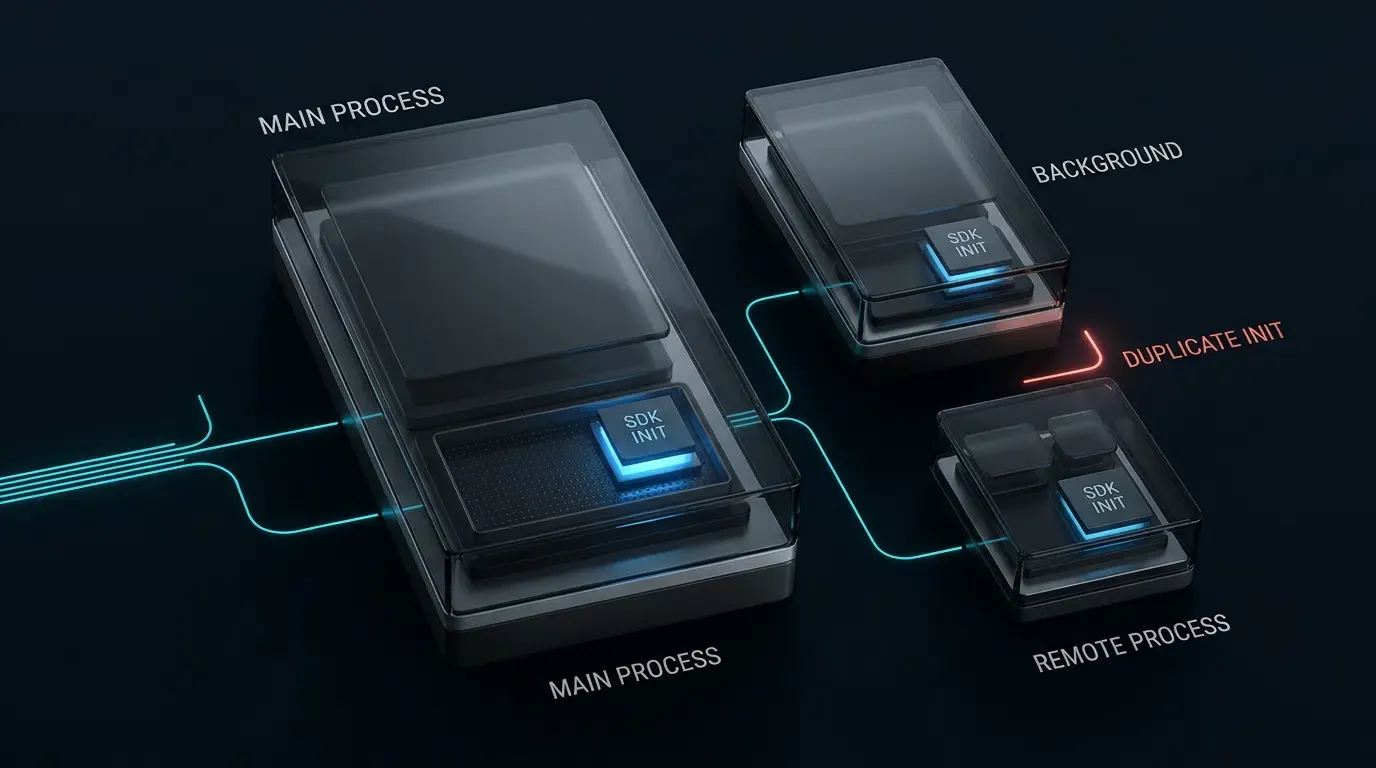
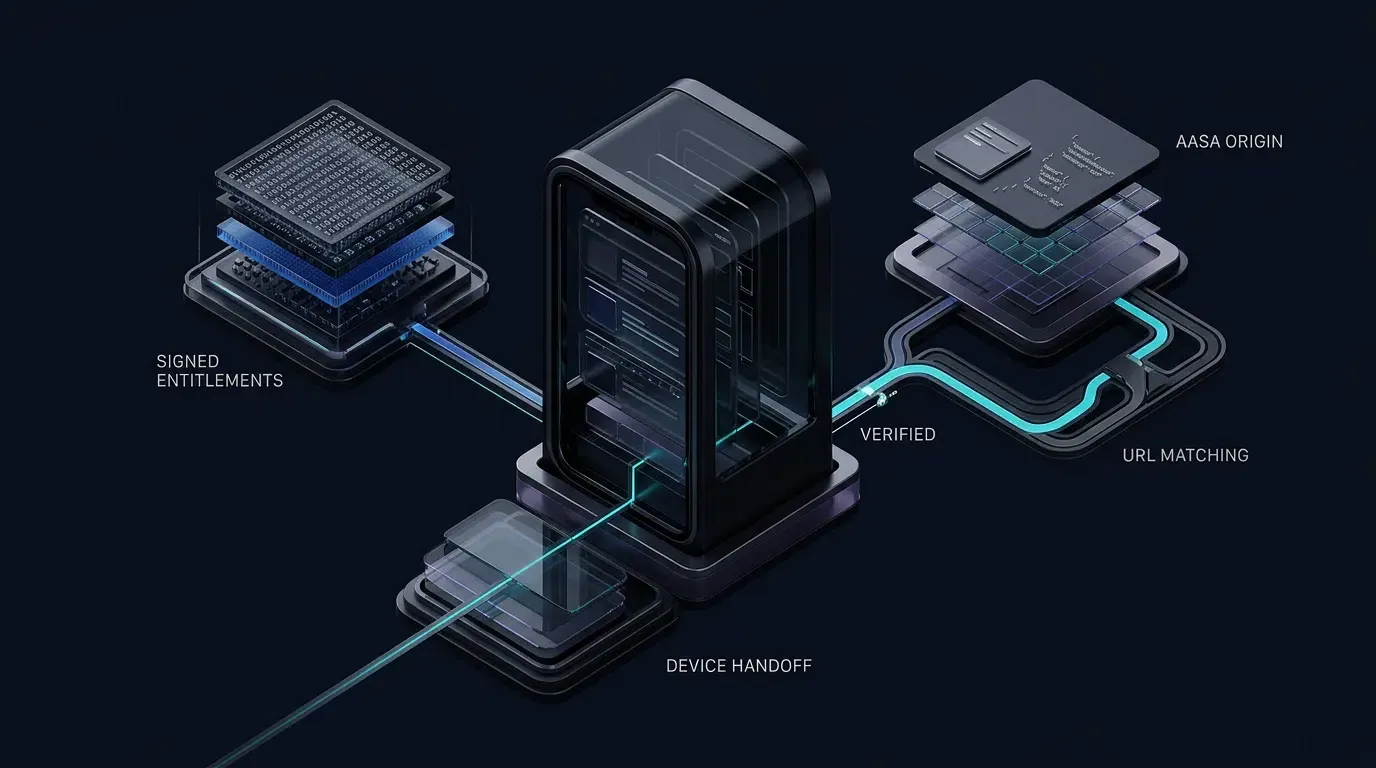
How Do You Verify Universal Links Entitlements in an iOS SDK? Inspect the signed host app on macOS with codesign and plutil to confirm that com.apple.developer.associated-domains contains the expected applinks: entry. Apple’s TN3125 documents how to read the app’s signed entitlements, and TN3155 shows how to check a specific URL against the apple-app-site-association (AASA) rules with swcutil verify. On a physical iPhone, test both cold and warm launches to confirm that iOS delivers the link to the host app and that the SDK handles it. These checks help isolate a signing, domain association, or SDK handoff failure.
Why Programmatic iOS Entitlement Verification Splits Between Build Time and Runtime
iOS Runtime Sandbox Boundaries and Provisioning Profile Limits
Engineers transitioning from macOS or Android frequently assume an iOS application can programmatically read its own compiled com.apple.developer.associated-domains array at runtime. Apple’s SecTaskCopyValueForEntitlement API documentation lists macOS and Mac Catalyst, whereas the native iOS SDK exposes no public SecTask entitlement-reading API.
Attempting to parse embedded.mobileprovision inside Swift code at runtime is equally unreliable across distribution channels, as detailed in Apple Technical Note TN3125: Inside Code Signing: Provisioning Profiles:
- Store Re-Signing & Profile Removal: Apps downloaded from the App Store do not contain an
embedded.mobileprovisionfile, and App Store Connect re-signs both App Store and TestFlight builds prior to distribution. Runtime code therefore cannot assume an embedded profile exists in production distributions. - Authorized Capability vs Compiled Domains: An embedded provisioning profile reflects authorized App ID capabilities rather than always enumerating the exact compiled
applinks:strings embedded inside the Mach-O binary signature. - DER-Encoded Profile Architecture: Provisioning profiles wrap data inside a Cryptographic Message Syntax (CMS) envelope, and modern iOS releases rely on the profile’s
DER-Encoded-Profilerepresentation rather than legacy plist fields as the authoritative source. Rather than slicing XML substrings fromembedded.mobileprovisioninside Swift, inspect pre-submission build artifacts that containembedded.mobileprovisionon macOS CI usingsecurity cms, and inspect compiled binary entitlements usingcodesign.
Because of these boundaries, verification splits across three isolated layers:
| Verification Layer | What It Checks | Passing Result Confirms | If It Fails, Inspect Next |
|---|---|---|---|
| 1. Build / CI Signed Artifact | Runs codesign and plutil on exported .app / .ipa |
Expected applinks: domain, application-identifier, and Team ID exist in signature |
Xcode CODE_SIGN_ENTITLEMENTS across Debug/Release configurations |
2. Origin AASA & swcutil |
Validates .well-known JSON (no 3xx) and swcutil verify -u |
Origin AASA passes the sample structural checks and the tested URL match/exclude cases | Web server redirects, appIDs/components syntax, or Apple CDN sync |
| 3. Physical Device Runtime | Tests cold/warm Universal Link taps via SceneDelegate and SDK |
iOS delivers NSUserActivity to host app and OpoInstallSDK handles link |
AASA path exclusions, User Approval (“Open in Safari”), or SDK delegate setup |
How Entitlement Mismatches Break iOS SDK Deep Linking
Universal Links route to Safari instead of the installed app—or fail to resolve business parameters—when one of several build mismatches occurs across Xcode targets:
- Debug vs Release
.entitlementsDrift: Xcode allows separateCODE_SIGN_ENTITLEMENTSpaths for Debug and Release configurations. Addingapplinks:links.example.comonly to a Debug entitlements file causes local runs to pass while TestFlight builds break. - App ID Alignment & Independent Team ID: Apple’s Associated Domains engine binds
applinks:domains using the exactapplication-identifier(<AppIDPrefix>.<BundleID>) inside the app signature, which must align with theappID/appIDsdeclared in your hosted AASA JSON. While the App ID Prefix usually matchescom.apple.developer.team-identifier, legacy apps can have distinct prefixes—requiring CI checks to validateapplication-identifieragainst AASA and treatcom.apple.developer.team-identifieras an independent assertion. - Main Target vs CocoaPods Sub-Targets: Framework or resource-bundle sub-targets inside
Pods.xcodeprojdo not carry the host app’scom.apple.developer.associated-domainsentitlement; associated domains must always be verified on the signed main application bundle. Where legacy flows fall back to custom URL schemes (url scheme), verify those scheme entries in the main target’sInfo.plist.
At a Glance
- Verify Exported Artifacts in CI/CD, Not Production Runtime: Native iOS exposes no public
SecTaskruntime API; inspect the final exported upload.ipaor.appsignature withcodesignandplutil. - Avoid In-App
embedded.mobileprovisionString Slicing: App Store downloads omit embedded profiles, App Store Connect re-signs App Store and TestFlight builds, and modern iOS relies onDER-Encoded-Profile; usesecurity cmson macOS CI when inspecting builds that containembedded.mobileprovision. - Test Concrete URLs with
swcutil verify -u: Confirm origin AASA hosting returnsHTTP 200without 3xx redirects, run structural schema pre-checks, and test both matching and excluded URLs with Apple’sswcutilCLI. - Align with OpoInstall SDK v2.1.0 Headers &
Info.plist: Configurecom.opoinstall.APP_KEYinInfo.plist, exposeOpoInstallSDK.hvia an Objective-C bridging header, propagateOpoInstallSDK.continue(userActivity)'sBoolresult, and verify preset test field arrival ingetWakeUpParams(_ appData: OpoInstallData?).
How to Extract and Validate Associated Domains Programmatically via CLI and CI
Inspecting Compiled .app and .ipa Bundles with codesign and plutil
The macOS codesign utility reads the exact entitlements embedded inside the signed Mach-O binary—making it the authoritative tool for inspecting exported .ipa archives prior to uploading to App Store Connect.
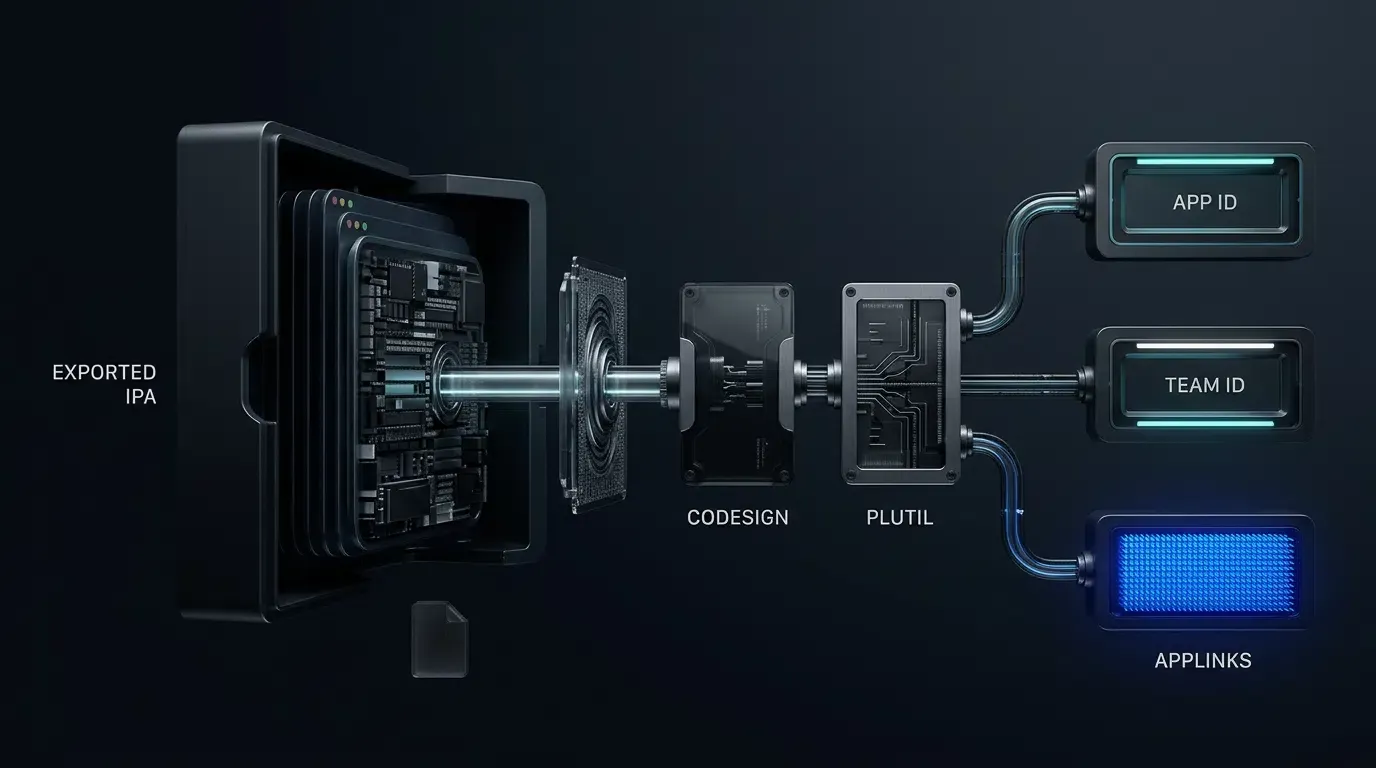
As documented in Apple Technical Note TN3125, pipe codesign --display --entitlements - --xml into plutil -convert xml1 -o - - to emit standardized XML1 plist output for downstream parsers:
# Extract exported .ipa, inspect compiled binary entitlements as XML1 plist, and check profile on macOS CI
unzip -q YourApp.ipa -d /tmp/ipa_inspect
codesign --display --entitlements - --xml /tmp/ipa_inspect/Payload/YourApp.app | plutil -convert xml1 -o - -

# For build artifacts containing an embedded provisioning profile: unpack via security cms
security cms -D -i /tmp/ipa_inspect/Payload/YourApp.app/embedded.mobileprovision | plutil -convert xml1 -o - -
Confirm three distinct values in the codesign XML output:
application-identifier: Matches<ExpectedAppIDPrefix>.<YourBundleID>(aligned with your AASA file).com.apple.developer.team-identifier: Matches your independent<ExpectedTeamID>.com.apple.developer.associated-domains: Contains the expectedapplinks:domain entries.
Automating Entitlement Assertions in CI Pipelines
Integrating codesign inspection into CI pipelines catches misconfigured Release builds before distribution. Always inspect the actual exported signed upload .ipa (before Apple Store re-signing), rather than only checking a pre-export .xcarchive.
The script below passes the Python validator via python3 -c '...' and pipes XML via stdin (<<< "${ENTITLEMENTS_XML}") to prevent standard input collisions. It requires an explicit --debug or --release flag—exiting non-zero on missing or invalid flags. Note that this script demonstrates checking a single exact applinks:<domain> entry for the sample project; if your project uses multiple associated domains or wildcard entries (applinks:*.<domain>, whose AASA hosting rules differ per TN3155), assert each declared entitlement string explicitly:
#!/usr/bin/env bash
# verify_ios_entitlements.sh
# Usage: ./verify_ios_entitlements.sh <path_to_app_or_exported_ipa> <expected_app_id> <expected_team_id> <expected_domain> <--debug|--release>
set -euo pipefail

ARTIFACT_PATH="${1:?Provide path to .app or exported .ipa}"
EXPECTED_APP_ID="${2:?Provide expected AppIDPrefix.BundleID}"
EXPECTED_TEAM_ID="${3:?Provide expected Team ID}"
EXPECTED_DOMAIN="${4:?Provide expected Universal Links domain}"
MODE_FLAG="${5:?Provide explicit --debug or --release flag}"

case "${MODE_FLAG}" in
    --debug|--release) ;;
    *)
        echo "ERROR: Invalid mode flag '${MODE_FLAG}'. Must specify --debug or --release." >&2
        exit 2
        ;;
esac

TMP_DIR=""
cleanup() {
    if [[ -n "${TMP_DIR}" && -d "${TMP_DIR}" ]]; then
        rm -rf "${TMP_DIR}"
    fi
}
trap cleanup EXIT

APP_BUNDLE=""
if [[ "${ARTIFACT_PATH}" == *.ipa ]]; then
    TMP_DIR="$(mktemp -d)"
    unzip -q "${ARTIFACT_PATH}" -d "${TMP_DIR}"
    APP_BUNDLE="$(find "${TMP_DIR}/Payload" -maxdepth 1 -name "*.app" -print -quit)"
    if [[ -z "${APP_BUNDLE}" ]]; then
        echo "ERROR: No .app bundle found inside Payload/ of ${ARTIFACT_PATH}" >&2
        exit 1
    fi
elif [[ "${ARTIFACT_PATH}" == *.app ]]; then
    APP_BUNDLE="${ARTIFACT_PATH}"
else
    echo "ERROR: Artifact must be an .app bundle or .ipa archive" >&2
    exit 1
fi

ENTITLEMENTS_XML="$(codesign --display --entitlements - --xml "${APP_BUNDLE}" | plutil -convert xml1 -o - -)"

python3 -c '
import plistlib
import sys

expected_app_id = sys.argv[1]
expected_team_id = sys.argv[2]
expected_domain = sys.argv[3]
mode_flag = sys.argv[4]
is_release = (mode_flag == "--release")

raw_xml = sys.stdin.buffer.read()
plist = plistlib.loads(raw_xml)

actual_app_id = plist.get("application-identifier")
if actual_app_id != expected_app_id:
    raise SystemExit(
        f"FAIL: application-identifier mismatch: got {actual_app_id!r}, expected {expected_app_id!r}"
    )

actual_team_id = plist.get("com.apple.developer.team-identifier")
if actual_team_id != expected_team_id:
    raise SystemExit(
        f"FAIL: com.apple.developer.team-identifier mismatch: got {actual_team_id!r}, expected {expected_team_id!r}"
    )

domains = plist.get("com.apple.developer.associated-domains")
if not isinstance(domains, list):
    raise SystemExit("FAIL: com.apple.developer.associated-domains missing or not an array")

expected_prod = f"applinks:{expected_domain}"
expected_dev = f"applinks:{expected_domain}?mode=developer"

if is_release:
    if expected_prod not in domains:
        raise SystemExit(f"FAIL: Missing production entry {expected_prod!r} in {domains}")
    if any("?mode=developer" in item for item in domains if isinstance(item, str)):
        raise SystemExit(f"FAIL: ?mode=developer leaked into Release artifact: {domains}")
else:
    if expected_prod not in domains and expected_dev not in domains:
        raise SystemExit(f"FAIL: Expected {expected_prod!r} or {expected_dev!r} not found in {domains}")

print(f"PASS ({mode_flag}): Verified {actual_app_id} (team={actual_team_id}) -> {domains}")
' "${EXPECTED_APP_ID}" "${EXPECTED_TEAM_ID}" "${EXPECTED_DOMAIN}" "${MODE_FLAG}" \
  <<< "${ENTITLEMENTS_XML}"
Illustrative Example: Catching a Release Entitlements Drift Before TestFlight Submission
Simulated Scenario / Illustrative Example: Consider a mobile application integrating an iOS attribution SDK where Universal Links open the app reliably during local Xcode Debug device runs, yet open Safari when distributed via TestFlight.
- Observed Symptoms: Testers tapping campaign links in Notes are routed to Safari instead of waking the installed TestFlight build. Local Debug builds signed on developer machines continue opening the app as expected.
- Programmatic Triage: Running
./verify_ios_entitlements.sh YourApp-Exported.ipa TEAM123456.com.example.app TEAM123456 links.example.com --releaseagainst the exported Release.ipaexits with a non-zero failure (FAIL: com.apple.developer.associated-domains missing or not an array). - Root-Cause Isolation: Inspecting Xcode’s Target Build Settings reveals that
CODE_SIGN_ENTITLEMENTSwas populated for theDebugconfiguration (AppDebug.entitlements) while theReleaseconfiguration was left blank or pointed to an older entitlements file lackingapplinks:links.example.com. - Remediation & Post-Fix Verification: Aligning
CODE_SIGN_ENTITLEMENTSacrossDebugandRelease, ensuring?mode=developeris absent from Release entitlements, re-exporting the.ipa, and re-running the CIcodesignscript confirmsPASS (--release)prior to upload.
Verifying Origin AASA Rules, Apple CDN Cadence, and swcutil
Understanding Apple’s Associated Domains CDN Update Cadence
On iOS 14 and later, Apple retrieves and caches AASA files through its associated domains CDN. Devices download the file when the app is installed and check for updates approximately once per week. Because Apple provides no direct developer CDN invalidation endpoint, reinstalling the app triggers a fresh download from the CDN, whereas developer mode bypasses the CDN and fetches the AASA file directly from your development server, as documented in Apple’s TN3155: Debugging Universal Links.
Furthermore, Apple’s AASA hosting requirements specify that the origin .well-known/apple-app-site-association endpoint must return HTTP 200 OK directly without relying on HTTP 301/302/307/308 redirects.
Strict Structural Pre-Check, Minimal Reproducible AASA, and swcutil verify -u
Because Apple evaluates AASA routing rules sequentially (the first matching rule takes precedence), a static JSON pre-check script can only verify schema integrity and field types—not whether a specific URL is shadowed by an earlier exclusion rule. Pair structural origin checks with Apple’s official swcutil verify tool using concrete matching and excluded URLs.

Consider the minimal reproducible apple-app-site-association file below, which places an explicit exclusion for /admin/login before the wildcard /campaign/* example route and the /account/profile host-owned route:
{
  "applinks": {
    "details": [
      {
        "appIDs": [
          "TEAM123456.com.example.app"
        ],
        "components": [
          {
            "/": "/admin/login",
            "exclude": true,
            "comment": "Keep admin login links in Safari"
          },
          {
            "/": "/campaign/*",
            "comment": "Route matching campaign links into the installed app"
          },
          {
            "/": "/account/profile",
            "comment": "Route host-owned profile links into the installed app"
          }
        ]
      }
    ]
  }
}
Test all three URLs (both matching routes and the excluded route) locally against the sample AASA using swcutil verify on macOS:
# 1. Expected MATCH (Campaign example): Verify /campaign/example matches TEAM123456.com.example.app
sudo swcutil verify \
  -d links.example.com \
  -j ./apple-app-site-association \
  -u https://links.example.com/campaign/example

# 2. Expected MATCH (Host link): Verify /account/profile matches TEAM123456.com.example.app
sudo swcutil verify \
  -d links.example.com \
  -j ./apple-app-site-association \
  -u https://links.example.com/account/profile

# 3. Expected EXCLUSION (blocked match): Verify /admin/login is excluded by explicit rule
sudo swcutil verify \
  -d links.example.com \
  -j ./apple-app-site-association \
  -u https://links.example.com/admin/login
In swcutil output, confirm that /campaign/example and /account/profile resolve to positive matched entries for TEAM123456.com.example.app (important when a domain hosts multiple App IDs), while /admin/login produces blocked match due to "exclude": true. On physical iPhones, capture a sysdiagnose archive and inspect swcutil_show.txt for both Site/Fmwk Approval and User Approval states. As an unofficial, non-blocking auxiliary diagnostic check, teams can also inspect https://app-site-association.cdn-apple.com/a/v1/<domain>, understanding that it neither serves as a stable Apple API nor confirms device-side association.
The Python pre-check script below validates the origin .well-known AASA endpoint—rejecting HTTP 3xx redirects, invalid UTF-8 bytes, network read truncations (http.client.HTTPException, OSError), malformed JSON roots, invalid component field types (per Apple’s components specification, supporting /, ?, #, exclude, comment, caseSensitive, and percentEncoded), empty strings in appIDs, empty rule lists, and exclusion-only configs. It inspects every entry in details and rejects mixed legacy and modern keys within an entry:
#!/usr/bin/env python3
# verify_aasa_origin.py
# Structural origin pre-flight check (no 3xx redirects); pair with `swcutil verify -u` for URL matching
import http.client
import json
import sys
import urllib.error
import urllib.request

class NoRedirectHandler(urllib.request.HTTPRedirectHandler):
    def redirect_request(self, req, fp, code, msg, headers, newurl):
        raise urllib.error.HTTPError(
            req.full_url, code, f"Disallowed HTTP redirect ({code}) -> {newurl}", headers, fp
        )

def fetch_json(url: str, allow_redirects: bool) -> tuple[int, str, object]:
    handlers = [] if allow_redirects else [NoRedirectHandler()]
    opener = urllib.request.build_opener(*handlers)
    req = urllib.request.Request(url, headers={"Accept": "application/json"})
    with opener.open(req, timeout=10) as resp:
        final_url = resp.geturl()
        body = json.loads(resp.read().decode("utf-8"))
        return resp.status, final_url, body

def is_valid_component(comp: object) -> bool:
    if not isinstance(comp, dict):
        return False
    allowed_keys = {"/", "?", "#", "exclude", "comment", "caseSensitive", "percentEncoded"}
    if not set(comp.keys()).issubset(allowed_keys):
        return False
    if "/" in comp and not isinstance(comp["/"], str):
        return False
    if "#" in comp and not isinstance(comp["#"], str):
        return False
    if "comment" in comp and not isinstance(comp["comment"], str):
        return False
    for bool_key in ("exclude", "caseSensitive", "percentEncoded"):
        if bool_key in comp and not isinstance(comp[bool_key], bool):
            return False
    if "?" in comp:
        q = comp["?"]
        if isinstance(q, dict):
            if not all(isinstance(k, str) and isinstance(v, str) for k, v in q.items()):
                return False
        elif not isinstance(q, str):
            return False
    return any(k in comp for k in ("/", "?", "#"))

def validate_aasa_structure(aasa_json: object, target_app_id: str) -> bool:
    if not isinstance(aasa_json, dict):
        return False
    applinks = aasa_json.get("applinks")
    if not isinstance(applinks, dict):
        return False
    details = applinks.get("details")
    if not isinstance(details, list) or not details:
        return False

    matched_target = False
    for entry in details:
        if not isinstance(entry, dict):
            return False

        has_modern = ("appIDs" in entry) or ("components" in entry)
        has_legacy = ("appID" in entry) or ("paths" in entry)

        # Inspect every entry in details, rejecting mixed legacy and modern keys within an entry
        if has_modern and has_legacy:
            return False
        if not has_modern and not has_legacy:
            return False

        if has_modern:
            app_ids = entry.get("appIDs")
            components = entry.get("components")
            if not isinstance(app_ids, list) or not app_ids or not all(isinstance(i, str) and i for i in app_ids):
                return False
            if not isinstance(components, list) or not components:
                return False
            if not all(is_valid_component(comp) for comp in components):
                return False

            if target_app_id in app_ids:
                if any(not comp.get("exclude", False) for comp in components):
                    matched_target = True

        elif has_legacy:
            app_id = entry.get("appID")
            paths = entry.get("paths")
            if not isinstance(app_id, str) or not app_id:
                return False
            if not isinstance(paths, list) or not paths or not all(isinstance(p, str) and p for p in paths):
                return False

            if app_id == target_app_id:
                if any(not p.startswith("NOT ") for p in paths):
                    matched_target = True

    return matched_target

if __name__ == "__main__":
    if len(sys.argv) != 3:
        print("Usage: verify_aasa_origin.py <domain> <AppIDPrefix.BundleID>", file=sys.stderr)
        sys.exit(1)

    domain, expected_app_id = sys.argv[1], sys.argv[2]
    origin_url = f"https://{domain}/.well-known/apple-app-site-association"
    # Auxiliary diagnostic endpoint only (non-blocking; does not prove device association)
    cdn_url = f"https://app-site-association.cdn-apple.com/a/v1/{domain}"

    try:
        status, final_url, origin_json = fetch_json(origin_url, allow_redirects=False)
        valid_origin = (status == 200) and validate_aasa_structure(origin_json, expected_app_id)
        print(f"[Origin] HTTP {status} at {final_url} -> structural_preflight={valid_origin}")
        if not valid_origin:
            sys.exit(1)
    except (urllib.error.URLError, http.client.HTTPException, OSError, RuntimeError, UnicodeDecodeError, json.JSONDecodeError) as exc:
        print(f"[Origin] FAIL for {origin_url}: {exc}", file=sys.stderr)
        sys.exit(1)

    try:
        status, final_url, cdn_json = fetch_json(cdn_url, allow_redirects=True)
        valid_cdn = validate_aasa_structure(cdn_json, expected_app_id)
        print(f"[Auxiliary CDN] HTTP {status} at {final_url} -> structural_preflight={valid_cdn}")
    except (urllib.error.URLError, http.client.HTTPException, OSError, RuntimeError, UnicodeDecodeError, json.JSONDecodeError) as exc:
        print(f"[Auxiliary CDN] Diagnostic notice (non-fatal): {exc}")
Configuring ?mode=developer Under Strict Apple Entitlement Constraints
During development, ?mode=developer enables testing origin AASA updates without waiting for weekly CDN checks or app reinstallation. However, per Apple’s Associated Domains Entitlement specification, ?mode=developer requires: (1) signing with a development provisioning profile, (2) enabling Developer Mode on the physical device (Settings > Privacy & Security > Developer Mode on iOS 16+), and (3) explicit user opt-in to Associated Domains Development (Settings > Developer).
The ?mode=developer configuration is restricted to apps signed with a development provisioning profile and devices where the user has explicitly opted in to Associated Domains Development. It is not a production entitlement or a general-purpose CDN cache invalidation mechanism.
Ensure XML declarations (<?xml ...?>) sit on line 1 with no preceding comments so plist parsers read both files cleanly:
Debug.entitlements (Development provisioning profiles + opt-in devices only):
<?xml version="1.0" encoding="UTF-8"?>
<!DOCTYPE plist PUBLIC "-//Apple//DTD PLIST 1.0//EN" "http://www.apple.com/DTDs/PropertyList-1.0.dtd">
<plist version="1.0">
<dict>
    <key>com.apple.developer.associated-domains</key>
    <array>
        <string>applinks:links.example.com?mode=developer</string>
    </array>
</dict>
</plist>
Release.entitlements (Production / TestFlight distribution):
<?xml version="1.0" encoding="UTF-8"?>
<!DOCTYPE plist PUBLIC "-//Apple//DTD PLIST 1.0//EN" "http://www.apple.com/DTDs/PropertyList-1.0.dtd">
<plist version="1.0">
<dict>
    <key>com.apple.developer.associated-domains</key>
    <array>
        <string>applinks:links.example.com</string>
    </array>
</dict>
</plist>
How to Validate Universal Link Delivery in Swift Using OpoInstallDelegate
Prerequisites: Info.plist AppKey, Static XCFramework Bridging, and SceneDelegate
Before testing Universal Link handoffs with the OpoInstall iOS SDK v2.1.0 release (see also the OpoInstall iOS integration guide), verify four host prerequisites:
- Configure
com.opoinstall.APP_KEYinInfo.plist: The SDK requires your application key inInfo.plistalongsideOpoInstallSDK.initWith(self)during startup:
<!-- Insert inside your host app Info.plist <dict> -->
<key>com.opoinstall.APP_KEY</key>
<string>YOUR_OPOINSTALL_APP_KEY</string>
- Configure an Objective-C Bridging Header: The v2.1.0 XCFramework packages a static
.alibrary with standaloneHeadersand nomodule.modulemap. In Swift targets, exposeOpoInstallSDK.hthrough your Objective-C bridging header rather than relying on a bare Swiftimport libOpoInstallSDKstatement unless your project explicitly supplies a custom module map. - Bridge
AppDelegateandSceneDelegate: Per Apple’sUISceneDelegatespecification, apps using scenes receive terminated cold-start Universal Links inscene(_:willConnectTo:options:)viaconnectionOptions.userActivities, and warm Universal Links inscene(_:continue:). Non-scene apps receive links inAppDelegate.application(_:continue:restorationHandler:). - Match Exact v2.1.0 Types & Verify Preset Test Fields: In
OpoInstallSDK.h,getWakeUpParams:is an optionalOpoInstallDelegatecallback accepting nullableOpoInstallData *(OpoInstallData?in Swift), andcontinueUserActivity:returnsBOOL(Bool). Propagate that actualBoolresult from your forwarding helper (falling back to your host app’s own Universal Link router scoped to the expected HTTPS host and path when the SDK returnsfalse), and log four separate checkpoints using a configured OpoInstall test link carrying a preset verification field (such ascampaign_test_id=ul_verify_01): (1) system delivery, (2)OpoInstallSDK.continue(userActivity)Boolreturn, (3)getWakeUpParamsinvocation, and (4) non-empty payload status plus preset test field match (matchedExpectedTestField), while omitting raw values from console output.
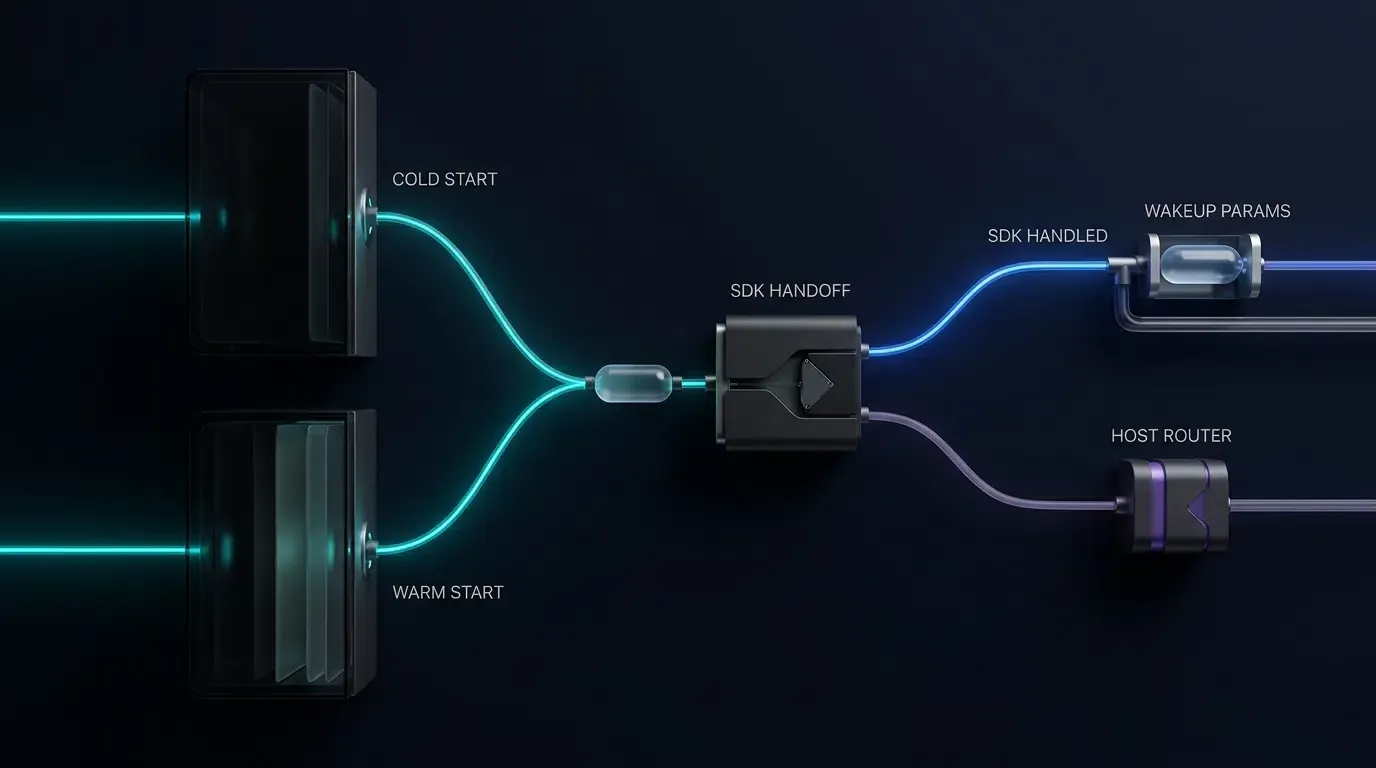
Reference Architecture Disclaimer: The following Swift implementation aligns with OpoInstall iOS SDK v2.1.0
OpoInstallSDK.hdeclarations (OpoInstallData?,continue(_:)returningBool, and optionalgetWakeUpParams). Compile in Xcode 26 and verify physical-device cold/warm launches from Notes before production rollout.
// YourApp-Bridging-Header.h
// Required in Swift targets when using the static v2.1.0 XCFramework Headers without a custom modulemap
#import "OpoInstallSDK.h"
// iOS - UniversalLinkDiagnostics.swift
// Reference architecture targeting OpoInstall iOS SDK v2.1.0 (exposed via Bridging Header)
import UIKit

@main
final class AppDelegate: UIResponder, UIApplicationDelegate, OpoInstallDelegate {

    var window: UIWindow?

    func application(
        _ application: UIApplication,
        didFinishLaunchingWithOptions launchOptions: [UIApplication.LaunchOptionsKey: Any]?
    ) -> Bool {
        OpoInstallSDK.initWith(self)
        return true
    }

    // Non-scene Universal Link entry point: return actual SDK OR host routing Bool result
    func application(
        _ application: UIApplication,
        continue userActivity: NSUserActivity,
        restorationHandler: @escaping ([UIUserActivityRestoring]?) -> Void
    ) -> Bool {
        return UniversalLinkForwarder.forwardIfBrowsingWeb(userActivity, source: "AppDelegate.continue")
    }

    // Matches OpoInstallSDK.h v2.1.0 signature (OpoInstallData *).
    // Verify Swift 6 language-mode isolation requirements against your project build settings.
    func getWakeUpParams(_ appData: OpoInstallData?) {
        let hasNonEmptyData = !(appData?.data?.isEmpty ?? true)
        let hasNonEmptyChannel = !(appData?.channelCode?.isEmpty ?? true)
        // Verify preset test field without logging raw payload strings
        let matchedExpectedTestField = (appData?.data?["campaign_test_id"] as? String) == "ul_verify_01"

        // Checkpoint 3 & 4: Log callback arrival, non-empty status, and preset test field match
        print("[ULDebug] getWakeUpParams fired (hasNonEmptyData: \(hasNonEmptyData), hasChannel: \(hasNonEmptyChannel), matchedExpectedTestField: \(matchedExpectedTestField))")

        DispatchQueue.main.async {
            // Execute business deep-link scene routing safely on the main queue
        }
    }
}

// Register SceneDelegate under UIApplicationSceneManifest in Info.plist for scene-based apps
final class SceneDelegate: UIResponder, UIWindowSceneDelegate {

    var window: UIWindow?

    func scene(
        _ scene: UIScene,
        willConnectTo session: UISceneSession,
        options connectionOptions: UIScene.ConnectionOptions
    ) {
        // Cold-start Universal Link delivery when app was previously terminated
        for userActivity in connectionOptions.userActivities {
            _ = UniversalLinkForwarder.forwardIfBrowsingWeb(userActivity, source: "SceneDelegate.willConnectTo")
        }
    }

    func scene(_ scene: UIScene, continue userActivity: NSUserActivity) {
        // Warm / background Universal Link delivery when app is already running
        _ = UniversalLinkForwarder.forwardIfBrowsingWeb(userActivity, source: "SceneDelegate.continue")
    }
}

enum UniversalLinkForwarder {
    private static let allowedHostRoutingDomain = "links.example.com"

    @discardableResult
    static func forwardIfBrowsingWeb(_ userActivity: NSUserActivity, source: String) -> Bool {
        guard userActivity.activityType == NSUserActivityTypeBrowsingWeb,
              let url = userActivity.webpageURL else {
            print("[ULDebug] Ignored non-browsing NSUserActivity in \(source)")
            return false
        }

        let scheme = url.scheme?.lowercased() ?? "unknown"
        let host = url.host?.lowercased() ?? "unknown"
        // Checkpoint 1: System delivered NSUserActivityTypeBrowsingWeb to host app
        print("[ULDebug] System delivered Universal Link in \(source) for \(scheme)://\(host)")

        // Checkpoint 2: Forward to OpoInstall SDK and inspect actual BOOL handling result
        let sdkHandled = OpoInstallSDK.continue(userActivity)
        print("[ULDebug] OpoInstallSDK.continue returned handled=\(sdkHandled)")
        if sdkHandled {
            return true
        }

        // If SDK did not claim the link, fall back to host-owned Universal Link router
        return handleHostSpecificUniversalLink(url)
    }

    private static func handleHostSpecificUniversalLink(_ url: URL) -> Bool {
        // Restrict host routing strictly to the expected HTTPS host and path
        guard url.scheme?.lowercased() == "https",
              url.host?.lowercased() == allowedHostRoutingDomain,
              url.path == "/account/profile" else {
            return false
        }

        print("[ULDebug] Host router claimed Universal Link route: \(url.path)")
        DispatchQueue.main.async {
            // Present your project's profile view controller here
        }
        return true
    }
}
Physical Device Acceptance Matrix (Pre-Lock Regression Gate)
Before promoting an integration to production, execute and record actual results from a macOS Xcode 26 build environment and physical iPhones across these four scenarios:
| Acceptance Scenario | Exact Command / Action | Expected Pass Condition |
|---|---|---|
| Xcode 26 Compilation | Build target using Xcode 26 (iOS 26 SDK) under Swift 5 or Swift 6 mode |
SDK static XCFramework links, bridging header imports OpoInstallSDK.h, and getWakeUpParams(_ appData: OpoInstallData?) compiles cleanly. |
Exported Release .ipa Check |
./verify_ios_entitlements.sh YourApp-Exported.ipa TEAM123456.com.example.app TEAM123456 links.example.com --release |
Script prints PASS (--release) confirming application-identifier, com.apple.developer.team-identifier, and applinks: without ?mode=developer. |
AASA swcutil Match & Exclude |
Run sudo swcutil verify against /campaign/example, /account/profile, and /admin/login |
/campaign/example and /account/profile output matched for TEAM123456.com.example.app; /admin/login outputs blocked match. |
| Debug & TestFlight Cold/Warm Launches | Tap a configured OpoInstall test link carrying campaign_test_id=ul_verify_01, excluded /admin/login, and host /account/profile from Apple Notes |
OpoInstall link logs SceneDelegate receipt, sdkHandled=true, getWakeUpParams, hasNonEmptyData=true, and matchedExpectedTestField=true; /admin/login opens Safari; /account/profile logs SceneDelegate receipt, sdkHandled=false, and [ULDebug] Host router claimed Universal Link route: /account/profile returning true. |
Comparative Analysis of iOS Entitlement Verification Methods
| Verification Method | Execution Environment | Sees Exact applinks: Domains |
Inspectable Artifact Scope / Stage | Recommended Usage |
|---|---|---|---|---|
codesign --display --entitlements - --xml | plutil |
macOS / CI Build Pipeline | Yes (Reads compiled Mach-O signature) | Inspects exported .ipa / .app pre-upload (before Apple Store re-signing) |
Primary programmatic CI gate |
Origin AASA Check (No Redirects) + swcutil verify -u + sysdiagnose |
Origin Python script on build server; swcutil verify on macOS; sysdiagnose on iPhone |
Verifies AASA JSON, appIDs, & URL matches |
Inspects hosted AASA rules, URL match/exclude decisions, and device approval | Origin preflight, Apple URL matching, and device approval diagnostics |
security cms -D -i embedded.mobileprovision |
macOS CI (Builds containing embedded.mobileprovision) |
No (Shows authorized capability, not exact list) | Pre-submission builds containing an embedded profile (absent in App Store downloads) | CI profile sanity check only |
Runtime NSUserActivity + getWakeUpParams |
Physical iOS Device | Indirectly confirms end-to-end routing | Live installed app builds (Debug, TestFlight, App Store) | End-to-end runtime handoff verification |
SecTaskCopyValueForEntitlement |
macOS / Mac Catalyst Only | Not available in native iOS public SDK | Not applicable to native iOS targets | Do not use in native iOS apps |
Frequently Asked Questions (FAQ)
Can an iOS app read its own com.apple.developer.associated-domains entitlement at runtime?
Why does embedded.mobileprovision disappear in App Store builds?
Why does Universal Link verification pass codesign checks yet still open Safari?
Summary and Decision Framework
Verifying Universal Links entitlements programmatically in an iOS SDK project requires shifting binary inspection to macOS build pipelines while reserving Swift runtime checks for installed-app wakeup diagnostics. By asserting com.apple.developer.associated-domains, application-identifier, and com.apple.developer.team-identifier via codesign and plutil on exported .ipa artifacts in CI, enforcing redirect-free origin AASA hosting paired with swcutil verify -u match/exclude tests, restricting ?mode=developer to eligible development builds, and propagating OpoInstallSDK.continue(userActivity) Bool results across SceneDelegate and OpoInstallDelegate.getWakeUpParams, engineering teams isolate signing, association, and handoff failures systematically.
Note the functional boundary between installed-app Universal Link routing and post-install deferred deep linking: this guide verifies installed-app Universal Link handoffs (OpoInstallSDK.continue(userActivity) and getWakeUpParams), whereas post-install parameter recovery relies separately on getInstallParmsCompleted. For complete client headers and integration assets, consult the OpoInstall iOS SDK v2.1.0 download center or the OpoInstall platform overview.
Entity Glossary
| Term | Definition | Related Entity | Search Intent Role |
|---|---|---|---|
| Universal Links | Apple’s HTTPS-based deep-linking standard connecting verified domains to installed iOS apps. | NSUserActivity |
Technical / Informational |
| Associated Domains | The com.apple.developer.associated-domains entitlement listing applinks: domains claimed by an app. |
apple-app-site-association |
Technical |
| iOS SDK | A compiled framework integrated into iOS apps for attribution, deep linking, or analytics. | OpoInstallDelegate |
Informational / Technical |
| codesign | The macOS command-line tool used to create, check, and inspect application code signatures and entitlements. | plutil / swcutil |
Technical |
Compatibility Baseline and Verification Status
-
Current Submission Toolchain (Effective April 28, 2026): App Store Connect and TestFlight uploads require Xcode 26 or later and the iOS 26 SDK (Xcode 26 includes the Swift 6.2 compiler, supporting both Swift 5 and Swift 6 language modes; Xcode 15/16 apply strictly as historical context).
-
Planned Target OS Coverage: iOS 15.0–26.x (
UISceneDelegateandAppDelegatelifecycles), OpoInstall iOS SDKv2.1.0, macOScodesign,plutil, andswcutiltoolchain. -
Verification Status:
-
OpoInstall SDK v2.1.0 Archive Inspection: Verified
OpoInstallSDK.h(OpoInstallData *parameter ingetWakeUpParams:,BOOLreturn fromcontinueUserActivity:, static.aXCFramework with standaloneHeadersand nomodule.modulemap), pluscom.opoinstall.APP_KEYInfo.plistrequirement. -
Apple Official Documentation Review: Verified against Apple TN3125, TN3155, Associated Domains Entitlement, AASA
componentsdictionary, and April 2026 Xcode 26 / iOS 26 SDK upload requirements. -
Pending Hardware & Build Execution: Not yet executed in this Linux review cycle. Run the updated
verify_ios_entitlements.shandverify_aasa_origin.pyscripts,swcutil verify -umatch/exclude checks on macOS, Xcode 26 compilation againstOpoInstallSDK.h, and physical iPhone cold/warm Universal Link tests across Debug and TestFlight builds prior to final lock.
-
References
Share this article