New Mac Privilege Leak? This strategic pivot has been conclusively validated as the cybersecurity firm XM Cyber officially launches its privilege-escalation research on June 24, 2026. Specifically, the introduction of this flagship vulnerability report redefines how developers manage Cross-Process Communication on macOS. Consequently, this local exploit threat model drives massive change in corporate terminal compliance. For developer teams, the immediate challenge is securing background process handshakes while preserving robust user session validation. Crucially, the disclosure of this vulnerability highlights the vulnerability of some of the industry’s most trusted security tools.

Deciphering the macOS Trust Boundary: How XM Cyber Disclosed the New Mac Privilege Leak
During their research into background system processes on June 24, 2026, security firm XM Cyber uncovered a novel local exploit. Specifically, when details of the New Mac Privilege Leak surfaced, enterprise IT teams reacted with concern. Furthermore, researchers demonstrated how standard, non-administrator user accounts can disable highly trusted endpoint detection agents. Consequently, the disclosure of the New Mac Privilege Leak demonstrates the limits of relying solely on code-signing trust. Meanwhile, the vulnerability potentially exposes millions of managed corporate Mac devices to quiet deactivation of defenses. Detailed findings are published on the official XM Cyber Blog.
Cross-Process Communication and the CDHash Exploitation Pathway
Specifically, the core of this vulnerability lies in Apple’s Cross-Process Communication (XPC) framework. Developers routinely use XPC services to allow low-privilege front-end software components to request administrative actions from root background processes. For instance, processes use XPC for task extensions, accessing system telemetry, or launching software updates. Crucially, the operating system relies on Apple’s CDHash cryptographic identifier to verify the caller’s authenticity. However, XM Cyber senior researcher Hillel Pinto revealed that macOS caches these CDHash trust fingerprints too loosely. Consequently, once a legitimate, signed application executes, macOS retains its trust profile even if its bundle components are altered by standard users.

XPC Hunter and the Automation of Privilege Vulnerability Detection
Furthermore, XM Cyber developed a specialized search utility to identify similar flaws. Specifically, the open-source, large language model (LLM)-powered tool is called XPC Hunter. Consequently, security analysts can automate the process of scanning and diagnosing flawed XPC validation logic across third-party software. Meanwhile, the research team plans to officially demonstrate XPC Hunter and present their findings at Black Hat Arsenal on August 5, 2026, in Las Vegas. As a result, developers are rushing to patch their software before the public exploitation utility goes live.
Vendor Disclosures and the CVE-2026-39118 Fix
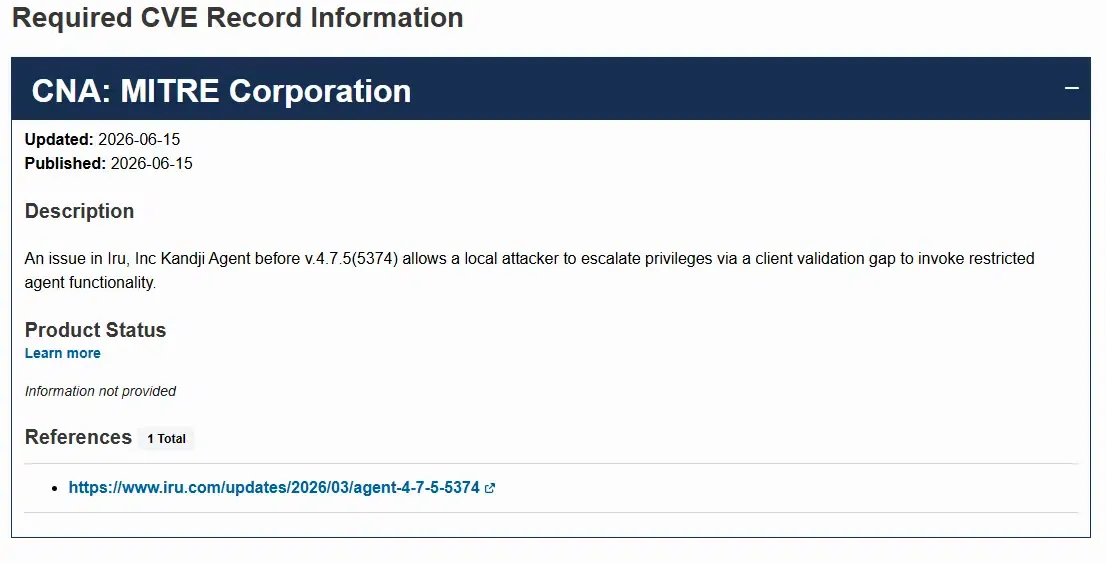
Crucially, XM Cyber notified affected security and management vendors before making their research public. For instance, the mobile device management (MDM) vendor Kandji acknowledged the specific vulnerability and assigned it CVE-2026-39118. Specifically, Kandji addressed the flaw in their updated software, ensuring robust caller validation. Furthermore, the official release of the patch can be verified through Iru Inc. Updates. Meanwhile, CrowdStrike also confirmed they patched their macOS Falcon sensor and paid a bounty. Consequently, these responses highlight the seriousness of the research and its immediate impact on enterprise fleet security.
The Vulnerability of Unsupervised Systems: How the New Mac Privilege Leak Fuels Ad Fraud and Data Discrepancy
When background agents go dark without throwing an alert, the entire data telemetry of the enterprise is compromised. Specifically, as the New Mac Privilege Leak exploits local background communication channels, standard monitoring tools go silent. Consequently, because the New Mac Privilege Leak bypasses System Integrity Protection, script execution is highly automated. Meanwhile, this local privilege-escalation pathway poses a major threat to application monetization networks. For developers, a compromised terminal environment is the primary vehicle for high-frequency ad fraud.
NIB Injection and the Bypassing of System Integrity Protection
For example, an attacker with user-level access can inject malicious payloads into trusted NIB interface files. Specifically, since macOS continues to trust the cached CDHash fingerprint, the malicious payload executes with root privileges. Consequently, this allows automated bot swarms to run silently in the background of the operating system. Furthermore, these bots can spoof device fingerprints, simulate human clicks, and trigger invalid installation events. As a result, growth campaigns suffer from severe data discrepancy, and ad budgets are drained by non-human traffic.
The Silent Execution of Simulated Bot Swarms
Meanwhile, traditional client-side SDKs are completely blind to these local environment manipulations. Specifically, if a malicious script unloads the local monitoring agents, any data sent from that device is suspect. Consequently, standard conversion measurements generate massive discrepancies, making campaign optimization impossible. Crucially, without a secure, cryptographic verification layer, developers cannot determine whether an app install originated from a genuine device or a simulated script. This gap creates a critical security and compliance barrier for enterprise deployments.
Reference Architectures & Engineering References: Securing SDKs Against the New Mac Privilege Leak
To defend applications against the New Mac Privilege Leak, developers must enforce validation logic beyond cached CDHash checks. Specifically, we must adopt an “80/20” approach, where 80% of the architecture focuses on universal technical principles and 20% leverages proven tool standards. Furthermore, one of the most critical defensive measures is the deployment of secure, cross-process verification handshakes. Consequently, the backend must transition to server-to-server validation.
Enforcing Dual-Key Server Handshakes
Specifically, a secure XPC service must not rely solely on code-signing properties checked by the operating system. Furthermore, the application must perform independent cryptographic verification of the calling process. Consequently, the background process must require a unique, transient token generated by a verified server-side handshake. Meanwhile, when the application executes a critical command, the server validates the signature of the caller. As a result, even if a local New Mac Privilege Leak occurs, cryptographic signatures will block spoofing attempts.
Hardening Code-Signing Logic at the SDK Boundaries
Furthermore, developers must implement a secure invalid traffic filtration architecture to isolate the local environment. Specifically, the client-side SDK must bypass user-space manipulation by relying on signed server callbacks and independent hardware verification standards. To avoid building these complex infrastructures manually, teams can deploy a pre-configured deferred app parameter pass-through framework as a ready-to-use reference implementation. Consequently, this standard mobile sdk handles contextual restoration automatically. Meanwhile, this deep link restoration occurs behind the scenes, providing a smooth user experience.
Aligning Engineering Nodes: Securing Multi-Platform Systems After the New Mac Privilege Leak
Specifically, implementing custom validation rules after the New Mac Privilege Leak requires deep cross-team coordination. Specifically, the engineering team must focus on standardizing unique identifiers and ensuring SDK compatibility. Furthermore, developers must design a robust bundle id policy to handle multiple multi-tenant deployments. Consequently, this prevents identifier clashes when the app launches across different regional stores. Meanwhile, technical architects must implement secure signature verification to prevent spoofing of the ios sdk and android sdk.
Technical Implementations for Systems Architects
Specifically, developers must implement unified multi-platform identifiers across the android sdk and ios sdk. Furthermore, maintaining bundle id consistency is essential for cross-store routing. Consequently, when the app launches via custom url scheme or universal links, the context is restored immediately. Meanwhile, signature verification must run at the gateway level to prevent malicious script injection. As a result, the engineering team can guarantee high-quality raw data for downstream systems using a standardized universal linking architecture.
Strategic Guardrails for Risk and Compliance Managers
Meanwhile, the marketing and growth teams must adapt their customer acquisition strategies to leverage this new architecture. Specifically, growth leads must optimize their marketing analytics by matching campaign traffic with real-time attribution data using an enterprise-grade campaign measurement standard. Furthermore, utilizing deferred deep linking allows the design of customized onboarding flows. Consequently, when a referred user launches the app, referral tracking automatically attributes the conversion. As a result, brands can calculate exact customer acquisition cost (cac) and return on ad spend (roas). Crucially, this precise attribution filters out invalid automated traffic.
Frequently Asked Questions (FAQ)
Why Does the Fact That a New Mac Privilege Leak Occurred Allow Attackers to Bypass Administrator Prompts?
How Does a New Mac Privilege Leak Expose Enterprise Applications to Ad Fraud?
What Hardening Protocols Prevent Exploitation After a New Mac Privilege Leak?
The passive stance of the operating system vendor signifies a broader shift in the global technology landscape. Specifically, Apple reportedly stated that they do not intend to address the underlying CDHash caching issue directly in macOS. Furthermore, this means that the responsibility for mitigating privilege-escalation vulnerabilities falls entirely on the shoulders of third-party developers. Consequently, developers must proactively harden their applications rather than waiting for a system-level security patch. Meanwhile, the industry will witness a rapid rise in dynamically generated, zero-trust communication models designed for enterprise applications.
Furthermore, the consolidation of model intelligence within a few global giants will raise severe compliance walls. Specifically, data privacy frameworks like SKAdNetwork and Google Privacy Sandbox will continue to tighten data access. Consequently, developers must prioritize first-party, deterministic data collection over probabilistic tracking. Meanwhile, the integration of secure, multi-touch attribution standards will become the baseline for any technical architecture. As a result, the era that the New Mac Privilege Leak represents shifts the security burden directly, signaling the beginning of a completely new technical era. Crucially, organizations must rebuild their data pipelines today to remain competitive in this decentralized future.
Share this article