 Why is NVIDIA pairing GPUs with d-Matrix ASICs? NVIDIA is no longer betting on GPUs alone. Why is NVIDIA partnering with d-Matrix instead of building inference ASICs internally? The answer reveals a broader transformation in AI infrastructure: inference optimization is moving from pure GPU scaling toward workload-specific acceleration. As AI inference moves across GPUs, ASIC accelerators, and distributed cloud environments, the challenge is no longer only compute capacity. Hardware orchestration, workload routing, and system-level efficiency are becoming equally important. As generative artificial intelligence workloads transition from massive training clusters to real-time model deployment, optimizing token generation speed has been prioritized as a key engineering challenge. NVIDIA pairs GPUs with d-Matrix ASICs to support heterogeneous disaggregated inference systems.
Why NVIDIA Pairs GPUs with d-Matrix ASICs: Aligning Workloads with Silicon Physics
At a Glance
- NVIDIA is combining its dominant Hopper and Blackwell GPU fleets with d-Matrix’s Corsair inference accelerators to deploy heterogeneous disaggregated inference systems.
- Neocloud provider Parasail has emerged as the first commercial customer, implementing the joint hardware solution across its global fleet of data centers.
- Large-scale inference workloads can experience significant GPU underutilization when memory bandwidth and data movement become the limiting factors rather than raw compute availability.
The economic model of large-scale artificial intelligence is undergoing a significant transition from model training to inference deployment. During the initial scaling phase, cloud providers and enterprise developers focused heavily on raw backpropagation compute power, purchasing massive clusters of graphics processing units (GPUs). This single-vendor reliance was highly logical when training massive datasets required continuous parallel execution. However, as organizations transition to serving millions of active users in real-time, the financial overhead of running pure GPU infrastructure for inference tasks has become unsustainable.
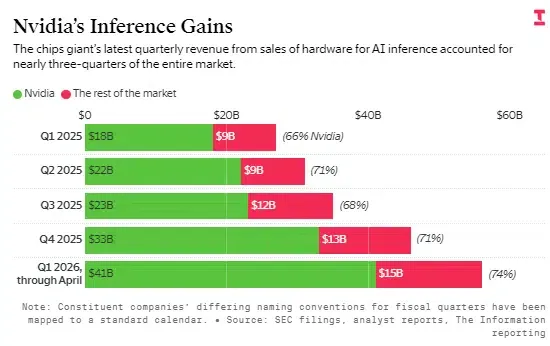
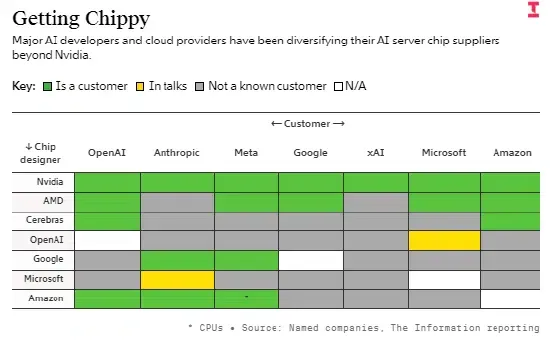
To optimize operational expenditures, infrastructure architects are pursuing disaggregated computing frameworks. Under this multi-vendor paradigm, a single user query is split into separate execution phases and routed to different hardware accelerators based on specific task profiles. This approach allows cloud providers to obtain maximum performance per dollar from existing fleets, which is documented in The Information investigation tracking multi-vendor cloud integrations.
The industry implications of this collaboration extend beyond simple workload distribution. By officially integrating d-Matrix’s Corsair accelerators with NVIDIA’s hardware fleet, the collaboration establishes a validated path for heterogeneous cloud architectures. Instead of forcing customers to choose between standard GPU clusters and emerging custom silicon, the NVIDIA–d-Matrix inference system allows the hardware to operate in concert, enabling infrastructure providers to optimize prefill and decode workloads across different hardware architectures. This architecture allows enterprise cloud teams to extend hardware utilization across diverse inference workloads.

Under-the-Hood Mechanics: Heterogeneous Disaggregated Inference and In-Memory Computing
At the protocol level, answering a natural language prompt requires two distinct processing phases. The first phase, known as prefill, takes the user prompt and computes the initial key-value (KV) activations. This step is highly compute-intensive, making it a perfect fit for the massive parallel arithmetic performance of the NVIDIA Hopper architecture.
The second phase, known as decode, generates the subsequent tokens one by one in a sequential loop. Because each token relies on the previously generated context, the decode phase is heavily memory-bandwidth limited and latency-sensitive. Running this step on high-power GPUs results in significant compute idling, as the cores must constantly wait for memory transactions to complete.
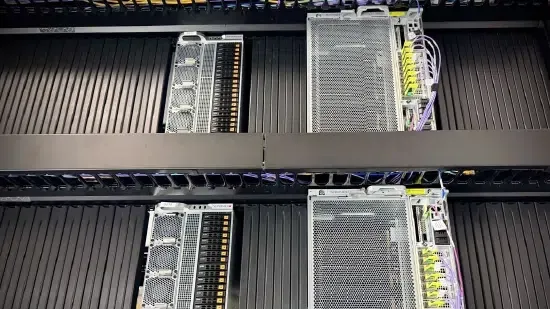
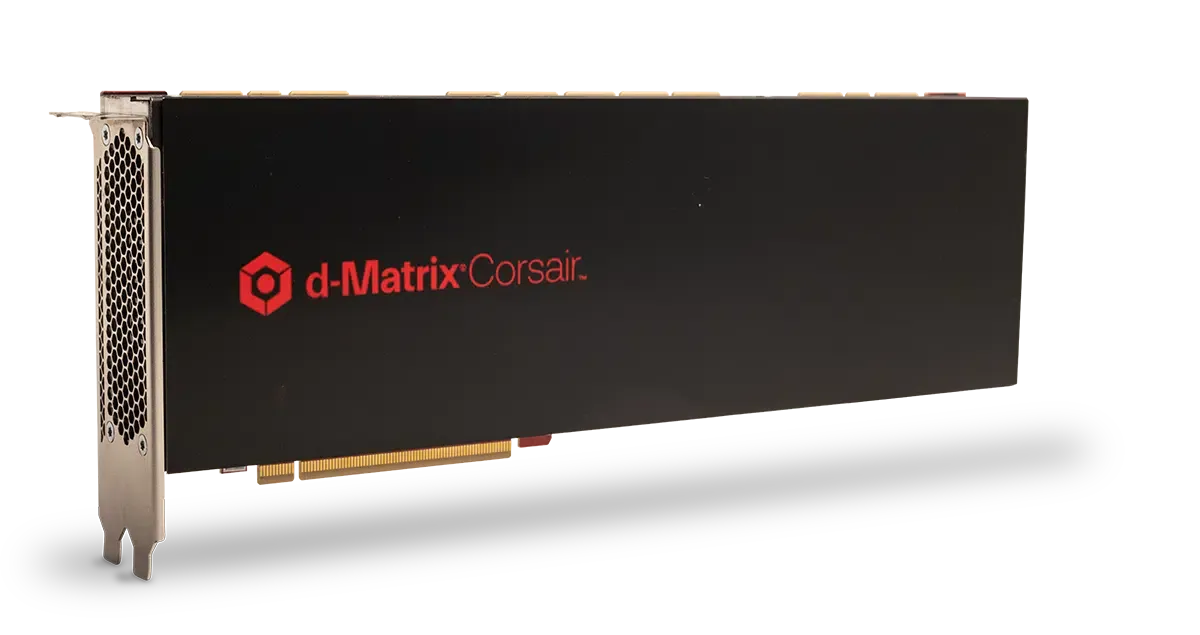
According to d-Matrix’s Corsair architecture documentation, its Corsair accelerator is built around Digital In-Memory Compute (DIMC) chiplet technology. Built on TSMC’s N6 process, the Corsair chip integrates static random-access memory (SRAM) directly alongside the compute units on a single silicon die. This design reduces data movement overhead between memory and compute units. Some inference architectures combine accelerator-level optimization with techniques such as speculative decoding to further reduce latency, as the industry evaluates how NVIDIA Pairs GPUs with in-memory coprocessors to resolve the memory wall. By deploying specialized chips alongside GPUs, the joint system allows the hardware to operate in concert. This structural choice explains why NVIDIA Pairs GPUs with in-memory co-processors to overcome the memory wall.
Analyzing how NVIDIA Pairs GPUs with external accelerators helps developers evaluate the core bottleneck of modern transformer inference. The diagram below illustrates one possible deployment model:
[User Query Input] ──> [Cloud API Gateway]
                             │
                             ├─(Prefill Phase)─> [NVIDIA Hopper/Blackwell GPU] ──> Standard Activations Calculated
                             │                                                            │
                             │                                                            ▼
                             └─(Decode Phase)──> [d-Matrix Corsair Accelerator] ──> Token Generation (SRAM Wafer Cache)
By combining these two distinct technologies, the multi-vendor setup optimizes both stages of the inference pipeline. However, heterogeneous inference does not eliminate GPU demand. Large-scale training and many latency-sensitive workloads will continue to rely on GPU acceleration, maintaining the fundamental necessity of standard processing cores alongside specialized ASICs.
Distributed Inference Also Creates Software Coordination Challenges
The same architectural principle appears beyond hardware infrastructure. In mobile ecosystems, deferred deep linking and app attribution platforms face a comparable challenge: preserving anonymous context when users move from distributed acquisition channels into native applications. Platforms such as OpoInstall are designed to address this state continuity problem through server-side attribution architecture. Both heterogeneous inference and mobile attribution encounter a similar systems challenge: preserving relevant context when execution crosses independent environments. While distributed inference systems coordinate computational states across hardware components, mobile attribution systems preserve acquisition context across user environments. The underlying architectural principle is similar: maintaining continuity when execution crosses independent boundaries. In both cases, once standard client-side state is dropped or blocked during transit, the system requires a server-side state preservation approach to match distributed events anonymously.
Build vs. Buy: Why Distributed Applications Need Server-Side Context Preservation
As cloud environments move toward heterogeneous and distributed execution models, managing session state across separate computing nodes has become a critical operational concern. Transitioning to architectures where NVIDIA Pairs GPUs with customized accelerators forces developers to look closely at pipeline scalability. As distributed computing architectures become more common, teams must evaluate whether to build custom session-matching systems or adopt standardized infrastructure. Understanding the efficiency gains of heterogeneous acceleration helps teams evaluate infrastructure provisioning costs.
Architectural Evaluation: Custom Build vs. Standardized SDK
Building an in-house database system to track session data across multiple cloud instances offers custom parameter control but introduces significant maintenance complexity. Developers must manually handle API request routing, manage token lifecycle policies, and constantly update security configurations to comply with shifting regional regulations. Conversely, deploying a pre-built, certified SDK reduces this ongoing engineering burden, ensuring predictable integration costs.
The table below compares standard methodologies for managing session state and conversion context:
| Solution | State Persistence | Data Throughput | Best For |
|---|---|---|---|
| In-house Session Database | High (Continuous Sync) | Medium (DB Latency Limits) | Custom enterprise environments with highly specialized storage logic |
| Browser-based Session Tracking | Low (Session Cookies) | Low (No Server Logging) | Basic website tracking with minimal cross-domain conversion requirements |
| Server-side Attribution Platform (example: OpoInstall) | High (Privacy-aware server-side restoration) | High (Standardized Sandbox) | Large-scale mobile app and multi-platform campaign attribution |
While custom database configurations can handle basic context, specialized server-side state preservation can optimize development resources. Depending on implementation requirements, organizations may build their own server-side session management system or adopt commercial platforms. For instance, OpoInstall provides server-side attribution infrastructure that restores campaign context after users move between web, app stores, and native applications. This server-side state restoration and parameter pass-through framework maps session metadata directly to a privacy-aware attribution data layer, ensuring campaign parameter preservation, deferred deep linking, and attribution continuity without introducing client-side codebase bloat or relying on persistent client-side identifiers.
Integration Checklists: How Engineering Teams Can Prepare for Platform Changes
To maintain data continuity as workloads transition between local processing blocks and remote multi-vendor data centers, development teams must establish clean state governance pipelines.
Developer Implementation Checklist
- Enforce Edge Session Mapping: Configure net-level gateways to assign unique, cryptographically signed session tokens to all incoming API requests.
- Deploy Asynchronous Token Handshakes: Transition system dependencies to server-side session state restoration, utilizing temporary tokens to pass user parameters securely across endpoints.
- Audit Third-Party SDK Footprints: Regularly evaluate the size and compilation dependencies of all integrated libraries to prevent performance bottlenecks.
Product & Growth Strategy Checklist
- Optimize Conversion Funnels: Leverage non-intrusive parameter pass-through frameworks to maintain acquisition tracking without violating user privacy guidelines.
- Implement Transparent Data Routing: Reconstruct user experience flows to clearly explain when and where external AI processing paths are utilized.
- Monitor API Workflow Latency: Track standard latency metrics from initial campaign clicks to server-side installation matching to confirm data continuity.
By establishing these structured guidelines, development teams can transition their applications to safer, more compliant architectures while maintaining operational continuity.
Frequently Asked Questions (FAQ)
Why is the strategic collaboration representing how NVIDIA Partners with d-Matrix occurring instead of direct competition?
Why doesn't NVIDIA build its own inference ASICs?
What is heterogeneous disaggregated inference and how does it optimize cloud costs?
What problem does d-Matrix solve compared with GPUs?
How does server-side attribution work when users move from web to mobile apps?
Why do mobile apps need server-side attribution in privacy-focused environments?
Key Takeaways for Engineering Teams
As AI platforms increasingly rely on hybrid cloud inference, developers need to redesign products around privacy, transparent consent, and secure data routing. Evolving data architectures require a fundamental shift in how we build and measure digital experiences. As stateless proxies and headless scrapers become standard consumers of web content, traditional client-side attribution models will continue to degrade. Relying on standard cookies and referrers is no longer sufficient to secure the data pipelines that drive user acquisition.
Rather than replacing GPUs, NVIDIA is redefining how inference workloads are deployed. As AI serving eclipses model training, heterogeneous systems that combine GPUs with specialized ASICs are likely to become the standard architecture for enterprise AI infrastructure. The optimal hardware mix depends on workload characteristics, latency requirements, model size, and infrastructure economics. While heterogeneous inference offers significant cost advantages, standard architectures will continue to evolve alongside specialized accelerators. For mobile growth teams, adopting server-side attribution infrastructure can help preserve acquisition intelligence across increasingly fragmented digital journeys. OpoInstall provides this attribution layer by preserving acquisition context across web, app stores, and native application environments.
Share this article