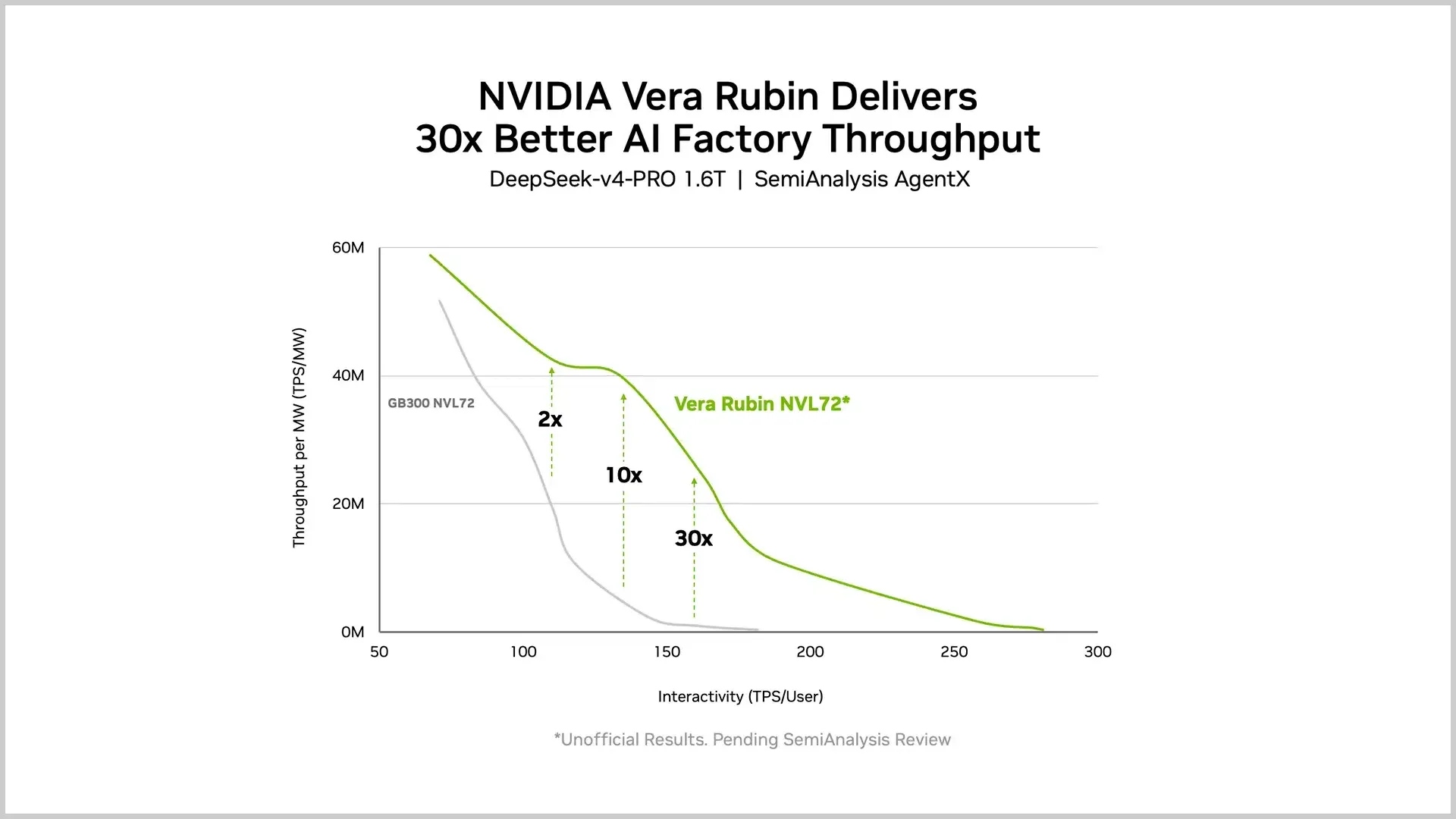
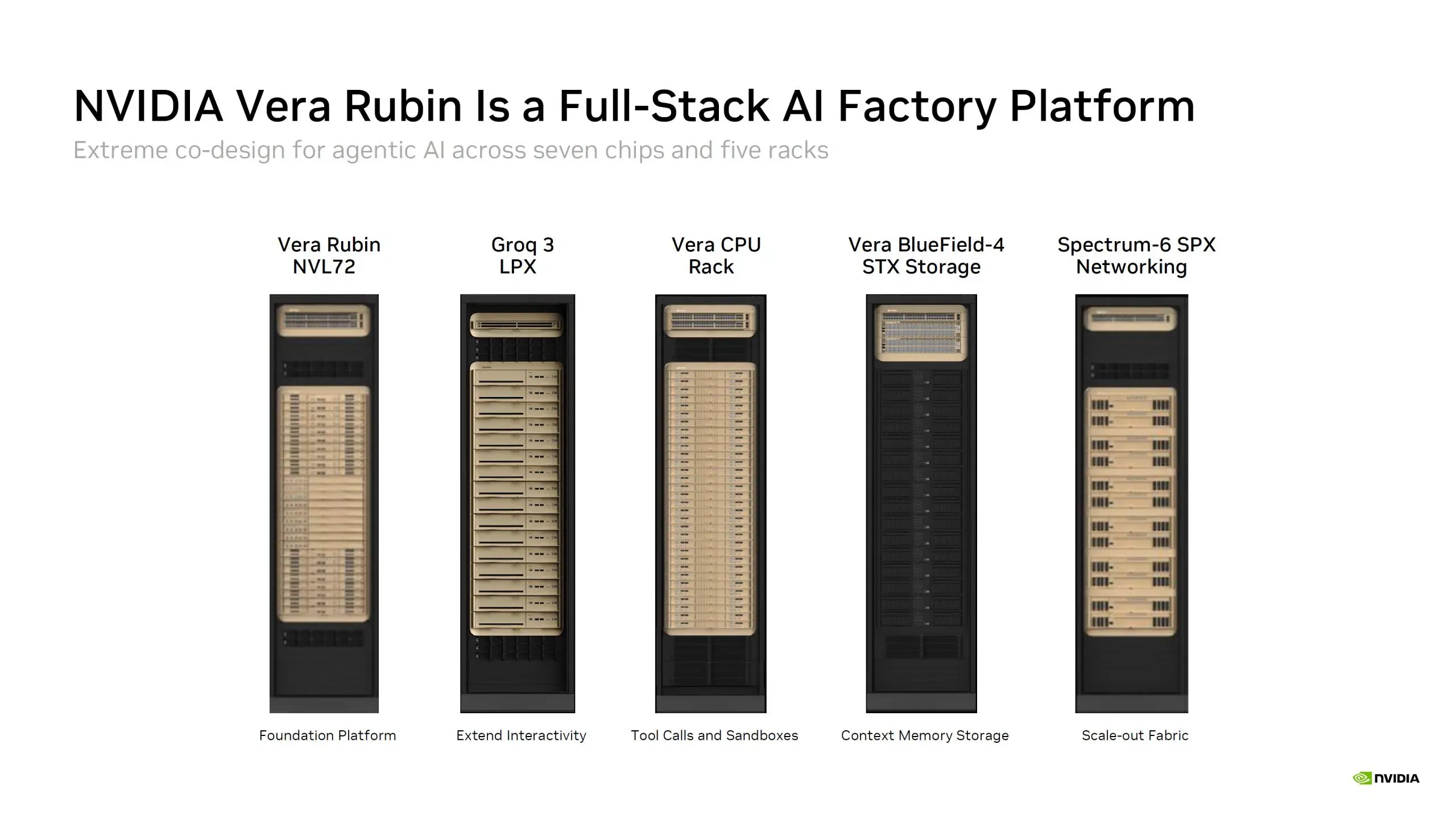
NVIDIA Ships Rubin NVL72? New on-silicon performance data reveals that the Vera Rubin NVL72 platform delivers up to 30x higher throughput per megawatt and 35x lower token costs for agentic AI workloads compared with GB300 NVL72 under the tested AgentX configuration, establishing a new hardware efficiency baseline for power-constrained AI factories. As autonomous software agents transition from experimental single-turn prompts into multi-step production pipelines, computational demand is expanding rapidly. OpenRouter usage data cited by NVIDIA indicates that a single agentic request consumes about 15 times as many tokens as an ordinary chat request because agents repeatedly query databases, retrieve external documents, spawn sub-agents, and maintain long-context memory. To sustain this high-density throughput within fixed data center power envelopes, server architectures are shifting toward extreme hardware-software co-design.
Core Industry Realignment & News Breakdown: Vera Rubin NVL72 for Agentic AI Scale
At a Glance
- On-silicon performance data released on August 24, 2026, shows Vera Rubin NVL72 delivering up to 30x higher throughput per megawatt than GB300 NVL72 on agentic coding workloads, with the results measured by NVIDIA using the SemiAnalysis AgentX workload and currently pending SemiAnalysis review.
- Multi-step autonomous agents consume roughly 15 times more tokens than standard chatbot interactions, making power availability, throughput per megawatt, and token economics increasingly important constraints for AI infrastructure.
- The platform combines disaggregated serving, distributed KV caching, KV-aware routing, NVFP4 precision, rack-scale networking, and broader hardware-software co-design, contributing to NVIDIA’s reported reductions in token cost of up to 35x versus GB300 NVL72 under the tested AgentX configuration.
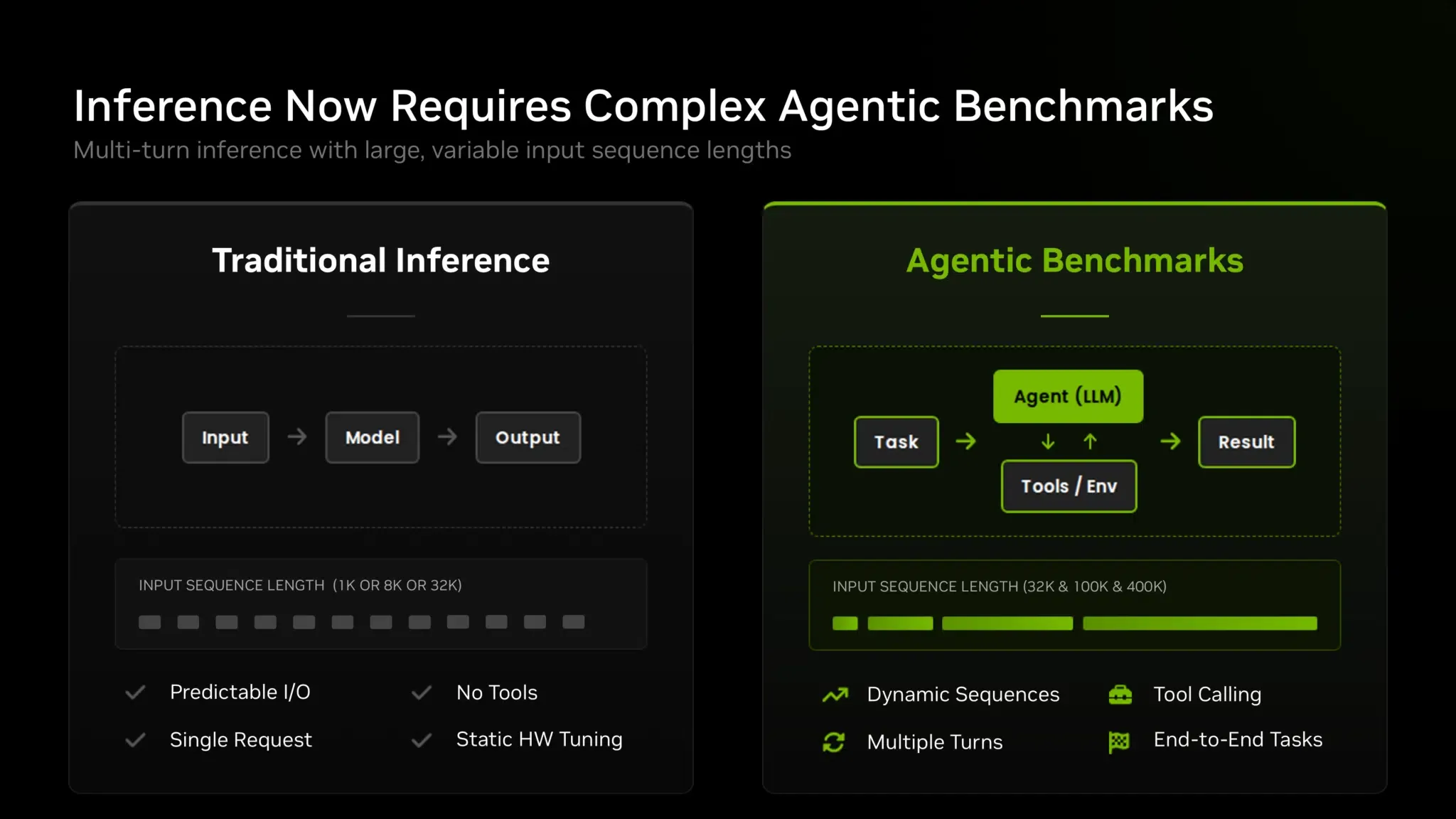
The transition from basic chatbot interfaces to autonomous agentic workflows is driving a structural transformation in data center engineering. Standard single-turn interactions typically operate within concise input-output boundaries ranging between 1,000 and 8,000 tokens. In contrast, autonomous agents execute iterative reasoning loops where every tool invocation, database retrieval, and intermediate output accumulates into the context window of subsequent steps. This compounding context creates irregular bursts of computation followed by periods of network latency, straining traditional inference servers designed for static prompt-and-response workloads.
To evaluate infrastructure performance under these realistic conditions, hardware benchmarks are moving away from fixed-length sequence evaluations toward dynamic session replays. Using the SemiAnalysis AgentX benchmark suite, NVIDIA measured sustained system throughput across replayed production-style coding trajectories from leading models, including DeepSeek V4 Pro, Kimi K3, and GLM-5.3. The recorded sessions preserve realistic context growth, tool-call intervals, and sub-agent spawning patterns to test how efficiently hardware converts raw power into usable output, as detailed in the NVIDIA corporate technical announcement. The Vera Rubin results reflect these early measurements and are currently pending SemiAnalysis review.
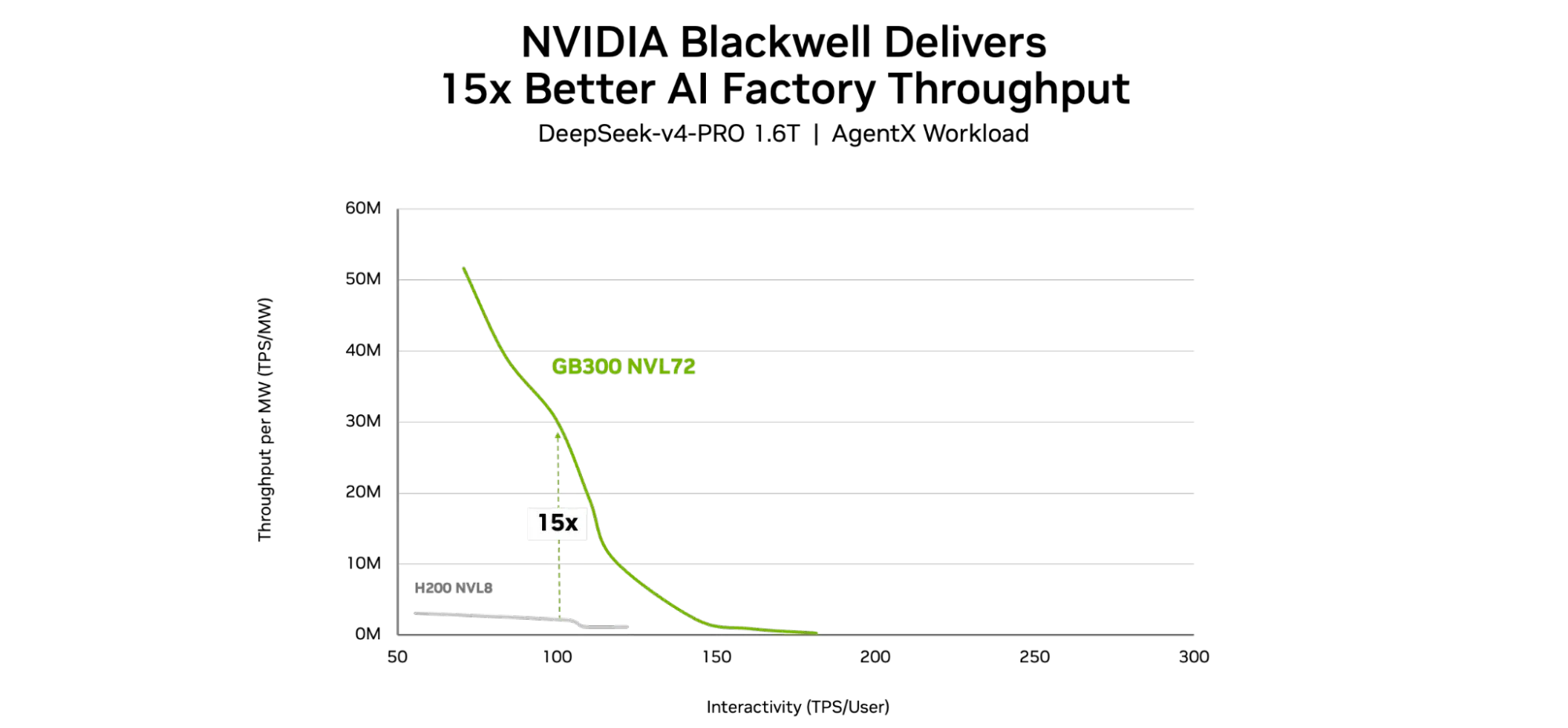
The measured efficiency leap across the Vera Rubin platform demonstrates a major shift in how accelerated computing platforms are evaluated. In power-constrained AI factories, throughput per megawatt determines total operating capacity, while cost per million tokens governs gross margins. Benchmark results indicate that Blackwell GB300 NVL72 delivers up to 15x higher throughput per megawatt and 10x lower token costs compared to Hopper H200 systems. The Vera Rubin architecture extends this efficiency curve further, achieving up to 30x higher throughput per megawatt than GB300 at interactive serving targets of 160 tokens per second per user on DeepSeek V4 Pro workloads, as reported in the NVIDIA Developer Blog report.
Under-the-Hood Architectural Disconnection: Disaggregated Serving and KV-Cache Routing
The performance gains of the Rubin architecture stem from addressing the fundamental physical mismatch between the prefill and decode stages of large language model inference. The prefill phase processes the incoming prompt and is compute-bound, benefiting from high parallel arithmetic throughput. In contrast, the decode phase generates tokens sequentially and is typically more memory-bandwidth-sensitive, especially at smaller interactive batch sizes, because token generation repeatedly accesses model weights and KV state.
To eliminate this operational friction, modern AI factory architectures implement disaggregated serving. This technique separates prefill and decode execution across independently scaled worker pools, allowing each stage to scale independently and match generation rates dynamically across the server cluster.
Memory Optimization: Distributed Caching and NVLink Scale-Up Domains
In long-running agentic sessions, recomputing previously processed tokens creates massive computational redundancy. To preserve efficiency, serving frameworks deploy distributed key-value (KV) caching across the high-speed interconnect domain, allowing GPUs to share and reuse context without redundant prefill calculations.
The diagram below illustrates the architectural separation between disaggregated prefill processing and KV-aware decode generation:
[Incoming Multi-Step Agent Request (Cumulative Context)]
                           │
                           ▼
    [ Disaggregated Prefill Worker Pool ] ──> Accelerated Context Encoding
                           │
                           ▼ (Context State Transfer via High-Bandwidth Fabric)
    [ KV-Aware Routing Dispatcher (Dynamo) ] ──> Matches Cached Worker Node
                           │
                           ▼
    [ Disaggregated Decode Worker Pool ]  ──> Low-Latency Token Generation
To support these distributed memory techniques, the system utilizes sixth-generation interconnect switching that delivers substantially higher packet rates and lower latency than off-the-shelf networking. Spanning optimized CUDA kernels, runtime libraries like TensorRT-LLM, and coordination frameworks like NVIDIA Dynamo, the serving layer routes requests directly to execution nodes that already hold relevant cached context. NVIDIA states that its DSX MaxLPS power-management technologies can provision up to 40% more GPUs within the same megawatt budget, further maximizing throughput at utility scale.
This full-stack approach demonstrates a broader technical principle: scaling modern AI workloads requires eliminating redundant computation and optimizing memory transport across every layer of the system. In distributed software engineering, parallel efficiency principles apply across high-throughput data pipelines, where architectures separate ingestion from state reconciliation to prevent processing bottlenecks.
Decoupled Systems & Comparison Analysis: Monolithic Serving vs. Co-Designed AI Factories
As high-concurrency architectures evolve toward disaggregated, server-side processing, engineering teams must evaluate how infrastructure design impacts unit economics. Deploying production-grade agentic pipelines requires backend systems that maximize throughput per megawatt while minimizing the cost per million tokens. Organizations must evaluate whether traditional monolithic serving instances can sustain agentic workloads or whether dedicated co-designed architectures are required.
Architectural Evaluation: Traditional Serving vs. Disaggregated Platforms
Deploying monolithic serving instances where each GPU handles both prefill and decode stages leads to severe resource underutilization during long-context agentic turns. While monolithic deployments offer simple initial setup, they suffer from compute starvation during decode phases and memory capacity limits during prefill bursts. In contrast, disaggregated AI factory architectures dynamically decouple context encoding from token generation, maintaining high utilization across both compute and memory domains.
The table below outlines key architectural trade-offs across different inference serving methodologies:
| Architecture Model | Context Scaling Strategy | Prefill/Decode Allocation | Throughput per Megawatt | Token Cost Economics |
|---|---|---|---|---|
| Monolithic Single-Node Serving | Static Memory Allocation | Tightly Coupled | Baseline | Standard High Baseline |
| Coupled Clustered Inference | Shared Resource Pools | Homogeneous Worker Allocation | Moderate (Workload Dependent) | Standard Clustered Rate |
| Disaggregated Co-Designed AI Factory | Distributed KV-Cache Routing | Fully Disaggregated & Independent | Up to 30x vs GB300 (Reported) | Up to 35x Lower Cost vs GB300 |
This structural shift represents a form of inference cost deflation: each fixed megawatt of data center capacity can produce materially more useful agentic work. By combining hardware acceleration with intelligent workload routing, operators can sustain interactive performance across complex, long-horizon tasks.
Engineering Checklist & Verification Schedules: Optimizing Rack-Scale Agentic Telemetry
To prepare data center infrastructure and application pipelines for high-throughput agentic workloads, technical and operations teams should establish structured optimization practices.
Developer Implementation Checklist
- Decouple Prefill from Decode Workers: Separate compute-heavy context ingestion from memory-bound token generation into independently scaled worker pools to maximize processor utilization.
- Implement KV-Cache-Aware Routing: Configure API gateways and load balancers to route incoming multi-turn requests to worker nodes that already store relevant cached context.
- Evaluate Lower-Precision Quantization: Benchmark NVFP4 and mixed-precision execution paths across target models to reduce memory footprint while verifying output reasoning stability.
Operations & Economics Checklist
- Monitor Throughput per Megawatt: Track sustained tokens per megawatt across live workloads rather than relying exclusively on isolated single-request latency benchmarks.
- Audit Token Unit Economics: Measure the all-in infrastructure cost per million tokens across multi-step agent trajectories to maintain sustainable profit margins.
- Profile Time-to-First-Token (TTFT): Monitor initial response latency during long-context prefill phases to ensure high-throughput batching does not compromise interactive user experience.
Adopting these operational methodologies enables engineering teams to deploy responsive, long-horizon agentic systems while maintaining strict infrastructure cost governance.
Frequently Asked Questions (FAQ)
Why do agentic AI workloads consume 15 times more tokens than standard chatbot queries?
How does disaggregated serving improve AI factory throughput per megawatt?
What is the difference between Blackwell GB300 NVL72 and Vera Rubin NVL72 efficiency metrics?
Key Takeaways for Engineering Teams
The hardware advancements demonstrated across the Vera Rubin NVL72 platform highlight an essential shift in computing infrastructure: scalable AI operations require full-stack co-design across silicon, memory architectures, and software runtimes. As multi-step autonomous agents become the standard interface for enterprise software, traditional monolithic serving models are being replaced by disaggregated, memory-centric systems.
For infrastructure architects and engineering leaders, navigating this high-throughput era requires adopting decoupled system principles across data center pipelines. By implementing disaggregated serving, distributed context caching, and intelligent workload routing, organizations can build resilient computing architectures capable of scaling agentic intelligence efficiently within fixed utility power budgets.
Share this article