How does probabilistic attribution work under strict privacy rules? Probabilistic attribution works by calculating statistical correlation probabilities across transient, non-persistent session signals—such as coarse network context, coarse browser compatibility signals, and temporal proximity—within a constrained lookback window, without generating persistent cross-app device identifiers.
Probabilistic attribution is a statistical measurement methodology that calculates the mathematical likelihood that an application installation is statistically associated with a marketing interaction. Rather than establishing a verified user identity, probabilistic models estimate conversion relationships by correlating non-unique, transient session signals within a constrained temporal window.
| Term | Definition |
|---|---|
| Probabilistic Attribution | Statistical correlation of non-persistent session signals to estimate install origins. |
| Attribution Model | A mathematical rule determining how conversion credit is distributed across marketing touchpoints. |
| Mobile Attribution | The measurement framework used to identify marketing sources that drive app installs and conversions. |
| Tracking Parameters | First-party contextual query keys appended to campaign URLs to transmit routing metadata. |
Executive Summary
In the post-IDFA mobile landscape, engineering teams cannot rely on persistent device identifiers for deterministic install matching. Probabilistic attribution provides a statistical estimation framework that evaluates transient, shared session context—such as coarse network signals, general browser environment characteristics, and event timestamps recorded within a limited attribution window—to measure aggregate campaign performance.
This guide outlines the mathematical foundations of probabilistic scoring, establishes the regulatory boundaries separating ephemeral session matching from prohibited device fingerprinting under Apple’s App Tracking Transparency (ATT) framework, highlights key platform constraints (such as iCloud Private Relay), and demonstrates how first-party routing layers operate alongside platform-native APIs like Apple AdAttributionKit and Google Play Install Referrer.
Important Regulatory Boundary: Probabilistic attribution does not bypass Apple’s App Tracking Transparency requirements. Any implementation that combines signals to identify or track users across apps or websites owned by other companies may constitute tracking and require explicit ATT authorization under Apple platform policies. This article describes technical measurement architectures and does not constitute legal advice regarding privacy compliance requirements.
Short Answer: How Probabilistic Attribution Functions Under Modern Privacy Rules
Probabilistic attribution calculates an estimated conversion probability between an ad interaction and an app launch by evaluating transient, shared contextual attributes. The architecture operates under specific operational boundaries:
-
Statistical Confidence Scoring: Instead of binary matches, the engine computes an illustrative confidence score (
S \\in \[0.0, 1.0\] ) derived from temporal proximity, coarse network context, and general environment properties. -
Decay Functions: Attribution confidence decreases exponentially as the time delta between the web click and the native app launch increases.
-
Compliance Boundaries: Statistical modeling cannot be used to circumvent platform privacy policies. Under Apple’s App Tracking Transparency (ATT) framework, the absence of a persistent identifier alone does not determine compliance; non-persistent signals may still constitute tracking when combined for identifying or linking a user or device across apps or services.
End-to-End Production Pipeline Architecture
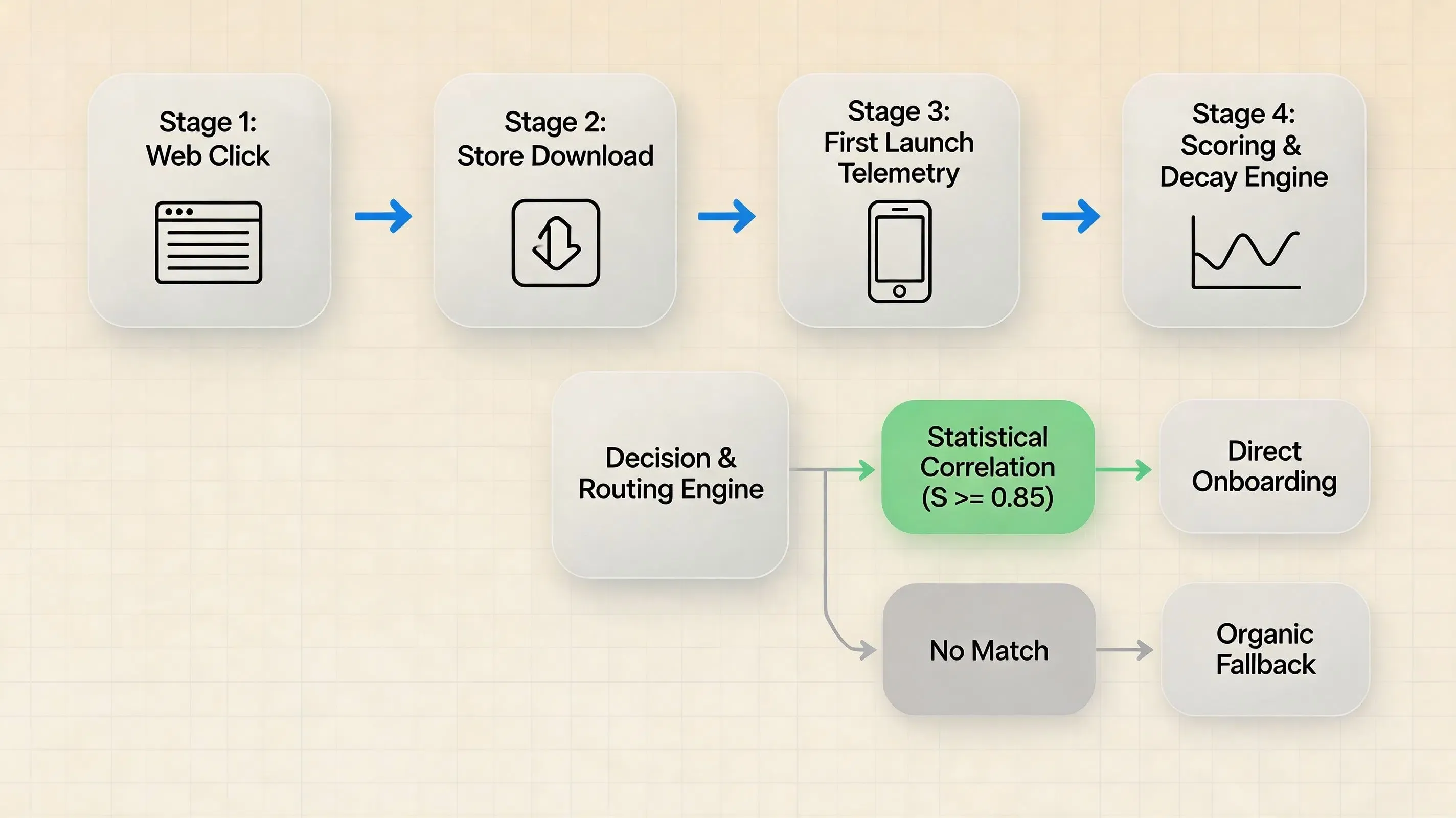
A production-grade probabilistic attribution and routing pipeline decouples transient telemetry collection from persistent identity storage:
[User Web Click] ──> [First-Party Routing / Ephemeral Context Logger]
                                  │
                                  ▼
[Store Redirection] ──> [App Store / Google Play] ──> [App Install]
                                                          │
                                                          ▼
[First App Launch] ──> [SDK Initialization Telemetry (Local Context)]
                                  │
                                  ▼
[Backend Processing] ──> [Entropy Weighting & Decay Scoring Pipeline]
                                  │
                                  ▼
[Decision Engine] ──> [Aggregate Campaign Reporting / Direct Onboarding]
What Is Probabilistic Attribution and How Does It Operate Without Device Identifiers
The Structural Transition from Deterministic Identity to Statistical Inference
Deterministic attribution requires an identical, unique identifier present at both ends of a conversion funnel (such as matching an ad-click IDFA with an in-app IDFA). When platform privacy frameworks—such as Apple App Tracking Transparency (ATT)—restrict access to these identifiers, deterministic joins become unavailable for non-consenting users.
Probabilistic attribution replaces exact identifier lookups with statistical inference. When a user clicks a campaign link on a web page, the attribution server logs an engagement record containing contextual telemetry. When an installation occurs, the client SDK transmits an initial launch context. The attribution engine estimates whether the observed events are statistically consistent with the same marketing interaction pathway. This statistical approach does not establish a verified user identity.
Core Input Vectors in Ephemeral Session Matching
A probabilistic attribution engine evaluates non-persistent metadata vectors composed of multiple contextual signals:
-
Network Context: Network-derived context signals processed in aggregated or coarse forms, subject to privacy requirements and applicable platform policies.
-
Device Environment Properties: General application and browser environment characteristics used strictly for session compatibility analysis.
-
Locale and Configuration: Device language settings, regional locale, and active timezone offset.
-
Temporal Proximity: Event timestamps recorded within a limited attribution window measuring the elapsed duration between the click event (
) and the initial app launch ( ).
Lookback Windows and Temporal Decay in Probabilistic Engines
Because individual contextual signals (such as general browser attributes or coarse network environments) are shared among thousands of devices, probabilistic models enforce short, restrictive lookback windows. While legacy deterministic windows typically spanned 7 to 30 days, probabilistic matching windows are constrained to short intervals (often 1 to 24 hours). Beyond this threshold, the statistical entropy of shared network environments degrades rapidly, increasing false-positive collision rates.
How Statistical Attribution Models Are Evaluated
Probabilistic attribution model performance and confidence reliability are inherently dynamic, depending on traffic composition, signal availability, and operational constraints:
-
Traffic Density and Subnet Size: In low-density regional networks, model confidence calibration is statistically stronger; in dense enterprise environments sharing a single network gateway, confidence degrades unless constrained by strict temporal windows.
-
Elapsed Time Delta: Model reliability is highest when app launch occurs within minutes of a web click and decays exponentially over time.
-
Aggregate vs. Individual Precision: Probabilistic attribution can provide directional, model-based estimates for campaign analysis when implemented within privacy and statistical validation constraints, but it does not provide individual-level certainty.
For growth and marketing teams:
-
What it answers: “Which marketing campaign or channel statistically contributed to this installation volume?”
-
What it does not answer: “Which specific, persistent individual user clicked this advertisement?”
What Probabilistic Attribution Cannot Do
To establish realistic engineering expectations, architectures must clearly document the technical limits of statistical modeling:
-
Cannot Recover IDFA Precision: Probabilistic modeling does not recreate deterministic, binary user-level tracking.
-
Cannot Replace Platform Postbacks: Statistical estimation cannot substitute for cryptographically signed attribution postbacks from Apple AdAttributionKit or SKAdNetwork.
-
Cannot Construct Cross-App Identity: Modeling must not generate persistent cross-app profiles or user graphs without explicit ATT consent.
-
Cannot Guarantee Conversion Delivery: In environments where network context shifts (e.g., cellular-to-Wi-Fi transitions), probabilistic confidence naturally drops to zero, requiring graceful degradation.
The Mathematical Foundations of Probabilistic Attribution Models
Probabilistic Scoring Models and Bayesian Interpretation
Probabilistic attribution calculates the posterior probability
Where:
-
represents the difference vector between click and launch telemetry. -
is the likelihood of observing vector for true conversion journeys. -
represents the prior probability that an observed click-install pair represents a true conversion before contextual evidence is evaluated. -
is the marginal probability of observing vector across all active users in that network segment.
Production attribution systems may implement this concept through Bayesian models, calibrated classifiers, or weighted scoring pipelines rather than a single probabilistic formulation. An installation is associated with a campaign touchpoint only when the composite confidence score exceeds a pre-configured threshold (e.g.,
Practical Trace Example: Scoring a Web-to-App Conversion
To illustrate how the scoring model processes discrete telemetry events in practice:
-
Click Event (
): Time = 10:00:00 UTC, Platform = iOS, Browser = Safari, Locale = en-US, Network = Coarse Regional Gateway -
Install Event (
): Time = 10:08:30 UTC ( ), Platform = iOS, Browser = Safari, Locale = en-US, Network = Coarse Regional Gateway
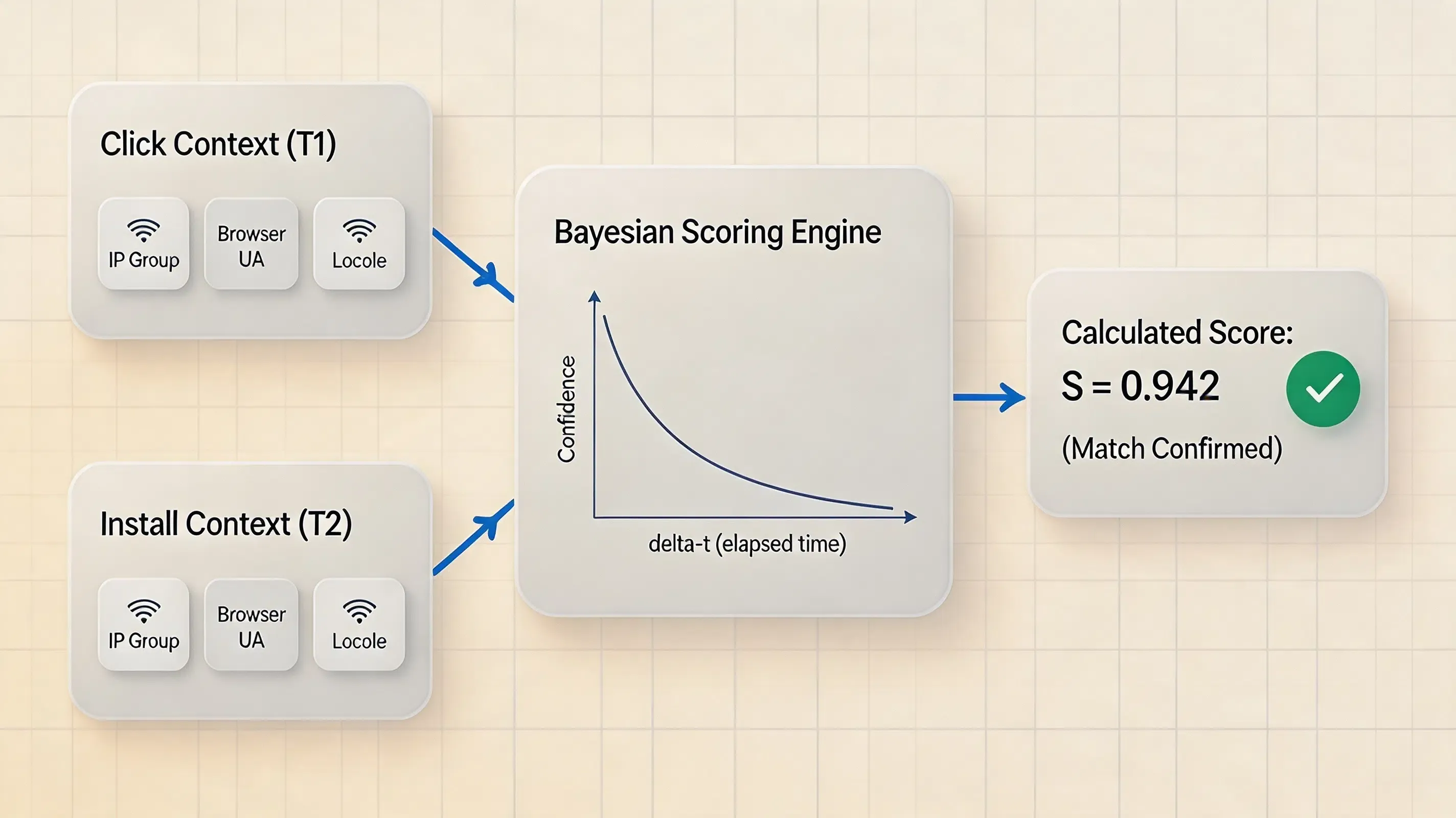
Because the temporal proximity is tight (
Vector Similarity Functions and Temporal Metric Alignment
To evaluate environmental similarity, engines calculate normalized distance metrics and convert them into statistical confidence:
-
Continuous Temporal Metrics: The temporal distance
increases with time elapsed, bounded between 0 and 1: decays as distance increases: represents the characteristic half-life decay constant of the campaign channel. -
Categorical Features (Browser Capabilities, Locales): Evaluated using weighted Jaccard similarity across discrete attribute sets
and :
[Web Ad Click: Context Payload (T1)] ──> [Transient Cache: Coarse Net + UA + Time]
                   │                                      │
                   ▼                                      ▼
        [User Redirects to Store]             [Mathematical Scoring Engine]
                   │                          P(Match | x) = f(Δt, Net, Env)
                   ▼                                      │
        [App Launch: SDK Telemetry (T2)] ──>  [Correlation Threshold Verification]
                   │                                      │
                   ▼                                      ▼
     [Statistical Correlation Estimated] <──> [Statistical Confidence Score ≥ 0.85]
Feature Weighting and Discriminatory Power
Not all contextual signals carry equal discriminatory power. In dense enterprise networks or public hubs, raw network signals yield low uniqueness. Features may receive different statistical weights for aggregate model calibration while strictly avoiding individual device identification.
Individual device attributes should remain coarse-grained and must never be combined into a persistent device-level identifier.
How Signal Entropy and Temporal Decay Determine Attribution Confidence
The Exponential Decay Function of Time-to-Install
Attribution confidence decays exponentially as the time between click and install increases. The temporal confidence multiplier
Where:
-
is the baseline initial confidence multiplier ( ). -
is the elapsed duration. -
is the campaign-specific half-life parameter (e.g., for direct web ads).
If a user installs within 15 minutes of clicking,
Handling Dynamic IP Allocations and Carrier-Grade NAT
Mobile network operators utilize Carrier-Grade NAT (CGNAT), routing tens of thousands of mobile devices through pooled public IPv4 gateways. Under CGNAT architectures, two completely unrelated devices in the same metropolitan area may share an identical public IP address.
Probabilistic attribution engines address CGNAT pooling by:
-
Coarse Signal Processing: Using network-derived context only as a coarse environmental signal, such as regional aggregation, rather than as a standalone identity matching key.
-
Multi-Attribute Cross-Validation: Requiring consistent application context, coarse browser compatibility signals, and language headers to validate a correlation.
-
Traffic Volume Throttling: Monitoring click-to-install ratios per IP pool to identify and penalize anomalous traffic spikes from proxy networks.
-
Purpose & Retention Constraints: Network-derived signals should only be evaluated within the declared attribution purpose and retention period, and should not contribute to persistent cross-context identity resolution.
Developers and data architects can consult the attribution modeling documentation for technical specifications regarding session payload handling.
The JSON schema below illustrates the structured telemetry payload used by a statistical attribution scoring engine:
{
“event_type”: “attribution_scoring_request”,
“click_context”: {
“event_reference”: “ephemeral_click_event_ref”,
“timestamp_utc”: “2026-08-17T07:15:00Z”,
“ttl_seconds”: 86400,
“network_context”: {
“region_group”: “us-west”
},
“environment_metadata”: {
“platform_family”: “mobile_os”,
“browser_family”: “mobile_browser”,
“locale_group”: “en-region”
},
“campaign_metadata”: {
“channel_code”: “web_display_01”,
“campaign_id”: “cmp_fall_launch”,
“custom_token”: “example_referral_token”
}
},
“install_context”: {
“event_reference”: “ephemeral_launch_event_ref”,
“timestamp_utc”: “2026-08-17T07:22:30Z”,
“network_context”: {
“region_group”: “us-west”
},
“environment_metadata”: {
“platform_family”: “mobile_os”,
“browser_family”: “mobile_browser”,
“locale_group”: “en-region”
}
},
“scoring_parameters”: {
“elapsed_time_seconds”: 450,
“temporal_half_life_seconds”: 7200,
“calculated_confidence_score”: 0.942,
“confidence_threshold”: 0.85,
“match_disposition”: “STATISTICAL_CORRELATION_ESTIMATED”
}
}
Probabilistic Attribution vs Fingerprinting: Key Differences
Understanding the fundamental boundaries separating compliant statistical modeling from prohibited device fingerprinting is essential for engineering governance:
| Architectural Dimension | Compliant Probabilistic Attribution | Persistent Device Fingerprinting |
|---|---|---|
| Primary Purpose | Ephemeral campaign performance measurement | Long-term cross-app user identification |
| Data Retention | Strict Time-to-Live ( |
Persistent, historical storage |
| Identity Graphs | None (Zero cross-app graphs) | Yes (Constructs multi-app device profiles) |
| Signal Granularity | Coarse, aggregated environmental context | High-entropy hardware/browser signatures |
| ATT Compliance Impact | Depends on purpose, data sharing, and policy | Generally constitutes prohibited tracking |
Technical Differences Between Contextual Session Matching and Device Fingerprinting
Defining the Regulatory and Architectural Boundaries under Apple ATT
A critical technical and compliance distinction exists between ephemeral contextual matching and persistent device fingerprinting:
-
Persistent Device Fingerprinting (Prohibited): The practice of harvesting persistent hardware configurations, audio stack signatures, battery status, or font lists to generate a permanent, unique device hash. The intent is to track a specific user across unrelated applications and websites over time without user consent.
-
Contextual Session Matching: The ephemeral correlation of non-unique, temporary session context associated with a single conversion workflow initiated through a marketing interaction (e.g., clicking a link and immediately downloading the app). A compliant implementation should scope the data to the specific conversion workflow, enforce limited retention, and prevent reuse for unrelated tracking purposes. Compliance depends on implementation details, including data handling, purpose limitation, user expectations, and whether signals are used for cross-app or cross-service tracking.
According to Apple’s User Privacy and Data Use documentation, deriving data from a device for the purpose of uniquely identifying it across third-party apps constitutes tracking, which requires explicit ATT authorization. Under Apple’s ATT framework, the absence of a persistent identifier alone does not determine compliance; non-persistent signals may still constitute tracking when combined for identifying or linking a user or device across apps or services. The purpose, recipients, and usage pattern of collected signals remain the deciding factors. The same technical mechanism may have different privacy implications depending on purpose, data retention, disclosure, and user expectations.
Probabilistic attribution is a measurement technique, not a substitute for user consent mechanisms or platform-provided attribution APIs.
Data Minimization and Privacy Engineering
To align with platform privacy policies and data protection standards:
-
Zero Persistent Identity Graphs: Raw contextual vectors must never be appended to historical user profiles or cross-app identity graphs.
-
Automatic TTL Purging: Caching layers must enforce automatic expiration policies (Time-to-Live
). Unmatched click records must be deleted or expired according to predefined retention policies. -
Network Signal Minimization: Network-derived signals should be minimized, truncated, or aggregated according to the intended purpose. Hashing alone does not make an identifier anonymous due to the finite search space of IP addresses.
What ID-Free Attribution Does Not Mean
ID-free attribution does not mean identifier-free analytics. Applications may still process internal user account IDs, authenticated login credentials, or first-party session tokens required for core product functionality. The architectural objective is to eliminate reliance on restricted, cross-app advertising identifiers for install matching, rather than claiming that all application telemetry is entirely anonymous.
Key Platform Constraints of Probabilistic Measurement
Engineering teams evaluating probabilistic architectures must account for fundamental platform limitations:
-
No Access to Signed Postbacks: Probabilistic models cannot generate cryptographically verified postbacks directly from the mobile operating system; they produce server-side statistical estimates.
-
No SKAN Conversion Values: Statistical session matching cannot decrypt or read Apple SKAdNetwork or AdAttributionKit conversion values embedded in store transactions.
-
iCloud Private Relay Masking: On iOS devices with iCloud Private Relay active, Safari routes traffic through dual-hop encrypted proxies, standardizing outgoing IP addresses to regional proxy egress nodes and significantly reducing network signal entropy.
-
Opt-Out Enforcement: Probabilistic systems must respect user opt-out preferences and cannot be used to reconstruct cross-app identities for users who have denied ATT tracking permission.
Probabilistic Attribution vs SKAN and AdAttributionKit
Growth teams evaluating iOS measurement often compare probabilistic modeling with Apple’s platform-native frameworks (SKAdNetwork and AdAttributionKit):
| Architectural Dimension | Apple AdAttributionKit / SKAN | Probabilistic Session Modeling |
|---|---|---|
| Data Authority | Deterministic cryptographic signatures validated by Apple | Statistical confidence estimation calculated by server |
| Reporting Latency | Delayed postbacks (governed by randomized timers) | Near real-time estimation upon first app launch |
| Conversion Granularity | Aggregated campaign IDs and coarse/fine conversion values | Session-level parameters (e.g., specific referral tokens) |
| ATT Prompt Requirement | Does not require an ATT authorization prompt | Must avoid cross-app tracking without ATT authorization |
| Primary Use Case | Paid ad network ROI calculation and media mix modeling | First-party onboarding restoration and instant routing |
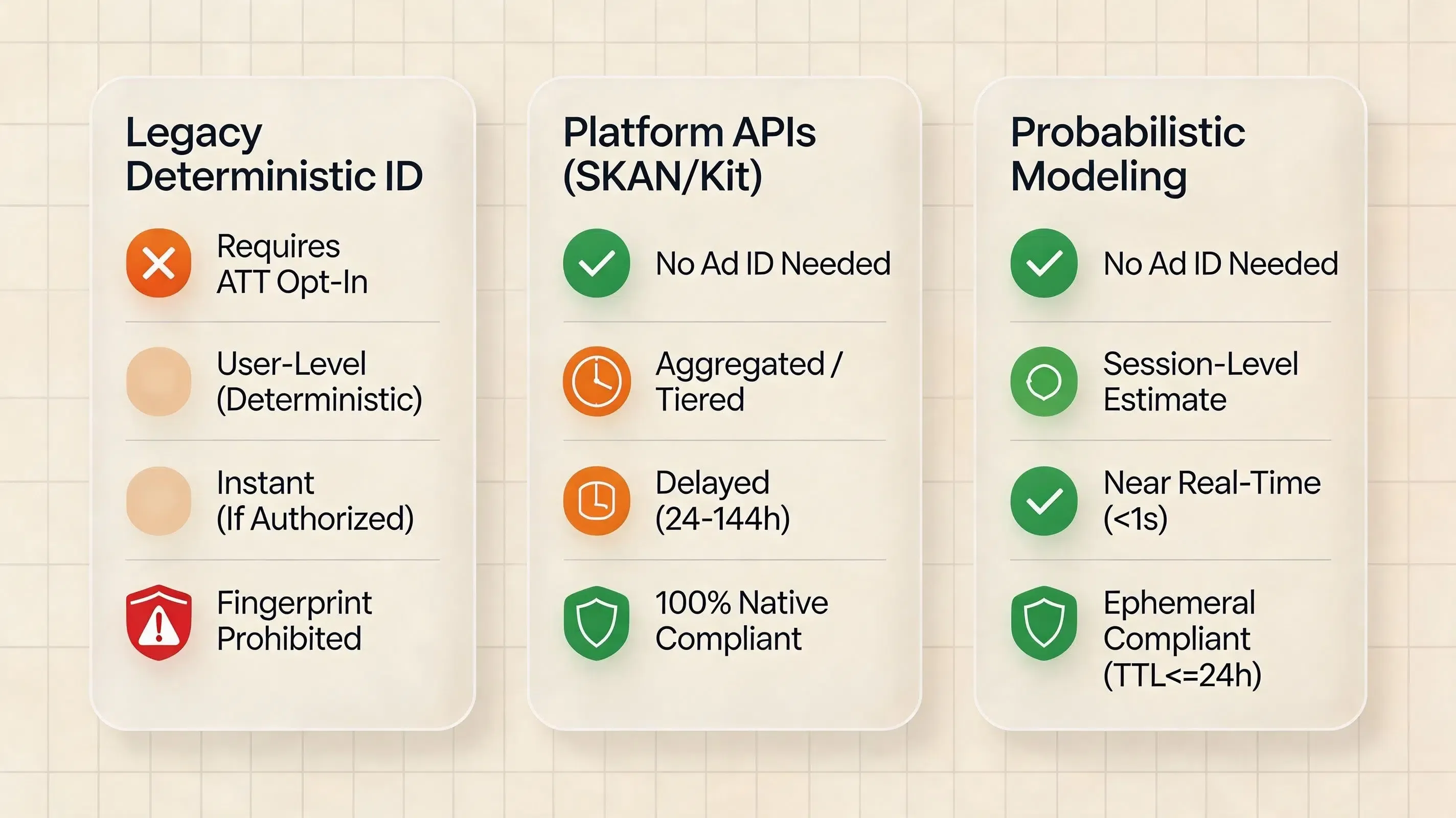
Comparative Analysis: Deterministic vs Probabilistic vs Platform Primitives
| Evaluation Criterion | Deterministic ID Matching (Legacy) | Platform Attribution APIs (AdAttributionKit / SKAN) | Probabilistic Session Modeling |
|---|---|---|---|
| Persistent Identifier Required | Yes (GAID / IDFA) | No | No (Non-persistent session signals) |
| Measurement Granularity | User-level | Aggregated / Cohort-level | Session / Campaign-level probability estimation |
| Attribution Latency | Instantaneous | Delayed (Platform postback timers) | Near real-time estimation (Subject to confidence thresholds) |
| Onboarding Context Restoration | Requires secondary lookup | Not supported (Ad measurement only) | Supported (First-party parameter routing) |
| Platform Policy Governance | Governed by ATT / AD_ID consent | Platform-native framework | Must avoid persistent cross-app fingerprinting |
Development teams evaluating measurement SDKs can download mobile attribution SDK packages to review client-side integration requirements.
When Should Engineering Teams Deploy Probabilistic Attribution Models
Suitable Conditions for Statistical Session Correlation
Probabilistic session correlation provides practical engineering value under specific operational conditions:
-
Top-of-Funnel Web Campaign Evaluation: Estimating the aggregate conversion performance of mobile web ads and influencer landing pages where platform-native attribution frameworks are unavailable.
-
First-Party Onboarding and Deep Linking: Restoring campaign routing parameters, invite codes, and customized onboarding states for user-initiated web-to-app conversion funnels.
-
Triangulating Macro Platform Reporting: Providing real-time directional telemetry to cross-reference against delayed, aggregated platform postbacks (such as Apple AdAttributionKit).
Unsuitable Conditions for Statistical Session Correlation
Probabilistic attribution is inappropriate and should not be deployed in the following scenarios:
-
Cross-App User Profiling: Attempting to track users across third-party applications without explicit user consent.
-
High-Security Financial Authorization: Workflows requiring absolute, binary deterministic certainty (such as payment processing or banking authorization).
-
Low-Volume, Stale Conversion Funnels: Campaigns where the expected time delta between click and install exceeds 24 to 48 hours.
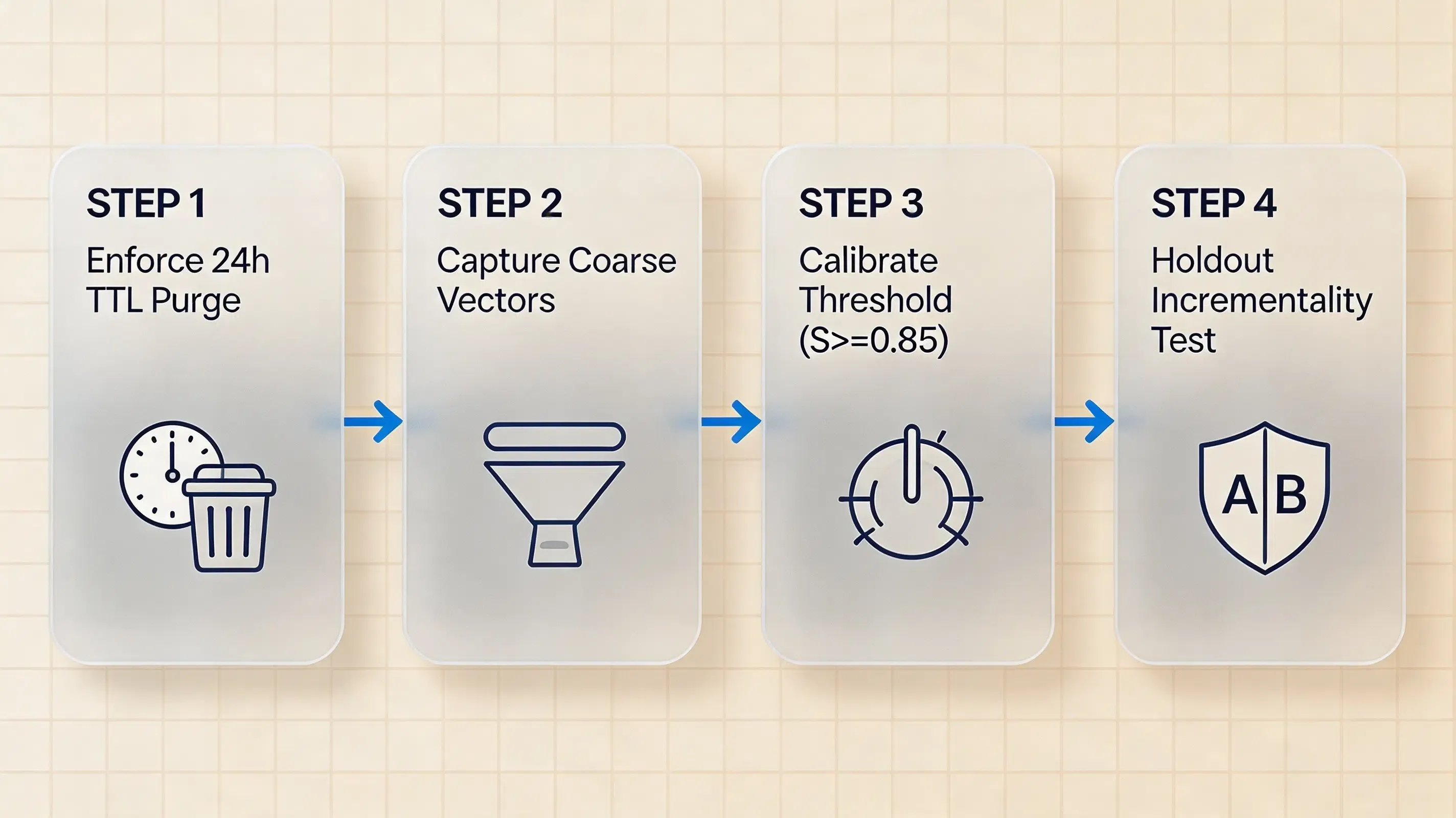
How Production Teams Validate and Calibrate Probabilistic Models
In production environments, data engineering teams continuously evaluate model health and calibration curves to prevent data drift:
-
Calibration Reliability Curves: Plotting predicted probability buckets against observed empirical conversion frequencies to ensure an
prediction corresponds to an 85% conversion probability within validation cohorts. -
Precision-Recall Sensitivity Tuning: Adjusting classification thresholds (
) to balance the trade-off between false-positive misattributions and unassigned organic installations. -
Holdout Incrementality Experiments: Utilizing public service announcement (PSA) or ghost ad holdout groups to measure baseline background noise and estimate true incremental lift.
-
Monitoring Unmatched Ratios: Tracking shifts in the proportion of organic, unattributed launches to identify when lookback windows are overly restrictive or network environments shift.
Production Measurement Considerations for Engineering Teams
In production environments, engineering teams deploying probabilistic models continuously monitor key operational metrics to maintain data reliability:
-
Attribution Confidence Calibration Error: Comparing predicted correlation probabilities against empirical conversion rates across holdout cohorts to detect systematic model overconfidence.
-
False-Positive Correlation Drift: Regularly auditing matching confidence distributions to ensure baseline conversion rates do not artificially inflate during peak traffic periods.
-
Unmatched Install Ratios: Monitoring the baseline volume of organic, unattributed launches to identify when lookback windows or threshold filters are overly restrictive.
-
Organic Install Contamination Ratio: Measuring the percentage of organic users misattributed to active campaigns due to overlapping network gateways.
Simulated Production Scenario: Evaluating Signal Behavior
Consider an e-commerce mobile application running web-to-app promotion links. In production validation:
-
Users completing the download on the same home network within 5 minutes exhibited high correlation confidence with zero observed collision.
-
Users switching from office cellular connections to corporate Wi-Fi showed an expected drop in network similarity, gracefully falling back to unattributed status to prevent false attribution claims against concurrent paid campaigns.
Implementation Checklist for Privacy-Conscious Attribution
Before deploying probabilistic or contextual measurement models, verify that your engineering architecture adheres to standard privacy hygiene:
-
Define Retention Windows: Enforce strict Time-to-Live limits (
) on cached session context in backend datastores. -
Eliminate Persistent Identifiers: Ensure no hardware attributes are combined to construct permanent device graphs.
-
Separate Measurement from Identity: Treat statistical output as an aggregate directional signal rather than verified user identity.
-
Coordinate with Platform APIs: Use Apple AdAttributionKit and Google Play Install Referrer as primary measurement primitives where applicable.
-
Audit SDK Data Collection: Review client-side telemetry to verify data minimization compliance under operating system policies.
Privacy Review Questions for Engineering Teams
Before production rollout, technical review boards should confirm:
-
Is any contextual signal persisted beyond the active attribution window?
-
Does the model attempt to re-identify returning users across unrelated third-party apps?
-
Are session signals isolated strictly to the immediate conversion workflow?
Frequently Asked Questions (FAQ)
Is probabilistic attribution permitted under Apple App Tracking Transparency rules?
Can probabilistic attribution recover IDFA-level accuracy?
Does probabilistic attribution work after iOS 17 and iOS 18 privacy changes?
How does probabilistic attribution handle network changes between click and install?
Does probabilistic attribution replace platform frameworks like AdAttributionKit?
Summary and Decision Framework
In practice, probabilistic attribution is best viewed as a measurement compromise: it can provide directional conversion signals and onboarding context, but it cannot recreate the certainty of deterministic identifiers. By evaluating transient session signals within tight temporal windows, engineering teams can estimate campaign performance without generating persistent cross-app identifiers.
Modern growth architectures achieve resilience by combining platform-provided measurement primitives (such as Apple AdAttributionKit and Google Play Install Referrer) for macro reporting with first-party contextual routing layers (such as OpoInstall, a first-party mobile routing and attribution infrastructure layer) for micro-level onboarding restoration.
To explore implementation patterns for privacy-compliant mobile measurement and routing, consult the mobile attribution implementation reference. Developers can review the OpoInstall developer documentation for technical specifications and integration guides.
Related Materials
-
Concepts: Probabilistic Modeling, Signal Entropy, Temporal Decay, Contextual Routing, App Tracking Transparency
-
Technologies: Bayesian Matching Engines, Apple AdAttributionKit, Google Play Install Referrer API, OpoInstall Mobile SDK
-
Standards: W3C Client Hints Specification, IETF RFC 7231 HTTP Semantics, OWASP Mobile Security Guidance
-
APIs: OpoInstall Context API, Apple ATTrackingManager, Google Play Install Referrer API
Official Documentation
Share this article