How to protect attribution tracking against SDK spoofing? Protecting attribution tracking against SDK spoofing requires implementing server-to-server HMAC-SHA256 request signatures, dynamic nonce replay defenses, and hardware-backed platform attestations.
SDK spoofing is an advanced form of mobile ad fraud where bad actors reverse-engineer mobile telemetry protocols and dispatch synthetic install or event payloads directly to attribution endpoints without executing an application on physical hardware. In mobile attribution tracking, mitigating SDK spoofing requires implementing a two-tier security architecture that combines server-to-server HMAC-SHA256 cryptographic signatures and dynamic nonces with hardware-backed platform integrity attestations.
| Term | Definition | Related Entity | Search Intent Role |
|---|---|---|---|
| Attribution Tracking | The systematic recording and validation of marketing touchpoints and conversions. | Mobile Measurement Partner | Informational / Commercial |
| SDK Spoofing | The server-side simulation of legitimate SDK traffic using reverse-engineered API payloads. | Ad Fraud | Technical / Informational |
| HMAC Signature | An HMAC authentication tag (informally called an HMAC signature) verifying request authenticity and payload integrity. | Conversion Tracking | Technical / Informational |
Why SDK Spoofing Threatens Attribution Tracking and Revenue Integrity
The Ghost Install Problem: Draining Acquisition Budgets Without Physical or Virtual Devices
In conventional mobile advertising fraud, bad actors rely on physical device banks (device farms) or virtualized operating systems (emulators) to simulate user behavior. These attacks require physical or computational infrastructure to download, install, and execute the application binary.
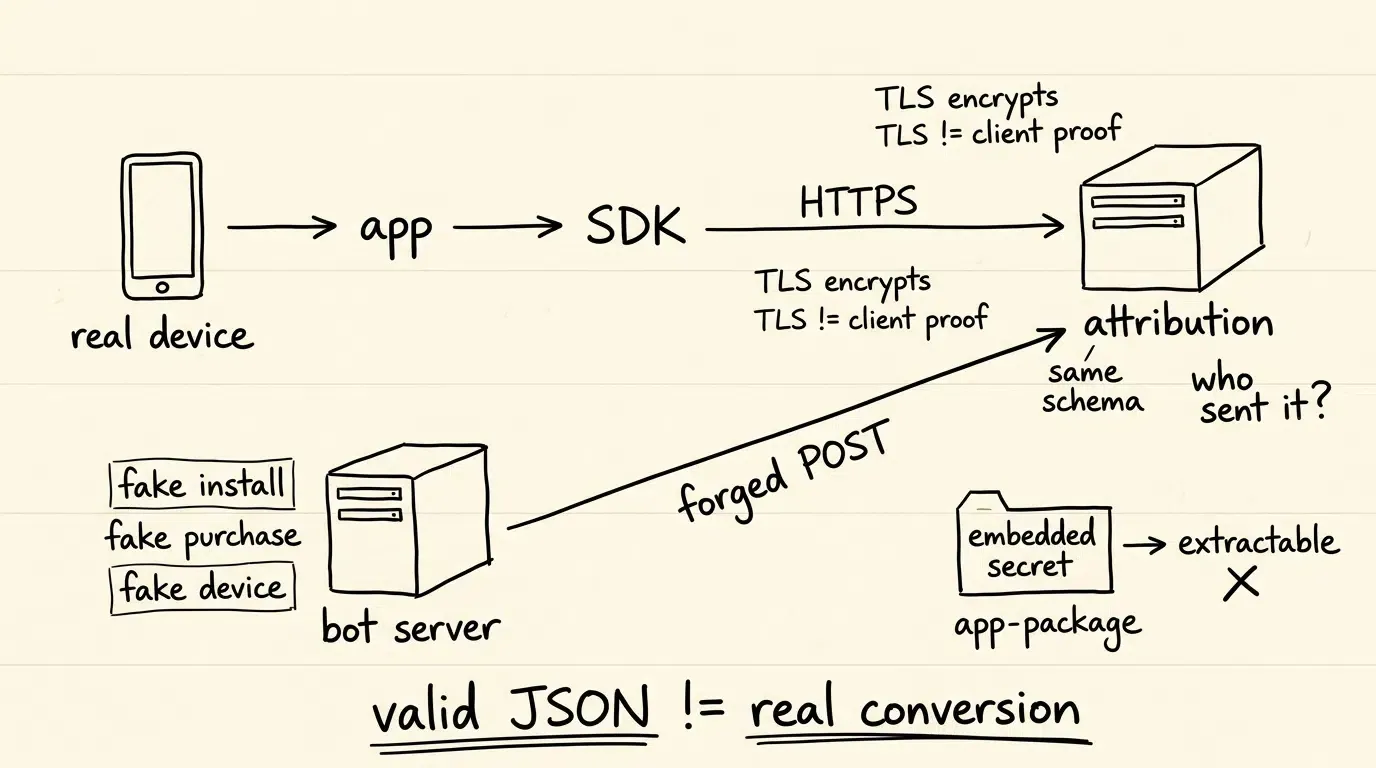
SDK spoofing removes the device requirement entirely. Bad actors analyze the network communication protocol between the mobile attribution SDK and the backend ingestion gateway. By scripting server-side bots to construct and dispatch synthetic HTTP POST requests directly to attribution endpoints, fraudsters generate millions of ghost installs without downloading a single byte of application code to a real device.
Because ghost installs consume marketing capital on completely synthetic events, performance marketing campaigns experience severe capital misallocation. Advertisers pay Cost Per Install (CPI) or Cost Per Action (CPA) fees to fraudulent distribution sources, draining acquisition budgets while acquiring zero authentic human users.
Fabricating High-Value Downstream Conversions: In-App Purchases, Registrations, and Level Completions
Early implementations of SDK spoofing focused exclusively on fabricating top-of-funnel install events. However, modern automated botnets script multi-step lifecycle journeys, firing simulated post-install telemetry events across sequential days.
By reverse-engineering event-tracking endpoints, fraudsters dispatch synthetic postbacks for high-bounty conversion milestones:
- Account Registrations: Generating fake user profile submissions to claim CPA registration bonuses.
- Gameplay and Milestone Progression: Simulating level completions, tutorial finishes, or engagement milestones to satisfy retention-gated publisher payouts.
- Synthetic In-App Purchases: Firing fabricated transactional receipts to deceive measurement platforms into calculating high Return on Ad Spend (ROAS), prompting algorithmic bidding engines to channel more ad spend toward fraudulent sub-publishers.
The Breakdown of Trust: How Synthetic Telemetry Corrupts Performance Marketing ROI
When attribution pipelines ingest spoofed telemetry, the downstream reporting datasets become structurally corrupted. Data science teams train predictive LTV models and automated programmatic bidding algorithms on fabricated conversion signals, leading automated bidding engines to optimize toward sources that produce zero authentic lifetime value.
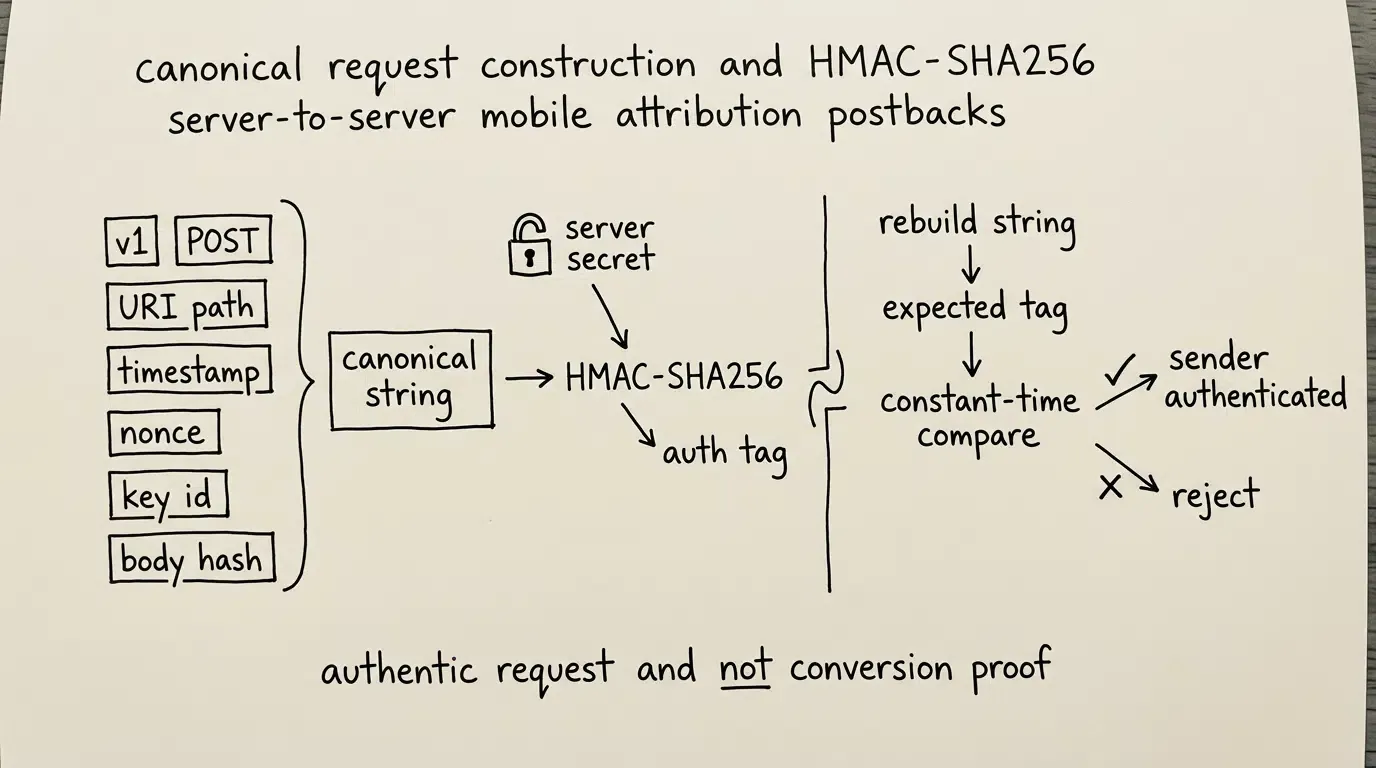
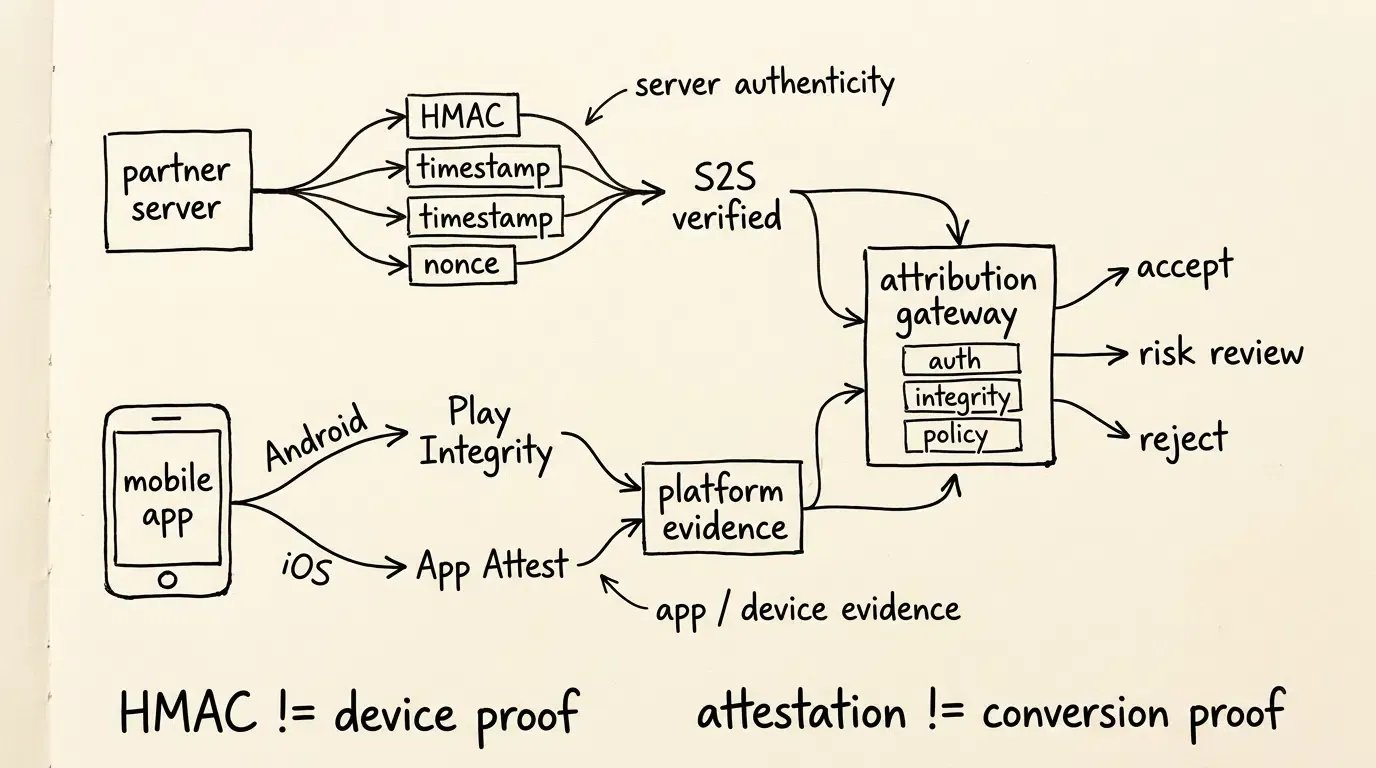
Cryptographic authentication allows the ingestion gateway to reject requests that fail configured sender-authentication and replay checks before attribution processing. Furthermore, a valid HMAC authentication tag authenticates the sending integration and verifies payload integrity; it does not independently prove that the underlying real-world conversion occurred. Establishing cryptographic verification alongside post-install behavioral auditing provides the layered defense needed to maintain clean attribution ledgers.
Developers seeking lightweight client telemetry and attribution SDKs can explore packages via the mobile analytics SDK package.
How Does SDK Spoofing Fabricate Conversions Without Physical Devices
The Mechanics of Protocol Reverse Engineering: Proxy Interception, Decompilation, and API Mapping
To execute SDK spoofing, bad actors deconstruct the application client and its measurement libraries through a sequence of reverse-engineering steps:
- Static Binary Decompilation: Using decompilers (such as JADX for Android or Ghidra for iOS) to inspect application packages (APKs or IPAs), locating API endpoints, parameter schemas, and hardcoded authentication tokens.
- Man-in-the-Middle (MitM) Proxy Interception: Routing real device traffic through local proxy tools (such as Charles Proxy or mitmproxy) with installed root certificates to decrypt TLS traffic and map outgoing JSON payloads.
- Dynamic Runtime Hooking: Utilizing dynamic instrumentation frameworks (such as Frida or Xposed) to bypass SSL pinning, inspect runtime memory, and extract cryptographic keys or parameters used in request construction.
Once the network contract is mapped, the attacker encodes the schema into automated server scripts, generating synthetic requests that mimic genuine client payloads on unauthenticated endpoints.
[Attacker Bot Server] ──► [Reverse-Engineered Payload] ──► [Forged HTTPS POST] ──► [Attribution Endpoint]
       │                                                                                   │
       ├─► Synthesizes Claimed Identifiers (GAID / IDFA)                                   ▼
       ├─► Replays Captured Network Parameters                                     [Attribution Recorded]
       └─► Fires Simulated In-App Purchase Receipts                                (Paid Bounty Released)
Anatomy of a Spoofed Payload: Synthesizing Hardware Hashes, Timestamps, and Advertising Identifiers
A spoofed telemetry payload contains synthetically generated or replayed metadata fields designed to mimic authentic mobile devices:
- Advertising Identifiers: Rotating claimed identifiers (such as synthetic GAIDs or IDFA tokens) to simulate distinct users.
- Claimed Device Metadata: Programmatically varying claimed device models, CPU architectures, screen resolutions, and OS build numbers to create an illusion of natural device entropy.
- Network Parameters: Routing requests through commercial proxy networks or residential VPNs to match target geographic campaign regions.
- Event Timestamps: Faking sequential timestamps to simulate natural user interaction latencies between install and conversion events.
Because unauthenticated gateways inspect only the JSON structure and parameter presence, they cannot determine whether the payload originated from a genuine mobile operating system or a script executing in a data center.
The Flaw of Client-Embedded Secrets: Why Storing Static API Keys in App Packages Fails
A common architectural flaw in mobile security is relying on static secret keys embedded directly within the client application binary (e.g., hardcoding a shared secret string in an Android Application class or iOS bundle).
Mobile application packages are deployed into untrusted, user-controlled execution environments. Any secret key embedded within an APK or IPA must be treated as extractable via static decompilation, memory dumping, or dynamic instrumentation. Once extracted, fraudsters use the compromised secret to sign synthetic requests, rendering client-side static signatures ineffective against determined attackers.
Protecting attribution tracking requires separating vulnerable client-embedded secrets from trusted server-to-server boundaries and utilizing hardware-backed platform attestations.
Cryptographic Architecture of Server-to-Server HMAC Request Signing
Separating Client-Side App Secrets from Server-to-Server Trust Boundaries
An enterprise anti-spoofing architecture establishes a strict separation between client-to-server telemetry and server-to-server (S2S) postback communications:
- Server-to-Server (S2S) Integration Layer: Direct API integrations between advertising networks, DSPs, and attribution endpoints operate within a trusted server environment. Shared secret keys are stored exclusively in secure backend key management systems (KMS) or hardware security modules (HSM), never exposed to client binaries.
- Client Telemetry Layer: Mobile client communications rely on platform-level cryptographic attestations (such as Google Play Integrity or Apple App Attest) rather than static embedded secrets to provide verifiable execution evidence.
Canonical String Construction: Structuring Raw Payloads to Prevent Parameter Tampering
To prevent tampering and ensure deterministic signature verification, the sending server and receiving gateway must assemble an identical canonical string prior to computing the cryptographic authentication tag.
The protocol defines an exact, unambiguous request-target representation:
- Protocol Version: Explicit protocol identifier header (
X-Signature-Version: v1). - HTTP Method: Standardized uppercase string (e.g.,
POST). - Request URI Path: Absolute normalized endpoint path, excluding query strings (e.g.,
/api/v1/attribution/event). - Timestamp: Integer Unix epoch timestamp in seconds (
X-Timestamp). - Nonce: Unique cryptographic random string containing at least 128 bits of entropy (
X-Nonce), restricted to alphanumeric characters. - Key Identifier: Explicit key version identifier (
X-Key-Id) matching an active or grace-period key. - Raw Payload Hash: Hex-encoded SHA-256 hash computed directly on the exact raw HTTP request entity bytes (
SHA256(RawBodyBytes)).
The canonical signing string is assembled using vertical bar delimiters (|), encoded strictly in UTF-8:
Mathematical Formulation of HMAC-SHA256 Request Signing
The HMAC authentication tag is computed using the HMAC-SHA256 algorithm as defined in IETF RFC 2104, applying the versioned shared secret key to the canonical string:
The Python implementation below demonstrates an enterprise-grade S2S HMAC-SHA256 verification middleware with full key lifecycle resolution (active, grace-period, and revoked states), asymmetric timestamp windows, and atomic nonce state management:
```python
# [CODE_BLOCK_01] Python S2S HMAC-SHA256 Signature Verification Middleware
import hmac
import hashlib
import time
import redis
from enum import Enum
from typing import Dict, Tuple, Optional, Set

class KeyStatus(Enum):
    ACTIVE = "active"             # Permitted for signing and verification
    GRACE_PERIOD = "grace_period" # Permitted for verification during key rotation; deprecated for signing
    REVOKED = "revoked"           # Compromised or explicitly retired; all verification rejected
    EXPIRED = "expired"           # Surpassed maximum lifetime; verification rejected

class KeyRecord:
    def __init__(self, key_id: str, secret: str, status: KeyStatus):
        self.key_id = key_id
        self.secret = secret
        self.status = status

class KeyProvider:
    """
    Abstract interface for resolving versioned shared secrets and lifecycle states from KMS/HSM.
    """
    def get_key_record(self, partner_id: str, key_id: str) -> Optional[KeyRecord]:
        raise NotImplementedError

class MemoryKeyProvider(KeyProvider):
    """
    Illustrative in-memory key provider demonstrating key lifecycle resolution.
    Production implementations should query a secure KMS or HSM service.
    """
    def __init__(self, key_registry: Dict[str, Dict[str, KeyRecord]]):
        # Format: { partner_id: { key_id: KeyRecord } }
        self.key_registry = key_registry

    def get_key_record(self, partner_id: str, key_id: str) -> Optional[KeyRecord]:
        return self.key_registry.get(partner_id, {}).get(key_id)

class AttributionSecurityMiddleware:
    def __init__(
        self,
        key_provider: KeyProvider,
        redis_client: redis.Redis,
        max_past_age_seconds: int = 300,
        max_future_skew_seconds: int = 30
    ):
        """
        Initializes S2S HMAC signature verification and replay defense middleware.

        :param key_provider: Provider resolving versioned partner secret records and states
        :param redis_client: Shared uniqueness store (Redis) for atomic nonce tracking
        :param max_past_age_seconds: Maximum allowed age for past timestamps (default 300s)
        :param max_future_skew_seconds: Maximum allowed tolerance for future clock skew (default 30s)
        """
        self.key_provider = key_provider
        self.redis = redis_client
        self.max_past_age_seconds = max_past_age_seconds
        self.max_future_skew_seconds = max_future_skew_seconds
        # Total TTL ensures nonces outlive the maximum possible request acceptance window
        self.nonce_ttl_seconds = max_past_age_seconds + max_future_skew_seconds + 30

    def verify_request(
        self,
        partner_id: str,
        http_method: str,
        uri_path: str,
        headers: Dict[str, str],
        raw_body: bytes
    ) -> Tuple[bool, Optional[str]]:
        """
        Executes cryptographic verification and replay prevention on an incoming S2S postback.
        Security invariant: HMAC tag is verified BEFORE consuming nonce state in Redis.

        :return: (is_valid, error_code_if_invalid)
        """
        # Step 1: Extract required cryptographic headers
        signature = headers.get("X-Signature")
        timestamp_str = headers.get("X-Timestamp")
        nonce = headers.get("X-Nonce")
        key_id = headers.get("X-Key-Id")
        sig_version = headers.get("X-Signature-Version", "v1")

        if not signature or not timestamp_str or not nonce or not key_id:
            return False, "MISSING_SECURITY_HEADERS"

        if sig_version != "v1":
            return False, "UNSUPPORTED_SIGNATURE_VERSION"

        # Validate nonce formatting: alphanumeric characters only, length between 16 and 64
        if not (16 <= len(nonce) <= 64 and nonce.isalnum()):
            return False, "INVALID_NONCE_FORMAT"

        # Step 2: Validate integer Unix epoch timestamp (seconds) against asymmetric bounds
        try:
            request_timestamp = int(timestamp_str)
        except ValueError:
            return False, "INVALID_TIMESTAMP_FORMAT"

        current_time = int(time.time())
        age_seconds = current_time - request_timestamp
        future_skew_seconds = request_timestamp - current_time

        if age_seconds > self.max_past_age_seconds or future_skew_seconds > self.max_future_skew_seconds:
            return False, "TIMESTAMP_OUT_OF_BOUNDS"

        # Step 3: Resolve versioned secret key and evaluate lifecycle status
        key_record = self.key_provider.get_key_record(partner_id, key_id)
        if not key_record:
            return False, "UNKNOWN_KEY_ID"

        if key_record.status == KeyStatus.REVOKED:
            return False, "REVOKED_KEY_ID"
        elif key_record.status == KeyStatus.EXPIRED:
            return False, "EXPIRED_KEY_ID"
        elif key_record.status == KeyStatus.GRACE_PERIOD:
            # Verification permitted for in-flight requests during rotation; log deprecation warning
            pass

        # Step 4: Construct Canonical Signing String
        # Protocol Specification: "v1" | HTTP_METHOD | URI_PATH | Timestamp | Nonce | KeyID | SHA256(RawBodyBytes)
        body_sha256 = hashlib.sha256(raw_body).hexdigest()
        normalized_method = http_method.upper().strip()
        normalized_path = uri_path.strip()

        canonical_string = f"v1|{normalized_method}|{normalized_path}|{request_timestamp}|{nonce}|{key_id}|{body_sha256}"

        # Step 5: Compute Expected HMAC-SHA256 Authentication Tag
        expected_signature = hmac.new(
            key=key_record.secret.encode("utf-8"),
            msg=canonical_string.encode("utf-8"),
            digestmod=hashlib.sha256
        ).hexdigest()

        # Step 6: Constant-time comparison to prevent timing attacks
        if not hmac.compare_digest(signature.lower(), expected_signature.lower()):
            return False, "INVALID_SIGNATURE"

        # Step 7: Atomic Nonce Consumption (Executed ONLY after HMAC verification passes)
        # Prevents unauthenticated state poisoning while guaranteeing atomic single-use enforcement
        nonce_key = f"s2s_nonce:{partner_id}:{nonce}"
        is_nonce_unique = self.redis.set(
            name=nonce_key,
            value="1",
            ex=self.nonce_ttl_seconds,
            nx=True
        )

        if not is_nonce_unique:
            return False, "REPLAY_ATTACK_DETECTED"

        # Request successfully authenticated and admitted
        return True, None
Server-Side Signature Validation Workflows and Error Response Standardization
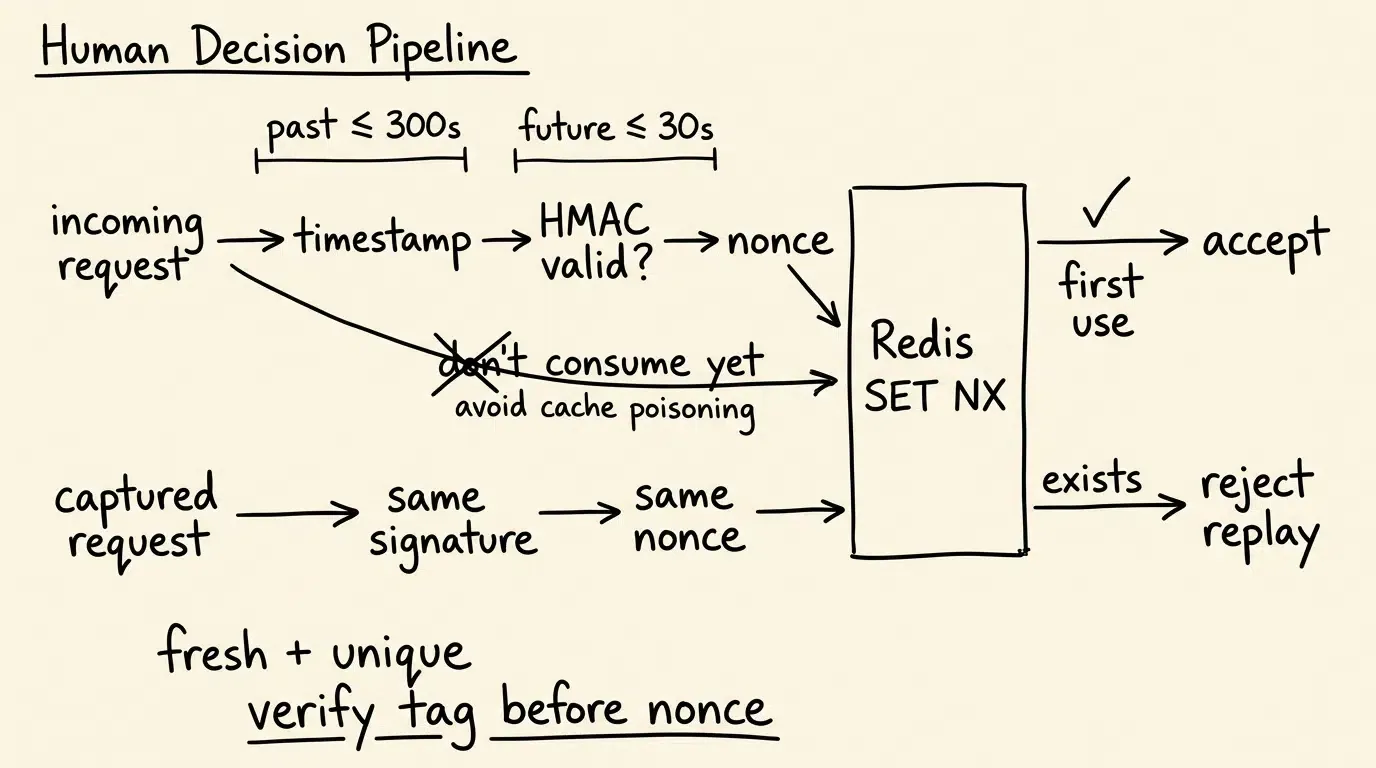
When an attribution ingestion gateway receives an incoming S2S request, it executes sequential validation steps to ensure security state cannot be poisoned by unauthenticated requests:
- Header Extraction: Extracts
X-Signature,X-Timestamp,X-Nonce,X-Key-Id, andX-Signature-Versionheaders. - Timestamp Freshness Verification: Confirms that the request timestamp (Unix epoch seconds) satisfies asymmetric freshness boundaries: evaluating past age (
) and future clock skew ( ). If expired or invalid, the request is rejected with HTTP 401 Unauthorized. - Versioned Key Resolution: Queries the key provider for the specified
X-Key-Id. If the key is revoked, expired, or unknown, verification fails immediately. If the key is in aGRACE_PERIODstate, verification proceeds but logs a deprecation warning for partner rotation. - Cryptographic Tag Verification: Reconstructs the canonical string using exact raw body bytes, computes the expected HMAC-SHA256 tag, and executes a constant-time comparison (
hmac.compare_digest) against the incoming signature. If invalid, the request is rejected withHTTP 401 Unauthorized. - Atomic Nonce Consumption: Only after the cryptographic authentication tag is verified, the gateway records the nonce in a shared uniqueness store (such as Redis) via an atomic
SET key "1" EX TTL NXoperation. If the nonce already exists, the request is rejected withHTTP 401 Unauthorized (REPLAY_ATTACK_DETECTED).
Verifying the HMAC tag before consuming the nonce ensures that unauthenticated attackers cannot poison the cache or execute denial-of-service attacks against legitimate nonces.
How to Implement Nonce Caching and Timestamp Windows for Replay Attack Defense
The Mechanics of a Replay Attack: Re-Transmitting Valid Historic Capture Payloads
Even when requests are authenticated cryptographically, bad actors who capture a valid signed request can execute a replay attack: capturing the complete payload (including valid signature, headers, and body) and re-transmitting it thousands of times to attribution endpoints.
Because the signature matches the payload, a static verification system without replay defenses will accept the duplicated requests as authentic, generating thousands of illegitimate conversion records from a single valid user action.
Enforcing Asymmetric Timestamp Windows: Separating Past Age from Future Clock Skew
Replay defense begins with strict timestamp window enforcement. The sender attaches an integer Unix epoch timestamp (in seconds) to the request header. Upon receipt, the attribution server calculates time deltas against its synchronized clock (via NTP):
The gateway enforces an illustrative asymmetric policy:
- Maximum Allowed Past Age: Typically
, rejecting stale requests. - Maximum Allowed Future Skew: Typically
, accommodating minor clock drift while rejecting timestamps set too far in the future.
Distributed Nonce Storage in Redis: Atomic Check-and-Set Operations with Automated TTL
To prevent replays within the valid timestamp window, the gateway tracks nonces (Number used ONCE). Every request must include a unique, cryptographically random nonce generated from a CSPRNG (minimum 128 bits of entropy).
The server stores verified nonces in a distributed in-memory cache (such as Redis) using atomic operations. To close the replay acceptance gap completely, the nonce retention time-to-live (
Executing the Redis command atomically:
- If Redis returns
OK, the nonce is unique; it is recorded and will automatically expire from memory after 360 seconds. - If Redis returns
nil(null), the nonce has already been processed; the request is identified as a replay attack and rejected.
[Incoming S2S Request]
           │
           ▼
[Step 1: Header Check] ──► ( Missing Signature / Timestamp / Nonce / Key-Id ) ──► [HTTP 401]
           │
           ▼ (Valid Format)
[Step 2: Timestamp Check] ──► ( Age > 300s OR Skew > 30s ) ───────────────────────► [HTTP 401]
           │
           ▼ (Within Freshness Window)
[Step 3: Resolve Key] ──► ( Unknown / Revoked Key-Id ) ───────────────────────────► [HTTP 401]
           │
           ▼ (Key Valid or Grace Period)
[Step 4: HMAC Validation] ──► ( Hash Mismatch via Constant-Time Compare ) ────────► [HTTP 401]
           │
           ▼ (Tag Authenticated)
[Step 5: Atomic Nonce SET NX] ──► ( Nonce Already Exists in Redis ) ──────────────► [HTTP 401]
           │
           ▼ (Nonce Consumed with TTL = 360s)
[Step 6: Event Ingested into Attribution Stream]
Comparative Evaluation of Anti-Spoofing Defense Mechanisms across System Layers
Contrasting Security Approaches across Client, Network, and Server Boundaries
Defending an attribution tracking pipeline requires evaluating security mechanisms across multiple implementation layers.
The matrix below contrasts primary anti-spoofing defense mechanisms:
| Security Layer | Implemented Defense Mechanism | Addressed Vulnerability | Inherent Operational Limitation |
|---|---|---|---|
| Client Obfuscation | Code shrinking, ProGuard keep-rules, string encryption | Hinders static binary decompilation | Ineffective against dynamic runtime hooking (Frida/Xposed) |
| Client-Side Secrets | Embedded symmetric signing keys in SDK binary | Basic payload integrity verification | Vulnerable to key extraction via memory inspection |
| S2S Request Signing | HMAC-SHA256 with shared backend secret | Secures server-to-server partner webhooks | Requires pre-shared secrets; applies only to server endpoints |
| Replay Defense | Distributed nonce tracking with timestamp TTL | Blocks re-transmission of captured requests | Requires distributed uniqueness state (such as Redis) |
| Platform Attestation | Hardware-backed integrity (Play Integrity / App Attest) | Provides platform-originated app/device integrity evidence | Requires platform support; subject to network attestation latency |
How Do Hardware Backed Platform Attestations Validate Client Authenticity
Why Cryptographic Attestation Replaces Vulnerable Static Client Secrets
Because static client-embedded keys cannot be secured against extraction in untrusted mobile environments, modern operating systems provide hardware-backed cryptographic attestation services.
Platform integrity systems expose different trust mechanisms: Google Play Integrity returns platform-evaluated integrity verdicts bound to protected actions, while Apple App Attest uses an attested, Secure Enclave-backed app-instance key and subsequent server-verified assertions. The attribution server validates these platform assertions, providing verifiable evidence that the request originated from an authentic, unmodified application on a genuine physical device.
Android Defense: Implementing Google Play Integrity API for Standard and Classic Requests
Android applications integrate the Google Play Integrity API to evaluate device trust and application authenticity. Google Play Integrity supports two distinct request architectures:
- Standard API Requests: Optimized for low-latency in-app checks, using an initial preparation call and generating integrity tokens bound to a client-provided
requestHash. Google infrastructure manages automated mitigation for replay attacks. - Classic API Requests: Designed for server-managed workflows, where the developer’s backend generates a cryptographic server nonce included in the client request to bind the resulting token to that specific server interaction.
The backend attribution server decrypts and verifies the integrity token, evaluating structured verdicts within a tiered enforcement policy:
- App Recognition (
appRecognitionVerdict): Confirms whether the app binary matches the official developer signing certificate registered on Google Play (PLAY_RECOGNIZED). - Device Recognition (
deviceRecognitionVerdict): Evaluates device trust levels (such asMEETS_DEVICE_INTEGRITYorMEETS_STRONG_INTEGRITY). - Account Details (
accountDetailsVerdict): Evaluates app licensing status (LICENSED).
Weaker, missing, or unexpected integrity verdicts serve as risk signals that feed a tiered server-side evaluation policy rather than assuming an immediate binary fraud classification.
iOS Defense: Deploying Apple App Attest and DeviceCheck for Hardware-Bound Server Assertions
On iOS, applications deploy the App Attest service (part of the DeviceCheck framework) to validate client legitimacy:
- Key Generation: The iOS application calls
DCAppAttestService.shared.generateKey()to create a hardware-bound, non-exportable cryptographic key pair inside the device’s Secure Enclave. - Key Attestation: The app requests Apple to attest the public key (
attestKey()), providing an attestation object containing the public key and certification chain. The backend server verifies this attestation object with Apple’s root certificates, extracting and storing the public key. - Assertion Verification: For subsequent conversion events, the app generates an assertion (
generateAssertion()) by signing a server-issued challenge nonce and the event payload hash using the private key. The backend server verifies the assertion signature against the stored public key, proving the telemetry originated from the authentic app instance without replay.
Complementing App Attest, DeviceCheck allows servers to store two bits of persistent state per device on Apple servers, supporting cross-install abuse tracking without accessing persistent hardware identifiers.
Integrating Platform Attestation Verdicts into Attribution Ingestion Pipelines
Platform attestation tokens are ingested alongside standard attribution parameters at the gateway level. By combining S2S HMAC authentication on server integrations with Play Integrity and App Attest on client endpoints, measurement platforms establish an end-to-end defense that raises the computational cost of synthetic spoofing and supplies verifiable evidence for rejecting untrusted client requests.
When Are Advanced Anti-Spoofing Frameworks Necessary for Performance Marketers
Suitable Conditions for Dedicated Anti-Spoofing Infrastructure
Implementing advanced cryptographic signing and platform attestation provides high operational value under specific campaign conditions:
- High CPA Bounty Programs: Campaigns offering high payouts for downstream conversions (e.g., financial account deposits, credit card submissions, crypto trades, or subscription trials).
- High-Volume Affiliate Networks: Marketing programs utilizing open, multi-tiered affiliate networks where publisher transparency is low and sub-syndication is common.
- Discrepancies Between Attribution and Internal Ledgers: Applications observing substantial gaps between attributed conversions in marketing dashboards and actual recorded revenue in financial databases.
Unsuitable Conditions for Complex Cryptographic Middleware
Deploying complex S2S cryptographic middleware may introduce unnecessary operational overhead in the following scenarios:
- Early-Stage Prototype Exploration: Pre-commercial applications focused on validating functional mechanics before launching public acquisition campaigns.
- Closed Self-Attributing Networks Exclusively: Marketing operations running 100% of ad spend through closed networks (e.g., Apple Search Ads or Google App Campaigns) that handle attribution internally without external S2S webhooks.
Common Misconceptions in SDK Spoofing Prevention
- Misconception 1: Transport Layer Security (TLS/HTTPS) Prevents SDK Spoofing: HTTPS encrypts data in transit between the client and server, preventing third-party eavesdropping on public Wi-Fi. However, TLS does not verify the identity of the client sending the request; an attacker running a Python script can establish a valid TLS connection and dispatch spoofed payloads.
- Misconception 2: Code Obfuscation Eliminates Spoofing Vulnerabilities: While tools like ProGuard or DexGuard increase the complexity of static reverse engineering, they do not prevent dynamic runtime interception (via Frida) or network proxy mapping. Obfuscation slows down attackers but cannot replace cryptographic request verification.
Frequently Asked Questions (FAQ)
How does SDK spoofing differ from emulator and device farm fraud?
Why is storing an encryption secret inside a mobile application insecure?
How do dynamic nonces prevent replay attacks on attribution endpoints?
Summary and Decision Framework
Protecting mobile attribution tracking against SDK spoofing requires moving beyond static client-embedded secrets to a robust, two-tier cryptographic architecture. SDK spoofing allows bad actors to fabricate conversions without physical devices, siphoning marketing capital and corrupting campaign optimization models.
Building a resilient anti-spoofing pipeline depends on enforcing HMAC-SHA256 authentication tags on server-to-server communications, maintaining dynamic nonce caches to block replay attacks, and integrating hardware-backed platform attestations like Google Play Integrity and Apple App Attest. By pairing independent measurement engines with rigorous cryptographic validation, platforms like OpoInstall provide the infrastructure required to inspect request authenticity, raise the cost of synthetic attacks, and support robust ingestion authentication.
To evaluate how unified attribution and cryptographic security infrastructure can protect your marketing campaigns, explore the mobile attribution implementation reference or configure your application on the OpoInstall developer console.
Related Materials
-
Concepts: Mobile Ad Fraud, SDK Spoofing, Attribution Tracking, Cryptographic Signing, Replay Attack Defense, Nonce Management
-
Technologies: HMAC-SHA256, Google Play Integrity API, Apple App Attest, Redis Distributed Caching, S2S Webhooks
-
APIs & Data Interfaces: Google Play Integrity API, Apple DeviceCheck / App Attest, OpoInstall S2S Security Configuration Interfaces
-
Official Documentation & References:
Share this article