How does a referral program increase user retention? Referral programs can improve user retention when peer invitations create relevant social context, shared product utility, and lower-friction onboarding; the effect should be verified by comparing referred and non-referred cohorts under consistent Day 1, Day 7, and Day 30 retention definitions.
An app referral program is a programmatic growth loop that incentivizes existing users to invite new members through trackable sharing mechanisms. In mobile growth architecture, referral loops operate not only as acquisition engines but as powerful retention drivers: by establishing immediate social connectivity and shared product utility, peer-referred cohorts frequently demonstrate higher retention baselines and lower long-term churn than unassisted paid traffic.
| Term | Definition | Related Entity | Search Intent Role |
|---|---|---|---|
| User Retention | The ongoing engagement and return behavior of a mobile user cohort over time. | Cohort Analysis | Informational / Commercial |
| App Referral Program | A structured in-app system enabling users to share personalized invite links. | Referral Marketing Software | Informational |
| Viral Coefficient (K-Factor) | The metric calculating the average number of qualified new users generated by each active user. | User Journey | Technical / Informational |
Why Referral Cohorts Can Outperform Paid Acquisition in Long Term User Retention
The Paid User Acquisition Trap: Rising Cost Per Install and Steep Cohort Decay
Performance marketing in mobile applications faces structural economic challenges driven by rising Cost Per Install (CPI) and steep post-install attrition. In programmatic display and paid social channels, users are acquired through interruptive ad placements. These users enter the application with cold intent and minimal context, frequently resulting in sharp Day 1 (
When growth relies exclusively on paid acquisition, maintaining active user volume requires continuous capital deployment to replace churning cohorts. This dynamic increases blended Customer Acquisition Cost (CAC) and shortens the effective economic lifespan of acquired cohorts. Referral loops introduce an organic growth mechanism that complements paid marketing by shifting acquisition from transactional ad clicks to relational peer invitations, creating user cohorts characterized by pre-existing social intent.
The Behavioral Mechanics of Social Proof and Pre-Established Trust in Mobile Apps
User acquisition through peer referral operates on distinct psychological principles compared to direct advertising:
- Transferred Trust: New users invited by colleagues, friends, or team members may benefit from transferred trust in the platform, mitigating the skepticism often directed toward paid ad creatives.
- Contextual Relevance: Peer invites are delivered within natural conversational contexts (e.g., inviting a teammate to collaborate on a document or join a private game lobby), ensuring the invitee understands the application’s functional purpose prior to download.
- Social Accountability: When an existing user provides a personalized referral bonus or shared workspace access, the new user experiences social motivation to explore the application beyond the first session.
Prior customer-referral research has observed higher retention among referred customers in specific datasets, with mechanisms linked to customer matching and social enrichment; mobile products should validate whether the same effect appears in their own segmented cohorts.
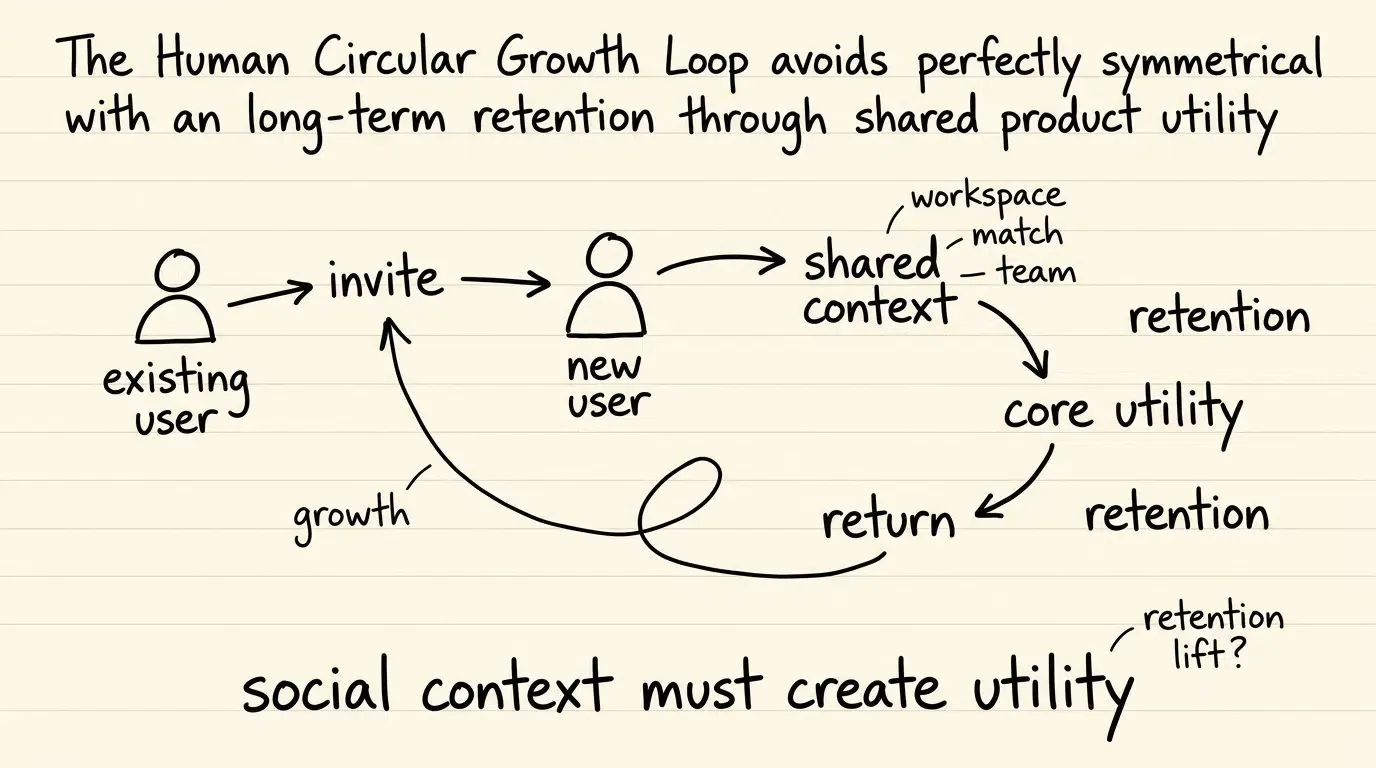
Shared Utility and Collaborative Network Effects: Why Multi-User Products Retain Better
In products with genuine collaborative or network dynamics—such as team workspaces, multiplayer games, communication platforms, or shared financial workflows—user utility expands as relevant peers join the same product environment. A single user operating in isolation encounters limited product depth, whereas a user connected to an active team, shared budget, or collaborative board experiences daily recurring utility.
Referral programs accelerate the formation of these local network clusters. By incentivizing users to invite their existing social and professional graphs, applications establish multi-user dependency loops that transform single-player tools into collaborative platforms, mitigating structural lifecycle churn.
Developers seeking lightweight client telemetry and attribution SDKs can explore packages via the mobile analytics SDK package.
How Does Peer Affiliation Transform Early Cohort Engagement Curves
The Day 0 Experience: Transitioning from an Isolated User to a Connected Member
A common failure point in mobile onboarding occurs on Day 0, when unassisted users are dropped into an empty, unconfigured interface.
Peer-referred users bypass this isolation. When an application implements contextual parameter restoration, the client retrieves the inviter’s referral metadata upon first launch, immediately rendering a personalized welcome state (e.g., “Welcome! You have been added to the Engineering Team Workspace”). Connecting the user to an active social context during initial setup accelerates time-to-value and supports early activation.
Day 1 and Day 7 Return Velocity: How Social Accountability Mitigates Early Inactivity
Between Day 1 and Day 7, initial onboarding novelty fades. For any acquisition cohort, early non-return signals retention risk, but peer-referred cohorts benefit from natural re-engagement catalysts:
- Contextual In-App Events: Notifications tied to peer activity (e.g., “A teammate assigned you a review” or “Your friend completed their turn”) prompt functional session returns.
- External Peer Communication: Workflows outside the application (e.g., a colleague asking for document input) encourage timely re-engagement without relying solely on promotional broadcast push notifications.
This social context can support Day 1 return behavior and may contribute to stronger Day 7 retention when peer interactions remain relevant to core product utility.
Flatter Power-Law Decay: Evaluating Long-Term Retention Baselines
Long-term cohort retention curves often exhibit non-linear decay and may, where supported by observed data, be fitted with a plateau-adjusted power-law model (
Retention Rate (%)
 100% ┬
      │  █
  40% ┼──█───────── Peer Referral Cohort (D1)
      │   ▀█
  20% ┼────█▀▀█▄▄▄▄▄▄▄▄▄▄▄▄▄▄▄▄▄▄▄▄▄▄▄▄▄▄▄▄▄▄ (Fitted Referral Baseline p_ref)
      │     ▀█
  10% ┼───────▀▀█▄▄▄▄▄▄▄▄▄▄▄▄▄▄▄▄▄▄▄▄▄▄▄▄▄▄▄ (Fitted Paid Ad Baseline p_paid)
   0% ┴───┬──────┬──────┬──────┬──────┬──────┬───► Elapsed Days (t)
         D0     D1     D7    D14    D30    D90
Peer-connected cohorts may exhibit slower observed retention decay when recurring social or collaborative utility remains relevant over time. However, this relationship represents an empirical hypothesis that must be estimated from observed cohort data rather than assumed as an automatic structural rule.
Mathematical Dynamics of Viral K Factor and Cohort Retention Interplay
Formulating the Viral Coefficient
The viral coefficient (
Where:
When
Modeling Staggered Viral Generations and Active Population Growth
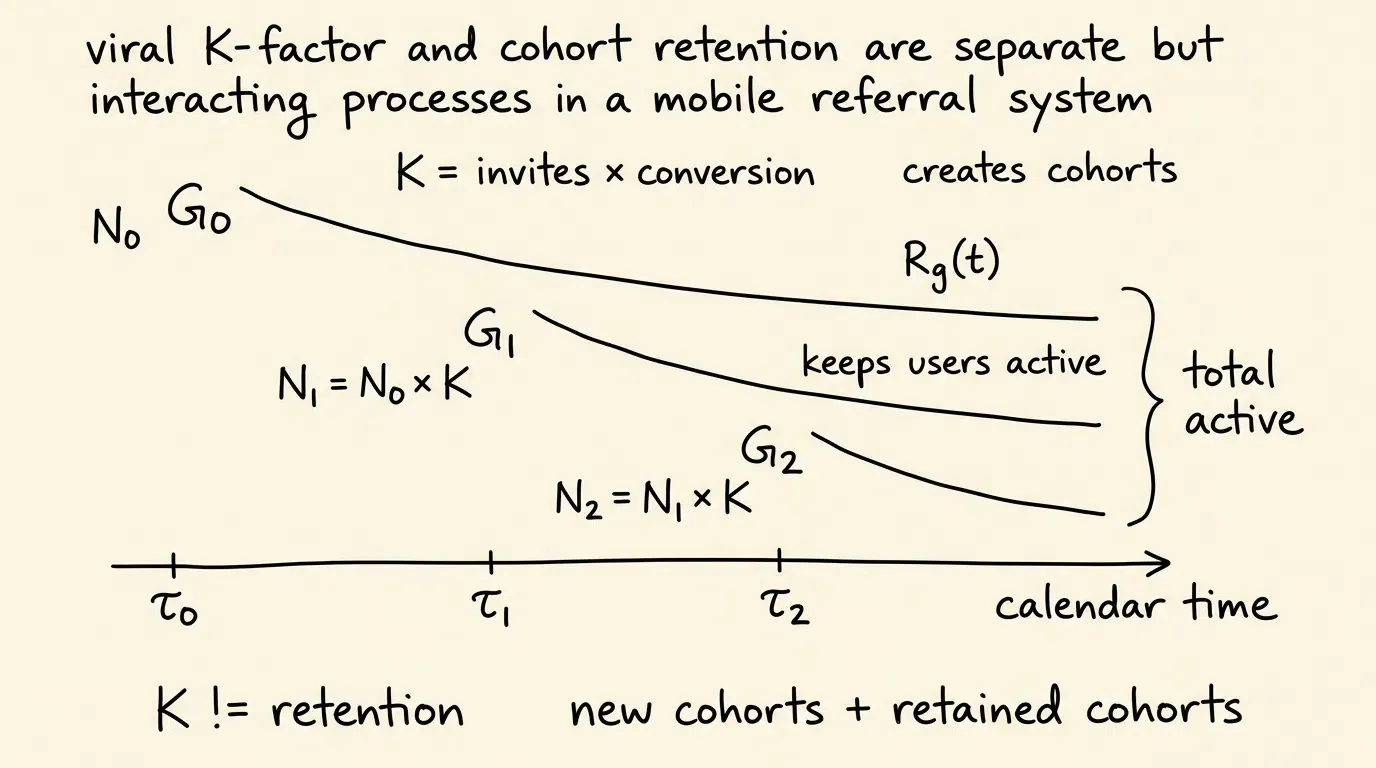
Referral virality and cohort retention operate as distinct, interconnected processes. Viral referral generations do not enter the application simultaneously on Day 0; each generation
Given an initial cohort size
The total active population
Where
Under an idealized, zero-delay theoretical model assuming a constant
Unit Economics Alignment: Linking Referral Costs to Customer Lifetime Value
Evaluating referral economics requires modeling acquisition expansion alongside program operating expenses. Production CAC calculations must account for referral incentives, platform infrastructure, and fraud mitigation:
To evaluate overall economic performance, growth teams calculate direct user monetization alongside total downstream network value:
- Direct Customer LTV: Evaluates the cumulative expected net revenue generated directly by an individual user over observation horizon
:
- Total Referral Network Gross Value: Evaluates the total gross monetization generated by the initial seeded cohort
plus all downstream referred generations :
Where
Total acquisition and program investment across the combined cohort is defined as:
Where
The capital efficiency of the referral-amplified acquisition engine is evaluated via the Network Value-to-Cost Ratio:
For standalone paid acquisition, the corresponding efficiency ratio is:
Comparing these ratios under consistent revenue, cost, attribution, and observation-window definitions allows growth teams to evaluate whether the referral-amplified acquisition system generates greater economic value per unit of acquisition cost than standalone paid acquisition.
How Does Parameterized Onboarding Remove the Invitation Code Friction Barrier
The Copy-Paste Dilemma: How Manual Promo Codes Cause New Referrals to Drop Off
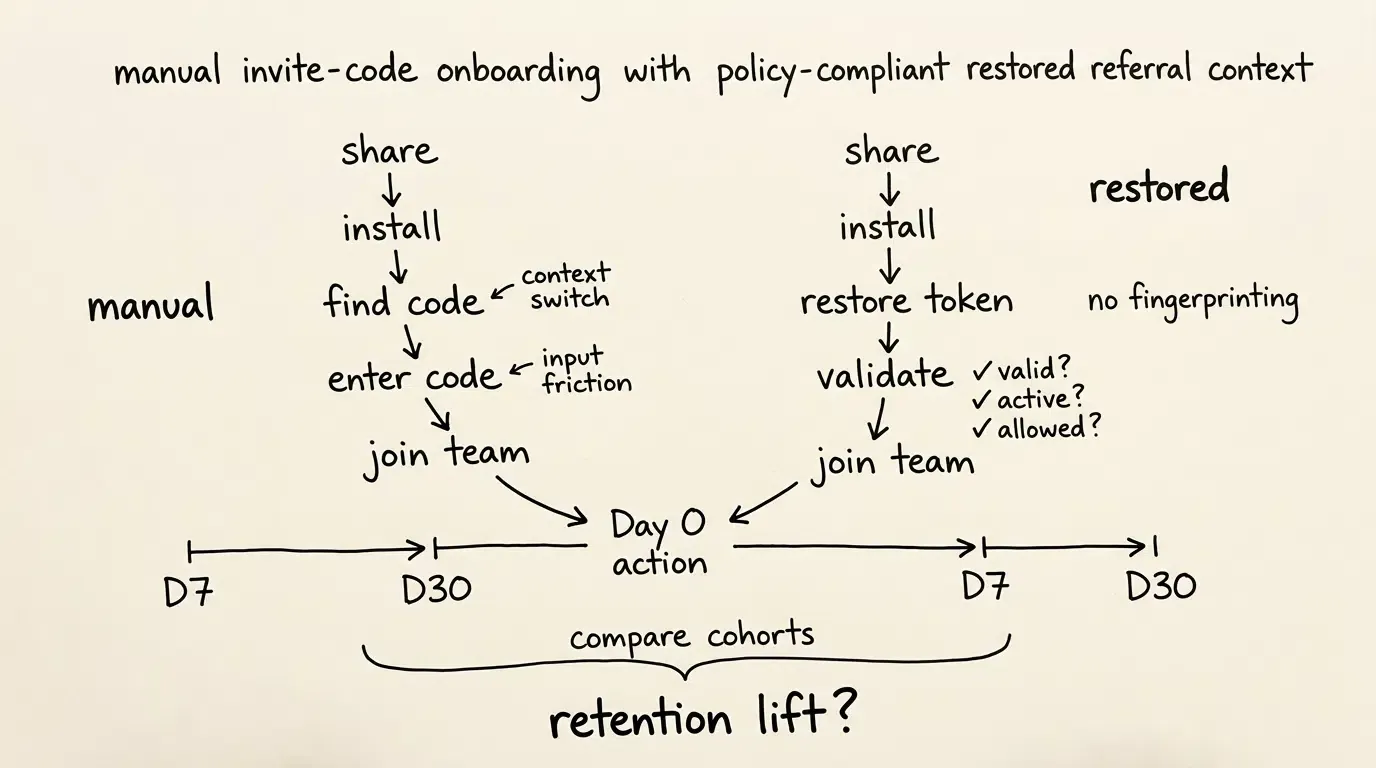
Manual data entry introduces significant procedural friction in referral, invitation, and campaign-driven onboarding flows, particularly when users must reconstruct context after installation. In legacy referral programs, existing users send an alphanumeric code via messaging apps; the recipient must copy the code, navigate to the app store, download the app, complete onboarding, locate a promo code input box, and paste the string.
This manual requirement creates conversion friction. If the invitee fails to apply the code, the referral attribution is lost, the inviter receives no reward, and the new user enters an unconfigured account state.
Contextual Parameter Preservation: Restoring Inviter Tokens and Custom Rewards via OpoInstall SDK
Parameterized onboarding mitigates this friction by programmatically preserving referral context across the app store installation barrier.
OpoInstall, a mobile attribution and deep linking platform, implements deferred deep linking by capturing URL query parameters (such as ?inviter_token=usr_7766&reward_id=PROMO50&workspace_id=team_alpha) on web landing pages. When the new user opens the application for the first time, the native mobile SDK retrieves the cached parameters from the attribution backend.
On Apple platforms, referral-context restoration must use mechanisms that comply with current App Store privacy requirements and must not derive a stable user or device identity through fingerprinting.
Engineers can consult the parameter restoration documentation for technical specifications on parsing dynamic payload dictionaries within native lifecycle callbacks.
Automated Welcome States: Direct Routing to Shared Workspaces, Private Matches, or Dynamic Credits
Restoring parameters upon first launch allows applications to automate account setup and render personalized welcome states without requiring manual input.
The diagram below illustrates the end-to-end data pipeline from initial referral share to early retention evaluation:
[Existing User Shares Link] ──> [Web SDK Captures Inviter ID & Tokens]
             │                                    │
             ▼                                    ▼
   [Store Install & Open]      ──> [OpoInstall SDK Restores Context]
             │                                    │
             ▼                                    ▼
 [Auto-Bound Social Context]   ──> [Zero-Code Welcome Experience]
             │                                    │
             ▼                                    ▼
    [Day 0 Core Action]        ──> [Measure D7 & D30 Retention vs Control]
Upon receiving restored parameters during initialization, the application client verifies token validity, expiration, and user authorization with backend servers before placing the user into the inviter’s team workspace, private game lobby, or active referral credit pool. Removing manual input barriers bridges social intent, enabling development teams to evaluate whether frictionless Day 0 onboarding improves Day 7 and Day 30 active player retention compared to unassisted control cohorts.
Comparative Evaluation of Paid Acquisition vs Referral Cohort Retention Trajectories
Analyzing Divergence in Retention Matrices Across Marketing Channels
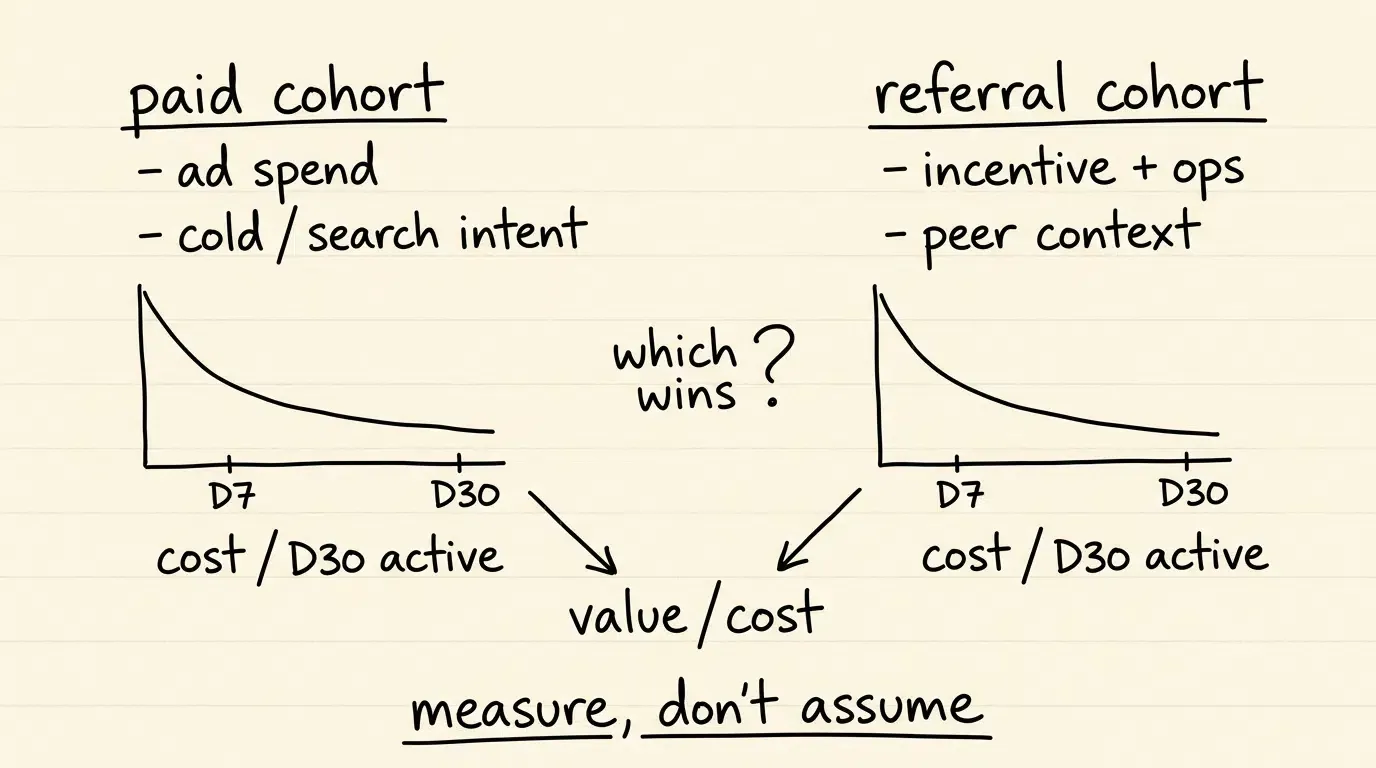
Evaluating retention performance requires segmenting cohort matrices by acquisition channel. Blended retention curves mask structural divergence between unassisted paid advertising and peer-referred user groups.
The diagnostic framework below contrasts primary acquisition channels across key operational dimensions:
| Cohort Evaluation Dimension | Paid Programmatic Display | Targeted Paid Search | In-App Peer Referral Loop |
|---|---|---|---|
| Initial User Intent | Low to Variable (Interruptive) | High (Active Search Query) | Context-Dependent (Peer Recommended) |
| Social & Team Context | Usually lacks pre-existing peer context | Usually lacks pre-existing peer context | Potentially connected through inviter |
| Onboarding Form Friction | Governed by App Form Design | Governed by App Form Design | Reduced via Contextual Parameter Restoration |
| Early Return Motivation | Product Utility / Lifecycle Messaging | High-Intent Functional Need | Peer Context / Collaborative Utility |
| Retention Measurement Focus | Rapid |
Search Keyword Intent Match | Long-Tail Network Retention & |
*Note: Qualitative dimensions represent structural analytical comparisons across mobile application cohorts. Specific retention rates must be measured empirically within each product’s own cohort analytics.
Long-Term Cohort Value Comparison
While paid display channels frequently deliver upfront download volume, their retention decay requires monitoring the effective cost per Day 30 active user (
In contrast, peer-referred cohorts frequently exhibit resilient retention plateaus when social features are integrated into the core product. Combining zero-code parameter restoration with pre-established trust may improve downstream cohort value when lower onboarding friction translates into higher activation and retained usage.
When Is a Built In Referral Program Effective for Retention Optimization
Structuring Diagnostic Telemetry Payloads for Referral-Driven Cohort Tracking
Constructing a referral analytics pipeline requires logging structured telemetry events that bind pre-install referral context with in-app engagement milestones and experimental variants.
The JSON payload below demonstrates an illustrative production-oriented telemetry record capturing a referral-driven onboarding session:
```json
{
  "schema_version": "1.2.0",
  "event_id": "evt_ref_9a8b7c6d-5e4f-3a2b-1c0d-8f7e6d5c4b3a",
  "event_name": "referral_onboarding_verified",
  "client_event_timestamp_utc": "2026-08-30T14:20:10.150Z",
  "session_elapsed_monotonic_ms": 48200,
  "server_received_timestamp_utc": "2026-08-30T14:20:10.820Z",
  "user_identity": {
    "app_instance_id": "inst_anon_a1b2c3d4-e5f6-7890-abcd-ef1234567890",
    "is_first_launch": true
  },
  "referral_context": {
    "inviter_token_pseudonymous": "usr_tok_anon_77665544",
    "referral_campaign_id": "cmp_q3_viral_expansion",
    "channel_code": "user_referral_link",
    "reward_tier_id": "reward_bilateral_credit_20",
    "target_workspace_id": "ws_collab_alpha_99",
    "parameter_restoration_status": "restored_success",
    "parameter_retrieval_latency_ms": 110
  },
  "referral_validation": {
    "token_valid": true,
    "invite_status": "active",
    "reward_eligibility": "eligible",
    "binding_status": "bound_success"
  },
  "experiment_context": {
    "experiment_id": "exp_referral_onboarding_2026q3",
    "assignment_unit": "app_instance_id",
    "assignment_timestamp_utc": "2026-08-30T14:19:20.000Z",
    "onboarding_variant": "parameter_restored"
  },
  "onboarding_telemetry": {
    "session_id": "sess_onboarding_9876543210fedcba",
    "event_sequence_index": 4,
    "step_name": "workspace_autojoin_complete",
    "step_transition_duration_ms": 3200,
    "is_core_action_completed": true
  },
  "device_telemetry": {
    "platform": "Android",
    "os_version": "16.0",
    "app_version": "3.2.0",
    "sdk_version": "<installed_sdk_version>",
    "network_type": "WIFI",
    "device_tier": "mid_range"
  },
  "diagnostic_metadata": {
    "is_background_wake": false,
    "memory_pressure_state": "normal"
  }
}
Suitable Conditions for Deploying In-App Referral Systems
Deploying dedicated referral marketing software and parameter restoration infrastructure delivers measurable retention ROI under specific conditions:
- Collaborative and Multi-User Applications: Products where core utility expands through peer interaction (B2B team workspaces, collaborative document tools, social commerce, and multiplayer gaming).
- High-Engagement Core Loops: Applications with strong product-market fit where existing active users naturally advocate organic value to their peer networks.
- Two-Sided Value Propositions: Platforms offering clear, balanced reward structures (such as bilateral account credits, premium feature unlocks, or exclusive digital content) that incentivize both parties.
Unsuitable Conditions for Standalone Referral Deployment
Implementing high-complexity referral loops may introduce unnecessary operational overhead in the following scenarios:
- Single-Session Utility Tools: Basic standalone utilities (such as offline file converters, system calculators, or single-use scanners) where ongoing social collaboration is absent.
- Pre-Product-Market-Fit Prototypes: Early-stage applications where the core functional loop suffers from structural retention failure; referral loops cannot fix a fundamentally unretentive product.
- Single-Player Niche Utilities: Products designed exclusively for private, isolated usage where sharing introduces privacy concerns rather than collaborative utility.
Common Misconceptions in Referral Retention Strategy
- Misconception 1: Referral Programs Only Impact Top-of-Funnel Acquisition: While referral programs drive acquisition volume, their primary long-term value lies in cohort quality: peer-referred users frequently exhibit stronger Day 7 and Day 30 retention than unassisted paid traffic.
- Misconception 2: Static QR Codes and Manual Codes Deliver Equal Conversion: Forcing users to manually copy and paste invitation codes introduces significant friction, causing substantial drop-off compared to automated parameter restoration via deferred deep linking.
Frequently Asked Questions (FAQ)
How does a referral program increase user retention compared to paid ad campaigns?
What role does zero-code parameter passing play in referral onboarding?
How does the viral coefficient (K-factor) interact with Day 30 cohort retention?
Summary and Decision Framework
Transforming user acquisition into sustainable mobile growth requires leveraging programmatic referral loops to drive durable long-term retention. Compared with acquisition channels that lack pre-existing peer context, well-designed referral programs can create additional social and collaborative reasons for users to return.
Building a high-retention referral engine depends on eliminating Day 0 manual input friction and connecting new users directly to their inviters. By deploying lightweight SDK integration and contextual parameter restoration, platforms like OpoInstall provide the infrastructure required to automate referral attribution, streamline user onboarding, and support customer lifetime value.
To evaluate how unified attribution and parameter-passing infrastructure can power your app referral program, explore the mobile attribution implementation reference or register on the OpoInstall developer console.
Related Materials
-
Concepts: In-App Referral Loops, Viral Coefficient (K-Factor), Social Proof, Parameterized Onboarding, Cohort Retention
-
Technologies: Referral Marketing Software, Deferred Deep Linking, Client Lifecycle Telemetry, S2S Webhooks
-
APIs & Data Interfaces: OpoInstall SDK
getInstallParamAPI, OpoInstallreportShareAPI, AndroidProcessLifecycleOwner, iOSUIWindowSceneDelegate -
Official Documentation & References:
Share this article