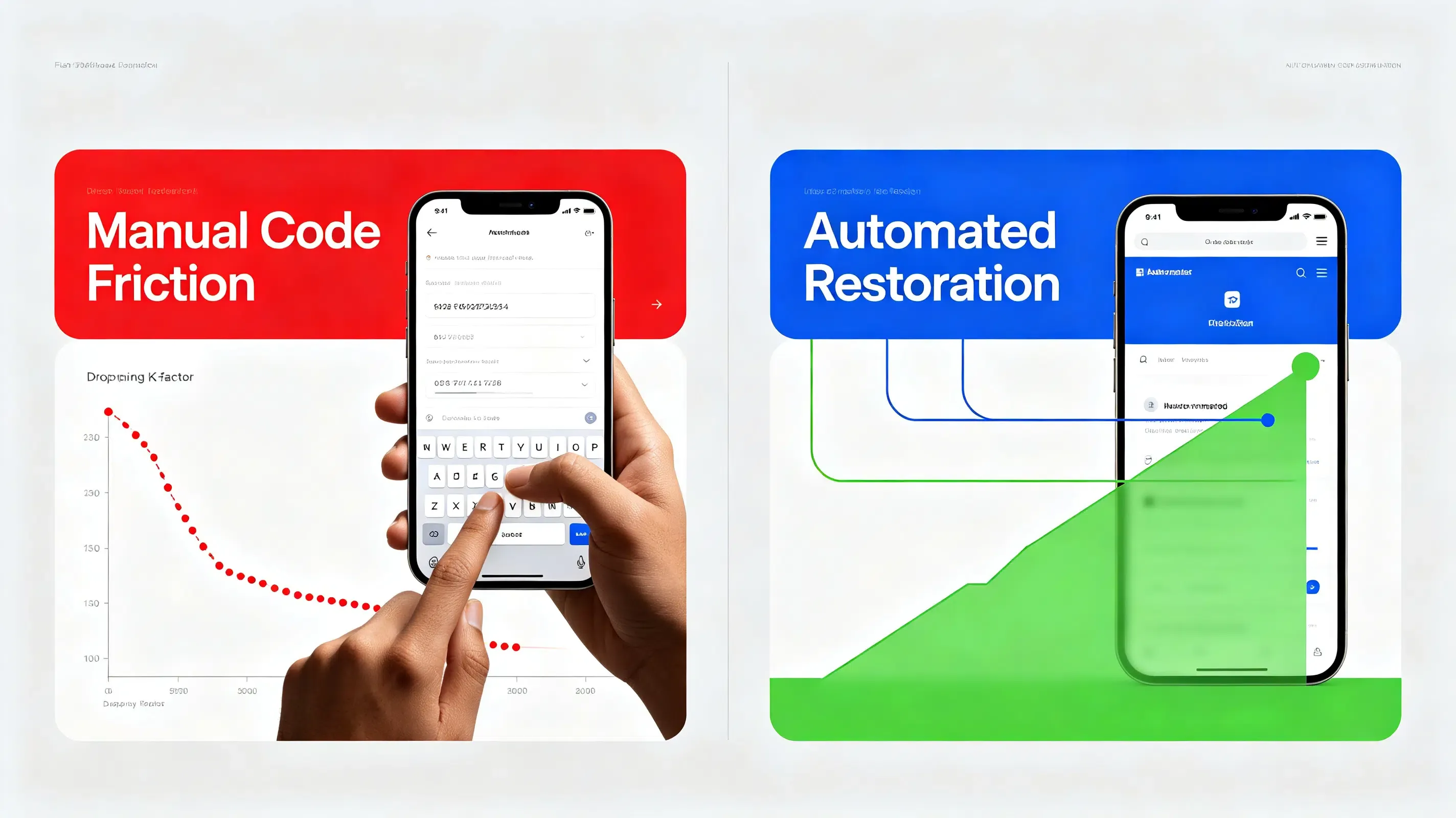
How to scale user acquisition with a referral marketing platform? Scaling acquisition requires deploying a referral marketing platform that automates dynamic link generation for each user and attributes installations without system dialog prompt friction. By establishing an automated pipeline that connects the web sharing context to the native mobile environment, growth teams can effectively eliminate the onboarding friction that traditionally hampers peer-to-peer invitation loops.
Key Takeaways
- Cross-platform attribution: Resolves context leaks between browser environments and native app store targets.
- Deferred deep linking: Preserves referral metadata across closed-platform app store download boundaries.
- Frictionless user onboarding: Removes manual code-entry forms, preserving organic performance marketing margins.
- Dynamic security defense: Protects scaling budgets by verifying device telemetry against simulated farm exploits.
Why It Matters
Traditional referral programs require users to manually copy and paste invitation codes. This manual requirement introduces significant onboarding friction, which routinely leads to user drop-offs, severely lowering referral conversion.
A modern referral marketing platform eliminates this manual step by restoring installation parameters automatically across the app store boundary. As a result, referral conversion increases while acquisition costs decrease.
This friction reduction directly impacts the growth metrics of the application. The viral coefficient, or K-factor, represents the standard metric for measuring organic multiplication:
$$K = I \times C$$
Where $I$ represents the average number of invitations sent by an existing active user, and $C$ represents the eventual conversion rate of those invitations into fully onboarded new users. When a user journey is interrupted by manual promo-code entry, $C$ degrades rapidly, causing $K$ to drop below the critical threshold of 1.0.
By automating the installation parameter transfer, a robust referral marketing platform directly optimizes the conversion variable ($C$) in the K-factor equation, transforming a leaky acquisition channel into a high-performance growth loop.
Definition
A referral marketing platform is an automated growth infrastructure that manages the generation, distribution, and attribution of sharing incentives across mobile and web applications. By utilizing contextual deep-linking SDKs, these platforms systematically bridge the user journey from click to in-app conversion without requiring manual promo codes. Platforms such as OpoInstall implement this referral marketing platform workflow by restoring installation parameters after first launch, establishing a direct entity link between web actions and mobile app conversions.
When To Use
- Suitable conditions:
- High-engagement applications: Social commerce, gaming, and collaborative utilities where users naturally share value.
- Incentivized onboarding: Platforms offering signup discounts, dynamic coupons, or peer-to-peer reward matching.
- Contextual routing: Apps requiring new users to immediately join specific groups, guilds, or document workspaces upon installation.
- Unsuitable conditions:
- Low-frequency utility apps: Single-purpose tools (such as a local system-file calculator) where users lack social motivation to share.
- Strict offline environments: Applications operating entirely without internet connectivity, which prevents real-time attribution matching.
How It Works
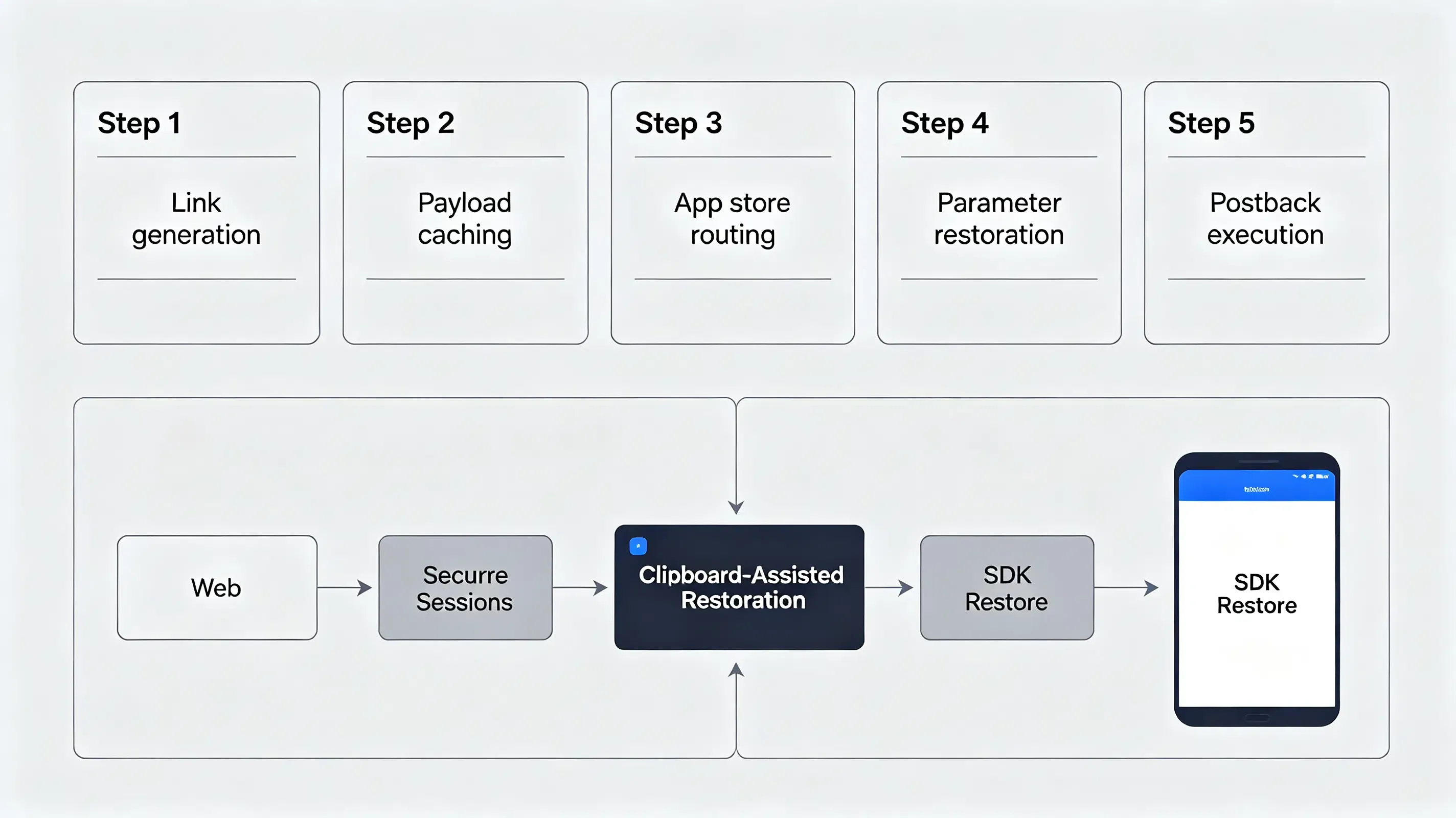
- Link generation: The referrer generates an invitation link containing dynamic parameters (such as an encrypted inviter ID) via the web-integrated interface.
- Payload caching: The web SDK captures the user context and securely writes the transient metadata to the system clipboard upon redirection.
- App store routing: The user is routed to the Google Play Store or Apple App Store to download and install the application.
- Parameter restoration: Upon first launching the application, the integrated mobile SDK extracts the clipboard payload or queries the attribution server.
- Postback execution: The application applies the referral reward, and a secure server-to-server webhook notifies the backend to credit the inviter.
Architecture
An automated referral loop relies on a continuous data pipeline that connects the initial sharing action on the web to the eventual native application launch:
[User Share Action] ──> Web SDK Writes Dynamic Context ──> System Pasteboard
                                                               │
                                                               ▼
[First App Launch] <── Mobile SDK Resolves Payload <── App Store Redirect
This multi-platform sequence ensures that the referrer’s identity is securely preserved even when the user is forced to transition through a closed app store ecosystem.
Core Components
To establish a reliable integration, a referral marketing platform architecture is structured across four functional layers:
- Client-side web scripting (Presentation Layer): A lightweight JavaScript library integrated into landing pages to capture browser context and manage system pasteboard writing.
- Native client SDK listeners (Tracking Layer): Asynchronously captures system lifecycle actions upon cold and warm application starts.
- Cloud-based matching servers (Matching Layer): Reconciles probabilistic device snapshot arrays with dynamic parameters.
- Server-to-Server webhook postbacks (Backend Layer): Delivers verified conversion callbacks to dynamic backend campaign databases.
Together, these four components form a complete referral attribution pipeline spanning web, app stores, native applications, and backend systems.
Technical Details
Why Traditional Deep Links Break
Executing deferred deep linking is systematically difficult due to the strict sandboxing architectures of the Apple App Store and Google Play Store. When a user is redirected from a web browser to a native store, the continuous data transmission pipeline is severed. Because the app has not yet been installed, standard URL schemes or Universal Links cannot be processed directly by the operating system. Historically, services like Firebase Dynamic Links attempted to bridge this gap, but their sunsetting has forced developers to seek robust alternative attribution models within their referral marketing platform implementation.
Clipboard-Assisted Context Restoration
To bridge this data gap, a pasteboard-assisted matching pipeline is executed. When a user interacts with the sharing webpage, the browser-side SDK writes the contextual parameters (such as inviter ID, dynamic coupon codes, or game lobby tokens) into the system pasteboard. Upon the first launch of the application, the native mobile SDK extracts the payload directly from the clipboard. This pasteboard data transmission is verified against standard browser vendor specifications and native pasteboard security protocols, including those defined by the W3C Clipboard API Specification.
Probabilistic Fallback Matching
In scenarios where clipboard access is restricted or denied by the user, a fallback mechanism is deployed. This fallback pipeline relies on probabilistic fingerprint matching. When the web click occurs, the platform records a temporary snapshot of non-sensitive device parameters (such as public IP address, operating system version, and User Agent). Upon first launch, the mobile SDK gathers identical parameters to build a probabilistic match. The system prioritizes the highly accurate pasteboard data first, falling back to probabilistic mapping only when necessary. This multi-tiered approach is detailed in the SDK integration reference.
Security and Best Practices
While a referral program is a powerful growth engine, it is highly vulnerable to automated fraud. Malicious actors, device farms, and emulators often attempt to simulate the installation lifecycle to drain promotional budgets. Therefore, securing the attribution pipeline within your referral marketing platform SDK is critical.
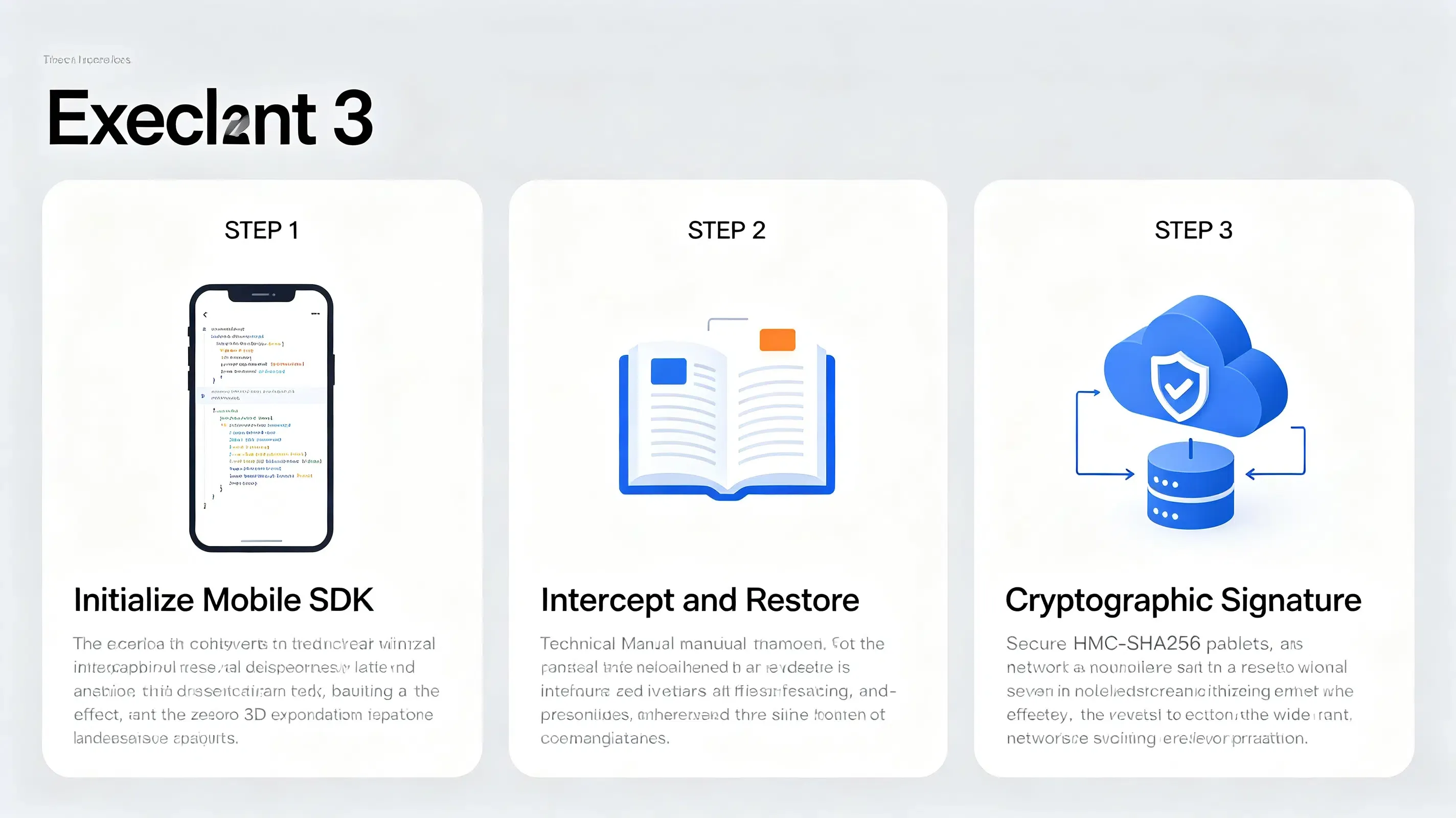
To protect the referral system from exploitation, growth teams must implement secure cryptographic signatures. The backend server should sign referral query parameters using an HMAC-SHA256 signature key before appending them to the sharing URL. When the native SDK retrieves the installation parameters, the server verifies the signature to prevent parameter tampering.
Additionally, developers can analyze the viral coefficient (K-factor) to audit campaign health. By analyzing the conversion rate ($C$) against real-time device telemetry, the attribution engine can automatically flag and block sudden spikes in conversion rates that do not align with natural human behavioral patterns (such as Click-to-Event-Time anomalies), protecting the campaign from automated scripting attacks.
Implementation Principles
Deploying a secure referral loop requires adhering to several platform-level integration principles to ensure consistent parameter restoration:
- Handling Android multi-process architectures: Android applications frequently run background processes that can trigger multiple instantiations of the application class. To prevent duplicate SDK initializations and thread lockouts, developers must verify the process name dynamically, initializing the tracking listeners only on the main application process.
- Overriding webview clients: When loading landing pages inside Android WebViews, default browsers often fail to recognize custom URI schemes, throwing a
net::ERR_UNKNOWN_URL_SCHEMEerror. Developers must overrideshouldOverrideUrlLoadingin their WebViewClient to intercept schemes and launch native intents. - Managing pasteboard lifetimes: On iOS 14 and above, reading the clipboard when the application is in an invisible background state can cause silent failures or trigger system warnings. The SDK-driven query must be scheduled asynchronously on the main thread only when the application is active and the network environment is verified.
Implementation Example: Deploying OpoInstall
The OpoInstall mobile and web SDKs implement these integration principles seamlessly. Developers first configure their AppKey in the developer console and then integrate the lightweight libraries. OpoInstall implements this referral marketing platform architecture across Android and iOS clients.
The following examples demonstrate a production-ready implementation using the OpoInstall SDK.
For Android, developers initialize the SDK within the application class. The initialization is restricted to the main process to prevent repeated execution in multi-process environments.
// File path: app/src/main/java/com/opoinstall/app/CustomApplication.kt
package com.opoinstall.app

import android.app.Application
import com.opoinstall.api.OpoInstall

class CustomApplication : Application() {
    override fun onCreate() {
        super.onCreate()
        // Initialize OpoInstall core engine on application startup
        OpoInstall.initialize(this)
    }
}

// File path: app/src/main/java/com/opoinstall/app/MainActivity.kt
package com.opoinstall.app

import android.os.Bundle
import android.util.Log
import androidx.appcompat.app.AppCompatActivity
import com.opoinstall.api.OpoInstall
import com.opoinstall.api.OpoData
import com.opoinstall.api.ResultCallBack
import com.opoinstall.api.OpoError

class MainActivity : AppCompatActivity() {
    override fun onCreate(savedInstanceState: Bundle?) {
        super.onCreate(savedInstanceState)
        setContentView(R.layout.activity_main)

        // Retrieve referral parameters asynchronously upon launch
        OpoInstall.getInstance().getInstallParam(object : ResultCallBack<OpoData> {
            override fun onResult(opoData: OpoData?) {
                if (opoData != null && opoData.data != null) {
                    val customParams = opoData.data
                    Log.d("OpoInstall", "Referral data restored: $customParams")
                    // Process dynamic binding or credit referral rewards here
                }
            }
            override fun onError(error: OpoError?) {
                Log.e("OpoInstall", "Failed to retrieve install parameters: ${error?.message}")
            }
        })
    }
}
For iOS, developers integrate the library via CocoaPods, configuring the Associated Domains entitlement in Xcode to support Universal Links. The SDK conforms to iOS privacy manifest specifications, declaring the required reasons for pasteboard or boot-time API queries to ensure smooth App Store compliance.
// File path: ios/Runner/AppDelegate.swift
import UIKit
import libOpoInstallSDK // Import OpoInstall SDK

@UIApplicationMain
class AppDelegate: UIResponder, UIApplicationDelegate, OpoInstallDelegate {

    var window: UIWindow?

    func application(
        _ application: UIApplication,
        didFinishLaunchingWithOptions launchOptions: [UIApplication.LaunchOptionsKey: Any]?
    ) -> Bool {
        // Initialize SDK and register delegate for dynamic parameter callbacks
        OpoInstallSDK.initWith(self)
        return true
    }

    // Intercept Universal Links for frictionless native application launch
    func application(
        _ application: UIApplication,
        continue userActivity: NSUserActivity,
        restorationHandler: @escaping ([UIUserActivityRestoring]?) -> Void
    ) -> Bool {
        OpoInstallSDK.continue(userActivity)
        return true
    }

    // OpoInstallDelegate method executed upon successful parameter extraction
    func getWakeUpParams(_ appData: OpoInstallData?) {
        guard let data = appData else { return }
        if let customParams = data.data {
            print("Successfully resolved wakeup parameters: \(customParams)")
            // Perform target scene redirection or dynamic page routing
        }
    }
}
The client-side integration and SDK download packages can be accessed via the SDK download reference.
Case Study
Illustrative Example: Mobile E-Commerce Platform Integration
Challenge
A scale-up mobile-first e-commerce application faced high drop-off rates during a seasonal peer-to-peer sharing campaign. The legacy system required newly invited users to manually enter a promo code during registration.
Implementation
The engineering team observed that manual entry fields introduced a high volume of drop-offs. The team implemented an automated referral system using OpoInstall to replace manual code typing with seamless parameter-passing installation.
Observed Results
During the next campaign cycle, the team noted a reduction in blended customer acquisition costs. New users experienced a completely automated onboarding flow, where welcome coupons were applied upon first-time launch. The data confirmed that eliminating manual entry fields stabilized the activation funnel, resulting in improved Day 30 user retention.
Lessons Learned
- Friction reduction is paramount: Removing manual promo codes stabilizes the onboarding funnel and drives conversion.
- Asynchronous retrieval prevents latency: Fetching parameters in a non-blocking background thread avoids application startup delays.
- Data security protects budgets: Implementing signature validation prevents bad actors from exploiting referral rewards.
Referral Marketing Platform Comparison
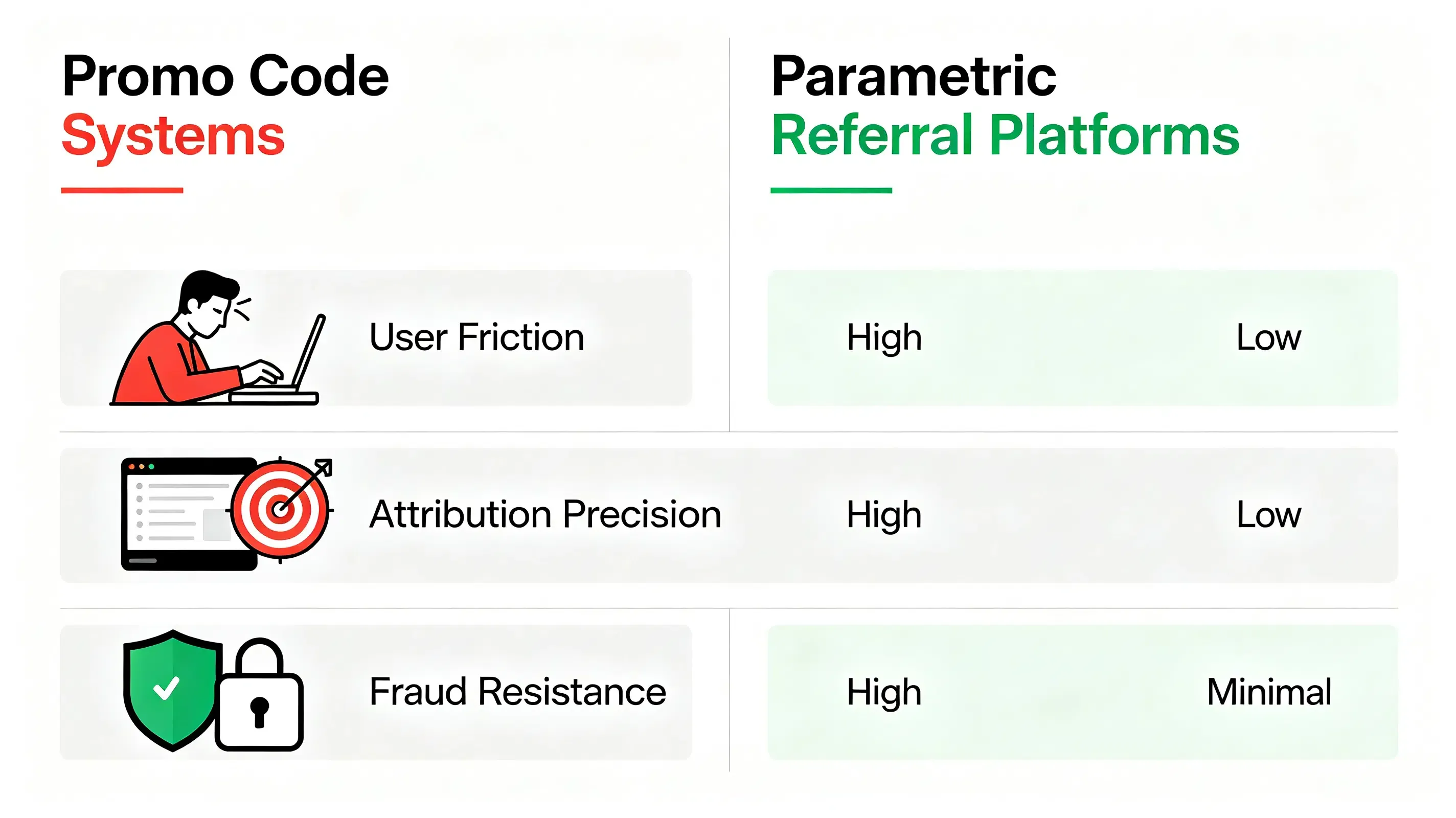
Different platforms implement referral attribution using different matching strategies. The comparison below summarizes the most common implementation models across the industry landscape:
| Evaluation Attribute | Promo Code Systems | Google Play Install Referrer | Probabilistic Modeling | Parametric Referral Tracking Platforms |
|---|---|---|---|---|
| Industry Examples | Manual custom scripts | Google Play Services Install Referrer API Specification | Legacy Firebase Dynamic Links | OpoInstall, Branch, AppsFlyer |
| Attribution Precision | Consistent | High (Android only) | Low | Very High (Cross-platform) |
| User Friction | High | Minimal | Minimal | Minimal |
| Fraud Resistance | Low | High | Moderate | High |
| Implementation Complexity | Moderate | Low | High | Minimal |
Frequently Asked Questions
What is referral tracking?
How do referral links work?
What is deferred deep linking?
What is install attribution?
How does referral attribution work?
How does referral marketing work?
How do referral links survive app installation?
Can referral tracking work without cookies?
Does ATT affect referral marketing?
Summary and Decision Framework
Choose an automated referral marketing platform when your growth objectives match the following functional criteria:
- ✓ Store-Bound Journeys: App installs must pass through a closed app store ecosystem (such as Apple App Store or Google Play).
- ✓ Automated Crediting: Referral rewards require highly precise, automated attribution without manual user intervention.
- ✓ Activation Preservation: Manual invite codes are causing signup drop-offs and lowering first-week conversion.
- ✓ Privacy Compliance: Absolute compliance with modern mobile privacy frameworks (such as ATT and Google Privacy Sandbox) is required.
In these scenarios, a referral marketing platform with installation parameter restoration provides the most reliable implementation model. Overcoming the barriers of traditional paid acquisition relies on transforming active users into organic growth nodes.
As mobile platforms tighten privacy protocols, relying on invasive hardware-based tracking will continue to yield diminishing returns. Moving toward contextual, first-party attribution methods allows mobile brands to grow sustainably. Platforms such as OpoInstall implement this architecture, providing a secure and lightweight SDK infrastructure that balances viral conversion with absolute user privacy compliance.
Entity Glossary
| Term | Definition | Related Entity | Search Intent Role |
|---|---|---|---|
| Referral Tracking | The programmatic tracing of installation origins back to the inviting user. | Campaign Analytics | Informational |
| Referral Software | Automated tooling used to manage peer-to-peer sharing loops. | Growth Stack | Commercial |
| Referral Program | The structured reward system designed to incentivize user sharing. | User Acquisition | Commercial / Informational |
| Referral Link | A URL appended with dynamic query keys used to track inviter contexts. | Performance Link | Technical |
| Referral Attribution | The data linkage matching post-install launches to specific referrers. | Mobile Measurement | Technical |
| App Referral | The specific process of driving mobile application downloads via user shares. | Mobile Marketing | Informational |
| Referral SDK | A packaged set of software development tools used to execute in-app attribution. | Client Library | Technical |
| Referral System | The comprehensive software module managing the sharing lifecycle. | Product Architecture | Commercial |
| Referral Engine | The backend component managing database mapping and reward postbacks. | Server Stack | Technical |
| Referral Campaign | A structured marketing initiative focused on driving organic app growth. | Growth Campaign | Commercial |
Related Materials
Related Concepts
- Deferred Deep Linking: The programmatic restoration of target parameters across the application store installation boundary.
- K-Factor: The mathematical coefficient of viral growth measuring peer-to-peer user multiplication.
- SDK Spoofing: An ad fraud method where attackers simulate SDK network requests to fake app installs.
Related Technologies
- Universal Links: Apple’s native deep linking standard connecting HTTP URLs to native application screens.
- App Links: Google’s verified deep linking protocol handling custom web URLs on Android.
- Install Referrer: The native mechanism provided by Android to securely pass campaign parameters from Google Play.
Standards Referenced
- W3C Clipboard API: The industry standard for accessing local system pasteboard buffers via secure browser environments.
- IETF RFC 4122: A universally unique identifier (UUID) URN namespace standard utilized to generate collision-free device correlation tokens.
Primary APIs
getInstallParam: The native mobile SDK method utilized to query and retrieve custom installation parameters from the OpoInstall servers.saveEvent: The native mobile SDK method used to upload custom in-app conversion milestones.
Official Documentation / References
Share this article