Tencent Launches Agent Email? This strategic pivot has been conclusively validated as the tech giant officially launches its specialized mailbox infrastructure under the Agently Mail brand on June 23, 2026. Specifically, the introduction of this flagship collaborative communication protocol redefines developer and model workflows inside enterprise ecosystems. Consequently, this always-on isolated communication layer drives massive change in team operations. For developer teams, the immediate challenge is managing collaborative chat flows while preserving secure context and parameter integration. Crucially, the introduction of the Agently Mail update marks a significant milestone in autonomous business coordination.
Deciphering Tencent’s Autonomous Infrastructure: Agently Mail and the Rise of Dedicated Agent Identities
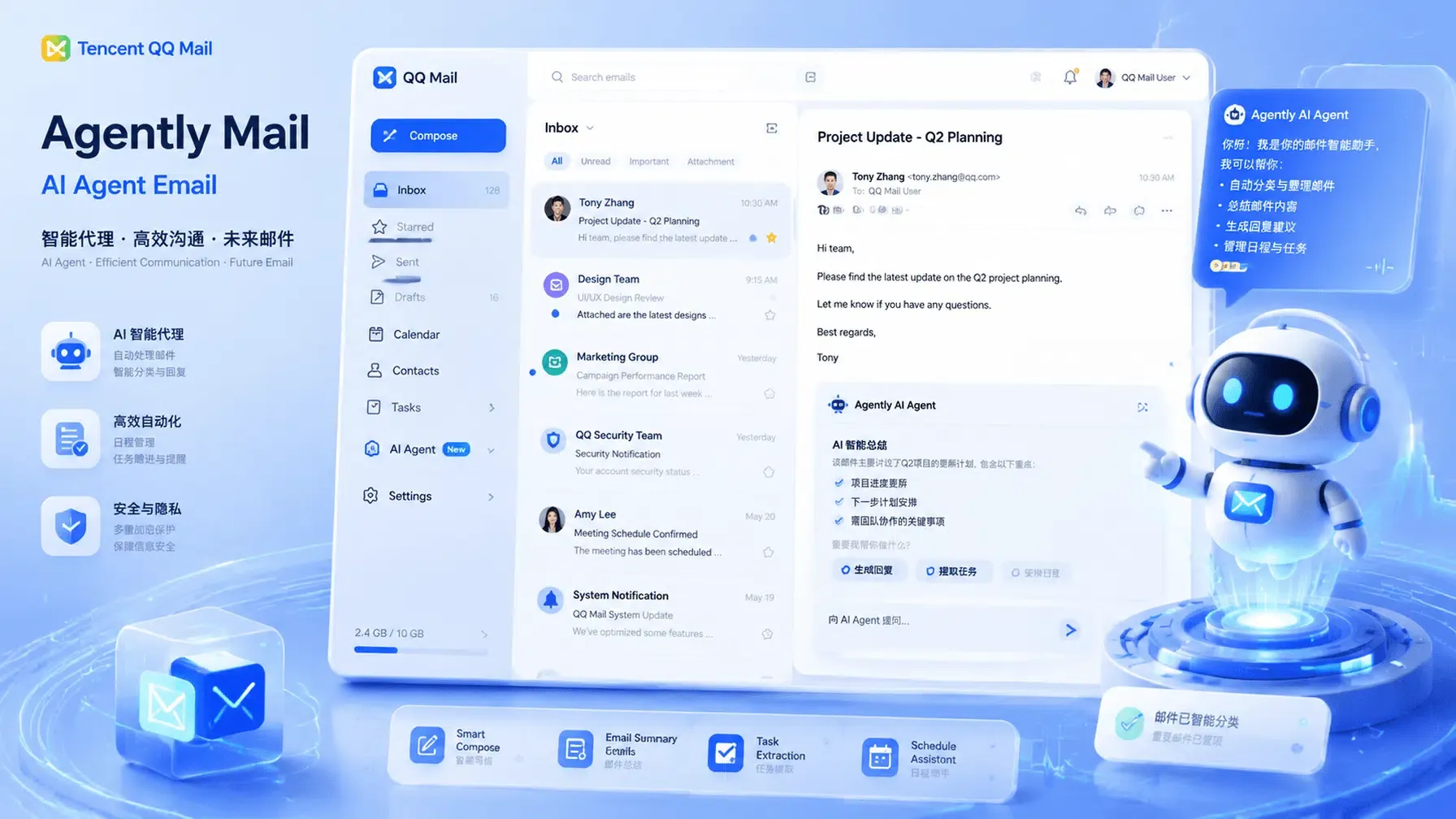
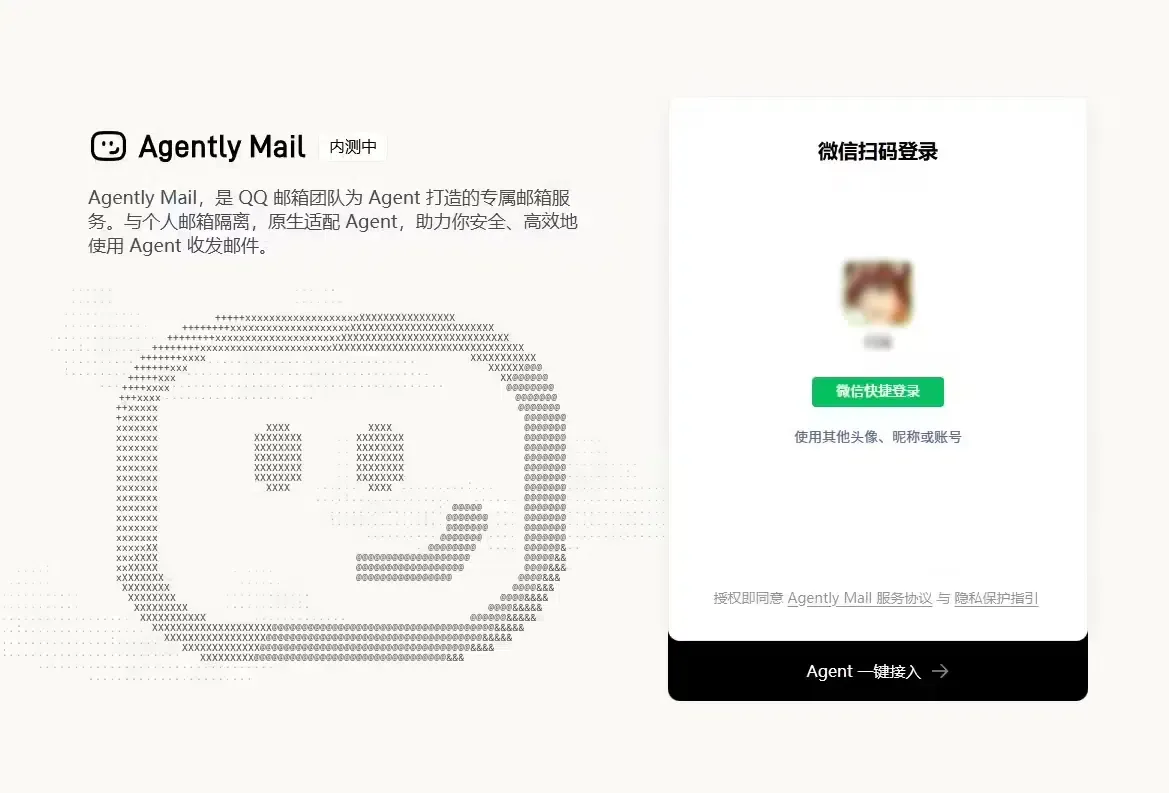
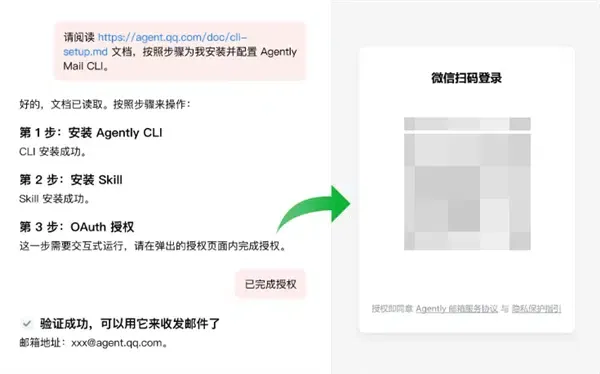
During the official release on June 23, 2026, Tencent QQ Mail launched its new specialized service under the Agently Mail brand. Specifically, when Tencent Launches Agent Email under the Agently Mail brand, it assigns a standalone digital identity. Furthermore, this product directly addresses the twin challenges of privacy security and digital identity management. Consequently, the milestone of Tencent Launches Agent Email introduces absolute mailbox isolation. Meanwhile, because Tencent Launches Agent Email, developers can connect models natively. For instance, the system is completely separated from the user’s personal QQ Mail inbox. Detailed registration can be verified through official portal Agently Mail.
Dedicated Identities and the Agently Mail Architecture
Specifically, the service bypasses the need for an agent to borrow a human’s personal account credentials. Furthermore, each agent can now independently register on third-party platforms and receive verification codes. Consequently, the model operates entirely on its own behalf. Meanwhile, the system requires mandatory real-name authentication during setup to prevent spam and ensure accountability. For instance, all transactions and outgoing emails are fully traceable for regulatory compliance and audit purposes.
Multi-Platform Compatibility and the Apache-2.0 Open Source Repository
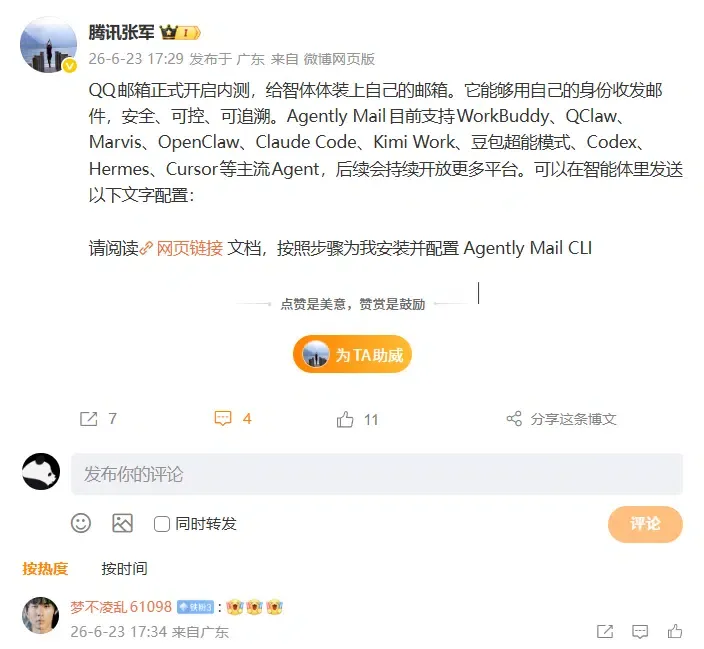
To ensure wide compatibility, Tencent designed Agently Mail to integrate with leading domestic and international agent frameworks. Specifically, the service supports ByteDance’s Doubao Super Mode, Moonshot AI’s Kimi Work, Anthropic’s Claude Code, and Cursor. Furthermore, the official public repository is open-sourced on GitHub under the Apache-2.0 license. Consequently, developers can inspect and audit the source code to verify security standards. Meanwhile, public relations director Zhang Jun confirmed that more integrations, including WorkBuddy, QClaw, Marvis, OpenClaw, Codex, and Hermes, are actively supported.
Secure Isolation, Real-Name Verification, and the Summary-First Security Loop
Because exposing private correspondence introduces obvious security risks, Tencent has built strict guardrails into the core layout. Specifically, every action such as forwarding, replying, or deleting an email must first generate a text summary. Furthermore, the system requires the user to review and confirm this summary before executing the command. Consequently, this prevents autonomous models from leaking data without human supervision. Meanwhile, the email-reading engine includes native prompt injection protection. This prevents malicious emails from manipulating the agent’s behavior through hidden commands.
The Fragmentation of Traditional Communication: How Independent Mailboxes Trigger a Web-to-App Ecosystem Shift
As agents assume the role of active communication partners, traditional client-side workflows begin to dissolve. Specifically, the era that Tencent Launches Agent Email shifts the entry point of business transactions. Consequently, since Tencent Launches Agent Email, automated agents can register on third-party sites. Meanwhile, this shift from human-driven browsing to automated agent execution triggers a severe attribution crisis. For developer teams, the immediate challenge is managing cross-platform transitions while maintaining robust user session validation.
Agent-to-Agent Autonomous Workflows and the End of Traditional Forms
Specifically, the system enables secure Agent-to-Agent (A2A) communication between different enterprises. Furthermore, AI agents can automatically complete processes like price inquiries, quotations, and order transactions. Consequently, the traditional web-form submission funnel disappears. Meanwhile, because these transactions are processed asynchronously in the background, standard cookie tracking becomes obsolete. As a result, marketing and product teams face massive data discrepancy, making it impossible to measure campaign ROI.

The Funnel Drop-off in Background-Executed Conversational Paths
Furthermore, when an agent processes an invoice or submits a resume autonomously, it bypasses the standard app download loops. Consequently, the traditional user acquisition funnel experiences a massive drop-off. For instance, the user is never prompted to download the native brand application, leading to a drop-off in post-conversion user engagement. Crucially, without a secure, cryptographic verification layer, developers cannot determine whether a conversion originated from a genuine user or an automated script. This gap creates a critical security and compliance barrier for enterprise deployments.
Reference Architectures & Engineering References: Establishing Cryptographically Secured Contextual Handoffs
To secure collaborative agent workflows and combat data discrepancies, software architects must implement standardized engineering safeguards. Specifically, we must adopt an “80/20” approach, where 80% of the architecture focuses on universal technical principles and 20% leverages proven tool standards. Furthermore, one of the most critical defensive measures is the deployment of secure, cross-process verification handshakes. Consequently, the backend must transition to server-to-server validation.
Constructing Token Spend Budgets and Access Control Planes
Specifically, deploying workflows after Tencent Launches Agent Email requires a clear security boundary. Furthermore, the application must perform independent cryptographic verification of the calling process. Consequently, the background process must require a unique, transient token generated by a verified server-side handshake. Meanwhile, when the application executes a critical command, the server validates the signature of the caller. As a result, even if a local security leak occurs, cryptographic signatures will block spoofing attempts.
Securing Contextual Restoration Through SDK Integration
Furthermore, developers must implement a secure invalid traffic filtration architecture to isolate the local environment. Specifically, the client-side SDK must bypass user-space manipulation by relying on signed server callbacks and independent hardware verification standards. To avoid building these complex infrastructures manually, teams can deploy a pre-configured deferred app parameter pass-through framework as a ready-to-use reference implementation. Consequently, this standard mobile sdk handles contextual restoration automatically. Meanwhile, this deep link restoration occurs behind the scenes, providing a smooth user experience.
Aligning Engineering Nodes: Coordinating Universal Linking and Multi-Agent Conversational Flows
Specifically, when Tencent Launches Agent Email, technical teams must coordinate secure deep linking protocols. Specifically, the engineering team must focus on standardizing unique identifiers and ensuring SDK compatibility. Furthermore, developers must design a robust bundle id policy to handle multiple multi-tenant deployments. Consequently, this prevents identifier clashes when the app launches across different regional stores. Meanwhile, technical architects must implement secure signature verification to prevent spoofing of the ios sdk and android sdk.
Technical Implementations for Systems Architects
Specifically, developers must implement unified multi-platform identifiers across the android sdk and ios sdk. Furthermore, maintaining bundle id consistency is essential for cross-store routing. Consequently, when the app launches via custom url scheme or universal links, the context is restored immediately. Meanwhile, signature verification must run at the gateway level to prevent malicious script injection. As a result, the engineering team can guarantee high-quality raw data for downstream systems using a standardized universal linking architecture.
Strategic Guardrails for Risk and Compliance Managers
Meanwhile, the marketing and growth teams must adapt their customer acquisition strategies to leverage this new architecture. Specifically, growth leads must optimize their marketing analytics by matching campaign traffic with real-time attribution data using an enterprise-grade campaign measurement standard. Furthermore, to track user conversions after Tencent Launches Agent Email, growth teams need to establish a first-party attribution baseline. Consequently, utilizing deferred deep linking allows the design of customized onboarding flows. As a result, brands can calculate exact customer acquisition cost (cac) and return on ad spend (roas) while filtering out invalid automated traffic.
Frequently Asked Questions (FAQ)
How Does the Fact That Tencent Launches Agent Email Prevent Prompt Injection Attacks?
Why Does the Fact That Tencent Launches Agent Email Cause an Attribution Crisis?
What Integration Protocols Secure Connections After Tencent Launches Agent Email?
Consequently, the era that Tencent Launches Agent Email represents a new paradigm, signaling the beginning of a completely new technical era. Specifically, as dedicated agent communication platforms expand, the traditional model of software access is beginning to dissolve. Furthermore, as autonomous agents handle routine negotiations, the primary interface for software will transition from complex visual dashboards to backend protocol handshakes. Consequently, traditional monolithic SaaS interfaces will lose their monopoly over user engagement. Meanwhile, the industry will witness a rapid rise in decentralized, agent-driven transactions. As a result, the demand for secure, zero-friction verification layers will escalate dramatically. Crucially, developers who fail to adapt their attribution and security layers to this new agentic paradigm will find themselves blind to their true traffic sources.
Furthermore, the consolidation of model intelligence within a few global giants will raise severe compliance walls. Specifically, data privacy frameworks like SKAdNetwork and Google Privacy Sandbox will continue to tighten data access. Consequently, developers must prioritize first-party, deterministic data collection over probabilistic tracking. Meanwhile, the integration of secure, multi-touch attribution standards will become the baseline for any technical architecture. Crucially, organizations must rebuild their data pipelines today to remain competitive in this decentralized future.
Share this article