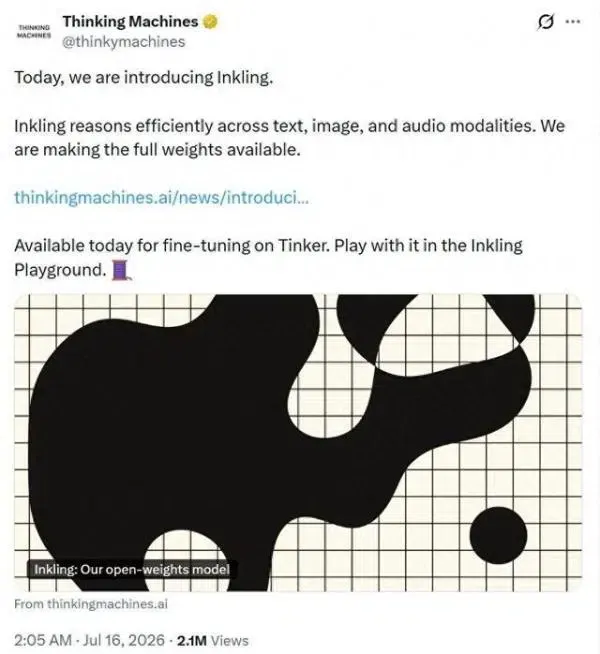
Thinking Machines Launches Inkling? This announcement has been officially confirmed as Thinking Machines Lab introduced its first open-weight multimodal model, Inkling, designed to compete with DeepSeek and other frontier AI systems. Rather than positioning the model as a closed commercial API, the company emphasizes enterprise customization, open-weight deployment, and lower operating costs for developers. Because Inkling is released as an Apache 2.0 open-weight model, enterprise developers can now deploy, modify, and fine-tune it without relying on proprietary inference APIs.

Why Thinking Machines Launches Inkling: Challenging the Closed-Source Monopoly
At a Glance
- Former OpenAI CTO Mira Murati’s startup, Thinking Machines Lab, has released its first in-house AI model named Inkling, featuring an open-weight Apache 2.0 license.
- The system is a Mixture-of-Experts (MoE) transformer with 975 billion total parameters (41 billion active per task), trained on 45 trillion tokens of text, image, audio, and video.
- Unlike standard closed-source models, Inkling is designed as a starting point for organizations to fine-tune themselves using Tinker, the company’s customization platform.
The division between centralized, general-purpose models and custom, domain-specific systems is undergoing a major evolution. Over the past several years, enterprises have increasingly compared proprietary APIs with self-hosted open-weight deployments. Inkling enters this competition by offering an Apache 2.0 model optimized for enterprise customization rather than general-purpose hosted inference.
Inkling’s launch reflects a broader industry shift toward self-hosted open-weight models and enterprise AI customization. When a company feeds its sensitive trade secrets, codebases, and financial calculations into a proprietary model, it risks having that knowledge absorbed into future public versions of the system. For many large-scale engineering groups, when Thinking Machines launches Inkling, it represents a direct opportunity to reclaim control over core software dependencies, as explained in the official Thinking Machines announcement.
Technical Architecture: How Inkling Compares with DeepSeek
At the protocol layer, standard dense transformers activate their entire parameter suite for every single token, resulting in high computing costs and latency. To resolve these compute bottlenecks, the newly released model utilizes a Mixture-of-Experts (MoE) design similar to the Chinese open-source flagship DeepSeek-V3. Each MoE layer contains 256 routed experts and 2 shared experts, with only 6 routed experts (approximately 41 billion active parameters) executing per token. This allows the system to maintain a vast, 975-billion-parameter knowledge base while keeping inference costs and latency low.
For attention mechanism, the system interleaves sliding-window and global layers at a 5:1 ratio, utilizing 8 key-value (KV) heads. Unlike popular architectures such as Llama and DeepSeek that rely on Rotary Positional Embedding (RoPE), the system implements relative positional embeddings, which show superior extrapolation performance over long-context sequences of up to 1 million tokens. Unlike DeepSeek-V3, Inkling is officially released under Apache 2.0 rather than MIT licensing, targeting the same enterprise open-weight market while emphasizing customization workflows through Tinker.
[Standard Dense Model Architecture]
  Input Token ──> All Parameters Active (975B) ──> High Computing Cost & Latency


[Mixture-of-Experts (MoE) Architecture]
  Input Token ──> Sigmoid-Based Router ──> Active Experts (41B) ──> Low-Cost, Rapid Inference
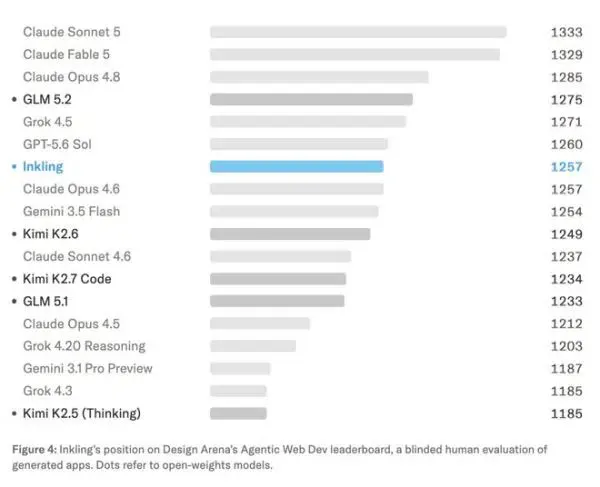
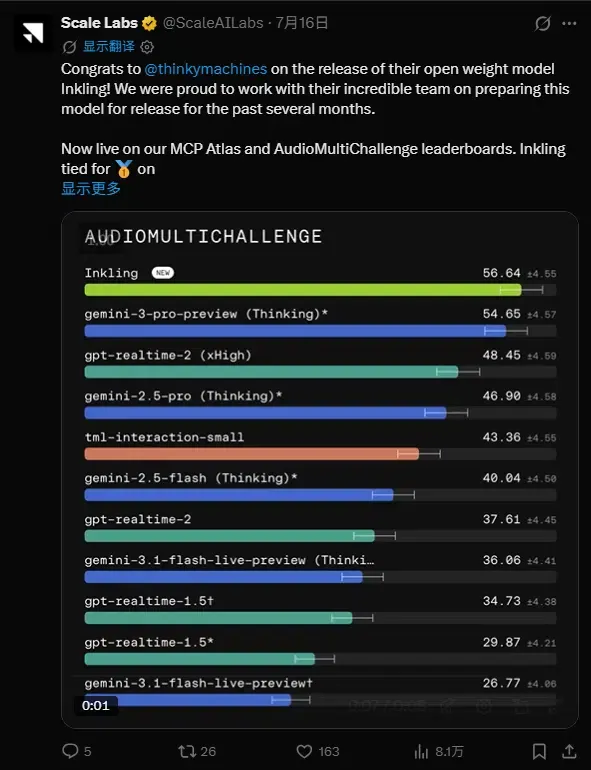
For many large MoE deployments, because inference efficiency increasingly depends on memory bandwidth rather than arithmetic throughput, many deployments are shifting toward memory-centric inference optimization. While the base model was pre-trained from scratch, the post-training phase utilized a synthetic data bootstrap generated by existing open-weights models, including Moonshot AI’s Kimi K2.5. Benchmark results show that Inkling achieves performance comparable to NVIDIA Nemotron 3 Ultra while using only one-third of the tokens. The structural capabilities verified when Thinking Machines launches Inkling demonstrate how custom MoE architectures reduce overall operational overhead, as described in the Thinking Machines Interaction Models report.
Inkling vs. DeepSeek-V3 at a Glance
To illustrate the technical variations between these leading open-weights architectures, the following comparison table outlines their baseline design choices:
| Technical Metric | Inkling MoE Model | DeepSeek-V3 Architecture |
|---|---|---|
| Open Source License | Apache 2.0 (Permissive) | MIT (Permissive) |
| Total Parameter Scale | 975 Billion total parameters | 671 Billion total parameters |
| Active Parameters | 41 Billion active per token | 37 Billion active per token |
| Context Window Size | Up to 1 Million tokens | Up to 128 Thousand tokens |
| Positional Embedding | Relative Positional Embeddings | Rotary Positional Embedding (RoPE) |
Build vs. Buy: Open-Weight Deployment Strategies
As the operational costs of maintaining general-purpose AI APIs continue to rise, the release of Inkling also prompts engineering teams to re-evaluate long-term infrastructure strategies. Re-evaluating system dependencies reveals a critical financial reality: renting proprietary models can lead to a dual-payment trap. Satya Nadella recently argued that enterprises using proprietary AI effectively pay twice: once in direct subscription costs and again by handing over their proprietary business knowledge embedded in prompts, which is discussed in the Nadella technical advisory post.
Lower inference costs also change how enterprises evaluate infrastructure spending. From a FinOps perspective, evaluating whether to build customized local pipelines or continue subscribing to proprietary cloud endpoints demands a rigorous assessment of compute efficiency. As Thinking Machines launches Inkling, developers can more easily balance token budgets with performance profiles. Because the model weights are openly available, organizations can customize deployment pipelines and commercially deploy customized weights without proprietary platform lock-in. This customization paradigm is fully supported by Thinking Machines Lab’s fine-tuning platform, Tinker, where organizations can upload private weights and execute targeted domain training.
Deployment Scenarios and Platform Selection
To help infrastructure architects evaluate their hosting configurations under these shifting economic models, the following deployment matrix outlines standard trade-offs:
| Deployment Scenario | Inference Cost | Customization Support | Data Sovereignty |
|---|---|---|---|
| Hosted Closed-Source APIs | High (Metered per-token pricing) | None (Static system defaults) | Low (External API routing) |
| Self-Hosted Base Inkling | Medium (Server infrastructure) | Medium (Manual local updates) | High (Local-first hosting) |
| Fine-Tuned Inkling on Tinker | Low (Optimized task-specific runtimes) | High (Programmatic fine-tuning) | High (Private cloud isolation) |
The value of the open-weights customization approach is demonstrated by a joint project between Thinking Machines and Bridgewater Associates, the world’s largest hedge fund. By taking a baseline open model and training it further on Bridgewater’s proprietary financial expertise, researchers built a system that scored 84.7% on financial reasoning tests. This customized model outperformed top-tier proprietary alternatives while costing approximately a fourteenth as much to run. These performance metrics directly support FinOps objectives, allowing developers to balance token budgets with performance profiles, as documented in the Bridgewater financial reasoning study.
Integration Checklists: How Engineering Teams Can Prepare for Platform Changes
To secure data pipelines and ensure technical autonomy as open-weights models become the industry standard, engineering and product teams must establish a clear migration roadmap.
Developer Implementation Checklist
- Evaluate Inference Pipelines: Set up quantization benchmarks using frameworks like SGLang, vLLM, or llama.cpp to optimize memory footprints.
- Benchmark GPU Utilization: Analyze active expert routing paths to minimize memory bandwidth constraints during concurrent inference runs.
- Audit Fine-Tuning Workflows: Configure model-customization templates on platforms like Tinker to automate evaluation rubrics.
Product & Growth Strategy Checklist
- Verify Model Licensing Parameters: Review Apache 2.0 terms to ensure compliance for subsequent commercial redistribution.
- Establish FinOps Monitoring: Compare the long-term server-hosting costs of self-hosted open weights against metered cloud API subscription billing to optimize compute pipelines.
- Isolate Proprietary Data Repositories: Establish strict data sandboxes to ensure that sensitive company knowledge is not ingested by external public models.
By establishing these structured guidelines, development teams can transition their applications to safer, more compliant architectures while maintaining operational continuity.
Frequently Asked Questions (FAQ)
Why does using closed-source proprietary models mean companies "pay twice"?
What are the technical advantages of Inkling's mixture-of-experts architecture?
Is Inkling safe for enterprise deployment without centralized guardrails?
Is Inkling open source?
Key Takeaways for Engineering Teams
Inkling demonstrates that enterprise AI is moving toward customizable open-weight deployment. Rather than replacing proprietary AI platforms outright, Inkling expands the range of deployment strategies available to enterprise engineering teams.
Organizations adopting open-weight models will increasingly prioritize private deployment, model governance, efficient inference, and long-term operational efficiency over dependence on proprietary APIs. Teams should therefore prioritize infrastructure capable of efficient fine-tuning, inference optimization, and governance.
Share this article