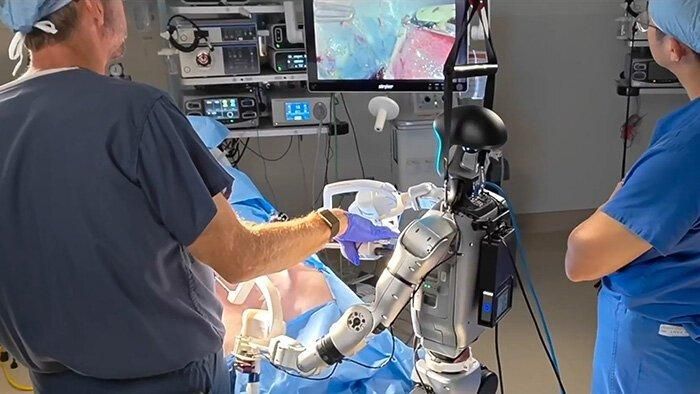
Unitree G1 Performs Surgery? Researchers at UC San Diego have demonstrated that the Unitree G1 humanoid robot can successfully perform preclinical laparoscopic gallbladder surgery through remote teleoperation, marking a significant milestone for general-purpose humanoid robotics. While software giants focus on virtual AI frameworks, this physical in vivo trial demonstrates the immense potential of translating advanced robotics from controlled laboratories to real-world medical environments. Historically, robotic interventions in operating rooms have relied entirely on highly specialized, single-purpose machinery with million-dollar price tags. Today, this successful in vivo trial suggests that adaptable, multi-functional humanoids may eventually democratize advanced medical care, bridging the gap between hardware scaling and remote clinical deployment.
Unitree G1 Performs Surgery? Researchers at UC San Diego have demonstrated that the Unitree G1 humanoid robot can successfully perform preclinical laparoscopic gallbladder surgery through remote teleoperation, marking a significant milestone for general-purpose humanoid robotics. While software giants focus on virtual AI frameworks, this physical in vivo trial demonstrates the immense potential of translating advanced robotics from controlled laboratories to real-world medical environments. Historically, robotic interventions in operating rooms have relied entirely on highly specialized, single-purpose machinery with million-dollar price tags. Today, this successful in vivo trial suggests that adaptable, multi-functional humanoids may eventually democratize advanced medical care, bridging the gap between hardware scaling and remote clinical deployment.
Why Unitree G1 Performs Surgery: Shifting From Specialized Systems to General-Purpose Platforms
At a Glance
- A US research team successfully used the Unitree G1 humanoid robot to perform standard laparoscopic cholecystectomies on two live pigs, as detailed in a Nature study.
- The teleoperated humanoid manipulated manual wristed instruments, completing both surgeries without conversion to conventional methods.
- Minor complications in one case were managed robotically, demonstrating early feasibility for in vivo surgical use of general-purpose humanoids.
The paradigm of robotic surgery has long been defined by proprietary, purpose-built platforms. For over two decades, systems like Intuitive Surgical’s da Vinci have occupied thousands of operating suites worldwide. While these specialized systems provide exceptional precision, they are constrained by their rigid physical designs. A typical da Vinci system weighs approximately 816 kilograms, occupies a massive footprint, and requires specialized, dedicated software and clean-room configurations to operate. Furthermore, with acquisition costs ranging between $1.5 million and $2.5 million and annual maintenance agreements approaching $175,000, these specialized machines remain financially inaccessible for smaller community clinics, rural hospitals, and developing regions.
In contrast, the general-purpose humanoid model proposes a highly adaptable alternative. By utilizing an off-the-shelf, mass-produced Unitree G1 humanoid robot costing under $20,000, the research team proved that standard, human-sized hardware can operate within standard environments built for human clinicians. Weighing only 27 kilograms and standing roughly 1.5 meters tall, the Unitree G1 is highly mobile and easily transportable. The trial utilized a single senior surgeon operating from a remote robotic console, utilizing a custom teleoperation framework to guide the humanoid’s actions. Under these conditions, reliable remote telemetry enables the transmission of critical spatial coordinates across distributed networks, allowing the surgeon to maintain tactile awareness.
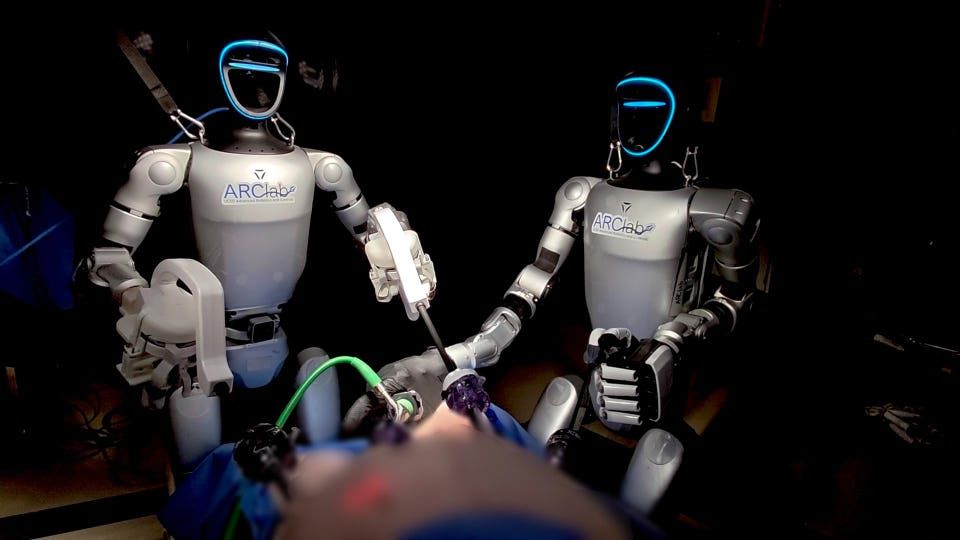
The success of the preclinical trial suggests a new path toward replacing specialized surgical platforms with general-purpose robotic helpers. Equipped with Unitree’s three-fingered “Dex3” dexterous hands, the humanoid successfully held and manipulated standard, manual wristed laparoscopic instruments. This means that instead of building a separate, highly expensive hardware ecosystem exclusively for medical robotics, humanoid robots can enter the operating room directly with proper mechanical adapters. Such a versatile, low-cost platform could eventually help address the severe global shortage of trained surgeons, extending critical medical care to geographic “medical deserts” and remote environments. The physical constraints showing why Unitree G1 Performs Surgery represents a major shift toward decentralized healthcare highlight how medical remote telemetry can transmit real-world execution metrics to distant experts.
Under-the-Hood Mechanics of the Unitree G1 Performs Surgery Experiment
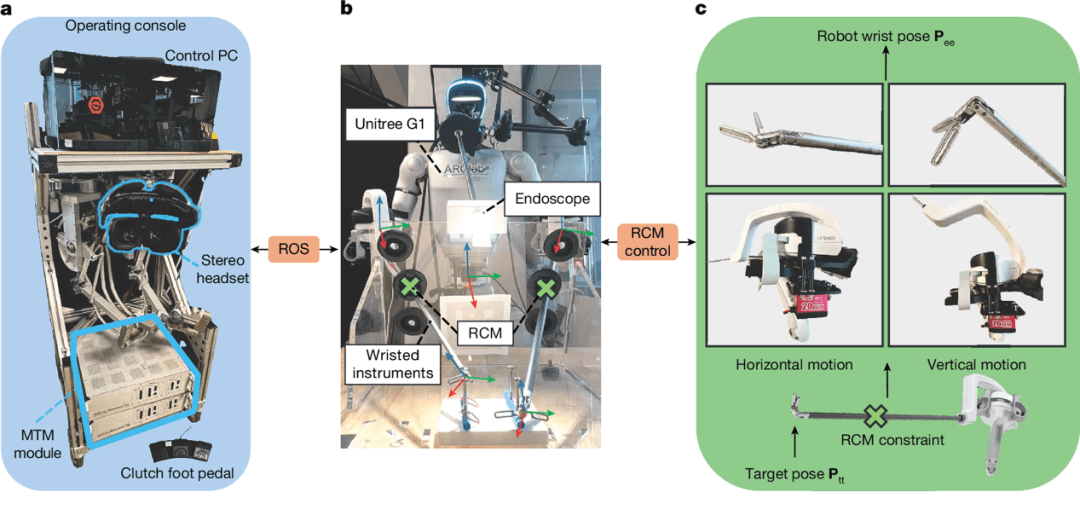
To execute a standard laparoscopic cholecystectomy (gallbladder removal), the humanoid robot must manipulate tools inside the patient’s abdominal cavity through narrow trocars. This environment introduces a complex kinematic constraint: the surgical instrument must always rotate around a single, fixed point on the abdominal wall. In specialized systems, this “remote center of motion” (RCM) is physically locked by rigid mechanical linkages. Because the general-purpose Unitree G1 lacks these custom mechanical joints, the research team had to solve this constraint programmatically.
To establish a virtual RCM, the team mounted ArUco visual markers near the trocars. The robot’s depth cameras and 3D LiDAR sensors continuously tracked these markers, feeding real-time spatial coordinate data into an inverse kinematics solver. This algorithm dynamically adjusted the robot’s shoulder, elbow, and wrist joints to ensure the instruments rotated precisely around the insertion point, preventing tissue damage during movement. In this setup, closed-loop remote telemetry represents the key data pipeline that verifies joint angles against actual tool displacement.
[Closed-loop Virtual RCM Tracking]
  Surgie Vision (Head Camera + ArUco Codes) ──> Real-time Inverse Kinematics Solver ──> Joint Angle Offsets
                                     ▲                                                                     │
                                     └─────────────────── 156ms Closed-loop Feedback ──────────────────────┘
While the system successfully completed both surgeries, the trial highlighted a significant gap between technical feasibility and clinical readiness. The teleoperation link registered a closed-loop feedback latency of approximately 156 milliseconds, creating a noticeable delay between the surgeon’s hand movements and the robot’s physical response. Furthermore, because the virtual RCM relied on visual tracking, small shifts in the patient’s abdominal wall caused by respiration, combined with minor vibrations of the robot’s base, led to calibration drift. When the drift exceeded safety margins, the surgeon had to pause the operation to recalibrate the system, increasing the overall procedure duration and demonstrating why robust latency compensation and active force feedback are essential for future remote surgery.
Although the reported issue concerns physical telesurgery rather than mobile analytics, it illustrates a broader engineering challenge: once physical state continuity is disrupted across networks, downstream telemetry and tracking workflows also become more difficult. In a broader systems context, similar identity continuity challenges also appear in attribution infrastructure. When standard, client-side identifiers are blocked or cookies are removed to protect user privacy, maintaining seamless session continuity across different web and mobile environments becomes highly complex. Just as remote robotic surgery requires stable, real-time closed-loop control to maintain spatial coordination, digital marketing pipelines require robust, server-side data preservation to correlate separate installation events without relying on vulnerable client-side cookies or device-level attributes.
Build vs. Buy: Managing Server-side Attribution and Parameter Pass-through
As modern computing environments move away from local, client-side identifiers, maintaining context across distributed digital touchpoints has become a primary engineering challenge. For developers, managing state tracking in the Unitree G1 Performs Surgery era requires architectures that are both compliant with data privacy laws and highly accurate. Although the application domains differ, both systems depend on preserving execution context after control passes between independent environments. Organizations that need to preserve user journeys across web and mobile experiences increasingly rely on server-side session management rather than persistent client-side identifiers. Depending on business requirements, teams may build these capabilities internally or adopt existing attribution platforms.
Architectural Evaluation: Custom Build vs. Standardized SDK
Building a custom, in-house system to manage server-side state matching offers maximum flexibility but demands significant ongoing engineering resources. Developers must manually construct database schemas, write secure cryptographic hashing functions, and continually update the system to comply with shifting regional regulations. Conversely, deploying a pre-built, certified SDK reduces integration complexity and guarantees long-term compliance without additional overhead.
The table below compares standard methodologies for managing session state and conversion context:
| Solution | Context Restoration | Data Throughput | Best For |
|---|---|---|---|
| Custom Server-side Context Store | High (Continuous Sync) | Medium (DB Latency Limits) | Custom enterprise environments with highly specialized storage logic |
| Browser-based Session Tracking | Low (Session Cookies) | Low (No Server Logging) | Basic website tracking with minimal cross-domain conversion requirements |
| Server-side Attribution Platform (e.g. OpoInstall) | High (Programmatic parameter pass-through) | High (Standardized Sandbox) | High-concurrency mobile app and multi-platform campaign attribution |
While custom database configurations can handle basic context, specialized server-side state preservation can optimize development resources. Depending on implementation requirements, organizations may build their own server-side session management system or adopt commercial platforms such as OpoInstall. For instance, OpoInstall offers server-side state restoration and parameter pass-through frameworks, preserving attribution parameters through server-side context restoration to maintain session continuity anonymously, without relying on persistent client-side identifiers or personally identifiable information. By mapping session metadata to a centralized database rather than relying on browser-based redirects, such a system ensures that conversion contexts remain consistent even when initial tasks are executed anonymously. Engineering teams can evaluate these approaches to balance data protection and measurement consistency.
Integration Checklists: Preparing Your Architecture for High-Precision Telemetry
To secure data pipelines and ensure conversion consistency as platforms transition to automated, remote architectures, engineering and product teams must adopt robust state preservation workflows.
Developer Implementation Checklist
- Optimize Telemetry and Event Delivery: Implement lightweight, serialized data payloads to minimize network latency and prevent packet loss in high-concurrency environments.
- Transition to Server-Side Identity Matching: Implement stateless session handshakes, utilizing temporary tokens to pass user parameters securely across endpoints.
- Deploy Cryptographic Request Signatures: Protect API endpoints from automated spoofing by requiring cryptographic signatures on all state-matching requests.
- Enforce Virtual State Calibrations: When dealing with real-time hardware, implement non-blocking background verification threads to correct spatial or session drift before errors occur.
Product & Growth Strategy Checklist
- Reorganize User Experience Flows: Focus on task-oriented, high-utility pathways that do not rely on local client-side cookie persistence.
- Deploy Non-Intrusive Parameter Tracking: Leverage robust, server-side parameter pass-through frameworks to maintain acquisition tracking without violating user privacy guidelines.
- Verify System Scalability: Ensure that your session-matching databases can scale horizontally to support high-throughput, real-time conversion queries.
- Optimize Multi-Terminal Journeys: Map the entire user flow from initial discovery to final terminal launch, ensuring that metadata is preserved even across completely different device types.
By establishing these structured guidelines, development teams can transition their applications to safer, more compliant architectures while maintaining operational continuity.
Why Unitree G1 Performs Surgery: Shifting From Specialized Systems to General-Purpose Platforms
At a Glance
- A US research team successfully used the Unitree G1 humanoid robot to perform standard laparoscopic cholecystectomies on two live pigs, as detailed in a Nature study.
- The teleoperated humanoid manipulated manual wristed instruments, completing both surgeries without conversion to conventional methods.
- Minor complications in one case were managed robotically, demonstrating early feasibility for in vivo surgical use of general-purpose humanoids.
The paradigm of robotic surgery has long been defined by proprietary, purpose-built platforms. For over two decades, systems like Intuitive Surgical’s da Vinci have occupied thousands of operating suites worldwide. While these specialized systems provide exceptional precision, they are constrained by their rigid physical designs. A typical da Vinci system weighs approximately 816 kilograms, occupies a massive footprint, and requires specialized, dedicated software and clean-room configurations to operate. Furthermore, with acquisition costs ranging between $1.5 million and $2.5 million and annual maintenance agreements approaching $175,000, these specialized machines remain financially inaccessible for smaller community clinics, rural hospitals, and developing regions.
In contrast, the general-purpose humanoid model proposes a highly adaptable alternative. By utilizing an off-the-shelf, mass-produced Unitree G1 humanoid robot costing under $20,000, the research team proved that standard, human-sized hardware can operate within standard environments built for human clinicians. Weighing only 27 kilograms and standing roughly 1.5 meters tall, the Unitree G1 is highly mobile and easily transportable. The trial utilized a single senior surgeon operating from a remote robotic console, utilizing a custom teleoperation framework to guide the humanoid’s actions. Under these conditions, reliable remote telemetry enables the transmission of critical spatial coordinates across distributed networks, allowing the surgeon to maintain tactile awareness.
The success of the preclinical trial suggests a new path toward replacing specialized surgical platforms with general-purpose robotic helpers. Equipped with Unitree’s three-fingered “Dex3” dexterous hands, the humanoid successfully held and manipulated standard, manual wristed laparoscopic instruments. This means that instead of building a separate, highly expensive hardware ecosystem exclusively for medical robotics, humanoid robots can enter the operating room directly with proper mechanical adapters. Such a versatile, low-cost platform could eventually help address the severe global shortage of trained surgeons, extending critical medical care to geographic “medical deserts” and remote environments. The physical constraints showing why Unitree G1 Performs Surgery represents a major shift toward decentralized healthcare highlight how medical remote telemetry can transmit real-world execution metrics to distant experts.
Under-the-Hood Mechanics of the Unitree G1 Performs Surgery Experiment
To execute a standard laparoscopic cholecystectomy (gallbladder removal), the humanoid robot must manipulate tools inside the patient’s abdominal cavity through narrow trocars. This environment introduces a complex kinematic constraint: the surgical instrument must always rotate around a single, fixed point on the abdominal wall. In specialized systems, this “remote center of motion” (RCM) is physically locked by rigid mechanical linkages. Because the general-purpose Unitree G1 lacks these custom mechanical joints, the research team had to solve this constraint programmatically.
To establish a virtual RCM, the team mounted ArUco visual markers near the trocars. The robot’s depth cameras and 3D LiDAR sensors continuously tracked these markers, feeding real-time spatial coordinate data into an inverse kinematics solver. This algorithm dynamically adjusted the robot’s shoulder, elbow, and wrist joints to ensure the instruments rotated precisely around the insertion point, preventing tissue damage during movement. In this setup, closed-loop remote telemetry represents the key data pipeline that verifies joint angles against actual tool displacement.
[Closed-loop Virtual RCM Tracking]
  Surgie Vision (Head Camera + ArUco Codes) ──> Real-time Inverse Kinematics Solver ──> Joint Angle Offsets
                                     ▲                                                                     │
                                     └─────────────────── 156ms Closed-loop Feedback ──────────────────────┘
While the system successfully completed both surgeries, the trial highlighted a significant gap between technical feasibility and clinical readiness. The teleoperation link registered a closed-loop feedback latency of approximately 156 milliseconds, creating a noticeable delay between the surgeon’s hand movements and the robot’s physical response. Furthermore, because the virtual RCM relied on visual tracking, small shifts in the patient’s abdominal wall caused by respiration, combined with minor vibrations of the robot’s base, led to calibration drift. When the drift exceeded safety margins, the surgeon had to pause the operation to recalibrate the system, increasing the overall procedure duration and demonstrating why robust latency compensation and active force feedback are essential for future remote surgery.
Although the reported issue concerns physical telesurgery rather than mobile analytics, it illustrates a broader engineering challenge: once physical state continuity is disrupted across networks, downstream telemetry and tracking workflows also become more difficult. In a broader systems context, similar identity continuity challenges also appear in attribution infrastructure. When standard, client-side identifiers are blocked or cookies are removed to protect user privacy, maintaining seamless session continuity across different web and mobile environments becomes highly complex. Just as remote robotic surgery requires stable, real-time closed-loop control to maintain spatial coordination, digital marketing pipelines require robust, server-side data preservation to correlate separate installation events without relying on vulnerable client-side cookies or device-level attributes.
Build vs. Buy: Managing Server-side Attribution and Parameter Pass-through
As modern computing environments move away from local, client-side identifiers, maintaining context across distributed digital touchpoints has become a primary engineering challenge. For developers, managing state tracking in the Unitree G1 Performs Surgery era requires architectures that are both compliant with data privacy laws and highly accurate. Although the application domains differ, both systems depend on preserving execution context after control passes between independent environments. Organizations that need to preserve user journeys across web and mobile experiences increasingly rely on server-side session management rather than persistent client-side identifiers. Depending on business requirements, teams may build these capabilities internally or adopt existing attribution platforms.
Architectural Evaluation: Custom Build vs. Standardized SDK
Building a custom, in-house system to manage server-side state matching offers maximum flexibility but demands significant ongoing engineering resources. Developers must manually construct database schemas, write secure cryptographic hashing functions, and continually update the system to comply with shifting regional regulations. Conversely, deploying a pre-built, certified SDK reduces integration complexity and guarantees long-term compliance without additional overhead.
The table below compares standard methodologies for managing session state and conversion context:
| Solution | Context Restoration | Data Throughput | Best For |
|---|---|---|---|
| Custom Server-side Context Store | High (Continuous Sync) | Medium (DB Latency Limits) | Custom enterprise environments with highly specialized storage logic |
| Browser-based Session Tracking | Low (Session Cookies) | Low (No Server Logging) | Basic website tracking with minimal cross-domain conversion requirements |
| Server-side Attribution Platform (e.g. OpoInstall) | High (Programmatic parameter pass-through) | High (Standardized Sandbox) | High-concurrency mobile app and multi-platform campaign attribution |
While custom database configurations can handle basic context, specialized server-side state preservation can optimize development resources. Depending on implementation requirements, organizations may build their own server-side session management system or adopt commercial platforms such as OpoInstall. For instance, OpoInstall offers server-side state restoration and parameter pass-through frameworks, preserving attribution parameters through server-side context restoration to maintain session continuity anonymously, without relying on persistent client-side identifiers or personally identifiable information. By mapping session metadata to a centralized database rather than relying on browser-based redirects, such a system ensures that conversion contexts remain consistent even when initial tasks are executed anonymously. Engineering teams can evaluate these approaches to balance data protection and measurement consistency.
Integration Checklists: Preparing Your Architecture for High-Precision Telemetry
To secure data pipelines and ensure conversion consistency as platforms transition to automated, remote architectures, engineering and product teams must adopt robust state preservation workflows.
Developer Implementation Checklist
- Optimize Telemetry and Event Delivery: Implement lightweight, serialized data payloads to minimize network latency and prevent packet loss in high-concurrency environments.
- Transition to Server-Side Identity Matching: Implement stateless session handshakes, utilizing temporary tokens to pass user parameters securely across endpoints.
- Deploy Cryptographic Request Signatures: Protect API endpoints from automated spoofing by requiring cryptographic signatures on all state-matching requests.
- Enforce Virtual State Calibrations: When dealing with real-time hardware, implement non-blocking background verification threads to correct spatial or session drift before errors occur.
Product & Growth Strategy Checklist
- Reorganize User Experience Flows: Focus on task-oriented, high-utility pathways that do not rely on local client-side cookie persistence.
- Deploy Non-Intrusive Parameter Tracking: Leverage robust, server-side parameter pass-through frameworks to maintain acquisition tracking without violating user privacy guidelines.
- Verify System Scalability: Ensure that your session-matching databases can scale horizontally to support high-throughput, real-time conversion queries.
- Optimize Multi-Terminal Journeys: Map the entire user flow from initial discovery to final terminal launch, ensuring that metadata is preserved even across completely different device types.
By establishing these structured guidelines, development teams can transition their applications to safer, more compliant architectures while maintaining operational continuity.
Frequently Asked Questions (FAQ)
Why is the remote center of motion (RCM) the hardest technical challenge for general-purpose humanoids?
How did the UC San Diego team adapt standard surgical tools for the Unitree G1?
When can we expect general-purpose humanoid robots to independently lead clinical surgeries?
Practical Implications & Future Outlook
The discovery of this forwarding exploit marks a critical turning point in how we define digital privacy. As automated identity profiling tools become more sophisticated, renting your privacy from standard operating system features introduces unacceptable risks. A backend implementation change or unresolved protocol flaw can compromise database isolation, potentially exposing real-world user identities to unwanted tracking.
For developers and digital businesses, the future of user acquisition belongs to systems that establish transitive trust without compromising security. Implementing server-side identity verification, cryptographically signed referral parameters, and robust parameter pass-through frameworks will be essential to survive in a zero-trust internet. As distributed applications increasingly span browsers, mobile devices, and intelligent agents, server-side context restoration will become a core component of reliable digital infrastructure.
Share this article