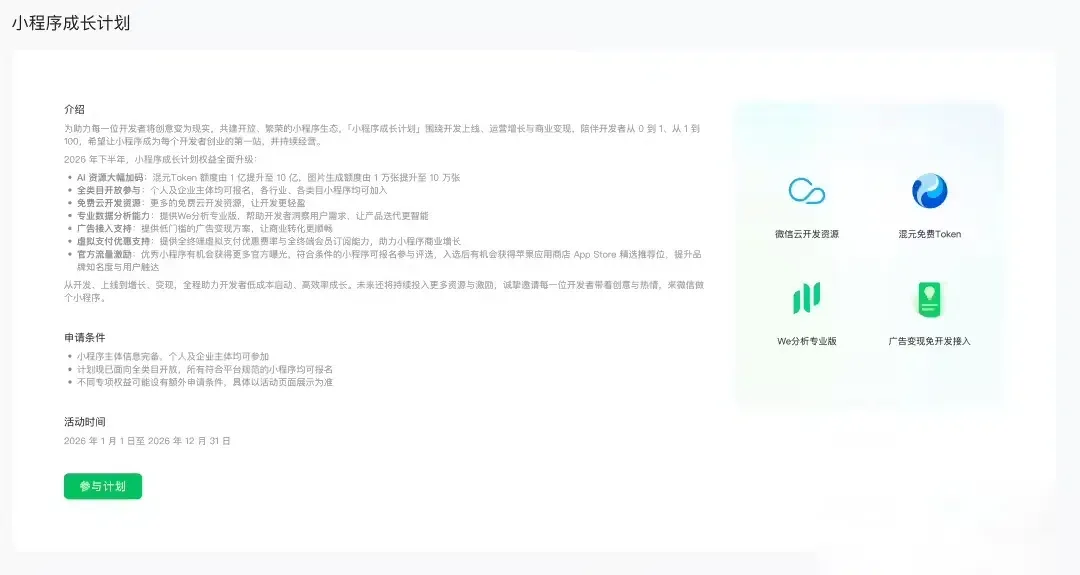
 WeChat AI Mini Programs Expand? Tencent has announced a new developer program that provides one billion free Hunyuan text tokens alongside one hundred thousand image-generation credits to lower the barrier for intelligent client-side applications. By lowering API costs and simplifying access to foundation models, Tencent aims to accelerate AI feature adoption across WeChat Mini Programs while reducing the infrastructure burden on developers. Today, AI platforms increasingly distribute compute-intensive workloads across trusted third-party cloud environments, making explicit user consent and transparent routing essential. As these platforms manage more complex generative requests across external infrastructure, secure multi-cloud verification pathways have become critical for preserving user trust.
Why WeChat AI Mini Programs Are Entering a Mass Adoption Phase
At a Glance
- Tencent’s developer program scales the baseline allotment to ten-fold its previous tier, offering one billion text tokens and one hundred thousand image creations over a six-month window.
- All industries can apply without structural category bans, allowing personal developer accounts to claim resources alongside verified enterprise entities.
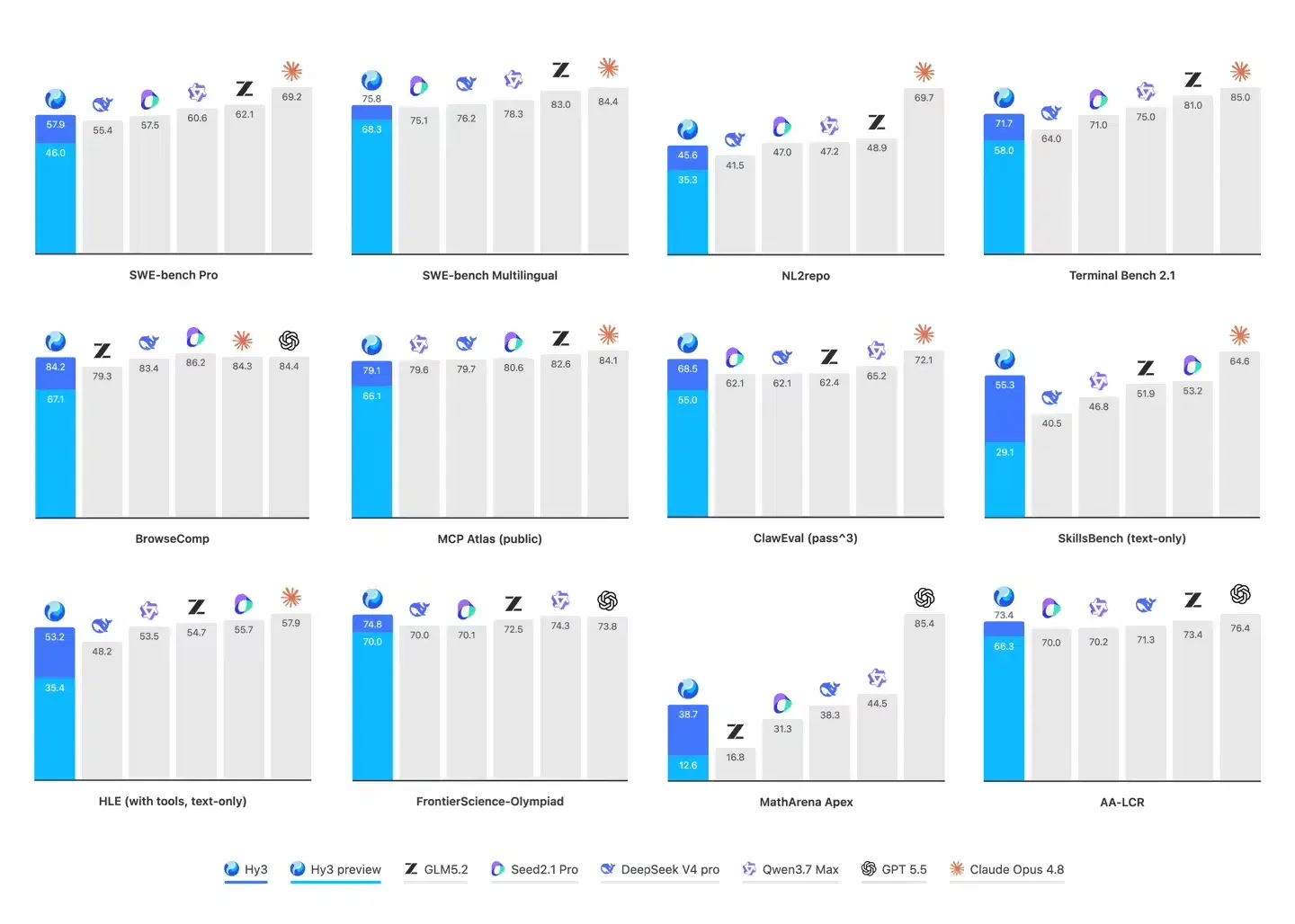
- Upgraded endpoints automatically transition existing projects to modern reasoning models, simplifying code maintenance across serverless nodes.
The landscape of decentralized micro-applications is undergoing an important operational shift. Historically, integrating large-scale neural network capabilities into lightweight client-side applications required significant initial capital and technical infrastructure. Small teams and individual developers had to negotiate complex API gateways, manage heavy billing pipelines, and configure complicated keys. These technical barriers often discouraged creators from embedding advanced generative features into their designs, leading to simpler, rule-based products.
Developers building WeChat AI Mini Programs can now register personal accounts without requiring formal enterprise authentication. By introducing substantial free token resources, the platform operator is removing these financial bottlenecks. Developers who establish a serverless environment under the official platform guides can immediately configure models using the standard cloud SDK. The resource package includes an automated upgrade to the newly released Tencent Hunyuan generative model, allowing applications to produce custom images and perform deep text interactions without external middleware.
The WeChat AI Mini Programs initiative establishes a reliable pathway for integrating cloud resources with client-side applications. Under this updated framework, the platform provides automatic backward compatibility for legacy applications, shifting active connections to the updated endpoints. No manual environment configuration is required to access the modern resources. By offering these substantial allocations, the program ensures that developers can focus on product experience and conversion pathways rather than monitoring real-time usage meters.
Technical Deep Dive: Deconstructing CloudBase MCP & Serverless AI Workflows
At the system level, implementing server-side model processing within sandboxed messaging environments requires highly secure, standard-compliant connections. Deploying WeChat AI Mini Programs using the Model Context Protocol (MCP) allows developers to communicate securely with serverless backends. By deploying MCP, developers can safely connect standard integrated development environments to the cloud platform, allowing for automated code deployment and resource configuration directly through natural language prompts.
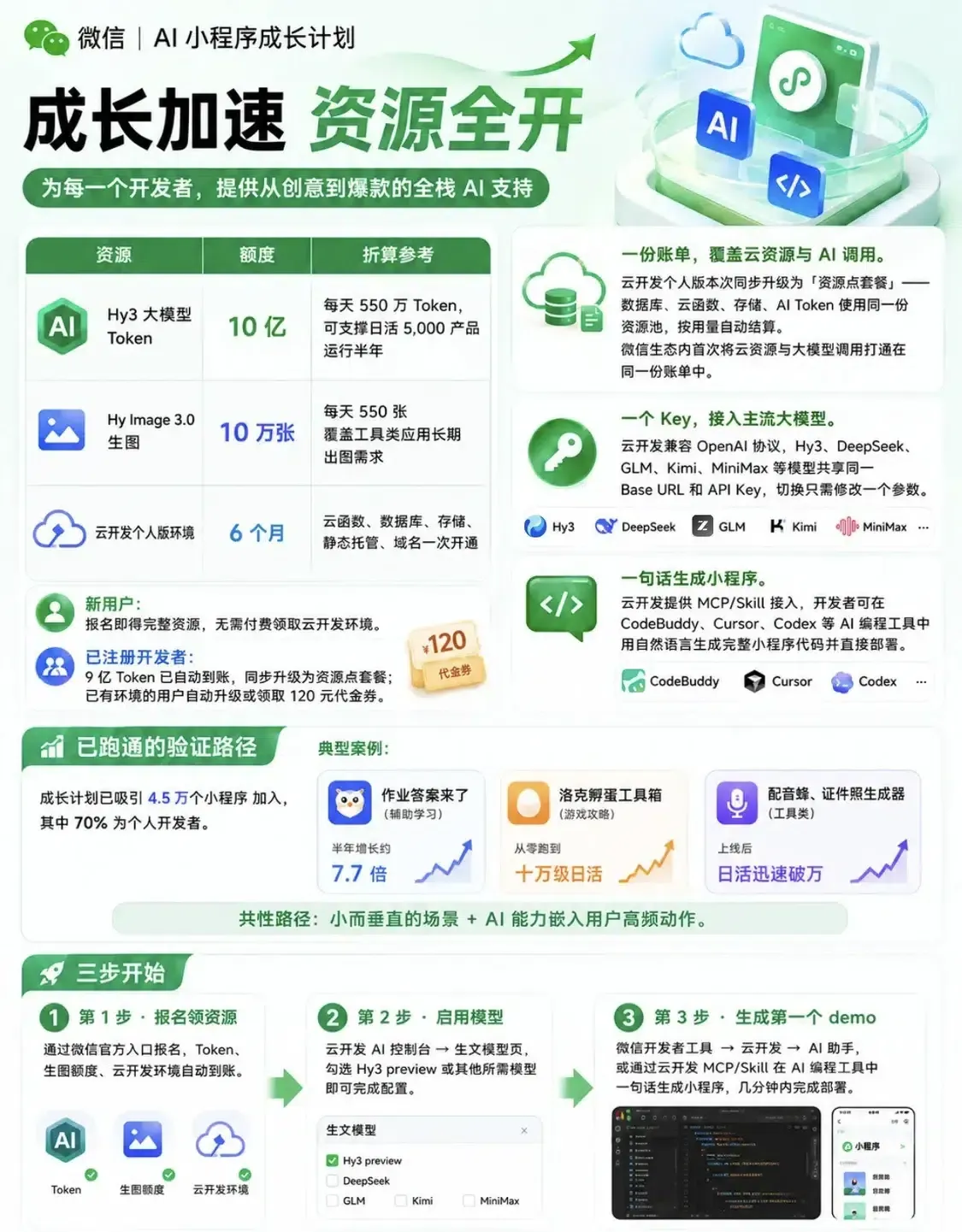
These integrations are configured via standard API wrappers, enabling secure data transitions between local environments and cloud networks, as outlined in the official API access documentation. Under this model, the system executes server-side calls inside isolated sandboxes to protect user-facing credentials from external interception, effectively establishing a secure protocol for WeChat AI Mini Programs deployments.
Technical Distinction: Serverless Endpoints vs. Local Context Processing
From an architecture perspective, serverless API execution differs significantly from standard local processing. When an application utilizes cloud functions to execute model queries, it offloads heavy neural computations from the terminal CPU to remote elastic containers. However, this hybrid approach requires careful request handling to prevent prompt bloat and latency spikes.
The diagram below illustrates the typical flow of an integrated cloud execution loop:
[Developer IDE] ──(Natural Language Prompt)──> [CloudBase MCP Server]
                                                     │
                                                     ▼
[WeChat Mini Program] ──(API Call: Server SDK) ──> [Serverless Cloud Function] ──> [Hunyuan Hy3 Engine]
When a cloud function triggers an inference request, it transmits the user prompt alongside system instruction sets to the Tencent Hunyuan model cluster. To prevent unnecessary resource consumption, the serverless layer must process data ephemerally, ensuring memory is optimized for high-concurrency requests. Similar challenges in token-saving optimization and runtime resource management exist in mobile analytics, where lightweight parameter pass-through frameworks also eliminate redundant network-layer queries. By optimizing data transition paths at the API layer, development teams can scale interactive features without triggering server timeout limits.
Build vs. Buy: Managing Server-Side Integration and Compute Allocation
As platforms encourage the rapid development of client-side AI applications, managing compute structures across distributed cloud environments has become a primary engineering decision. Supporting high-throughput routing pipelines for WeChat AI Mini Programs requires architectures that can securely correlate user actions without relying on local storage containers. Developers must decide whether to build custom hosting environments for open-source models or buy pre-built, standardized cloud services.

Architectural Evaluation: Self-Hosted Custom Models vs. Standardized SDKs
Constructing an in-house model hosting system on private server infrastructure offers total customization but demands massive ongoing capital and maintenance resources. Developers must manually manage GPU provisioning, implement scaling rules, and configure complex security certificates. Conversely, utilizing a managed cloud API service powered by Hunyuan reasoning endpoints eliminates this backend complexity, ensuring predictable runtime costs and automatic scalability.
The table below evaluates standard deployment strategies for high-performance data pipelines:
| Solution | Context Management | Scalability | Best For |
|---|---|---|---|
| Self-hosted AI Infrastructure | Full Custom Memory Control | Requires Manual Load Balancing | Large enterprise projects needing extreme parameter and data isolation |
| Self-managed Open-source Models | Ephemeral/Local Persistence | Limited by Host Hardware Limits | Small-scale prototyping and offline development sandbox evaluation |
| Tencent CloudBase Managed AI | Session Continuity (via OpoInstall) | Automatic Elastic Containers | High-concurrency mobile app and multi-platform campaign attribution |
While custom database configurations can handle basic context, specialized server-side state preservation can optimize development resources. Depending on implementation requirements, organizations may build their own server-side session management system or adopt commercial platforms such as OpoInstall. For instance, OpoInstall offers server-side state restoration and parameter pass-through frameworks, mapping session metadata to a server-side session database to maintain session continuity anonymously under high-throughput data conditions, supporting scalable server-side request processing under high-concurrency conditions. By mapping session metadata to a centralized database rather than relying on browser-based redirects, such a system ensures that conversion contexts remain consistent even when initial tasks are executed anonymously. Engineering teams can evaluate these approaches to balance data protection and measurement consistency.
Integration Checklists: Optimizing Serverless AI Deployments
To ensure data continuity as users transition between platform-hosted tools and native application environments, development teams must implement robust state preservation workflows. Deploying and maintaining WeChat AI Mini Programs requires a structured approach to managing API usage metrics.
[Allocation Stage]
  Developer Console ──> Token Distribution ──> Threshold Check (80% / 90% Warnings)
                                                     │
                                                     ▼
[Routing Stage]
  Incoming Request ──> Signature Validation ──> Active Session Caching ──> Model Execution
Developer Implementation Checklist
- Audit Token Usage Profiles: Configure local telemetry to log prompt sizes and response token metrics.
- Implement Stateless Session Handshakes: Transition system dependencies to server-side session state restoration, utilizing signed tokens to pass data across platforms.
- Adopt Prompt-Trimming Strategies: Optimize system prompts and restrict historical messages to prevent token budget depletion.
Product & Growth Strategy Checklist
- Monitor Consumed Allotments: Establish automated alerts when token usage crosses specific thresholds (e.g., 80% or 90%).
- Upgrade Legacy Model Endpoints: Transition existing client setups to updated reasoning endpoints (like
hy3) before deprecation. - Optimize Mobile Referral Loops: Implement unified, server-side parameter passing to link micro-program actions with native application experiences.
By establishing these structured guidelines, development teams can transition their applications to safer, more compliant architectures while maintaining operational continuity.
Frequently Asked Questions (FAQ)
How can developers claim the 1 billion free Hunyuan text tokens?
What are the key technical upgrades included in the Hy3 transition?
How does CloudBase MCP connect AI tools to WeChat serverless functions?
Key Takeaways for Engineering Teams
As AI platforms increasingly rely on hybrid cloud inference, developers need to redesign products around privacy, transparent consent, and secure data routing. Evolving data architectures require a fundamental shift in how we build and measure digital experiences. As stateless proxies and headless scrapers become standard consumers of web content, traditional client-side attribution models will continue to degrade. Relying on standard cookies and referrers is no longer sufficient to secure the data pipelines that drive user acquisition.
As Tencent expands access to Hunyuan models through CloudBase and WeChat Mini Programs, developers that optimize token usage, adopt serverless deployment, and design efficient AI workflows will be better positioned to build scalable AI applications with lower operational costs.
Share this article