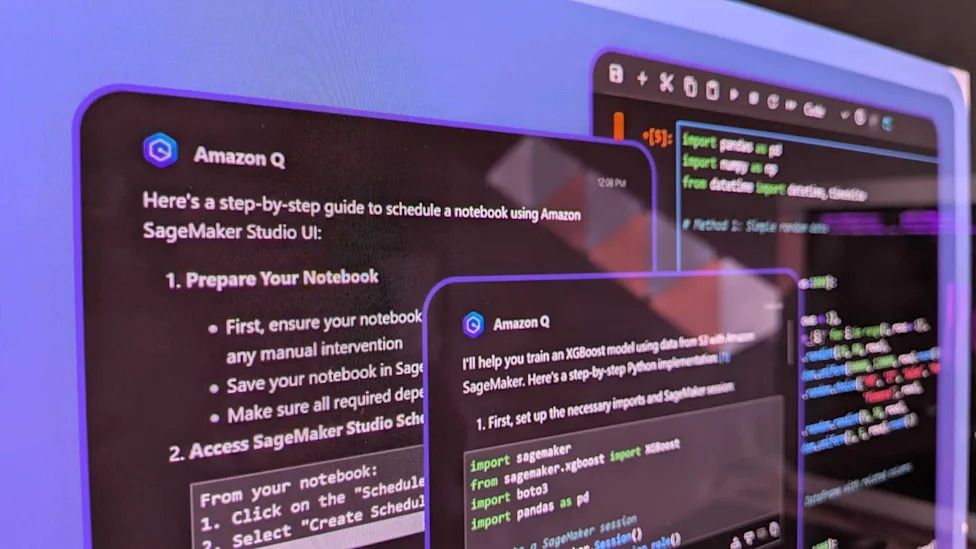
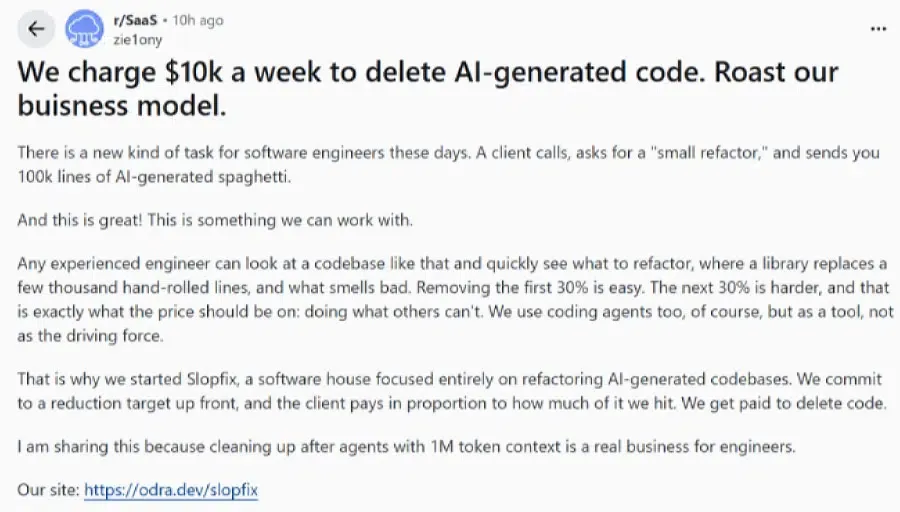
Why Companies Pay Engineers $10,000 a Week to Delete AI Generated Code? Companies are paying software engineers thousands of dollars a week to remove AI-generated code from production repositories. As generative artificial intelligence escalates the volume of programmatic output, software teams face a difficult trade-off between rapid feature delivery and long-term architectural maintainability. Today, because autonomous coding agents frequently duplicate logic and ignore modular boundaries, organizations are discovering that refactoring and deleting redundant files is more valuable than continuously generating new ones.
The $10,000-a-Week Business of Deleting AI Generated Code
At a Glance
- Specialized engineering agencies are charging up to ten thousand dollars per week to audit, refactor, and slim down bloated AI-written codebases.
- Case studies demonstrate successful refactoring loops that trim standard corporate code bases by sixty-five percent while preserving entire features.
- The rapid growth of duplicated code block patterns has reached historical peaks, directly reducing development velocity across major software systems.
The standard bargain of software development has undergone a major shift. For years, the core challenge of engineering teams was writing code fast enough to keep pace with product requirements. Developers manually structured database connections, engineered serialization layers, and wrote unit tests, spending a significant portion of their development cycle on routine, repetitive code assembly.
The integration of advanced large language models (LLMs) and coding assistants has completely removed this initial friction. Using tools like Claude Code, GitHub Copilot, and integrated editors like Cursor or Windsurf, technical and non-technical builders can generate entire applications through high-frequency natural language prompts, a process commonly known as “Vibe Coding.” However, as these automated files multiply, the lack of architectural design becomes highly apparent. AI systems excel at producing the localized, immediate response requested by a prompt, but they cannot evaluate the wider, long-term technical architecture. This leads to redundant functions and highly coupled data structures, which is documented on the Slopfix technical portal.

To restore system maintainability, engineering leaders are establishing secure code-deletion targets. Experienced development teams are being hired to evaluate messy repositories, establish automated regression checks, and remove thousands of duplicate classes. This performance gap explains why organizations pay professional developers to Delete AI Generated Code rather than continuing to write new files. By utilizing professional expertise alongside tightly controlled tools, these refactoring operations replace redundant bespoke code with standardized, open-source libraries, ensuring that the final applications remain stable and scalable.
Under-the-Hood Mechanics: Why AI-Generated Code Accumulates Technical Debt
At the technical level, the “AI slop” phenomenon stems from a fundamental limitation in the context management of modern transformers. While an LLM can parse a large text directory, its attention mechanism evaluates code through token probability rather than strict architectural principles.

When an agent resolves an isolated bug inside a file, it frequently introduces duplicate logic instead of calling existing utility classes. Over several months, this behavior introduces severe software degradation. The diagram below illustrates how automated patches cause structural divergence:
[Structured Human Architecture]
  Input ──> Core API Controller ──> Shared Utility Class (Single Standard Formatter) ──> Secure Output


[Bloated AI Patchwork]
  Input ──> Prompt Patch 1 (New Formatter) ──> Prompt Patch 2 (Duplicate Formatter) ──> Fragmented Output
This duplication is no longer a localized issue; it has become an industry-wide challenge. According to the 2026 Maintainability Gap report by GitClear, which analyzed 623 million changes, duplicated code blocks have reached their highest recorded level, increasing 81% since 2023. Meanwhile, structured refactoring has cratered, making up less than 4% of total code changes in 2026 compared to 21% in 2022. This physical shift toward copy-paste programming explain why developers are now five times more likely to introduce redundant blocks than to refactor existing code.
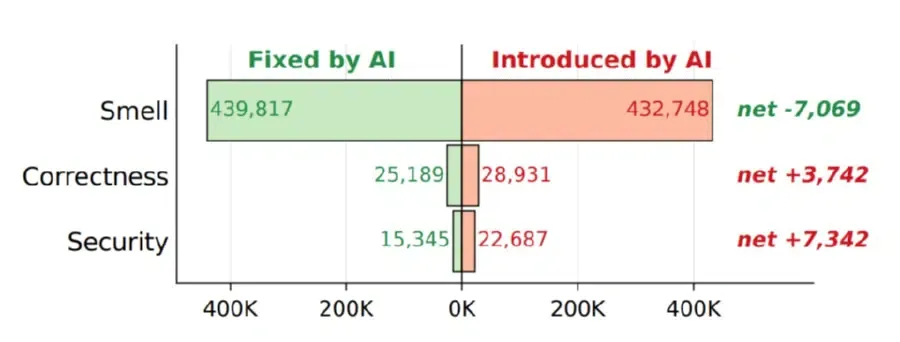
These findings are further supported by a large-scale empirical study tracking code debt. The researchers examined over 300,000 AI-generated commits across 6,299 GitHub repositories, discovering that over 15% of submissions from Copilot, Claude, Cursor, and Gemini introduced detectable code smells, correctiveness errors, or security risks.
This risk of cascading failures often compels software teams to Delete AI Generated Code when localized fixes break existing endpoints. Furthermore, the study revealed that 22.7% of these AI-introduced issues remained unresolved in the latest versions of the codebases, with many persisting longer than nine months, emphasizing the long-term cost of unmanaged AI output.
Although repository code cleanup and mobile install tracking operate on different layers, both environments share the same technical challenge: once automated systems generate redundant request chains or unvetted scripts, the risk of data collision and attribution corruption increases. Similar challenges exist in mobile attribution, where privacy restrictions and automated bot traffic also reduce reliance on persistent client-side identifiers. If security teams cannot distinguish between clean user requests and automated, agentic interactions, the entire analytics pipeline becomes vulnerable to reporting false-positive conversions.
Industry Impact: How AI Code Cleanup Reshapes Software Engineering
The rapid proliferation of automated code generators has triggered a shift in the standard role of software engineers. Developers are transitioning from authors to auditors, focusing on system architecture, data flow, and interface integrity.
- Enterprise Teams: Large organizations are establishing dedicated CI/CD gates and static analysis protocols with tools like ESLint, Prettier, or SonarQube to reject commits containing unvetted AI structures, preserving long-term maintainability.
- Startups: While early-stage ventures leverage tools like Devin, CodeRabbit, or Cursor to quickly validate MVPs, they require human refactoring before handoffs to production-grade engineering teams.
- Open Source Communities: Projects like the Godot game engine have restricted AI-generated contributions because developers could not understand or verify the complex scripts they submitted.
- SDK and Library Vendors: Software vendors must ensure their integrated libraries remain completely modular and lightweight to prevent automated tools from misinterpreting dependencies.
Reducing AI Code Bloat Without Rewriting Everything
As organizations confront the technical realities of AI-driven code expansion, engineering teams must evaluate how they manage third-party dependencies and SDK selections. Reconciling high-throughput routing pipelines requires architectures that can securely correlate user actions without relying on local storage containers. Developers must decide whether to build bespoke, custom-tailored database sync frameworks using AI auto-generators or deploy standardized, pre-built infrastructure.
Architectural Evaluation: Custom Build vs. Standardized SDK
When confronted with codebase expansion, developers must decide whether to build extensive in-house utilities or leverage mature, external libraries to implement supplementary functions. Developing bespoke solutions from scratch using AI auto-generators often introduces thousands of lines of untested logic and redundant classes. Conversely, integrating minimalist, verified software packages helps maintain a small compiled footprint.
The table below outlines the trade-offs between custom data architectures and certified external SDKs:
| Approach | Code Footprint | Maintenance Overhead | Typical Scenario |
|---|---|---|---|
| Bespoke In-house Development | High (Thousands of Lines of Custom Scripting) | Extremely High (Continuous Internal Audits) | Enterprise teams with highly specialized internal telemetry needs |
| AI-generated Modules | Unpredictable (Spaghetti Paths) | High (Prone to Context Collapses) | Rapid prototyping where long-term system stability is secondary |
| Minimalist SDK Integration | Ultralight (Fewer than 10 Kilobytes) | Negligible (Audited, Self-contained SDKs) | High-concurrency systems needing standard parameter matching |
Consequently, engineering managers increasingly prioritize removing redundant AI-generated code before new features are introduced. Lightweight SDKs that minimize integration complexity have therefore become increasingly attractive. For instance, developers integrating multi-platform conversion telemetry can deploy the lightweight OpoInstall SDK. Rather than generating hundreds of lines of untested AI code to handle cross-platform parameters, this pre-built, zero-dependency SDK maps session metadata to a server-side session database. This maintains campaign and referral context anonymously without adding compiled client-side weight.
Integration Checklists: Preparing Your Architecture for Lightweight Deployment
To prevent future code deterioration and maintain conversion consistency across distributed platforms, engineering and product teams must establish clean codebase boundaries.
Developer Implementation Checklist
- Enforce Strict Linters and Gating: Configure automated CI/CD pipelines with toolchains like ESLint, Prettier, or SonarQube to reject PRs that exhibit high similarity scores or duplicate utility functions.
- Audit Third-Party SDK Sizes: Verify the compiled footprint of all integrated libraries to prevent bloated packages from slowing down device start times.
- Implement Continuous Code Refactoring: Dedicate a fixed percentage of development sprints to collapsing redundant directories into modular components.
Product & Growth Strategy Checklist
- Optimize Memory Utilization: Evaluate app dependencies to minimize garbage collection pauses and avoid client-side thermal throttling.
- Streamline SDK Selection: Prioritize single-purpose, highly optimized third-party tools that deliver reliable outcomes with zero extraneous dependencies.
- Monitor API Workflow Latency: Track standard latency metrics from initial campaign clicks to server-side installation matching to confirm data continuity.
By establishing these structured guidelines, development teams can transition their applications to safer, more compliant architectures while maintaining operational continuity.
Frequently Asked Questions (FAQ)
Is AI-generated code bad for software maintainability?
Should developers trust AI coding tools for complex architectures?
Does deleting redundant AI code improve system performance?
Key Takeaways for Engineering Teams
As AI-assisted development becomes mainstream, software teams are shifting their attention from generating more code to maintaining healthier codebases. The emergence of businesses specializing in AI code cleanup reflects a broader change in how organizations evaluate software quality in the age of generative AI. Relying on automated agents to repeatedly patch structural problems will continue to accumulate technical debt. Rebuilding internal engineering guidelines around strict modularity, automated testing, and highly optimized third-party dependencies is essential to maintain application scalability.
Looking ahead, successful organizations will prioritize codebase maintainability over raw generation speed. By integrating lightweight, zero-dependency infrastructure and shifting complex tracking states to server-side databases, developers can protect their deployment pipelines from redundant code creep. This transition is not merely about adapting to automated tools; it is about building stable, sustainable software structures in an agent-heavy engineering environment.
Share this article