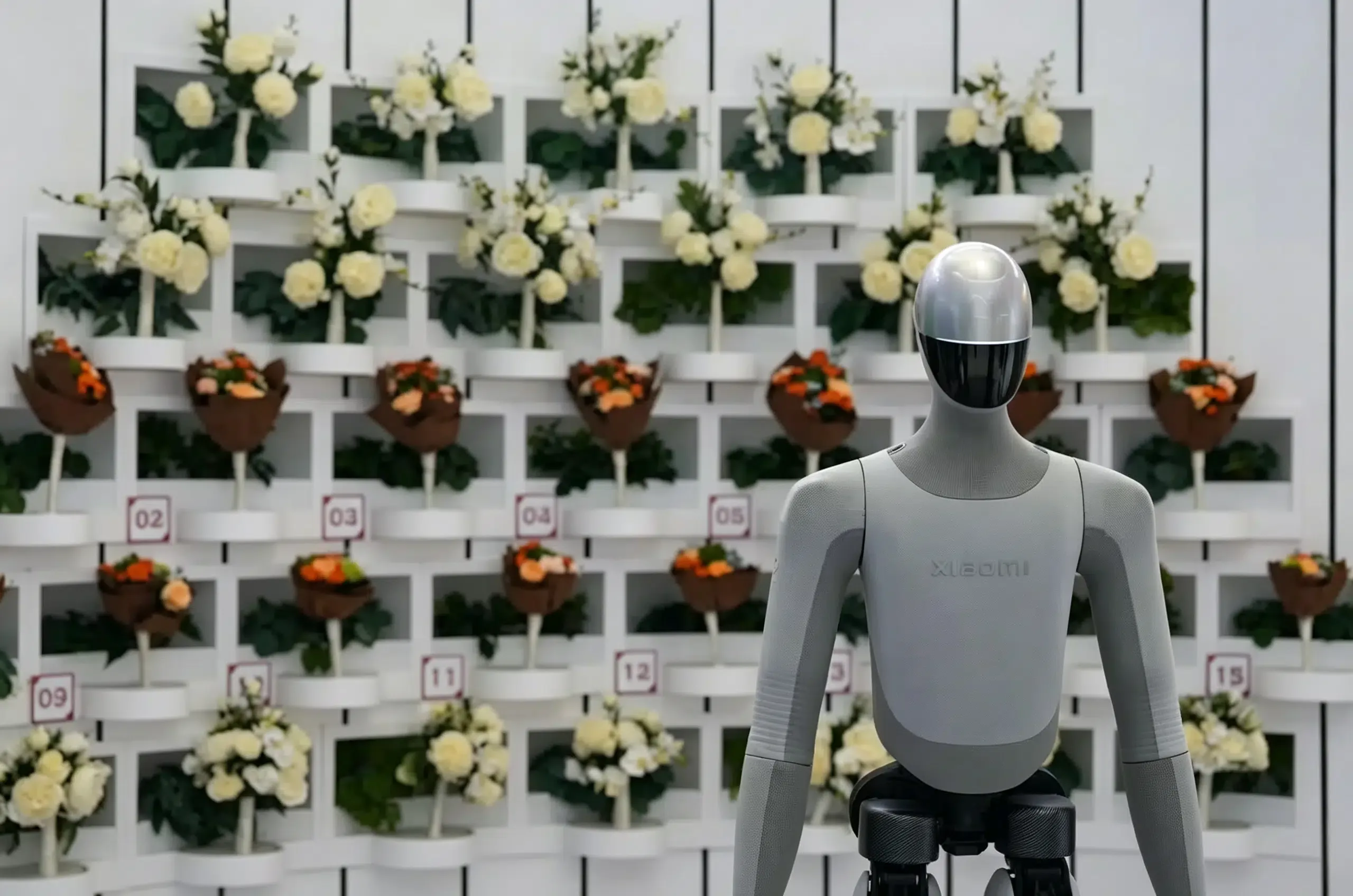
What did Xiaomi reveal with its new 66-DoF humanoid robot? At WRC 2026, the company publicly showcased a next-generation bipedal prototype built around greater hand dexterity and industrial-task execution, while Xiaomi’s broader robotics research is increasingly focused on VLA and embodied foundation models. As physical artificial intelligence changes how digital intelligence interfaces with the physical world, developers must evaluate how standard software stacks adapt to embodied environments. Traditional industrial robotics has often relied on highly structured environments, task-specific programming, and model-based control. Today, because advanced systems integrate multimodal perception directly into real-time control loops, engineering priorities are shifting toward generalizable, vision-language-action (VLA) foundation models.
Why 33 Hand DoF Matter for Industrial Manipulation
At a Glance
- The next-generation bipedal prototype stands approximately 1.70 meters tall, weighs 66 kilograms, and expands its joint mobility to 66 degrees of freedom.
- Fine manipulation is heavily prioritized, with 33 degrees of freedom concentrated across the hands to enable dexterous handling of flexible and non-standard industrial components.
- Earlier factory trials met a roughly 76-second production-cycle requirement; after four months of iteration, Xiaomi reported that success at the self-tapping-nut station had improved from 90.2% to 98%.
The rise of physical AI shifts the software problem from screen-based interaction toward perception, planning, and physical execution. Rather than rendering visual assets and managing flat interfaces, developers are now engineering systems that can reason about three-dimensional spatial environments and coordinate high-precision bimanual trajectories.
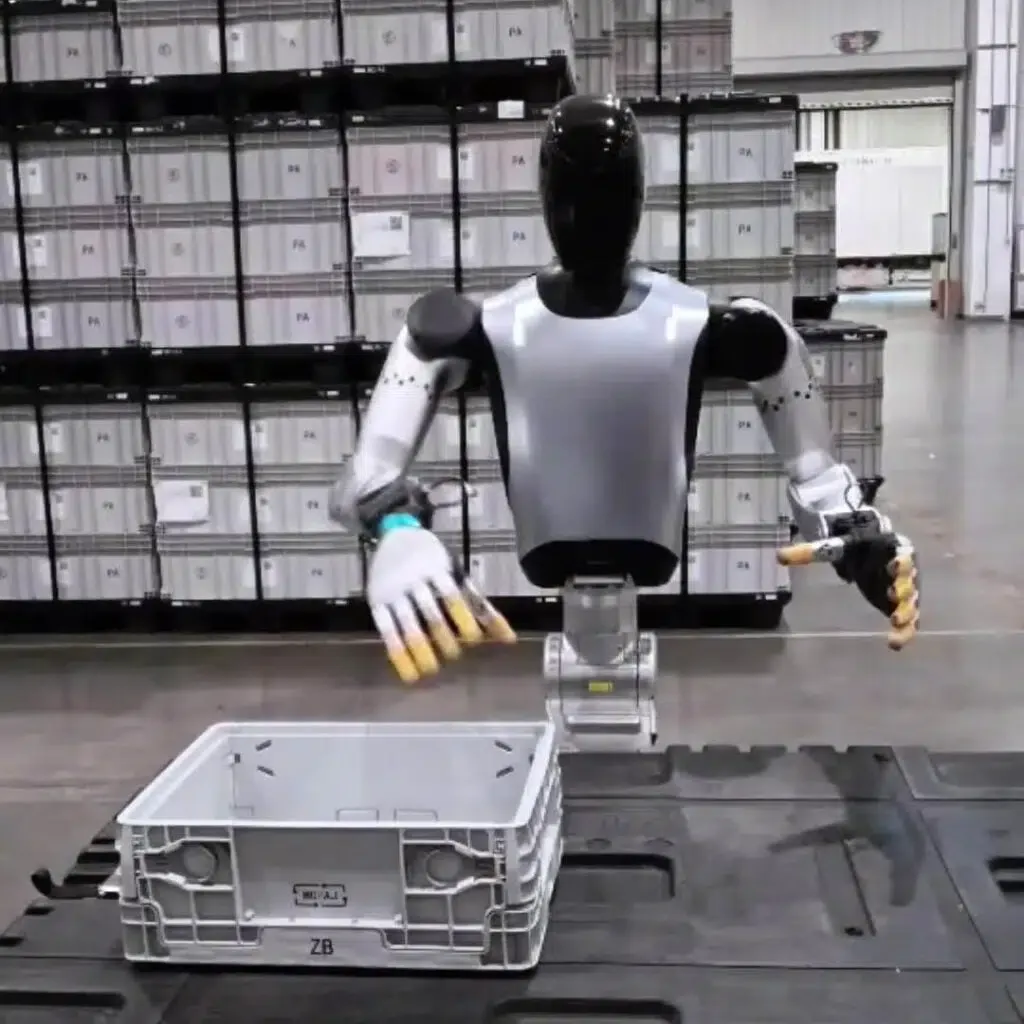
Xiaomi’s factory trials show that the company is prioritizing repeatable manufacturing tasks before broader deployment. Before its public exhibition, the bipedal system completed a rigorous four-month internship on the Xiaomi electric vehicle assembly line, performing tasks such as self-tapping nut installation and material box handling. Earlier trials required the robot to operate within a roughly 76-second workstation cycle. After four months of iteration, Xiaomi reported that success at the self-tapping-nut installation station had improved from 90.2% to 98%. This transition demonstrates that humanoid robotics is moving past basic walking demonstrations toward repeatable, high-dexterity operations in complex physical environments.
Understanding the Technical Architecture of the Xiaomi Humanoid Robot Ecosystem
Under the hood, the next-generation platform represents a substantial increase in mechanical design and artificial intelligence integration compared to the 2022 CyberOne prototype. While the first-generation CyberOne featured only 21 joint degrees of freedom, the new model raises this to 66 joint degrees of freedom. This mechanical expansion is concentrated primarily in the hands, allocating 33 hand DoF in total to enable fine motor control, precise object grasping, and delicate tool manipulation.
Separately, Xiaomi Robotics has published several embodied-AI models and research projects under its unified framework. These open-source projects include the real-time execution model Xiaomi-Robotics-0, the scaled model Xiaomi-Robotics-1 which leverages over 100,000 hours of real-world trajectories, and the 38B unified autoregressive model Xiaomi-Robotics-U0. Together, these projects span robot action generation, foundation policies, and embodied world modeling. However, public materials do not establish that the WRC prototype runs any one of these models as its production control stack.
A simplified conceptual VLA control pipeline can be represented as:
[Visual / Language Input]
           │
           ▼
[Embodied Policy or VLA Model]
           │
           ▼
[Robot Action / Motion Command]
           │
           ▼
[Embodiment-Specific Controller]
These research directions illustrate a broader shift from task-specific policies toward embodied models designed to transfer knowledge across tasks and robot configurations. By developing models that translate visual and language inputs into robot actions or task-level control signals, developers can explore software that generalizes across a wider range of tasks and embodiments. The software stack must coordinate multimodal sensor inputs with embodiment-specific state estimation, motion planning, and low-level control.

Traditional Robot Control vs. VLA Foundation Models
As the physical requirements of robotic development move beyond simple navigation, developers must choose how to structure their robot control layers. Building a custom control loop using traditional mathematical models offers high precision but lacks adaptability to non-standard environments. Conversely, Large-scale learned policies often require substantially more training data, but can offer broader adaptability when training coverage and embodiment alignment are sufficient. Purely pre-programmed control becomes harder to scale as task variability and object diversity increase.
Architectural Evaluation: Traditional Kinematics vs. Generative VLA
Model-based control can offer precise and predictable behavior, but adapting it to highly variable environments often requires additional perception, planning, and task-specific engineering. This approach can provide predictable behavior within well-defined operating constraints. Developing a custom, in-house kinematic controller requires substantial engineering resources to map joint constraints and solve inverse kinematics equations in real time. Conversely, deploying a pre-trained, vision-language-action (VLA) foundation model can offer greater adaptability depending on training coverage and embodiment alignment, at the expense of higher local compute requirements.
The table below compares standard methodologies for managing robotic control and task execution:
| Paradigm | Typical Data Dependence | Adaptability | Runtime Characteristics | Best For |
|---|---|---|---|---|
| Model-Based / Kinematic Control | Low to moderate | Strong within defined constraints | Predictable and often low latency | Deterministic industrial motion in highly structured factory environments |
| Behavior Cloning | Demonstration data | Limited outside training distribution | Model dependent | Repetitive learned tasks on structured, stationary workstations |
| VLA / Foundation Policies | Large heterogeneous datasets | Higher potential across tasks and environments | Higher compute and inference complexity | General-purpose manipulation and language-conditioned tasks in dynamic settings |
These architectural decisions directly influence the robot’s physical capabilities on the production line. By adopting unified foundation models, robotic systems can transition from executing single, isolated actions to performing multi-stage, collaborative tasks in dynamic workspaces. Engineering teams must evaluate these software paradigms based on their specific hardware capabilities, task complexity, and real-time execution constraints.
Integration Checklists: How Engineering Teams Can Prepare for Embodied Software Development
To ensure operational stability and safe execution as humanoid platforms transition into industrial environments, engineering and product teams should establish safety, validation, and deployment workflows.
Developer Implementation Checklist
- Define Safety-Constrained Control Boundaries: Keep joint, velocity, force, and workspace limits outside the learned policy so unsafe actions can be rejected before execution.
- Validate Policies in Simulation and Controlled Hardware Tests: Evaluate learned behaviors in simulation and staged real-robot environments before production deployment.
- Measure End-to-End Control Latency: Profile perception, model inference, motion planning, and low-level control separately to identify bottlenecks.
- Test Out-of-Distribution Behavior: Evaluate unfamiliar objects, lighting conditions, layouts, and task variations rather than relying only on training-distribution benchmarks.
- Design Fallback Control Modes: Provide deterministic recovery or safe-stop behavior when learned policies produce low-confidence or invalid actions.
Product & Strategy Checklist
- Define High-Value Industrial Workstations: Identify repetitive, high-precision assembly stations that are most suitable for robot integration.
- Establish Task-Verification Pipelines: Leverage multi-camera monitoring systems to evaluate robot task success rates in real time.
- Build Cross-Embodiment Software Interfaces: Ensure that the robotic operating system can communicate with surrounding factory automation networks.
By establishing these structured guidelines, development teams can transition their applications to safer, more compliant architectures while maintaining operational continuity.
Frequently Asked Questions (FAQ)
What are the key hardware differences between Xiaomi's CyberOne and the next-generation robot?
What were the exact results of the robot's EV factory internship?
Why is hand dexterity considered the key threshold for industrial humanoid robots?
Key Takeaways for Engineering Teams
Xiaomi’s 66-DoF humanoid prototype shows how industrial humanoid development is shifting from locomotion demonstrations toward repeatable manipulation tasks. With 33 degrees of freedom concentrated across the hands and factory trials covering nut installation, flexible component handling, and materials management, dexterity and task reliability are becoming central engineering metrics.
For developers, Xiaomi’s broader robotics research also illustrates the growing role of VLA policies and embodied world models alongside conventional control systems. The practical challenge is not to replace deterministic control outright, but to combine learned policies with simulation, safety constraints, latency profiling, fallback behavior, and embodiment-specific controllers before deploying robots into production environments.
References
-
Xiaomi Robot set to make public debut at 2026 World Robot Conference on August 19. https://www.gizmochina.com/2026/08/18/xiaomi-robot-set-to-make-public-debut-at-2026-world-robot-conference-on-august-19/
-
Xiaomi-Robotics-0: An Open-Sourced Vision-Language-Action Model with Real-Time Execution. https://arxiv.org/abs/2602.12684
-
Xiaomi-Robotics-1: Scaling Vision-Language-Action Models with over 100K Hours of Real-World Trajectories. https://arxiv.org/abs/2607.15330
-
Xiaomi-Robotics-U0: Unified Embodied Synthesis with World Foundation Model. https://arxiv.org/abs/2607.11643
-
Xiaomi updates progress on humanoid robots in auto factory, achieves 98% success rate in some tasks. https://technode.com/2026/07/15/xiaomi-updates-progress-on-humanoid-robots-in-auto-factory-achieves-98-success-rate-in-some-tasks/
Share this article