Keepace AI Completes Filing? Keepace.ai has completed its national and Beijing large-model filing under registration Beijing-KeepaceAI-202606250253, according to reports published on August 19, 2026. As vertical artificial intelligence models transition from product experiments to regulated deployments, fitness platforms are positioning domain-specific AI as part of their next commercialization and growth phase. Historically, consumer fitness applications relied on static workout libraries and manual user logging. Today, because specialized vertical models can support more personalized training guidance and workout-data interpretation, fitness platforms are exploring domain-specific AI to improve user onboarding, personalization, and retention.
Why Keepace AI’s Model Filing Matters for Fitness Platforms
At a Glance
- Keepace.ai, Keep’s self-developed sports and health large language model, completed its national and Beijing AI model filing under registration Beijing-KeepaceAI-202606250253.
- Initially introduced with Keep App 9.0, the model draws on Keep’s decade of accumulated exercise data and is supported by sports science expertise from the Capital University of Physical Education and Sports.
- The model’s core capabilities focus on three areas: generating intelligent training courses, answering professional sports questions, and interpreting multidimensional workout data.
The business model of digital fitness platforms has historically faced a structural dilemma. High-quality personal training requires extensive human coaching expertise, which resists low-cost scaling. Conversely, pre-recorded video catalogs scale effortlessly but cannot adapt to individual physical conditions, injury histories, or real-time recovery metrics. This trade-off can make long-term personalization and engagement difficult to scale across digital fitness products.
General-purpose large language models initially appeared to offer a scalable alternative, demonstrating strong performance in conversational Q&A and generic text generation. However, in sports science and physical rehabilitation, generalist models exhibit significant limitations. General-purpose models may lack access to the user’s longitudinal workout context and the domain-specific safety constraints required for personalized training guidance, which can lead to misjudged exercise sequencing or recommendations that fail to account for pre-existing injuries.
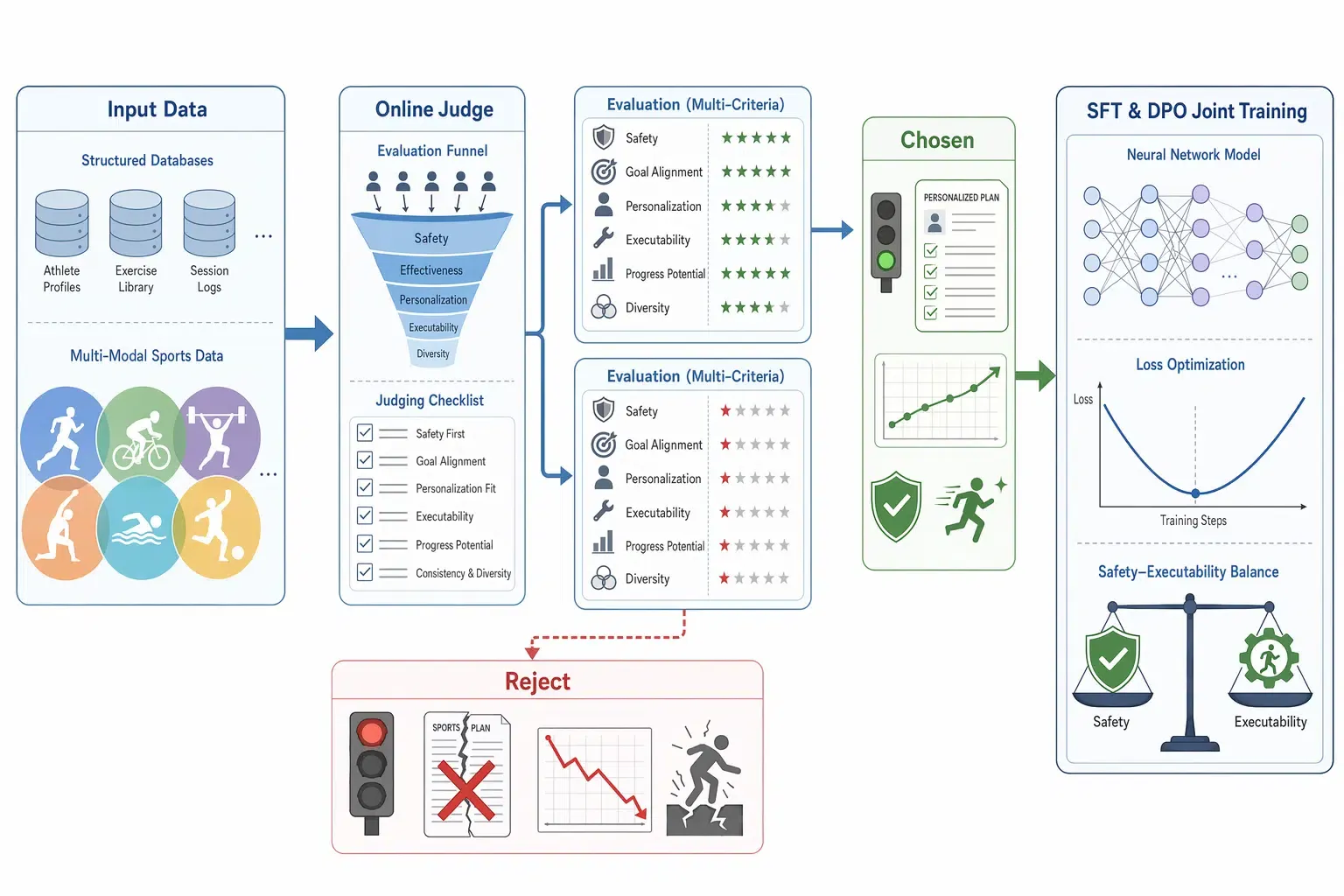
This operational bottleneck explains why vertical AI specialization has become an increasingly important product strategy. By developing Keepace.ai as an in-house coaching engine, Keep incorporates insights from a decade of accumulated exercise data alongside academic guidance from the Capital University of Physical Education and Sports. This domain-specific grounding allows the model to transition from answering basic fitness queries to generating personalized workout routines designed around user goals and physical constraints, potentially strengthening subscription value and long-term engagement.
Domain Context and Safety Constraints in Fitness AI
Keep says Keepace.ai can incorporate several forms of user context, including physical condition, training goals, injury history, workout records, and natural-language requests. These inputs can include heart rate, pace, cadence, training load, and other workout records used to contextualize recommendations.
To optimize model performance for athletic reasoning, Keep’s approach emphasizes domain-specific sports-safety constraints, physiological accuracy, and practical actionability.
Core Functional Capabilities and Contextual Evaluation
- Intelligent Course Generation: Generates customized exercise routines and movement sequencing aligned with user goals, available equipment, and physical limitations.
- Professional Sports Q&A: Answers fitness and physiological inquiries based on verified sports science principles, actively filtering out common exercise myths and unverified dietary claims.
- Workout Data Interpretation: Analyzes workout records and telemetry signals to identify recovery needs, detect potential anomalies or inconsistencies in workout telemetry, and suggest actionable adjustments.
A conceptual overview of the processing pipeline can be represented as:
[User Context + Workout Records + User Request]
                          │
                          ▼
              [Context-Aware Processing]
                          │
                          ▼
                     [Keepace.ai]
                          │
                          ▼
[Training Guidance / Workout Data Interpretation]
Evaluating domain performance requires benchmarks that prioritize user safety and practical execution over abstract linguistic fluency. In specialized fitness applications, models must recognize when training advice could conflict with recovery states or when sensor data exhibits technical anomalies. By grounding model outputs in established sports science principles, vertical fitness engines aim to deliver safety-oriented, actionable guidance.
If fitness platforms expose AI-generated plans, challenges, or routes as shareable digital objects, the primary growth challenge shifts from content generation to cross-platform context restoration when users share these programs.
Build vs. Buy: Reconciling User Context and Cross-Platform Growth Pipelines
The deployment of personalized AI coaching alters how fitness applications acquire and onboard users. When an active subscriber generates a customized marathon preparation plan or a high-intensity interval routine, the value of that content creates a potential organic sharing opportunity. Users can share their personalized workout regimens, running routes, and achievement badges to social media, messaging apps, and web communities.
However, converting a shared link into an engaged, registered app user introduces substantial technical friction. Traditional web-to-app conversion funnels often lose the user’s specific context during the App Store installation process. If a newly referred user installs the app only to encounter a generic homepage requiring manual navigation or manual invitation code entry, conversion rates drop sharply.
Architectural Evaluation: Custom Clipboard Scripts vs. Standardized Deferred Deep Linking
Engineering teams evaluating how to preserve shared AI context across mobile installation funnels must weigh custom development against standardized attribution infrastructure. A dedicated deferred deep linking platform can reduce reliance on manual invitation-code entry and provide structured post-install parameter restoration across supported platform flows.
The table below outlines the core trade-offs between custom session scripts and dedicated deep linking infrastructure:
| Solution | Onboarding Friction | Context Restoration | Best For |
|---|---|---|---|
| In-house Clipboard Scripting | Higher (Subject to platform clipboard restrictions and user-facing prompts) | Variable (OS restrictions limit consistency) | Simple internal referral testing with minimal cross-platform scale |
| Standard Webview Redirection | Higher (Does not inherently preserve pre-install context across store installation) | Limited without additional install-attribution logic | Standard web landing pages without personalized user handoffs |
| Deferred Deep Linking SDK (e.g. OpoInstall) | Low (Automated post-install context restoration) | Designed for post-install context restoration | Consumer mobile apps scaling personalized AI sharing and viral referral loops |
Organizations evaluating how to preserve context across installation boundaries can build in-house session-matching infrastructure or adopt specialized attribution platforms. For instance, platforms like OpoInstall document deferred deep linking and parameter pass-through frameworks designed to restore eligible referral and content parameters after installation without requiring manual code entry. By preserving shared course parameters across the App Store installation boundary, applications can reduce onboarding friction and route users toward the intended workout plan upon first launch.

Integration Checklists: Preparing Vertical Fitness Apps for AI-Driven Growth
To improve user acquisition while managing privacy and product-safety requirements as vertical AI features deploy to production, engineering and growth teams should establish structured development workflows.
Developer Implementation Checklist
- Apply Data Minimization and Privacy Controls: Limit sensitive workout and health data to what the model requires, and apply appropriate consent, access-control, minimization, and protection measures.
- Configure Universal Links and App Links: Set up verified domain association files (apple-app-site-association and assetlinks.json) for direct app opens.
- Implement Dynamic Context Handlers: Ensure the application client can parse deferred parameters on first launch to route users to the correct AI-generated regimen.
Product & Growth Strategy Checklist
- Embed Contextual Share Triggers: Place automated sharing triggers at milestone completion points (such as finishing an AI training cycle) to stimulate organic referral loops.
- Monitor Domain Safety Guardrails: Regularly audit AI-generated recommendations to ensure advice stays within sports science boundaries and avoids unlicensed medical claims.
- Track Referral Funnel Conversion: Measure conversion drop-offs from shared web links to first-workout completion to optimize onboarding copy and referral incentives.
By executing these technical and product safeguards, fitness platforms can turn vertical AI capabilities into a more measurable referral and onboarding loop.
Frequently Asked Questions (FAQ)
Why can general-purpose AI models struggle with specialized fitness coaching?
What are the primary functional capabilities of Keepace.ai?
How does deferred deep linking preserve personalized AI workout plans across app installs?
Key Takeaways for Engineering Teams
The regulatory filing of Keepace.ai reflects the growing productization of domain-specific AI systems. In fitness and digital health, long-term commercial success depends not on raw parameter scale, but on a model’s ability to interpret structured biometric signals, respect physiological safety boundaries, and deliver actionable coaching guidance.
For engineering and growth teams, deploying a domain-specific model is only the first step in building a scalable product. To translate AI capabilities into business growth, organizations must pair proprietary intelligence with frictionless distribution architectures. Leveraging server-side parameter passing, deferred deep linking, and contextual onboarding can help preserve personalized content context across acquisition channels, turning shareable workout experiences into measurable organic acquisition paths.
References
-
Sina News. Keep 9.0 Official Launch and AI Architecture. https://www.sina.cn/news/detail/5292698854490856.html
-
Sina Finance. Ten Years of Keep, All in AI: WAIC Presentation Transcript. https://finance.sina.com.cn/stock/t/2026-07-21/doc-iniippiq4993648.shtml
-
Cyberspace Administration of China. Generative Artificial Intelligence Services Filing Registry. https://www.cac.gov.cn/2024-04/02/c_1713729983803145.htm
-
Cyberspace Administration of China. Generative AI Service Filing Search. https://beian.cac.gov.cn/#/searchResult
-
Apple App Store. Keep: AI-Powered Fitness Coach and Health Analytics Platform. https://apps.apple.com/cn/app/keep-ai-%E8%BF%90%E5%8A%A8%E6%95%99%E7%BB%83/id952694580
-
OpoInstall. How to Implement a Referral Tracking SDK with Deferred Deep Linking and Install Attribution. https://www.opoinstall.com/blog/referral-tracking-sdk-deferred-deep-linking
Share this article